THE DISCOURSE OF DIVISION

The US election campaign through a language lens
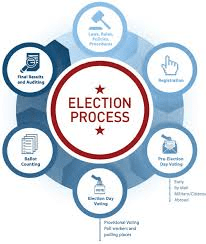
As the campaigning reached its climax and the polling-stations began to open, I spoke to Kate O’Connell and Gemma Chatwin of the Corporate Communications Team at King’s College London about the language used by the rival candidates, their aides and their supporters during the twelve months since the election process began. Kate and Gemma’s questions are below with my replies…

  • As a language specialist, what have you observed/found interesting about the US election?

One thing that strikes an outsider – British or European, I suggest – is the different  nature of the vocabulary and rhetoric employed in US campaigning: the seemingly chaotic and unrestrained messaging, pivoting and veering unexpectedly into new areas sometimes, showing a lack of consistency, except in tone (Trump’s particularly). There is actually less reliance on a narrow range of repeated specific keywords, slogans and soundbites than has been the case in UK political campaigning – for Brexit, during the pandemic and in the recent election: (‘Take back control’, ‘Brexit means Brexit’, ‘Eat out to help out’, ‘Stop the Boats’ etc.). The Republicans’ messages have been more consistent in emphasising a few key ‘wedge’ issues while Democrats seemed to take a long time to decide on their priorities in terms of focus.

  • How has the language used by both candidates differed? What does their language tell us about their campaign strategy/ voter base?

Linguists – myself included – have tried to track the formulations (not so much genuinely new language as reworking of familiar tropes) used by each side and measure the frequency with which particular topics and particular trigger-words recur. Donald Trump has employed a vocabulary containing many examples of the language of fear and violence, and much intemperate language throughout: ‘vermin’, ‘criminal migrants’, ‘the enemy from within’, ‘radical left lunatics’, and words evoking existential threats: ‘invaded’, ‘conquered’, ‘occupied’, ‘deportation’ and violence: ‘kill’, ‘death’, ‘blood’, ‘nuclear war’, ‘guns trained on her face’. One analysis concluded that Trump had used more violent language than any other recent political orator except Fidel Castro!

Trump has consistently favoured the use of ‘I’ and ‘they’, Harris more often emphasising ‘we’. The Democrats on the other hand, while perhaps favouring less inflammatory language have possibly failed, until the closing days of the campaign (‘neighbors not enemies’ is a last-minute exception), to find memorable, resonant phrases to inspire and motivate. While initially hesitant, and despite Kamala Harris being accused in the more distant past of ‘word salads’ the Democrats, apart from Joe Biden, have been measurably more coherent, while many of Trump’s recent performances have been criticised as meandering if not incomprehensible. His justification for this being that he is practising ‘the weave’, a sort of improvisational incantation that his followers appreciate.
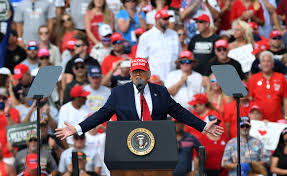
  • We have seen a lot of name-calling in the 2024 election, has it been effective?

A famous example of a slur which seems to have worked is Tim Walz’s characterising of Trump and the Republicans as ‘weird’. This is effective since the word is not especially offensive or toxic but frames the opposition as odd, eccentric, unstable in worrying ways, by implication disturbing – a relatively casual criticism of a community that is old and out of touch with reality. The Republicans accusing ‘immigrants’ of eating pet dogs and cats and likening Puerto Rico to a ‘floating island of garbage’ outraged their opponents, though Joe Biden also came unstuck when he reached for the same metaphor. It’s notable that both sides have used proxies to deliver some of the most stinging criticisms of the leaders, rather than have them delivered by the candidates themselves: ‘childless cat lady’ for example, or ‘unhinged, unstable, unchecked’ – words supplied by former Trump aides and reposted by the Democrats. One rather surprising blip in the unfolding news cycle occurred when Harris suddenly approved the f-word, agreeing when it was suggested to her that Donald Trump was a ‘fascist’. He quickly returned the insult, adding the ‘N-word’ which everyone had so far avoided: ‘I’m the opposite of a Nazi’. Both sides seem to have tacitly put those words aside for the final phase of the campaigning, though tellingly, in a final peroration J.D Vance urged followers to ‘take out the trash’ in reference to the Vice-President.

I think that outsiders listening in bemusement or horror at the campaign rhetoric misunderstand the nature of the voter bases involved. Doom-laden warnings and threats and angry braggadocio can be effective, reassuring and motivating to an audience for whom ‘make America great again’ carries a conviction that the country is at the mercy of hostile forces and on the edge of social breakdown. Conversely Kamala Harris’s more upbeat, feelgood emphasis attempts to instil a cheerful positivity which may not always have been backed up with hard facts or firm commitments (apart perhaps where reproductive rights are concerned).

  • Could this be the first election won on TikTok?

Kamala Harris’s folksy reference, early in the campaign, to having ‘fallen out of the coconut tree’ cleverly appealed to a family audience and referenced her own potentially controversial heritage in a positive way. She has also tried, seemingly with some success, to tap into the female and feminine constituency and the relatively youthful energy  displayed by users of TikTok, a platform which avoids threats and displays of anger and relies on self-promotion, performances of success and – crucially – an element of self-mockery and humour that is entirely missing from Donald Trump’s repertoire. TikTok currently occupies the high-ground of the social media landscape and is a valuable channel by which to reach millennials and GenZ (the latter voting for the first time) millions of whom are potential democrat supporters. It does not reach, however the middle-aged or elderly undecided. Celebrity endorsements apparently can motivate potential non-voters to change their minds and vote, but unsurprisingly probably only affect a demographic which is already on-side anyway (‘Swifties’ for example who are said to have added 400,000 votes to Harris’s tally). Elon Musk’s embracing of Donald Trump is more difficult to assess, as Musk’s own fanbase – tech bros, startup promoters and bitcoin traders among them – aren’t necessarily effective multipliers or influencers on his behalf or Trump’s and perhaps less likely to sway the undecided.

  • How did brat summer and ‘vibes’ benefit Kamala Harris’s campaign?

When pop icon Charli XCX posted her endorsement on X, ‘Kamala IS brat’, young women flooded social media with pro-Harris ‘brat’ memes, kickstarting her takeover from Biden and effectively labelling her as endearingly ‘messy, honest and volatile.’ The democrat campaign switched up to make good use of the tropes and tendencies of pop culture and entertainment media, receiving endorsements from many musicians and Hollywood names, culminating in their candidate’s surprise appearance on Saturday Night Live in which she launched viral versions of her own name -‘End the drama-la’, ‘Cool new step mom-ala’ and returned to that conflicted keyword, asserting that she would be able to open the ‘doors of the garbage truck’ that Trump had fumbled with. This confident banter in the very last moments of the campaign, along with her pivot, after Bill Clinton’s disastrous intervention, to promising some sort of support for Gaza, can only help the democrats’ chances, and these messages are featuring in places that Trump cannot usually access. Nevertheless the Republican candidate is doubling down on his insurrectionist rhetoric, welcomed by his base, saying now that he ‘should never have left the White House in the first place’.
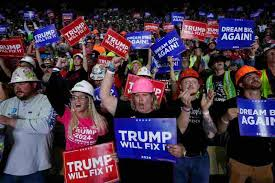
My friend Serena Smith wrote perceptively for Dazed magazine about the role of celebrities in the presidential race…

https://www.dazeddigital.com/life-culture/article/64995/1/will-pop-culture-impact-the-result-of-the-2024-us-election

Once the race was over the avalanche of post-mortems and recriminations began. Among them were a few which focused, as I had tried to, on the discourse of division. In the New Yorker Joshua Rothman considered the very different flavour of the two parties’ language…

“Id been spending a lot of time watching interviews with Kamala Harris and Donald Trump – conversations that tended to be below average. On shows like “60 Minutes” and in her CNN town tall, Harris had been charming and trenchant but also repetitive and inflexible. Restrained by her determination to stay on message, she often failed to answer questions directly. Trump, for his part, lied, rambled and spouted nonsense as usual. And yet his lack of constraint at least made him entertaining…

…Harris and Trump’s flawed performances were typical of the duelling communications styles now wielded by Democrats and Republicans. Broadly, Democrats preach while Republicans riff; Democrats stick to their messages while Republicans let loose with whatever comes into their heads.”

In the Guardian Nesrine Malik convincingly dismantled the lazy consensus that held that the result was a defeat for the Democrats’ supposedly embracing ‘woke’ policies and relying on endorsement by ‘woke’ celebrities…

https://www.theguardian.com/commentisfree/2024/nov/25/woke-lost-us-election-patrician-class-identity-politics

X-COMMUNICATION

…OR X-TERMINATION?

Twitter – a space I value greatly and make use of to keep abreast of cultural, social, political controversies, to exchange facetious remarks and gossip, and, above all, to keep in touch with linguists, writers, influencers, anonymous wits across the virtual globe, has of course been a-buzz with the news that its owner, would-be tech-bro, multi-billionaire Elon Musk, has rebranded the platform as ‘X’.

In ‘linguistic’ terms the X sign is already overburdened with signification – in other words it has an ‘excess’ of potential meanings, so is a very odd choice for a brand in that many of those meanings have negative connotations or connotations of absence, erasure, taboo, cancellation, prohibition, etc, etc. Among the only well-known positive ones are kisses, the marking of the spot on a treasure map and the Christian chi-ro symbol ( ⳩).

Although it can evoke mystery or anonymity, the many meanings of ‘X’ veer strongly towards the antipathetic: the cancellation mark, X-rated, unknown values, in superstition and mysticism death, danger, endings. In branding(!), as it depicts a generic version of the product being promoted—as in “Brand X”—the unidentified product deprecated as inferior to the named brand; it can serve like the asterix in replacing key letters in taboo words, in demographics Generation X is the ill-defined, cohort, adrift and stranded between boomers and millennials. It can suggest the scene of the crime, the sniper’s crosshairs, if multiplied it can describe the strength of strong liquor or moonshine, it can imitate crossed fingers or a puckered or defiant closed mouth. All these and more potential senses of the sign make it both risky and confusing as a solo identifier. Musk’s declared notion that the sign will also remind us of our ‘imperfections’ is putting it very mildly indeed (and who wishes to be reminded of their imperfections every time they log on?). Geeks, nerds, ‘edgelords’ and tech-bros (and nepo-/man-babies too), as we have seen in the case of other dominant brands, have their own , touchingly ingenuous ideas of what is mysterious, evocative, triggering or inspiring. They also have the means to inflict these insights on the wider, often more engaged, more discerning online community…

I spoke to Clare Thorp of BBC Culture about the linguistic implications of the rebranding and Clare’s article is here…

https://www.bbc.com/culture/article/20230728-twitters-rebrand-why-x-could-be-the-most-powerful-letter-in-english

The reaction of the World Wildlife Fund: the German text reads ‘Protect our wildlife before it is too late’

The reactions to the imposition of the new symbol by tweeters/tweeple/the twitterati (what should we call them now?), at least those who inhabit my corner of the platform, has been overwhelmingly negative, hostile and dismissive. Just a very few tech-bros, would-be influencers, crypto-enthusiasts have sympathised with Musk’s declared attempt to re-present the site as a multi-purpose, multimodal platform including new facilities such as banking, investment, dating(?). I have put together a checklist of articles commenting on all aspects of the venture, focusing especially on the symbolism and semiotics of the X itself. A small selection is here..

https://www.theweek.in/news/biz-tech/2023/07/24/a-brief-history-of-twitter-logo-and-xcom-as-musk-gears-up-to-free-the-bird.html

https://www.theguardian.com/commentisfree/2023/jul/29/will-rebranding-twitter-give-elon-musk-the-x-factor-i-wouldnt-bank-on-it?CMP=share_btn_tw

https://apnews.com/article/twitter-tweet-elon-musk-x-c1c3871e9bef60aa0a4c1a40129c155a

https://www.theguardian.com/commentisfree/2023/jul/28/the-guardian-view-on-twitters-rebranding-x-marks-an-everything-or-nothing-gamble?CMP=share_btn_tw

https://www.wionews.com/technology/explained-why-is-elon-musk-so-obsessed-with-the-letter-x-619050

On 30 July came news of a tagline or slogan designed to accompany ex-Twitter’s new visual identity. The phrase being promoted is ‘Blaze Your Glory’. @SmoothDunk’s response to this was a visual one:

…Other users of the site are fighting back, finding ways to delete or mask the ‘X’ trademark and restore their cherished bird symbol:

I talked to Jim Mora at Radio New Zealand on the same subject on August 4th:

https://www.rnz.co.nz/national/programmes/sunday/audio/2018901451/tony-thorne-what-to-make-of-the-letter-x

…And, as if to confirm my misgivings about the choice of letter, the Guardian reported on August 8th: ‘Ministers have opened a new vaccine research centre in the UK where scientists will work on preparing for “disease X”, the next potential pandemic pathogen.’

DOCTORS OF SPIN

The New Language of New Britain – 25 Years On

I thought it might be interesting, even informative, to look back from our post-Brexit, post-COVID vantage point in early 2023 to a time before a culture of impunity had become embedded, a time when there still seemed to be a consensus across political persuasions that competence was a first requirement of whoever was elected to govern Britain, (but a time, too, in which there was a feeling among many that profound changes were overdue). In 1997 I made a series of programmes for BBC World Service Radio, looking at how emerging words and phrases seemed to embody novel attitudes on the part of the British. The broadcasts were aimed at listeners outside the UK, although at that time also accessible inside the territory.

The first in a series of short programmes looked at the language of New Labour, at perceptions of a closer relationship between its politicians and what is now called the mainstream media and at the role of the spin doctors (one of the very new formulations heard in those days) responsible for what is now called comms and messaging and for negotiating that rapprochement.

I was fortunate to be able to draw upon insights from Derek Draper, at that time one of New Labour’s highest placed political advisors and lobbyists, journalist and columnist Julia Hobsbawm and writer and critic Peter Bradshaw. Our conclusions were at that time revealing, I think, even if now the notions and the behaviour we were looking at and the terminology that accompanied them have become commonplace.

These recordings were lost for many years, and I am very grateful, both to my then-producer Colin Babb for recovering some of them, and to Urban Mrak who has managed to restore and re-record a small selection of the damaged tapes. The first of them can be accessed here, although the first few seconds during which we listened in the studio to reiterations of the ‘New Labour, New Britain’ mantra are missing…

https://www.podbean.com/player-v2/?i=wph5j-139127f-pb&from=pb6admin&share=1&download=1&rtl=0&fonts=Arial&skin=1&font-color=auto&logo_link=episode_page&btn-skin=7

In the following days I will add two more of these short recordings, dealing, respectively, with the idea that late-90s Britain was experiencing an upsurge in aggressive, selfish behaviour, typified by the new concept of ‘road rage‘, and an increase in female assertiveness caricatured as ‘girl power‘.

Derek Draper

Julia Hobsbawm

Peter Bradshaw

A ‘PUERILE’ RACE?

‘Expert commentary’ on a volatile, contentious process

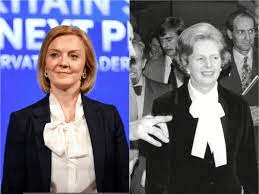
I was somewhat bemused to be asked, as a linguist and someone who has written about government communications and messaging, to comment recently, this time on the self-presentation of the candidates vying for leadership of the Conservative Party, hence also for the role of Prime Minister of the UK (in a series of back-and-forth slurs and clumsily staged photo-opportunities characterised today by Cabinet Office Minister Johnny Mercer as ‘puerile’). My first observations concerned Foreign Secretary Liz Truss’s identification with an earlier political icon.*

These were my comments in answer to the Daily Mail‘s questions on the performance of Lizz Truss and Rishi Sunak in the latest and final stages of the contest…

  1. Both candidates seem to me to be reaching for very simple and basic images and messages – not complex or ‘deeper’ concepts and as a linguist I suspect that they are both trying to avoid having to demonstrate the ‘oratorical’ skills that Boris Johnson’s supporters claimed for him. In other words they are going for visual over verbal as neither of them is renowned as an inspiring public speaker.  
  2. In terms of oratorical skills or lack of them Liz Truss has been gaffe-prone and can come across as hesitant while Rishi Sunak, though articulate, has to avoid the impression of an over-eager schoolboy in his attempts to convince.
  3. In  terms of the core messages, Rishi Sunak is very obviously trying to counter the sense of him as someone removed from the concerns of ordinary people because of his privileged upbringing and his great wealth. Thus he emphasises the (quite authentic) role of the family man, devoted to wife and children, at the same time countering Truss’s projection of herself as an assertive ‘lone’ female – the image Margaret Thatcher conveyed in her exercising dominance over male colleagues. Thatcher also kept husband and children in the background and emphasised her own gravitas and steeliness above all else.
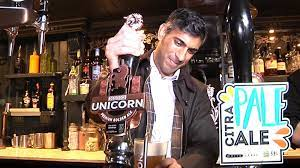
  4. Pulling pints is another attempt by Sunak to demonstrate that he is not wholly out of touch with the ‘common man’, but this sort of posing does risk backfiring as when he fumbled in his attempts to use a bank debit card to buy fuel for a humble, borrowed car.
  5. I’m surprised that Sunak does not more strongly emphasise his financial background and expertise gained as a financier/fund manager (the sort of professional experience that Liz Truss would have trouble competing with), but he may rightly sense that public perceptions of hedge fund manipulators are far from entirely positive.

Both candidates are attempting to focus, as they must, on the universally understandable issues of taxation and immigration/refugee management, subjects on which those entitled to vote for them (a very small number of key individuals incidentally) are already likely to have very firm views.

I added the following…

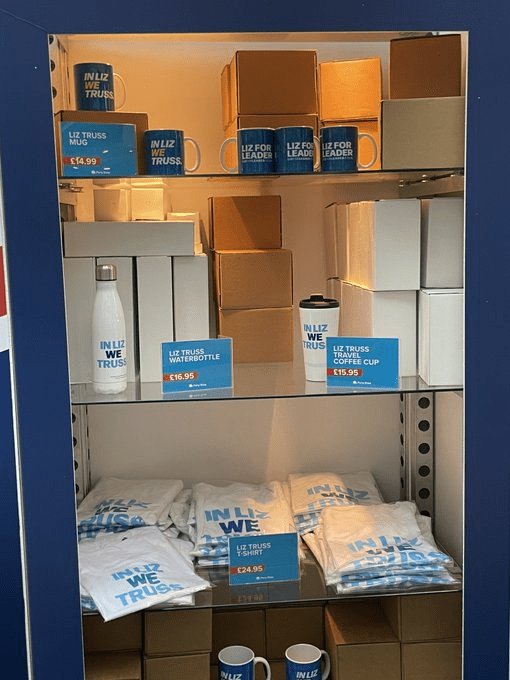
I don’t wish to seem contentious or uncharitable, but their messaging – in both cases – really does leave much to be desired, beginning with the campaign slogans, ‘Ready for Rishi!’ and ‘Liz for Leader.’

On Rishi Sunak’s part, his public postures belie the fact that he is, among many other things, a teetotaller…

And as for Ms Truss…

Which approach, I was asked, was likely to play out better with the 1600 party members entitled to vote in the leadership contest?

I think it’s very difficult to predict: I suspect that many Tories will still instinctively prefer the certainty and strength of purpose that Margaret Thatcher represented – the steely glare rather than the eager-to-please smile. But perhaps on reflection they may come to decide that someone at ease with financial manipulations (public or private!), and someone who is not really encumbered with ideological baggage could be more convincing in the long run and a safer pair of hands? It’s perhaps reassuring and worth noting that those two ancient bugbears of British political life, ethnicity and gender, probably are no longer barriers to advancement.

This is how my remarks were incorporated into the Mail’s front page of July 25 2022…

https://www.dailymail.co.uk/news/article-11045839/Nigel-Farage-blasts-teetotal-Rishi-Sunak-copycat-man-pub-routine.html

More evidence if you need it…

*https://www.dailymail.co.uk/news/article-10828621/Now-Liz-Truss-SOUNDS-like-Margaret-Thatcher-Speech-expert-says.html

At the Conservative party conference in October…

Looking back at my comments while awaiting the general election in July 2024, it’s clear that I was too kind to both the then leadership candidates. This was in part because I can’t pose as a political expert, partly as I don’t think the Daily Mail would have printed my comments if they had been much harsher. Liz Truss went on to perform surreally badly as shortlived PM, then, in more recent comments, to astonish many by her seeming intellectual confusion and lack of self-awareness. Rishi Sunak, in my strictly personal view, has shown above all an astonishing immaturity, in his parliamentary and media performances and his interactions with the public. His and his party’s communications strategies, despite the complicity of most of the the UK’s mainstream media, have been clumsy and inept. The press and the opposition equally have failed to hold him to account, focusing on his role as member of a hedge fund that helped trigger the 2008 financial crash only in the run-up to the coming election.

https://www.mirror.co.uk/news/politics/rishi-sunak-tv-debate-coach-32952402