THE FIRST FEW WORDS

– of 2025

Back in December last year I wrote a second opinion piece on words of the year for the Conversation. You can find it here… *

At the end of January this year the Lexis Podcast team kindly invited me to discuss some of those words and why – if – they were really significant. We also looked at new terms recorded in 2025 so far, making a first attempt to explain and assess them, and to wonder which if any of them might endure. Our discussion, which went on for 40 minutes, is here…

…and, from February, a little puzzle for you. Can you unscramble and reassemble these two-word novelties? (Thanks to simplewordcloud.com)

It’s now July, and my attempts to go on recording this year’s wholly new, or reworked and updated terms and expressions have been interrupted by the need to react to the news-cycle – to the sinister euphemisms, avoidances and untruths perpetrated by war criminals, would-be dictators and their servants in the media. Examples of their language have been added my glossary of toxic terminology and the updated version is here…

John Belgrove reminded me that in May Donald Trump bragged of coming up with a new word – ‘a good word’, but the word in question was ‘equalising’. I have managed nonetheless, with the help of other friends and contacts on Twitter, BlueSky, Instagram and Facebook, to gather a few more examples of lexical innovation, candidates for an end-of year survey in due course…

But I would very much welcome suggestions of other new words and phrases, ideally together with their meanings and comments on their usage in context. All donations will be credited and donors thanked.

*https://theconversation.com/most-words-of-the-year-dont-actually-tell-us-about-the-state-of-the-world-heres-what-id-pick-instead-246190

THE SLANG AND NEW LANGUAGE ARCHIVE

A research portal for scholars, the press and the public

The Slang and New Language Archive was created in 1994 while I was Director of the Language Centre at King’s College London. The archive, consisting of a small library of books and periodicals and a number of databases and sub-directories, was designed as a repository for the collection, storage and dissemination of new language, in particular examples of nonstandard varieties of English such as slang, jargon and buzzwords. The archive was later expanded to take in examples of media language, political language, linguistic curiosities and etymologies. It remains a resource, unique in the UK and not-for-profit, assisting researchers, students, teachers and journalists, as well as non-specialists, in accessing information about aspects of contemporary language that are under-represented in traditional dictionaries and reference works.

This link will take you to the Archive webpage at King’s College, where there are further links to relevant articles and published sources…

https://www.kcl.ac.uk/research/slang-and-new-language

Glossaries from the archive may be accessed on this site by entering keywords, such as slang, jargon, MLE (Multiethnic London English), familect (highly colloquial language used in the home), coronaspeak (language related to the COVID-19 pandemic) and weaponised words (the contentious language of Brexit, populism and biased reporting) and slurs (racist and misogynist terms) in the search box. Once you have accessed a post of interest, check the tags and categories at the foot of the page for other articles or glossaries on the same topic.

Two of the larger archive datafiles are hosted on Aston University’s Institute of Forensic Linguistics Databank site. These are a glossary of current youth slang

https://fold.aston.ac.uk/handle/123456789/4

And a glossary of UK street slang, rap music and gang terminology

https://fold.aston.ac.uk/handle/123456789/5

Please note that the King’s archive focuses principally on contemporary language, that is terms used from the twentieth century to the present day. If you are interested in historical slang, I strongly recommend the monumental work by my associate, the British lexicographer Jonathon Green. His dictionary, now generously freely available online, lists current and historical slang terms with timelines and citations illustrating their usage and development…

https://greensdictofslang.com/

For more information, for queries, or to donate examples of language, contact me via this website or via the King’s College webpage. I’m on Twitter as @tonythorne007 too.

In terms of new slang and nonstandard language there are few reliable resources online. In February 2025, however, US publisher Merriam-Webster launched their own slang dictionary. You can find it here…

https://www.merriam-webster.com/slang

Among the many more informal glossaries and wordlists of slang posted on the internet in 2025, this review of slang in English schools is unusually comprehensive and accurate…

https://teachertapp.com/uk/articles/down-with-the-kids-slang-in-british-classrooms-2025/

THE SEARCH FOR SLANG

Researching and tracking the latest slang can now draw upon statistical analysis of online data.

As 2024 draws to its end and talk among lexicographers, culture journalists and language buffs turns to ‘words of the year’, I’m immensely grateful to Randoh Sallihall of Unscramblerer for providing me with his datasets showing lookups (Google searches) for the most popular recent slang expressions…

Most searched for slang words in United Kingdom:

1.      Gaslighting (170 000 searches) – a type of manipulation that makes you doubt your memories and feelings. The person doing it may lie and deny things.

2.      Skibidi (125 000 searches) – refers to a viral internet trend featuring surreal, animated videos of singing toilets and dancing heads, popularized on platforms like TikTok for its bizarre humor.

3.      Pookie (47 000 searches) – to show endearment and affection. Used for a close friend, partner or family member. A playful way to say someone is special.

4.      Hawk tuah (40 000 searches) – imitative of a spitting sound. The catchphrase originates from a viral street interview conducted in June 2024 with Haliey Welch, who stated that her signature move for making a man ‘go crazy’ in bed was to ‘give him that hawk tuah and spit on that thang’.

5.      Sigma (37 000 searches) – refers to an independent, self-reliant person who operates outside traditional social hierarchies, often described as a ‘lone wolf.’

6.      SMH (31 000 searches) – internet slang for ‘shaking my head’. Used to express disapproval or disappointment.

7.      Demure (26 000 searches) – reserved, modest or shy in manner or appearance. The TikTok user Jools Lebron made a series of viral videos using the phrase “very demure”. This trend gave the word a playful slang meaning. She uses it to assess appropriate makeup and fashion choices in various settings.

8.      Rizz (25 000 searches) – style, charm or attractiveness. The ability to attract a romantic partner and make others like you.

9.      Dei (17 000 searches) – diversity, equity, inclusion. A family friendly way of saying woke.

10.   Aura (13 000 searches) – the vibe someone gives off. When used by tweens and teens it is likely a reference to how badass someone is. Aura points make you cooler. So you definitely want to earn more aura points instead of losing them.

We can compare this list with Randoh’s equivalent for the USA, used in the Newsweek article posted previously to which I contributed, and reproduced here with his explanatory comments…

Analysis of Google search data for 2024 reveals the most searched for slang words in America:

1.      Demure (260 000 searches) – reserved, modest or shy in manner or appearance. The TikTok user Jools Lebron made a series of viral videos using the phrase “very demure”. This trend gave the word a playful slang meaning. She uses it to assess appropriate makeup and fashion choices in various settings.

2.      Sigma (220 000 searches) – refers to an independent, self-reliant person who operates outside traditional social hierarchies, often described as a ‘lone wolf.’

3.      Skibidi (205 000 searches) – refers to a viral internet trend featuring surreal, animated videos of singing toilets and dancing heads, popularized on platforms like TikTok for its bizarre humor.

4.      Hawk tuah (180 000 searches) – imitative of a spitting sound. The catchphrase originates from a viral street interview conducted in June 2024 with Haliey Welch, who stated that her signature move for making a man ‘go crazy’ in bed was to ‘give him that hawk tuah and spit on that thang’.

5.      Sobriquet (105 000 searches) – a nickname or descriptive name given to a person or thing. Borrowed from French sobriquet (nickname).

6.      Schmaltz (65 000 searches) – refers to excessive sentimentality or melodrama. Often used for art, movies, music or storytelling if there is too much sappiness.

7.      Sen (50 000 searches) – slang for self.

8.      Katz (34 000 searches) – a term for anything enjoyable, fun or pleasing. It can also mean ‘yes’.

9.      Oeuvre (25 000 searches) – refers to the complete works produced by an artist, writer or composer. A word used by literature professors to express superiority.

10.   Preen (20 000 searches) – slang for a child who tries to act like a teenager(wears teen clothes or makeup).

A spokesperson for Unscramblerer.com commented on the findings: “The English language is ever changing. Every year new slang words are created. Many slang words are born through trending topics and viral videos on social media. However only few manage to stick around long enough to be added to the dictionary and remain in daily use. Slang words are a normal and fun evolution of language. We encourage everyone to learn some new words and surprise their children by using them.”

Research was conducted by word-finding experts at Unscramblerer.com.

We analyzed 01.01.2024 -25.10.2024 search data from Google Trends for terms related to slang words.

Methodology: We used Google Trends to discover the top trending slang terms and Ahrefs to find the number of searches. Americas most popular slang terms can be discovered in Google Trends through the keyword ‘meaning’. People will hear or read slang terms and search for the meaning of the term (example ‘demure meaning’). Ahrefs shows many variations of meaning searches like ‘slang’ or ‘trend’ (example ‘demure slang’) and similar keyword combinations (example ‘what does demure mean’). We added up 150 search variations of top slang terms.

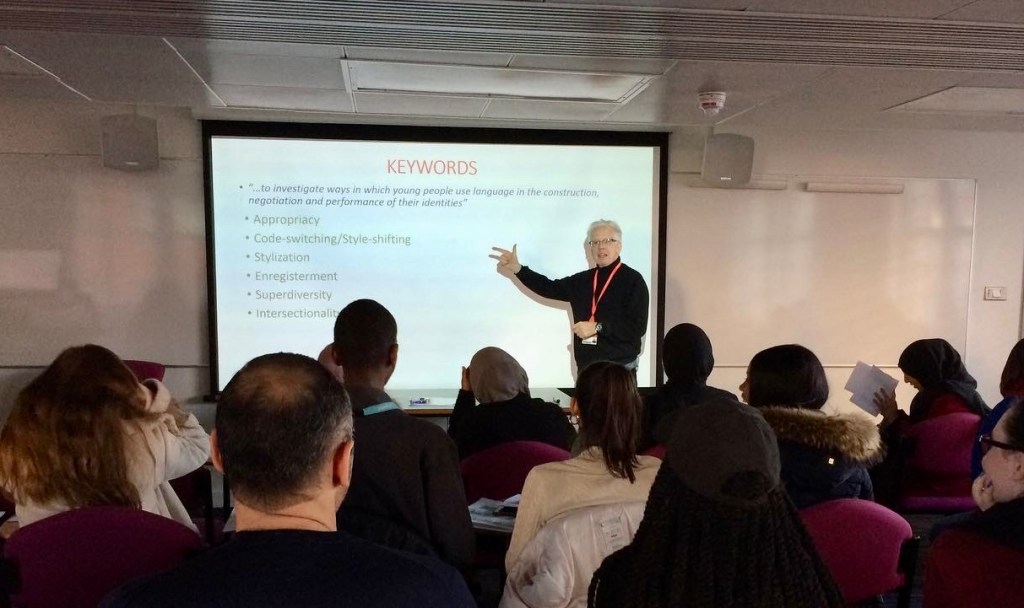
A few days after Randoh’s findings were published, I was asked by Robert Milazzo* to take part in the masterclass on new slang and youth language that he convened at Virginia Commonwealth University. The whole lively one-hour event was recorded and can be accessed here…

https://drive.google.com/file/d/1yYlV7LkKdEf5AqFF-bJQAfIE5s5PUpGi/view?usp=sharing

Robert’s class was particularly illuminating, allowing as it did for contributions from young slang users themselves and from puzzled old-timers too. Bear in mind that the samples handled by data analysts are taken solely from online usage and not from authentic speech. Nearly all the slang used on TikTok, YouTube, Instagram, etc. originates in the USA whereas the slang terms used by British youth in their IRL conversations will differ considerably from their North American counterparts, showing much greater influence from African Caribbean rather than African American sources.

*https://www.linkedin.com/in/robert-milazzo-3a8860116/

LANGUAGE AND LONGEVITY -1

Digital media enables language change and innovation – of course, but how much and for how long?

I spoke to Caitlin Talbot, Culture Researcher for the Economist magazine, who asked me about the effect of TikTok talk and the slang, catchphrases and viral puns invented by Gen Z. Caitlin wondered how many new terms were actually being added to the global conversation each year, and whether these novelties would last.

My own solo attempts to record new language and to understand and comment on its sources rely on fairly haphazard, old-fashioned techniques, so it’s not possible for me to quantify the lexical items, locutions, expressions and longer elements of discourse that I come across. The major dictionary publishers do have access to powerful and sophisticated electronic methods of scanning, scraping (‘aggregating’ as it should more properly be termed) raw linguistic data from across the internet. This material can be categorised to a certain extent and entered into giant databanks from which lexicographers can select the terms they periodically admit into published dictionaries.

Attempts to amass and analyse examples of language in use are nonetheless hampered by several considerations: the language in question is primarily in the form of text, rather than authentic speech, and the texts in question are largely recoverable from published sources and media platforms, only to a limited extent from personal messages. Tracking their use over time is possible, and the popularity of some usages can be subjected to frequency counts and represented on timelines, but private use and communications by local and specialist communities is far harder to assess. One of the more interesting challenges to the lexicographer is to predict which novel terms may become embedded in the national conversation and which drop out of use – some almost immediately and others over time. In fact my experience (since I began to collect slang in the 1980s) proves that it’s impossible to predict, let alone to speculate as to why this happens.

Caitlin’s article, with useful links, is here…(if it is paywalled for you, go to here *)

TikTok is changing how Gen Z speaks

In speculating about the number of new terms generated (and the playful, sometimes absurdist tendencies featuring on social media involve not only inventing new terms but reworking and re-purposing existing language like ‘demure’, ‘babygirl’, ‘millennial pause’, etc.) we can only fall back on subjective, anecdotal, incomplete accounts, even if these may be interesting and informative in their way…

TikTok Slang: The Exclusive Language of Gen Z (Study)

TikTok is full of made-up slang and trendbait | Vox

* TikTok is changing how Gen Z speaks

On social media new words spread far and fast

The illustration shows a playful evolution of speech bubble characters, progressing from a small, four-legged figure to a larger one riding a skateboard, against a bold red background
Illustration: Mark Long

Oct 21st 2024SavedShareGive

THE WORD “demure” is old—it describes the sort of modest lady Victorians esteemed—but it is freshly fashionable. There are some 800,000 posts on TikTok with the tag #demure. Youngsters today are using the word with lashings of irony, invoking it to describe everything from Saturn to sunset to New York City’s bin service.

TikTok is changing how young people talk. Other fusty words, such as “coquette”, are fashionable again. Colloquialisms are on the rise: members of Gen Z say “yapping” instead of “talking” and trim “delusional” to “delulu”. New words have also become popular. Take “skibidi”, a term popularised by a meme of an animated head singing in a toilet; it means “cool”, “bad” or “very”, depending on the context.

On social media words spread far and fast. At least 100 English words are produced, or given new meaning, on TikTok a year, reckons Tony Thorne, director of the Slang and New Language Archive at King’s College London. Some linguists think the platform is changing not just what youngsters are saying, but how they are saying it. A “TikTok accent”, which includes “uptalk”, an intonation that rises at the end of sentences, may be spreading.

The platform’s versatility encourages experimentation. Users can combine audio, text and video in a single post. That means words that sound especially satisfying can go viral, as well as those that are memorable in written form. Linguistic code has emerged, dubbed “algospeak”, to dodge content-moderation algorithms. It includes euphemisms (sex workers are called “accountants”), and misspellings (“seggs” instead of sex).

The mutation of language on TikTok is also due, in large part, to the age of its users. Most are 18-34 years old. That matters because “Young people are language innovators,” says Christian Ilbury, a linguist at the University of Edinburgh. For decades youngsters have created words to distinguish themselves from adults. On social media such neologisms find a big audience. Mr Ilbury describes this as “linguistic identity work”; parents have long called it attention-seeking.

The platform brings together fan groups and communities, from #kpopfans (people who like Korean pop music) to #booktokers (people who love reading). These groups create their own slang, says Adam Aleksic, a linguist and influencer. Some of it leaks into the mainstream. Other slang comes from specific groups: black people have innovated and spread hundreds of English words over the years, from “cool” to “tea” (gossip). Journalists and screenwriters popularise such words; now TikTokers do, too.

*For help in understanding the language and online mannerisms of TikTok and GenZ, I’m grateful to my daughter, Daisy Thorne Mrak*