THE SLANG AND NEW LANGUAGE ARCHIVE

A research portal for scholars, the press and the public

The Slang and New Language Archive was created in 1994 while I was Director of the Language Centre at King’s College London. The archive, consisting of a small library of books and periodicals and a number of databases and sub-directories, was designed as a repository for the collection, storage and dissemination of new language, in particular examples of nonstandard varieties of English such as slang, jargon and buzzwords. The archive was later expanded to take in examples of media language, political language, linguistic curiosities and etymologies. It remains a resource, unique in the UK and not-for-profit, assisting researchers, students, teachers and journalists, as well as non-specialists, in accessing information about aspects of contemporary language that are under-represented in traditional dictionaries and reference works.

This link will take you to the Archive webpage at King’s College, where there are further links to relevant articles and published sources…

https://www.kcl.ac.uk/research/slang-and-new-language

Glossaries from the archive may be accessed on this site by entering keywords, such as slang, jargon, MLE (Multiethnic London English), familect (highly colloquial language used in the home), coronaspeak (language related to the COVID-19 pandemic) and weaponised words (the contentious language of Brexit, populism and biased reporting) and slurs (racist and misogynist terms) in the search box. Once you have accessed a post of interest, check the tags and categories at the foot of the page for other articles or glossaries on the same topic.

Two of the larger archive datafiles are hosted on Aston University’s Institute of Forensic Linguistics Databank site. These are a glossary of current youth slang

https://fold.aston.ac.uk/handle/123456789/4

And a glossary of UK street slang, rap music and gang terminology

https://fold.aston.ac.uk/handle/123456789/5

Please note that the King’s archive focuses principally on contemporary language, that is terms used from the twentieth century to the present day. If you are interested in historical slang, I strongly recommend the monumental work by my associate, the British lexicographer Jonathon Green. His dictionary, now generously freely available online, lists current and historical slang terms with timelines and citations illustrating their usage and development…

https://greensdictofslang.com/

For more information, for queries, or to donate examples of language, contact me via this website or via the King’s College webpage. I’m on Twitter as @tonythorne007 too.

In terms of new slang and nonstandard language there are few reliable resources online. In February 2025, however, US publisher Merriam-Webster launched their own slang dictionary. You can find it here…

https://www.merriam-webster.com/slang

Among the many more informal glossaries and wordlists of slang posted on the internet in 2025, this review of slang in English schools is unusually comprehensive and accurate…

https://teachertapp.com/uk/articles/down-with-the-kids-slang-in-british-classrooms-2025/

SLANG NOW – the Language of UK Youth in 2021

At the very end of September this year came another example of a UK school seeking to police its students’ language and to ban the use of slang and colloquialisms. I have been writing about youth slang since 1990 (there are numerous articles on this site, accessible by entering slang, youth or MLE in the search box) and about such interventions for more than a decade: this time I spoke to the Guardian‘s Social Affairs Correspondent Rob Booth and his article is here…*

https://www.theguardian.com/education/2021/sep/30/oh-my-days-linguists-lament-slang-ban-in-london-school

September 2021 also saw the fruition, or culmination (portentous words) of a long-term project of mine dealing with the same topic: the rich, creative, controversial use of highly informal language by younger speakers. I have collected the multicultural slang, traded among younger people and used especially in urban centres across the UK. I have listed authentic examples of this language variety gathered from conversations, messaging, fieldwork interviews and donations and stored these in the Archive of Slang and New Language which I have curated at King’s College London.

Looking for a way to make this data available to the widest possible readership – whether students, teachers, researchers, fellow lexicographers or simply individuals fascinated by language change and novelty – I decided against traditional publishing in hardcopy in favour of putting the material online and so was gratified when, a year ago, the University of Aston’s Institute for Forensic Linguistics agreed to host an extract from the Archive, an up-to-date Glossary of UK Youth Slang, in its Forensic Linguistics Databank. This lexicon, very modest in its format but unique in the UK and I think in the wider Anglosphere, has just been made accessible. I hope it will be helpful for interested parties and I urge anyone consulting it to comment, criticise and, above all, send me additions for inclusion in future versions (rights to the content are restricted, so please don’t circulate it or republish it without full acknowledgement). I am constantly updating and expanding this and other datasets of nonstandard and socially significant language as well as teaching and broadcasting about them.

The Youth Slang Glossary in question is here…

http://fold.aston.ac.uk/handle/123456789/4

I am very grateful indeed to all the collaborators, colleagues, students, parents, youth workers and many others who have helped me to record and analyse this exciting, inventive, sophisticated and technically innovative language – and to celebrate it rather than decry and stigmatise it in doing so.

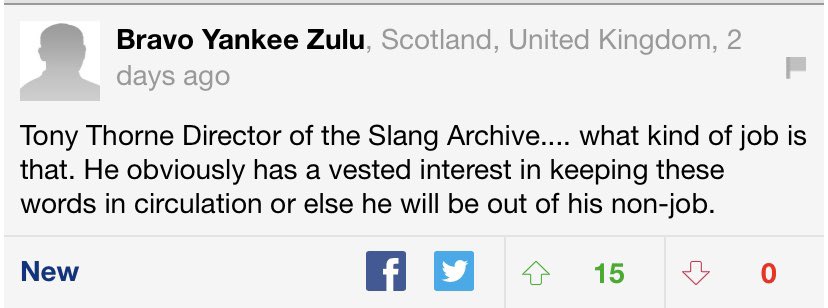
* Rob Booth’s Guardian article was rewritten very slightly and republished by the Daily Telegraph and the Daily Mail. I think the last word on my contribution to the subject, and indeed my career, should go to the anonymous poster of a comment following the Mail‘s piece…

Image

LONDON’S LANGUAGE

My exploration of the Language of London is a work in progress. Here is a fragment thereof, to be followed by others…

When on his Box the nodding Coachman snores,
And dreams of fancy’d Fares; when Tavern Doors
The Chairmen idly croud; then ne’er refuse
To trust thy busie Steps in thinner shoes…

…But when the swinging Signs your Ears offend
With creaking Noise, then rainy Floods impend;
Soon shall the Kennels swell with rapid Streams,
And rush in muddy Torrents to the Thames.
The Bookseller, whose Shop’s an open Square,
Foresees the Tempest, and with early Care
Of Learning strips the Rails; the rowing Crew
To tempt a Fare, cloath all their Tilts in Blue:

– John Gay, Trivia, 1716

Linguists know that language, public or private, is never singular but always pluralistic, in their words a shifting and evolving pattern of dialects, ‘sociolects’ and ‘idiolects’. An enduring myth is that Brits, Londoners among them, are ‘monoglots’ and always have been, imprisoned in the one-dimensional reality of a single language. This may have been true of some of us in recent years, but the Londoner of the past was as likely as not to be bi-, if not multi-lingual. The common inhabitants of Roman Londinium, if they wished to better themselves, would have been fluent in Latin as well as in their own Ancient British dialects. Dark-Age traders plying the Thames from Lundenwic had to negotiate the many varieties of Anglo-saxon spoken in England as well as Viking Norse and the ancestors of Dutch and French. For centuries after the Norman Conquest those working in the courts of law had to be tri-lingual as the proceedings were conducted simultaneously in Latin, French and Old English.

At any time in its history the city has resounded to all sorts of Englishes: the picturesque slangs of costermongers, butchers and pickpockets, the arcane jargon of bankers and lawyers, the polished verbal posturing of salon wits and the literati.

In London there I was bent,
I saw my-selfe, where trouthe shuld be ateynte;
Fast to Westminstar-ward I went
To a man of lawe, to make my complaynt.
I sayd, “For Marys love, that holy seynt,
Have pity on the powre, that would procede.
I would gyve sylvar, but my purs is faynt.”
For lacke of money, I may not spede.

– An anonymous man of Kent, London Lickpenny, c 1440

Of course the languages of London are not only varieties of English. From the earliest times other tongues have resonated around its hills and streams: the lost Celtic languages of Iron Age Britain, Caesar’s Latin and his legionaries’ vernaculars from around the Empire, the French of mediaeval court and convent, immigrant dialects from Huguenot French and sailor’s Dutch to Yiddish, yielding to the multinational, polyphonic buzz of the modern metropolis.

“If I hole up for a bit I won’t stand a chance of earning myself no more. You’ll have to sausage me a goose’s.” “Sausage you a goose’s? What the hell are you talking about?” Len had turned round from the window and was staring at Snowey. “Cash me a cheque, dopey.”

– James Curtis, You’re in the Racket Too, 1937

It was in London’s Westminster that English finally became a language in its own right, symbolically used for the first time by Edward III in 1362 at the opening of parliament. It was in London above all that the unparalleled marvel of Modern English, with its plunderings of other European tongues and borrowings from across the Empire, first evolved in the time of Jonson, Marlowe and Shakespeare. And now, five hundred years on, a wholly new hybrid, drawing on sources as disparate as Jamaican, Urdu, Arabic and Gaelic is set, some experts claim, to displace the native Cockney and Estuary dialects of London, even eventually transform Standard English itself into something strange and novel.

Statistics from the latest Census show that 78 per cent of the capital’s 7.8 million residents speak English as their main language. But the remaining 22 per cent — equivalent to just over 1.7 million people — have one of more than 300 first languages. Of these nearly 320,000 declare, rather worryingly, that they cannot speak English well or at all. The most striking revelation, however, is the scale of linguistic diversity. Overall there are 53 community or heritage languages in the capital spoken by at least 0.1 per cent of residents. There are also another 54 which include variants of established languages such as Chinese or those, such as Caribbean Creole, Cornish or Gaelic, spoken by a small number of people. The most common other language is Polish, spoken by nearly two per cent of residents, followed by Bengali, Gujarati, French, Urdu and Arabic. The most diverse borough is Hillingdon, where 107 languages defined by the Census are spoken, followed by Newham with 104. Tony Thorne’s own researches reveal that these ‘other’ languages themselves are undergoing weird transformations as they come into contact with one another and with native ‘white’ London usages.

A decade later and I still haven’t realised my wish to stage an exhibition, online or, preferably, IRL, to celebrate the language(s) of London. I was reminded by a news item this week recording the publication of a new and original  – and personal – account of South London words and sayings… 

https://www.richmondandtwickenhamtimes.co.uk/news/25408835.south-london-speaks-book-slang-sayings/?ref=twtrec