SLANGS IN CONTENTION

Chronocentric confusion as youth cohorts clash

It’s my responsibility, despite my very advanced age and despite the linguistic distractions from war crimes abroad and political meltdown at home, to try to keep track of the latest slang. For some time Gen Z, the population group born between 1997 and 2010, has been torchbearer for the zeitgeist, via TikTok, Instagram and YouTube, promoting such novelties as influencer-talk and its accelerated succession of fads and looks known as aesthetics or vibes (search this site with those keywords for more on all of these).

Now, in early May, help arrives in the form of a diatribe by 21 year-old LA-based singer-songwriter Allegra Miles, calling out aging millennials for their use of dated terminology and urging them to update themselves with Gen Z’s newest catchphrases and slogans. Allegra’s translations attracted the attention of the mainstream media in Australia and the UK and you can read them here…

https://www.dailymail.co.uk/femail/real-life/article-13386193/Gen-Z-woman-tells-millennials-stop-saying-old-phrases-slang-vibe-game-slay-YOLO.html

But Allegra’s generation are no longer the youngest on the block, and I’m curious as to how Gen Alpha – those born between 2010 and 2024 – will modify existing language and generate their own novelties. Tiktok influencer Nicole Pellegrino comments here…

Unfortunately, attempts by parents and teachers to get to grips with their students’ new ways of expressing themselves are embarrassingly inept, if well-meaning. Witness this glossary of terms, one of several ‘guides’ published this year, that is actually a ragbag of well-worn language items favoured by younger millennials and Gen Z…

https://www.classpoint.io/blog/gen-alpha-slang-for-teachers

I’ll continue, from my distant vantage point, to investigate, but my post is, then, an appeal, to any members of Gen Alpha (or their siblings, classmates, neighbours) who bother with online blogs or antique social media platforms, to send me samples of their favourite expressions. I’ll add these to my databases and write about them in due course.

In fairness, I should also list one of several similar articles published recently, again by the Daily Mail in this case, but whose source (the Curry’s electronic retail group) is perhaps not exactly representative of the age-group it describes…

https://www.dailymail.co.uk/femail/article-13341497/slang-makes-old.html

*For help in understanding the language and online mannerisms of TikTok and GenZ and Gen Alpha, I’m especially grateful to my daughter, Daisy Thorne Mrak*

Long January

First language updates from 2024

I have written several times on this site about new language and novel forms of expression generated by Generation Z and about how evolving attitudes, fashions and social behaviour among younger cohorts translate into a multimodal mix of verbal and visual on platforms such as TikTok. I have argued that older generations should not ignore or deride the unfamiliar and often baffling messaging practised by ‘the youth’, but try to understand and engage with it. During the slow, fraught, trying first weeks of 2024 the UK’s mainstream media has for the first time begun to pay some attention to the new language appearing online and on the street.

Earlier in the month my friend, Financial Times journalist Emma Jacobs, wrote about intergenerational language differences and resulting misunderstandings in the workplace. Her article, which quotes me, is here…

https://www.ft.com/content/b73d81c0-b4b8-40f9-b0e4-8f97a1701d0b

More recently the BBC focused on the changes in accents and vocal affectations associated with online influencers and new media platforms…

https://www.bbc.com/future/article/20240123-what-tiktok-voice-sounds-like-internet-influencer

Dr Christian Ilbury, quoted in that article, added this caveat subsequently: “it’s just HRTs + memetic discourse styles which keep the audience engaged (linked to platform capitalism) not a *new accent*”. Christian had previously helped to explain the latest incarnations of the once taboo c-word

For Dazed magazine Jess Bacon looked back at the many successive incarnations of the ‘girl’ featuring on media platforms during 2023…

2023: The year of the girl | Dazed

The Guardian meanwhile valiantly attempted to help its readers interpret the latest catchphrases and slang…

https://www.theguardian.com/lifeandstyle/2024/jan/24/so-babygirl-its-the-new-gen-z-term-of-endearment-but-what-does-it-mean?CMP=share_btn_tw

While the Daily Mail sent its reporters on to the streets to discover whether well-established slang terms were understood by members of the public…

https://www.dailymail.co.uk/news/article-12994057/So-Gen-Z-slang-know-MailOnline-visits-streets-London-Solihull-Sunderland-ask-millennials-boomers-know-real-meaning-terms-like-peng-bare-beef.html

In distressing contrast, the news cycle has been dominated throughout the month of January, in fact since October last year, by far less frivolous concerns. The Israeli-Palestinian conflict in a very different way has generated language (‘administrative detention’, ‘the other team’, ‘educide’, ‘nakba 2’) – or recycled older terminology (‘ethnic cleansing’, ‘demilitarization’, ‘collateral’) – which is controversial and which demands analysis. While recording the language of Donald Trump, of Brexit and of the Covid pandemic, and once again, while tracking the atrocities taking place today, I have been conscious of distortion, untruths, avoidance and manipulations practised both by the participants in the conflict, by their allies or sponsors, and by those who should be reporting on it objectively and, where possible, impartially. It is by scrutinising their language and treating public and media discourse critically, by exposing bad faith and countering falsehood that linguists can make some small contribution to the global conversation taking place.

Linguists have begun to discuss the ways in which facts and opinions are being presented to the public and to unpack the assumptions and covert intentions of those controlling, or attempting to control the narratives in question…

https://newlinesmag.com/argument/language-is-a-powerful-weapon-in-the-israel-palestine-conflict/

For my part I am collecting new examples of contentious language relating to the middle eastern crises and adding them to my existing glossary of weaponised words and toxic terminology on this website. I would be very grateful for contributions from readers and will acknowledge these in upcoming posts.

After language?

The latest multimodalities examined

During October I relished the chance to talk to the editors of DazedDigital, Serena Smith and Gunseli Yalcinkaya, and they told me about the most recent developments in online and digital communication and the new language varieties trending on social media. I have tried to make sense of a much younger generation’s performances and interactions and the notes I made follow here…

 Language and the way we use it is now for the first time truly globalised. This means for example that new accents and intonations and vocal affectations take place across several cultures almost simultaneously. This gives us pronunciation and intonation novelties like Youtuber or Influencer accent, TikTok voice, etc. These are fluid, evolving and can blend more than one traditional source (UK and US linguistic styles and usages for example). The phenomenon is not new – the mid-Atlantic accent dates back many decades and both Valley Girls and users of Multiethnic London English – MLE – have played with new ways of pronouncing, but the platforms and apps of the 2020s – TikTok in particular – highlight these…

Obviously the way we consume and exploit media has changed radically with the internet and mobile technology and determines the kinds of messages we exchange and the words, sounds and visuals we actually use. Short attention-spans mean that messages need to be accelerated, brief and telling: the constraints of apps and platforms make for compressed and dense information packages.  At the same time the imperative for innovation​ (something that has always been part of language evolution, but used to happen very gradually) – novelty, neologisms, new and more liberated attitudes to formality and informality and style in general – is integral to changing fashions, aesthetics, vibes. Even such basics as whether messages have to make sense have been destabilised by Gen Z‘s playful surrealism and absurdism and TikTok’s creative conventions.

One major change is the way that the distinction between written and spoken language has broken down since people began to type conversations and exchange rapid interactions electronically. Also Pre-existing words and expressions are hijacked, reversed, toxified, appropriated and modified as never before. And we all​ now have the power to do this via electronic media – we don’t need permission to publish and exchange our ideas and indulge our playful, mischievous or creative new usages.

Gunceli asked, There are so many memes joking about how we’ve ‘progressed past the need for language’. Obviously worth taking with a pinch of salt, but do you think there’s any truth to this? 

We won’t evolve ‘beyond language’ since language is simply a label for human interaction and communicative practices, but the specifics of that language will continue to adapt and mutate along with our social needs and our technologies. Linguists do talk increasingly in terms of multimodality whereby both online and offline communication involves much more than speech or writing – ‘language’ as we have known it. The buzzword multimodality can refer to how IRL we blend all sorts of semiotics often simultaneously: stance and posture, facial expression, gesture, writing, speaking and using a communication device, but also refers to how online and app messages employ abbreviations, acronyms, audio, video, symbols, memes as well as or instead of words (…soon probably touch and smell as well!)

The NPC streamers phenomenon highlighted by Dazed is another example of what I described as GenZ and TikTokers’ minimalist, surrealist or absurdist treatment of language. NPC stands for ‘non-playable character(s)’, the digital background entities with a limited repertoire of utterances and repetitive actions encountered in video games, and the streaming is an online activity, primarily on the TikTok platform, whereby creators imitate these characters by livestreaming themselves, and viewers reward them with in-app gifts for doing it.

The new primacy of image (and audio) over simply text and conversation has resulted in a human imitation of cartoon sounds and seemingly meaningless bits of language that only followers and enthusiasts will recognise and be positively triggered by. Playing with identities by way of words, slogans, soundbites and catchphrases is as much influenced by the poses of cosplayers or Furries and the behaviour of video-gamers as it is by ‘traditional’ ways of using verbal and visual language.

How do you think the mainstreaming of emerging tech like AI is changing the way we communicate verbally with one another?

Algorithms being used for automated reasoning and the generating of persuasive messaging or content are already operating at sophisticated levels, but the linguistic aspect is just as much prey to error and detectable failures as, for example, deepfake images and impersonations of artistic productions. If we are digitally literate and managing to keep up, we can often see through the deception, and this is probably reassuring. AI has some interesting potential: for example, to allow us to communicate with people whose language we don’t share. But I think the limitations of AI(-its difficulties in interpreting or reproducing human nuance, implication, indirectness, etc) will lead to – is already leading to – new forms of incoherence and misunderstanding. I suspect we will soon be able to recognise a particular ‘AI style’ so that artificially generated messages can be recognised as such in some cases – at least I hope so! Translators and teachers are already grappling with potential of AI to assist, supplement or replace their work – and its limitations in doing so. More alarmingly AI is already inventing and using languages that we humans can’t understand: https://www.fastcompany.com/90132632/ai-is-inventing-its-own-perfect-languages-should-we-let-it

Gunceli’s fascinating review of all these themes and more is here…

Serena Smith spoke to me about the latest version of familect, the intimate, informal, often comical language invented in private domestic spaces, about which I’ve written before on this site. Her excellent account of TikTok’s #MarriageLanguage is here…

LEVITY – OR LEVY-T?

Wordplay to keep the world at bay

I posted this in January 2023, but now – in May of the following year – it seems timely to update and repost the article and the links, given the fact that the snappy genners were right and a UK genny lec has been announced for July 4…

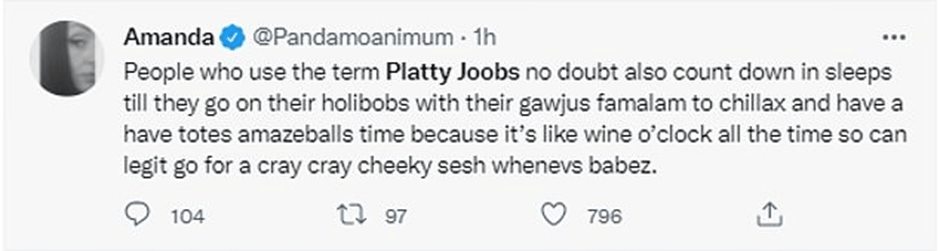
We are halfway through January now. The Holibobs are over and we have come to the end of Chrimbo Limbo – that uncertain period between Christmas and New Year. Dishy Rishi is still in number 10 and, despite unprecedented crises in the health services (though the Panny-D seems to have subsided and Locky-D is just a memory) and family finances (in meltdown due to the Cozzi-Liv), we will have to wait until next year for a Genny-Lec (and perhaps the predicted Labby-Maj once the votes have been counted). In the midst of adversity, on social media (on Facey-B, Insta-G, and even Linky-D) the usual barrage of banter, badinage and bonhomie continues unabated nevertheless. As my Twitter friend Amanda comments…

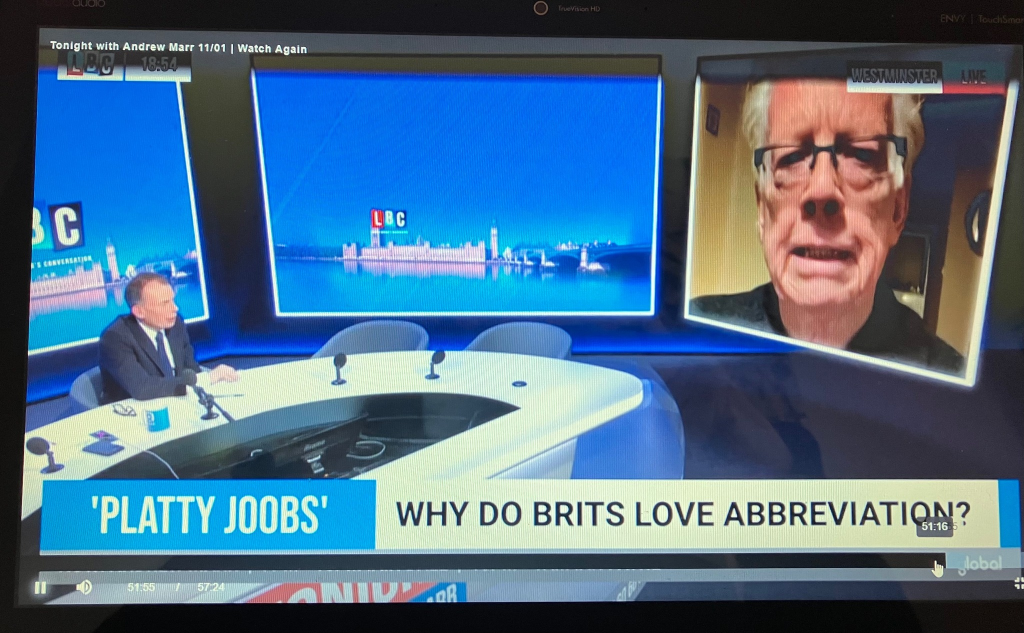
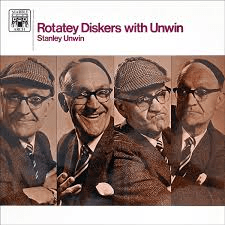
Platty Joobs’ (for Platinum Jubilee in case you missed it) and ‘famalam’ have a Professor Stanley Unwin feel, for me and possibly others of my advanced years. Unwin was an eccentric old chap who used to perform monologues on the radio in the 1950s in which he mangled words and phrases and challenged listeners to interpret what he was saying. ‘Unwinese’ added nonsense syllables, reversed syllables, jumbled parts of sentences – like children’s nonsense stories and nursery and baby talk does. Exaltation of childhood by way of whimsy and nonsense (as in the works of Lewis Carroll, Edward Lear) has been an enduring feature of British literary and popular culture – perhaps a tactic by which we try to play down the dark side of life, smooth over social inequalities and make light of the blunders of our ruling class: deploying non-stop facetiousness, irony, cheek and irreverence in all everyday communications.

I spoke to Serena Smith, editor at Dazed Digital, about the sassy, cutesy – or cringe-inducing – humour involved in abbreviating, coining nicknames, dismantling and reassembling words and phrases in a particularly British manner, then a few days later answered questions on the same subject from Andrew Marr on LBC Radio. Serena’s article is here…

https://www.dazeddigital.com/life-culture/article/57904/1/why-do-british-people-love-to-abbreviate-things-cozzie-livs-platty-joobs

It’s heartening that, despite the seeming indifference of older commentators and experts, some, mainly younger academic linguists are beginning to study these developments, applying statistical techniques to tracking the spread of new terms and analysing specifics of their users. Dr Christian Ilbury of Edinburgh University, with whom I’ve exchanged ideas, has been doing this for some time and writes here of the online personas created and celebrated by new labels, catchphrases and in-jokes…

https://onlinelibrary.wiley.com/doi/full/10.1111/josl.12563

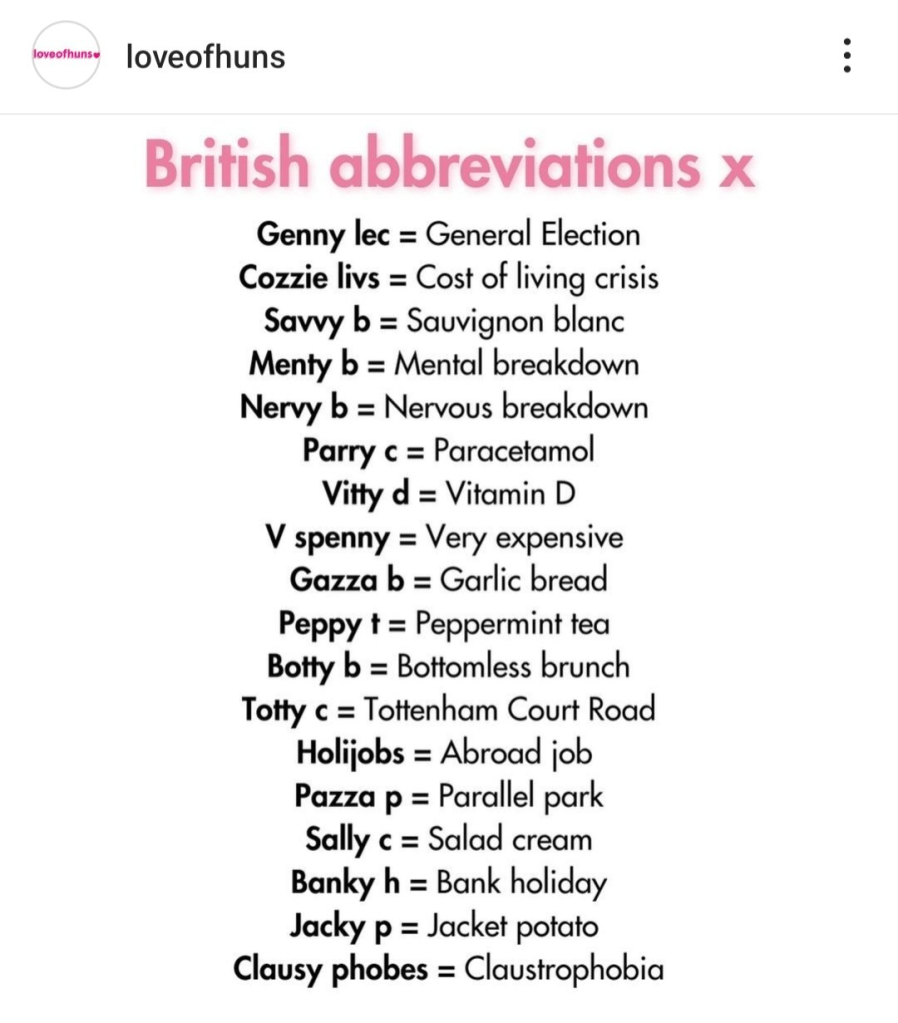
The announcement of a genny lec in May 2024 sparked renewed interest in the phrases, as listed by the Loveofhuns Instagram account…

More here, from Christian Calgie via Puja Teli

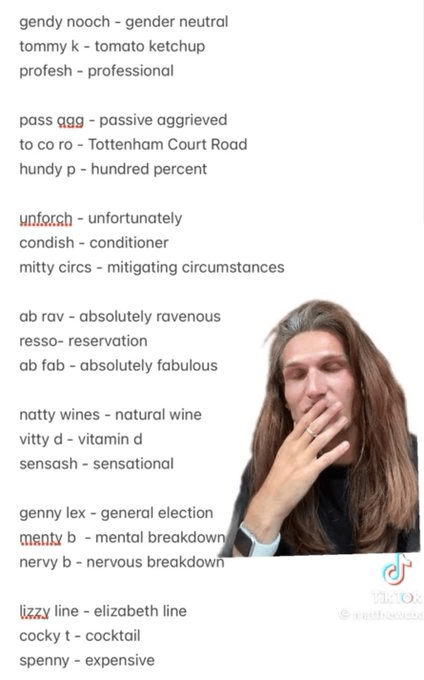
And on Tiktok via Twitter

In August I spoke to Madeline Sherratt about the latest developments in abbreviating and wordplay, and her update in The Independent is here…

From the ‘panny d’ to a ‘jackie p’, is the language of hun culture leaving you behind? | The Independent

LANGUAGE, ‘AESTHETICS’ AND INNOVATION IN 2022 – THE ROLE OF GEN Z

Fads, Fashions, Lifestyles and Vibes – thirty years on

During 2022 I wrote several times about the new terminology that has been generated by younger generations’ (younger Millennials and so-called Gen Z or Zoomers) online celebration of an accelerated series of Fads, Fashions and Cults (the title of my book on the same topic published back in 1993). I was bemused, but not surprised that my articles and posts received little attention. Those over 40, even if active online or otherwise in touch with the wider culture, seem to pay no attention to what their children and grandchildren are saying, or perhaps just view their activities on social media as trivial, frivolous and ephemeral*. It’s slightly absurd that someone of my advanced age should be trying to record and comment on youth-based popular culture, but, just as back in the nineties, only a few fashionistas and influencers and a handful of style journalists manage to achieve any sort of critical perspective on the high-speed succession of poses, performances and pastiches that plays out on 21st century cyberspaces (and incidentally in teenagers’ bedrooms and college dorms too).

At the end of the year, however, I was asked to contribute to a major press review of these same phenomena, and discussed them with the MailOnline’s science reporter, Fiona Jackson. Fiona had picked up on recent mutations in slang and online jargon, in the novel use of emoji and punctuation, and changes, too, in the accents and intonations used on platforms such as TikTok – in particular the voice affectation known as ‘vocal fry.’

It’s interesting that Gen Z is seen as having a particularly exotic or impenetrable vocabulary, baffling and irritating parents, teachers, journalists and anyone too old to keep up. Inventing new words and changing the meanings of old ones, though, is something that each generation does (see UK millennials with their MLE – Multiethnic London English) and is a natural part of language. Accent is another essential component in curating and projecting one’s identity. ‘Vocal fry’ or ‘creaky voice’ first got noticed and was fiercely debated in the USA in 2015. The low, raspy growling voice tone favoured by female US celebrities has since been imitated by some younger people in the UK, and by British ‘influencers’ online, but not to the same extent. What I have noticed is not specifically vocal fry but something newer and more complex: a UK accent favoured by fashionable younger females which mixes a sort of high-pitched, lisping breathless ‘girly’ delivery with a lower-pitched drawl that can slide in and out of American intonations. Something like this is now prevalent, particularly on TikTok which is where Gen Z goes to influence and be influenced.

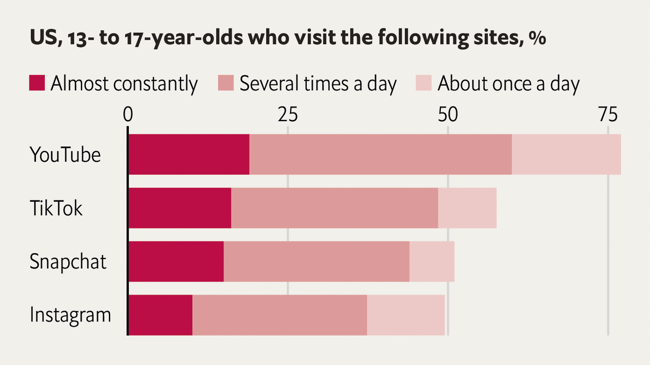
In the US now 63% of people aged 13 to 17 use TikTok weekly, a rate that now tops both Snapchat and Instagram. TikTok is also the go-to environment for the celebration of youth fads, fashions and lifestyle trends, not to mention the parodies, mash-ups, spoofs and in-jokes which are central to its video performances. Older people trying to keep up or simply to comprehend what is happening on TikTok or understand what Gen Z is saying and messaging should however beware: I have a suspicion, shared by a few other commentators, that many of the fads, fashions and trends they celebrate (they call them ‘vibes’ or ‘aesthetics’) are not really taken seriously at all by most of them, are passing fancies or simply spoofs perhaps designed to mock the tedious concerns of outdated millennials. Fashionable new ‘looks’ like so-called ‘goblin-mode’ which has, unusually, been noticed and publicised in the mainstream, have been appearing and disappearing on Gen Z platforms with a bewildering speed (see ‘cottagecore’, ‘blokecore’, ‘hag chic’, ‘frazzled English woman’, etc.).

The MailOnline article is here…

https://www.dailymail.co.uk/sciencetech/article-11541685/How-Generation-Z-changed-communicate.html

…and my articles from 2022 are here…

Gen Z, as they come of age and begin to access power and influence in mainstream society, will inevitably affect the way we collectively behave and of course communicate. But there is an interesting phenomenon that those like me who try to track slang and new language have to face up to. That is that it’s quite impossible to predict exactly how language is going change. No so-called linguistic authorities have ever been able to guess how technology and society is going to mutate, or how fast, or which aspects of human behaviour will come to predominate in the future – even in the near-future. Gen Z may settle down into family life and work and become distracted by adult responsibilities, just as we once-radical Boomers, muted, tortured Gen X and much misunderstood millennials have done before them. Or perhaps they will not, and will manage to realise the boomers’ dream of staying radical, innovative and young forever? How their destiny plays out will dictate what they say and how they say it (and they will have to find ways to negotiate their obsessions and describe their changing environments), but I, for one, don’t dare to hazard any more than that.

*She’s much younger than 40, but journalist Marie le Conte struck a contrarian note in the New Statesman, suggesting that we shouldn’t be interested in Gen Z’s predilections…

Its finger still on the pulse of the zeitgeist, the Mail followed up with a warning to older generations that Gen Z disapprove not only of their language and their emoji use, but of their gesturing too (unsurprisingly the hand-signals castigated are all part of my own sad repertoire)…

https://www.dailymail.co.uk/news/article-11627655/Generation-Z-reveal-hand-gestures-cool.html

Last summer the Daily Mash had issued another (spoof) warning to the middle-aged, this time of Gen Z‘s behaviour in the workplace…

https://www.thedailymash.co.uk/news/work/the-middle-aged-guide-to-fitting-in-with-gen-z-work-colleagues-20220704222915

At the end of January I talked to Karyn Hay of Radio New Zealand about Generation Zed (the preferred term in Wellington and Auckland), their language and online activities…

https://www.rnz.co.nz/national/programmes/nights/audio/2018875098/tony-thorne-gen-z-communication

In February 2023 King’s College London Faculty of Arts and Humanities, host to my Slang and New Language Archive, featured my activities in their Net Gains series…

https://www.kcl.ac.uk/is-tiktok-a-breeding-ground-for-a-mutation-of-culture

*For help in understanding the language and online mannerisms of TikTok and GenZ, I’m grateful to my daughter, Daisy Thorne Mrak*

The Word(s) on the Street(s)

GANG CULTURE, RAP MUSIC, STREET SLANG AND POLICING

I have written elsewhere on this site about my own unusual forays into forensic linguistics, whereby I have helped legal defence teams, police forces and other interested parties in decoding, interpreting and assessing the slang used by gang members, an authentic urban language variety which is shared with rap music genres, particularly Drill music.

The citing of rap lyrics in the context of criminal trials and attempts to ban Drill lyrics is very controversial and some academic linguists, musicologists and criminologists argue that they should never in any circumstances be admitted in evidence – a stance I sympathise with, but feel is mistaken.*

One London Met Police officer with whom I have worked has written about his own recent activities at the intersection of music, youth culture and youth violence. The article offers a very rare professional insider’s perspective on the issues in contention, and with Michael Railton‘s permission I have linked to it here…

https://www.college.police.uk/article/analysing-gang-related-music-linked-serious-violence

*journalist Will Pritchard and I have debated the value of such evidence in court. Here he puts the case against in The Face

https://theface.com/music/rap-lyrics-used-in-court-young-thug-gunna-racist-stereotypes-rap-music

In June 2023 another piece by Will Pritchard ran in the Guardian

https://www.theguardian.com/music/2023/jun/21/behind-bars-how-rap-lyrics-are-being-used-to-convict-black-british-men

Tick Tock, TikTok

Earlier in May I talked to Dillon Thompson of Yahoo News about slang and its online incarnations. Dillon was exploring the ways in which slang and new language both affect the way we interact in an accelerated digital age, and the way in which digital environments such as TikTok and Instagram and Twitter and the internet-based rituals, gestures and poses embraced by Generation Z in turn might influence the sort of language we – or some of us – are creating, adopting and using.

Dillon’s article, with new insights and with contributions by me and from US linguists Sunn m’Cheaux and Daniel Hieber is here…

https://www.yahoo.com/lifestyle/internet-changing-think-slang-133422776.html

More on how internet culture has displaced ‘pop culture’, from Günseli Yalcinkaya for Dazed magazine…

FAMILECT AGAIN

DOMESTIC DIALECT FEATURES FAMILY FIXATIONS

Families and Older Generations Stock Vector - Illustration of grandparents,  seniors: 114207016

In 2016 I wrote about so-called familect, the ‘microdialect’ originating in the home*. Also known as ‘family slang’ and ‘kitchen table lingo’, this is one of those underappreciated, under-researched varieties of ‘in-group’ language which, like slang and jargon, make use of the same techniques (metaphor, irony, analogy – alliteration, rhyme, assonance, reduplication) as poetry and literature and at the same time offer a window into the private worlds of ordinary people: their preoccupations, pleasures and ways of bonding. Familect can also be a sharing ritual within the household whereby humour and creativity and inventiveness are enjoyed across generations. Kids are adept in creating new words from an early age and at playing with existing language to create new and colourful expressions, while older family members have their own ways of coining expressions and recycling or reworking the language of their youth, so the home is also a laboratory in which to cultivate new literacies.

Just recently the cApStAn Translation Team reviewed the topic and provided a useful link-fest and bibliography…

Today another article, by my friend Connie Chang, featuring interviews with specialists in the field, was published in the National Geographic

https://www.nationalgeographic.com/family/article/why-your-familys-secret-language-is-good-for-kids?loggedin=true

Familect can provide a useful subject for research and field work as part of exploring word creation and language innovation for school or college projects. Its users can be encouraged to look more carefully at the words and phrases they have invented themselves or shared or just heard, and asked to consider…

  1. Why was the expression invented? (usually because the object, idea or feeling described is precious or important or super-familiar. Sometimes because there isn’t an existing word or a memorable word to describe it in standard English)  
  2. What is it that makes these words funny, understandable, memorable? Is it that they sound like something else, remind you of something already familiar? Or is it the spelling and sound of them itself that makes them amusing?

In fact the school itself may be a source of similar novelties, as Tabitha McIntosh wrote in the TES this summer…

https://www.tes.com/news/schools-teachers-does-your-classroom-have-its-own-unique-language

Grandparents with Kids are Walker Stock Vector - Illustration of happiness,  cute: 153811703

One year on, in August 2022, the Guardian featured the phenomenon in an article by Arwa Mahdawi

https://www.theguardian.com/commentisfree/2022/aug/09/i-am-beshwiggled-and-incatacipated-why-theres-nothing-better-than-family-slang?CMP=share_btn_tw

*https://language-and-innovation.com/2016/07/23/family-language/

SLANG NOW – the Language of UK Youth in 2021

At the very end of September this year came another example of a UK school seeking to police its students’ language and to ban the use of slang and colloquialisms. I have been writing about youth slang since 1990 (there are numerous articles on this site, accessible by entering slang, youth or MLE in the search box) and about such interventions for more than a decade: this time I spoke to the Guardian‘s Social Affairs Correspondent Rob Booth and his article is here…*

https://www.theguardian.com/education/2021/sep/30/oh-my-days-linguists-lament-slang-ban-in-london-school

September 2021 also saw the fruition, or culmination (portentous words) of a long-term project of mine dealing with the same topic: the rich, creative, controversial use of highly informal language by younger speakers. I have collected the multicultural slang, traded among younger people and used especially in urban centres across the UK. I have listed authentic examples of this language variety gathered from conversations, messaging, fieldwork interviews and donations and stored these in the Archive of Slang and New Language which I have curated at King’s College London.

Looking for a way to make this data available to the widest possible readership – whether students, teachers, researchers, fellow lexicographers or simply individuals fascinated by language change and novelty – I decided against traditional publishing in hardcopy in favour of putting the material online and so was gratified when, a year ago, the University of Aston’s Institute for Forensic Linguistics agreed to host an extract from the Archive, an up-to-date Glossary of UK Youth Slang, in its Forensic Linguistics Databank. This lexicon, very modest in its format but unique in the UK and I think in the wider Anglosphere, has just been made accessible. I hope it will be helpful for interested parties and I urge anyone consulting it to comment, criticise and, above all, send me additions for inclusion in future versions (rights to the content are restricted, so please don’t circulate it or republish it without full acknowledgement). I am constantly updating and expanding this and other datasets of nonstandard and socially significant language as well as teaching and broadcasting about them.

The Youth Slang Glossary in question is here…

http://fold.aston.ac.uk/handle/123456789/4

I am very grateful indeed to all the collaborators, colleagues, students, parents, youth workers and many others who have helped me to record and analyse this exciting, inventive, sophisticated and technically innovative language – and to celebrate it rather than decry and stigmatise it in doing so.

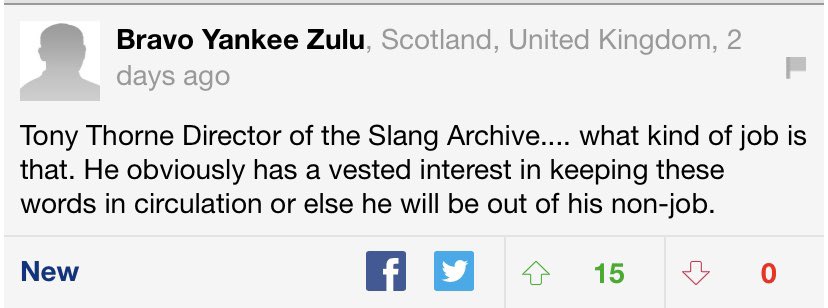
* Rob Booth’s Guardian article was rewritten very slightly and republished by the Daily Telegraph and the Daily Mail. I think the last word on my contribution to the subject, and indeed my career, should go to the anonymous poster of a comment following the Mail‘s piece…

Image

An Antique Perspective: Slang in 1997

One of my tasks during this strange summer of 2021 was to try to recover old files and folders, deleted in error from my archive at King’s College London during a redesign of the website. Among them was a tour d’horizon of the characteristics and significance of Slang, written in 1997. Now an antique curio, I thought nevertheless it might be worth reproducing here for anyone teaching or learning about slang, or simply interested in that variety of language, so that comparisons could be made and conclusions might be drawn.

338 TATTOO - 1997 | Facebook

SLANG AND THE DICTIONARY


Tony Thorne  

Slang … an attempt of common humanity to escape from bald literalism, and express itself illimitably … the wholesome fermentation or eructation of those processes eternally active in language, by which froth and specks are thrown up, mostly to pass away, though occasionally to settle and permanently crystallise.

  Walt Whitman, 1885

What is slang?

 Most of us think that we recognise slang when we hear it or see it, but exactly how slang is defined and which terms should or should not be listed under that heading continue to be the subject of debate in the bar-room as much as in the classroom or university seminar. To arrive at a working definition of slang the first edition of the Bloomsbury Dictionary of Contemporary Slang approached the phenomenon from two slightly different angles. Firstly, slang is a style category within the language which occupies an extreme position on the spectrum of formality. Slang is at the end of the line; it lies beyond mere informality or colloquialism, where language is considered too racy, raffish, novel or unsavoury for use in conversation with strangers … So slang enforces intimacy. It often performs an important social function which is to include into or exclude from the intimate circle, using forms of language through which speakers identify with or function within social sub-groups, ranging from surfers, schoolchildren and yuppies, to criminals, drinkers and fornicators. These remain the essential features of slang at the end of the 1990s, although its extreme informality may now seem less shocking than it used to, and its users now include ravers, rappers and net-heads along with the miscreants traditionally cited.

There are other characteristics which have been used to delimit slang, but these may often be the result of prejudice and misunderstanding and not percipience. Slang has been referred to again and again as ‘illegitimate’, ‘low and disreputable’ and condemned by serious writers as ‘a sign and a cause of mental atrophy’(Oliver Wendell Holmes), ‘the advertisement of mental poverty’(James C. Fernal). Its in-built unorthodoxy has led to the assumption that slang in all its incarnations (metaphors, euphemisms, taboo words, catchphrases, nicknames, abbreviations and the rest) is somehow inherently substandard and unwholesome. But linguists and lexicographers cannot (or at least, should not) stigmatise words in the way that society may stigmatise the users of those words and, looked at objectively, slang is no more reprehensible than poetry, with which it has much in common in its creative playing with the conventions and mechanisms of language, its manipulation of metonymy, synechdoche, irony, its wit and inventiveness. In understanding this, and also that slang is a natural product of those ‘processes eternally active in language’, Walt Whitman was ahead of his time.

More recently some writers (Halliday being an influential example) have claimed that the essence of slang is that it is language used in conscious opposition to authority. But slang does not have to be subversive; it may simply encode a shared experience, celebrate a common outlook which may be based as much on (relatively) innocent enjoyment (by, for instance, schoolchildren, drinkers, sports fans, Internet-users) as on illicit activities. Much slang, in fact, functions as an alternative vocabulary, replacing standard terms with more forceful, emotive or interesting versions just for the fun of it: hooter or conk for nose, mutt or pooch for dog, ankle-biter or crumb-snatcher for child are instances. Still hoping to find a defining characteristic, other experts have seized upon the rapid turnover of slang words and announced that this is the key element at work; that slang is concerned with faddishness and that its here-today-gone-tomorrow components are ungraspable and by implication inconsequential. Although novelty and innovation are very important in slang, a close examination of the whole lexicon reveals that, as Whitman had noted, it is not necessarily transient at all. The word punk, for example, has survived in the linguistic underground since the seventeenth century and among the slang synonyms for money – dosh, ackers, spondulicks, rhino, pelf – which were popular in the City of London in the early 1990s are many which are more than a hundred years old. A well-known word like cool in its slang sense is still in use (and has been adopted by other languages, too), although it first appeared around eighty years ago.

Curiously, despite the public’s increasing fascination for slang, as evinced in newspaper and magazine articles and radio programmes, academic linguists in the UK have hitherto shunned it as a field of study. This may be due to a lingering conservatism, or to the fact that it is the standard varieties of English that have to be taught, but whatever the reasons the situation is very different elsewhere. In the US and Australia the study of slang is part of the curriculum in many institutions, in France, Spain, Holland, Scandinavia and Eastern Europe slang, and especially the slang of English, is the subject of more and more research projects and student theses; in all these places slang is discussed in symposia and in learned journals, while in Russia, China and Japan local editions of British and American slang dictionaries can be found on school bookshelves and in university libraries.

 Slang Lexicographers

The first glossaries or lexicons of European slang on record were lists of the verbal curiosities used by thieves and ne’er-do-wells which were compiled in Germany and France in the fifteenth century. A hundred years later the first English collections appeared under the titles The Hye Waye to the Spytell House, by Copland, Fraternite of Vacabondes, by Awdeley, and Caveat for Common Cursetours, by Harman. Although dramatists and pamphleteers of seventeenth-century England made spirited use of slang in their works, it was not until the very end of the 1600s that the next important compilation, the first real dictionary of slang, appeared. This was A New Dictionary of the Terms ancient and modern of the Canting Crew by ‘B. E. Gent’, a writer whose real identity is lost to us. In 1785, Captain Francis Grose published the first edition of his Classical Dictionary of the Vulgar Tongue, the most important contribution to slang lexicography until John Camden Hotten’s Dictionary of Modern Slang, Cant and Vulgar Words, 1859, which was overtaken its turn by Farmer and Henley’s more sophisticated Slang and its Analogues in 1890. All these were published in Britain and it was the New Zealander Eric Partridge’s single-handed masterwork A Dictionary of Slang and Unconventional English, also published in London, in 1937, that, despite its lack of citations and sometimes eccentric etymologies, became the yardstick of slang scholarship at least until the arrival of more rigorously organised compendiums from the USA in the 1950s. Since then several larger reference works have been published, usually confining themselves to one geographical area and based mainly on written sources, together with a number of smaller, often excellent specialist dictionaries dealing with categories such as naval slang, Glaswegian slang, rhyming slang, the argot of police and criminals and the jargon of finance and high technology.

 The Bloomsbury Dictionary Of Contemporary Slang

The Bloomsbury Dictionary of Contemporary Slang was first produced with the idea of combining the enthusiasms and instincts of a user of slang – someone who had been part of the subcultures and milieux where this language variety has flourished ( and in later life still ventures into clubs, bars, music festivals, football matches and, on occasion, homeless shelters) – with the methods of the modern lexicographer (earlier work on the Longman Dictionary of Contemporary English being a particular influence) and applied linguist. The first edition set out to record the 6,000 or so key terms and 15,000-odd definitions which formed the core of worldwide English language slang from 1950 to 1990: the new, updated edition, published in Autumn 1997, extends the time-frame almost to the millennium and expands the number of entries by two thousand, losing a few obscure, doubtfully attested or just plain uninteresting terms in the process. The dictionary aims to pick up the elusive and picturesque figures of speech that really are in use out there in the multiple anglophone speech communities, and many terms which appear in its pages have never been recorded before. In keeping with the modern principles of dictionary-making, the headwords which are listed here are defined as far as possible in natural, discursive language. The modern dictionary ideally moves beyond mere definition and tries to show how a term functions in the language, who uses it and when and why, what special associations or overtones it may have, perhaps even how it is pronounced. Where possible a history of the word and an indication of its origin will be included and its usage illustrated by an authentic citation or an invented exemplary phrase or sentence.

As with all similar dictionaries, the Bloomsbury volume is based to some extent on consulting written sources such as newspapers, magazines, comic books, novels and works of non-fiction. Other secondary sources of slang are TV and radio programmes, films and song lyrics. Existing glossaries compiled by researchers, by journalists and by Internet enthusiasts were also checked, but treated, like fictional texts and broadcasts, with caution; investigators may be misled by their informants and, as society becomes more self-conscious in its treatment of new and unorthodox language, varieties of so-called slang appear that are only partly authentic, such as the gushing ‘teen-talk’ (a variety of journalese) appearing in UK magazines like Just Seventeen, My Guy or Sugar directed by twenty- and thirty-something journalists at their much younger readers, or the argot developed by writers for cult movies such as Bill and Ted’s Bogus Journey, Wayne’s World and Clueless. The embellishing or inventing of slang is nothing new; Damon Runyon, Raymond Chandler and P. G. Wodehouse all indulged in it, as did British TV comedy writers for Porridge, Minder, Only Fools and Horses, etc., over the last three decades. For the Bloomsbury dictionary terms have been admitted if they can be verified from two or more sources, thereby, sadly, shutting out examples of idiolect (one person’s private language), restricted sociolects (terms shared by very small groups) and nonce terms (one-off coinages).

Any description of slang that is based purely on secondary or written sources (and most still are) cannot hope to do justice to a language which is primarily transmitted orally. Slang terms may exist in spoken usage for many years, even for centuries, before being written down; some are never committed to paper, so there is an absolute need for work ‘in the field’ with primary sources; eavesdropping on and interviewing the users of slang themselves, and, where they are not able to report objectively on the words and phrases they are using, their neighbours, parents, colleagues, fellow-students and friends must be mobilised. This is the most exciting part of lexicography, if sometimes the most risky. The modern language researchers going undercover to listen in on conversations or setting up networks of informants at street-level can imagine themselves as successors to the pioneering anthropologists of the last century, rather than ‘harmless drudges’ (Dr Johnson’s memorable definition of the lexicographer) toiling alone in dusty libraries or staring at flickering screens.

Slang at the Millennium

The traditional breeding grounds of slang have always been secretive, often disenfranchised social groups and closed institutions with their rituals and codes. This has not changed, although the users in question have. Where once it was the armed forces, the public schools and Oxbridge that in Britain dominated socially and linguistically, now it is the media, the comprehensive playground and the new universities which exercise most influence on popular language: the office, the trading-floor and the computer-room have replaced the workshop, the factory and the street-market as nurturing environments for slang. The street gang and the prison, whence came nearly all the ‘cant’ that filled the early glossaries, still provide a great volume of slang, as do the subcultures of rave, techno and jungle music, crusties and new agers, skaters and snowboarders. Football metaphors and in-jokes have long since ousted the cricketing imagery of yesteryear. Some special types of slang including pig-latin, infixing, and backslang (reversal, as in yob) seem virtually to have disappeared in the last few years, while the rhyming slang which arose in the early Victorian age continues to flourish in Britain and Australia, replenished by succeeding generations, and the even older parlyaree or polari (a romance/romany/yiddish lingua franca) lingers on in corners of London’s theatre-land and gay community. The effect of the media and more recently of the Internet means that slang in English can no longer be seen as a set of discrete localised dialects, but as a continuum or a bundle of overlapping vocabularies stretching from North America and the Caribbean through Ireland and the UK on to South Africa, South and East Asia and Australasia. Each of these communities has its own peculiarities of speech, but instantaneous communications and the effect of English language movies, TV soaps and music means that there is a core of slang that is common to all of them and into which they can feed. The feeding in still comes mainly from the US, and to a lesser extent Britain and Australia; slang from other areas and the slang of minorities in the larger communities has yet to make much impression on global English, with one significant exception. That is the black slang which buzzes between Brooklyn, Trenchtown, Brixton and Soweto before, in many cases, crossing over to pervade the language of the underworld, teenagers ( – it is the single largest source for current adolescent slang in both the UK and US), the music industry and showbusiness. Within one country previously obscure local slang can become nationally known, whether spread by the bush telegraph that has always linked schools and colleges or by the media: Brookside, Coronation Street, Rab C. Nesbitt and Viz magazine have all helped in disseminating British regionalisms. This mixing-up of national and local means that past assumptions about usage may no longer hold true: the earnest English traveller, having learned that fag and bum mean something else in North America, now finds that in fashionable US campus-speak they can actually mean cigarette and backside. In the meantime the alert American in Britain learns that cigarettes have become tabs or biffs and backside is now often rendered by the Jamaican batty

Speakers of English everywhere seem to have become more liberal, admitting more and more slang into their unselfconscious everyday speech; gobsmacked, O.T.T, wimp and sorted can now be heard among the respectable British middle-aged; terms such as horny and bullshit which were not so long ago considered vulgar in the extreme are now heard regularly on radio and television, while former taboo terms, notably the ubiquitous British shag , occur even in the conversation of young ladies. In Oakland, California, the liberalising process reached new extremes late in 1996 with the promotion of so-called Ebonics : black street speech given equal status with the language of the dominant white culture. 

Youthspeak

The greatest number of new terms appearing in the new edition of the dictionary are used by adolescents and children, the group in society most given to celebrating heightened sensations, new experiences and to renaming the features of their world, as well as mocking anyone less interesting or younger or older than themselves. But the rigid generation gap which used to operate in the family and school has to some extent disappeared. Children still distance themselves from their parents and other authority figures by their use of a secret code, but the boomers – the baby boom generation – grew up identifying themselves with subversion and liberalism and, now that they are parents in their turn, many of them are unwilling either to disapprove of or to give up the use of slang, picking up their children’s words (often much to the latters’ embarrassment) and evolving their own family-based language (helicopters, velcroids, howlers, chap-esses are examples).

The main obsessions among slang users of all ages, as revealed by word counts, have not changed; intoxication by drink or drugs throws up (no pun intended) the largest number of synonyms; lashed, langered, mullered and hooted are recent additions to this part of the lexicon. These are followed by words related to sex and romance –copping off, out trouting, on the sniff and jam, lam, slam and the rest – and the many vogue terms of approval that go in and out of fashion among the young (in Britain ace, brill, wicked and phat have given way to top, mint, fit and dope which are themselves on the way out at the time of writing). The number of nicknames for money, bollers, boyz, beer-tokens, squirt and spon among them, has predictably increased since the materialist 1980s and adolescent concern with identity-building and status-confirming continues to produce a host of dismissive epithets for the unfortunate misfit, some of which, like wendy, spod, licker, are confined to the school environment while others, such as trainspotter, anorak and geek, have crossed over into generalised usage.

Other obsessions are more curious; is it the North American housewife’s hygiene fetish which has given us more than a dozen terms (dust-bunny, dust-kitty, ghost-turd, etc.) for the balls of fluff found on an unswept floor, where British English has only one (beggars velvet)? Why do speakers in post-industrial Britain and Australia still need a dozen or more words to denote the flakes of dung that hang from the rear of sheep and other mammals, words like dags, dangleberries, dingleberries, jub-nuts, winnets and wittens? Teenagers have their fixations, finding wigs (toop, syrup, Irish, rug) and haemorrhoids (farmers, Emma Freuds, nauticals) particularly hilarious. A final curiosity is the appearance in teenage speech fashionable vogue terms which are actually much older than their users realise: once again referring to money, British youth has come up with luka ( the humorous pejorative “filthy lucre” in a new guise), Americans with duckets (formerly “ducats”, the Venetian gold coins used all over Renaissance Europe).

 This introductory article is adapted from the Bloomsbury Dictionary of Contemporary Slang, 2nd edition, 1997.

MTV VMAs: Flashback to the 1997 show | EW.com

For other articles on Slang on this site see below or enter keyword (slang, MLE, youth language) in the search box