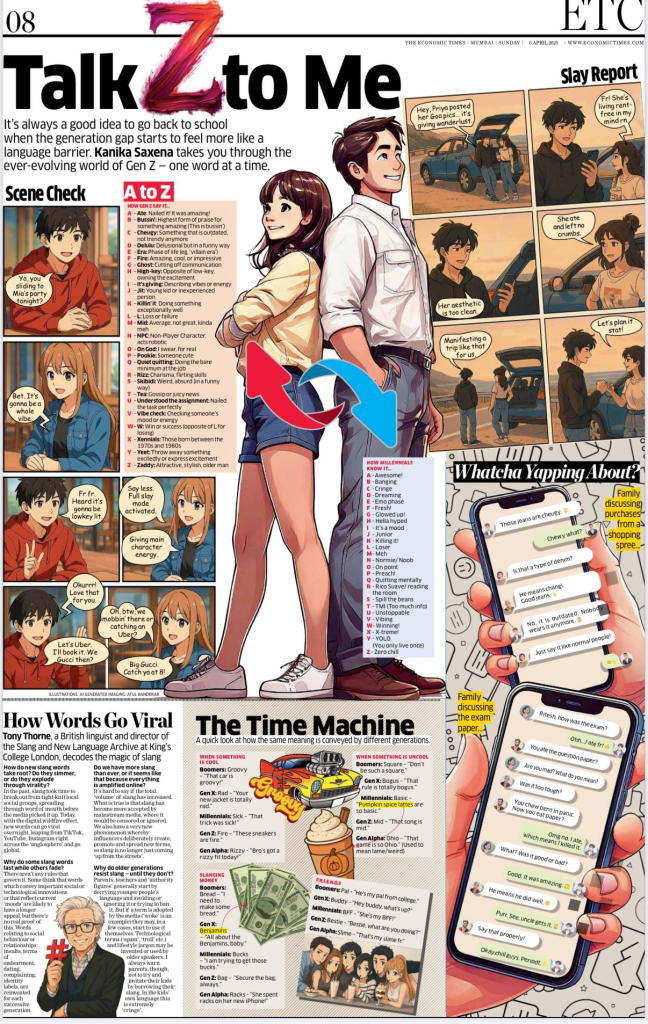
Last week I was interviewed by two young journalists about the pervasive slang generated by Gen Z and Gen Alpha. Interestingly both journalists are operating outside the US/UK matrix from which much of this language variety emanates. Interestingly too, both journalists asked similar questions about the latest linguistic novelties and how we might respond to them. Kanika Saxena‘s piece appeared in the Economic Times of India, and my contribution is here…
1. How do new slang words take root in a generation? Do they slowly build momentum, or does one viral moment suddenly put them everywhere?
In the past it could take some time for slang to escape from the local social group (‘in-group’ or ‘peer group’: a group of friends, a gang, fellow workers, etc.) where it originates into the outside world, then to spread by word of mouth into other parts of society, finally perhaps being picked up by the entertainment or print media. Nowadays this process has been massively speeded up by messaging and the internet, so that a novel term can go viral and reach beyond its original community almost instantaneously. New expressions can spread via social media and platforms like TikTok, Youtube, InstaGram right across the ‘anglosphere’ and go global.
2. Some words stick around for decades, while others vanish overnight. What makes certain slang words stand the test of time?
Linguists have tried to analyse why some terms become briefly fashionable and then disappear while others endure. There don’t seem to be any rules that govern why this happens. Some experts think that words which convey important social or technological innovations or that reflect current ‘moods’ or preoccupations are likely to have a longer appeal, but there’s no real proof of this. It could also be because a word relates to important social behaviour or relationships: insults, terms of endearment, ‘dating’ language, complaining, identity labels, for example, have to be reinvented for each successive generation, then persist until their users mature or grow older.
3. With social media throwing new words at us daily, are we actually creating more slang than before, or does it just feel that way because everything is amplified online?
It’s hard to say if the total ‘volume’ of slang has increased because, in the past at least, it was impossible to quantify it. What is definitely true is that slang has for some time become more accepted by mainstream media whereas it used to be censored or ignored. We also have the very new phenomenon whereby influencers, TikTok stars and content creators are using online resources to consciously, deliberately create, promote and spread new terms, so slang is no longer just coming ‘up from the streets’ (or spread via music, TV and movies) but is a commodity exchanged and pushed to gain prestige or sell oneself.
4. Older generations always seem skeptical of new slang—until, of course, they start using it too. What’s the secret to a word crossing generational lines?
Parents, teachers and ‘authority figures’ generally start by decrying younger people’s language and avoiding or ignoring it or trying to ban it. (This isn’t really justified by the way: slang may be seen as socially marginal but is not technically deficient or defective language and uses the same techniques as poetry or literature) But if a term is adopted by the media (‘woke’ is an example) they may in a few cases start to use it themselves. Technological terms (‘spam’, ‘troll’ etc.) and lifestyle jargon may be invented or used by older speakers. I always warn parents, though, not to try and imitate their kids by borrowing their slang. In the kids’ own language this is extremely ‘cringe’.
My second interview was with Austėja Zokaitė who is based in Lithuania and it appears in the online magazine Bored Panda, an arresting and anarchic daily roundup of the latest viral images, memes and commentary on internet culture. The whole report is here, with my comments interspersed with the succession of visual elements…
During October I relished the chance to talk to the editors of DazedDigital, Serena Smith and Gunseli Yalcinkaya, and they told me about the most recent developments in online and digital communication and the new language varieties trending on social media. I have tried to make sense of a much younger generation’s performances and interactions and the notes I made follow here…
Language and the way we use it is now for the first time truly globalised. This means for example that new accents and intonations and vocal affectations take place across several cultures almost simultaneously. This gives us pronunciation and intonation novelties like Youtuber or Influencer accent, TikTok voice, etc. These are fluid, evolving and can blend more than one traditional source (UK and US linguistic styles and usages for example). The phenomenon is not new – the mid-Atlantic accent dates back many decades and both Valley Girls and users of Multiethnic London English – MLE – have played with new ways of pronouncing, but the platforms and apps of the 2020s – TikTok in particular – highlight these…
Obviously the way we consume and exploit media has changed radically with the internet and mobile technology and determines the kinds of messages we exchange and the words, sounds and visuals we actually use. Short attention-spans mean that messages need to be accelerated, brief and telling: the constraints of apps and platforms make for compressed and dense information packages. At the same time the imperative for innovation (something that has always been part of language evolution, but used to happen very gradually) – novelty, neologisms, new and more liberated attitudes to formality and informality and style in general – is integral to changing fashions, aesthetics, vibes. Even such basics as whether messages have to make sense have been destabilised by Gen Z‘s playful surrealism and absurdism and TikTok’s creative conventions.
One major change is the way that the distinction between written and spoken language has broken down since people began to type conversations and exchange rapid interactions electronically. Also Pre-existing words and expressions are hijacked, reversed, toxified, appropriated and modified as never before. And we all now have the power to do this via electronic media – we don’t need permission to publish and exchange our ideas and indulge our playful, mischievous or creative new usages.
Gunceli asked, There are so many memes joking about how we’ve ‘progressed past the need for language’. Obviously worth taking with a pinch of salt, but do you think there’s any truth to this?
We won’t evolve ‘beyond language’ since language is simply a label for human interaction and communicative practices, but the specifics of that language will continue to adapt and mutate along with our social needs and our technologies. Linguists do talk increasingly in terms of multimodality whereby both online and offline communication involves much more than speech or writing – ‘language’ as we have known it. The buzzword multimodality can refer to how IRL we blend all sorts of semiotics often simultaneously: stance and posture, facial expression, gesture, writing, speaking and using a communication device, but also refers to how online and app messages employ abbreviations, acronyms, audio, video, symbols, memes as well as or instead of words (…soon probably touch and smell as well!)
The NPC streamers phenomenon highlighted by Dazed is another example of what I described as GenZ and TikTokers’ minimalist, surrealist or absurdist treatment of language. NPC stands for ‘non-playable character(s)’, the digital background entities with a limited repertoire of utterances and repetitive actions encountered in video games, and the streaming is an online activity, primarily on the TikTok platform, whereby creators imitate these characters by livestreaming themselves, and viewers reward them with in-app gifts for doing it.
The new primacy of image (and audio) over simply text and conversation has resulted in a human imitation of cartoon sounds and seemingly meaningless bits of language that only followers and enthusiasts will recognise and be positively triggered by. Playing with identities by way of words, slogans, soundbites and catchphrases is as much influenced by the poses of cosplayers or Furries and the behaviour of video-gamers as it is by ‘traditional’ ways of using verbal and visual language.
How do you think the mainstreaming of emerging tech like AI is changing the way we communicate verbally with one another?
Algorithms being used for automated reasoning and the generating of persuasive messaging or content are already operating at sophisticated levels, but the linguistic aspect is just as much prey to error and detectable failures as, for example, deepfake images and impersonations of artistic productions. If we are digitally literate and managing to keep up, we can often see through the deception, and this is probably reassuring. AI has some interesting potential: for example, to allow us to communicate with people whose language we don’t share. But I think the limitations of AI(-its difficulties in interpreting or reproducing human nuance, implication, indirectness, etc) will lead to – is already leading to – new forms of incoherence and misunderstanding. I suspect we will soon be able to recognise a particular ‘AI style’ so that artificially generated messages can be recognised as such in some cases – at least I hope so! Translators and teachers are already grappling with potential of AI to assist, supplement or replace their work – and its limitations in doing so. More alarmingly AI is already inventing and using languages that we humans can’t understand: https://www.fastcompany.com/90132632/ai-is-inventing-its-own-perfect-languages-should-we-let-it
Gunceli’s fascinating review of all these themes and more is here…
Serena Smith spoke to me about the latest version of familect, the intimate, informal, often comical language invented in private domestic spaces, about which I’ve written before on this site. Her excellent account of TikTok’s #MarriageLanguage is here…
‘Expert commentary’ on a volatile, contentious process
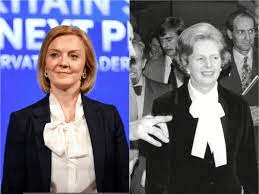
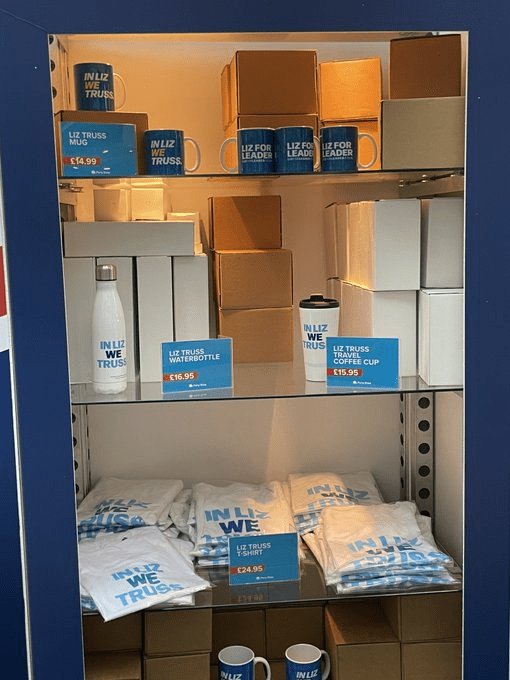
I was somewhat bemused to be asked, as a linguist and someone who has written about government communications and messaging, to comment recently, this time on the self-presentation of the candidates vying for leadership of the Conservative Party, hence also for the role of Prime Minister of the UK (in a series of back-and-forth slurs and clumsily staged photo-opportunities characterised today by Cabinet Office Minister Johnny Mercer as ‘puerile’). My first observations concerned Foreign Secretary Liz Truss’s identification with an earlier political icon.*
These were my comments in answer to the Daily Mail‘s questions on the performance of Lizz Truss and Rishi Sunak in the latest and final stages of the contest…
Both candidates seem to me to be reaching for very simple and basic images and messages – not complex or ‘deeper’ concepts and as a linguist I suspect that they are both trying to avoid having to demonstrate the ‘oratorical’ skills that Boris Johnson’s supporters claimed for him. In other words they are going for visual over verbal as neither of them is renowned as an inspiring public speaker.
In terms of oratorical skills or lack of them Liz Truss has been gaffe-prone and can come across as hesitant while Rishi Sunak, though articulate, has to avoid the impression of an over-eager schoolboy in his attempts to convince.
In terms of the core messages, Rishi Sunak is very obviously trying to counter the sense of him as someone removed from the concerns of ordinary people because of his privileged upbringing and his great wealth. Thus he emphasises the (quite authentic) role of the family man, devoted to wife and children, at the same time countering Truss’s projection of herself as an assertive ‘lone’ female – the image Margaret Thatcher conveyed in her exercising dominance over male colleagues. Thatcher also kept husband and children in the background and emphasised her own gravitas and steeliness above all else.
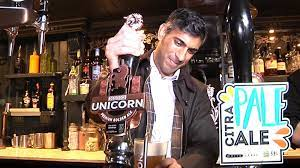
Pulling pints is another attempt by Sunak to demonstrate that he is not wholly out of touch with the ‘common man’, but this sort of posing does risk backfiring as when he fumbled in his attempts to use a bank debit card to buy fuel for a humble, borrowed car.
I’m surprised that Sunak does not more strongly emphasise his financial background and expertise gained as a financier/fund manager (the sort of professional experience that Liz Truss would have trouble competing with), but he may rightly sense that public perceptions of hedge fund manipulators are far from entirely positive.
Both candidates are attempting to focus, as they must, on the universally understandable issues of taxation and immigration/refugee management, subjects on which those entitled to vote for them (a very small number of key individuals incidentally) are already likely to have very firm views.
I added the following…
I don’t wish to seem contentious or uncharitable, but their messaging – in both cases – really does leave much to be desired, beginning with the campaign slogans, ‘Ready for Rishi!’ and ‘Liz for Leader.’
On Rishi Sunak’s part, his public postures belie the fact that he is, among many other things, a teetotaller…
And as for Ms Truss…
Which approach, I was asked, was likely to play out better with the 1600 party members entitled to vote in the leadership contest?
I think it’s very difficult to predict: I suspect that many Tories will still instinctively prefer the certainty and strength of purpose that Margaret Thatcher represented – the steely glare rather than the eager-to-please smile. But perhaps on reflection they may come to decide that someone at ease with financial manipulations (public or private!), and someone who is not really encumbered with ideological baggage could be more convincing in the long run and a safer pair of hands? It’s perhaps reassuring and worth noting that those two ancient bugbears of British political life, ethnicity and gender, probably are no longer barriers to advancement.
This is how my remarks were incorporated into the Mail’s front page of July 25 2022…
Looking back at my comments while awaiting the general election in July 2024, it’s clear that I was too kind to both the then leadership candidates. This was in part because I can’t pose as a political expert, partly as I don’t think the Daily Mail would have printed my comments if they had been much harsher. Liz Truss went on to perform surreally badly as shortlived PM, then, in more recent comments, to astonish many by her seeming intellectual confusion and lack of self-awareness. Rishi Sunak, in my strictly personal view, has shown above all an astonishing immaturity, in his parliamentary and media performances and his interactions with the public. His and his party’s communications strategies, despite the complicity of most of the the UK’s mainstream media, have been clumsy and inept. The press and the opposition equally have failed to hold him to account, focusing on his role as member of a hedge fund that helped trigger the 2008 financial crash only in the run-up to the coming election.
– Jon Birch, channelling Turing and repurposing the Enigma machine
The UK government’s handling of the information transfer required in a national emergency has differed significantly from the strategies employed in other states. While Donald Trump has used the White House ‘pressers’ to expound a bewildering sequence of personal claims, accusations and commentaries, and Angela Merkel has favoured occasional official announcements via mainstream and social media, the government at Westminster has relied on daily televised briefings to keep the public informed of progress in combatting the pandemic and to advise on regulations and desirable behaviour.
After more than two months there has been a chance to reflect on the official recommendations and diktats and to assess their consistence and credibility. It is not clear exactly who is responsible for the drafting of messages or the invention of rallying cries and slogans. The ‘comms’ (communications, including information dissemination and public relations) team probably consists of activists involved in the Brexit Vote Leave campaign, ‘spads’ (unelected special advisors to ministers and the cabinet), spin-doctors and civil service speechwriters from relevant departments, (oversight by the GCS – Government Communication Service – is unconfirmed) *. With an admixture of improvisations by the prime minister and cabinet members, the UK comms have been, in the view of many, a disaster.**
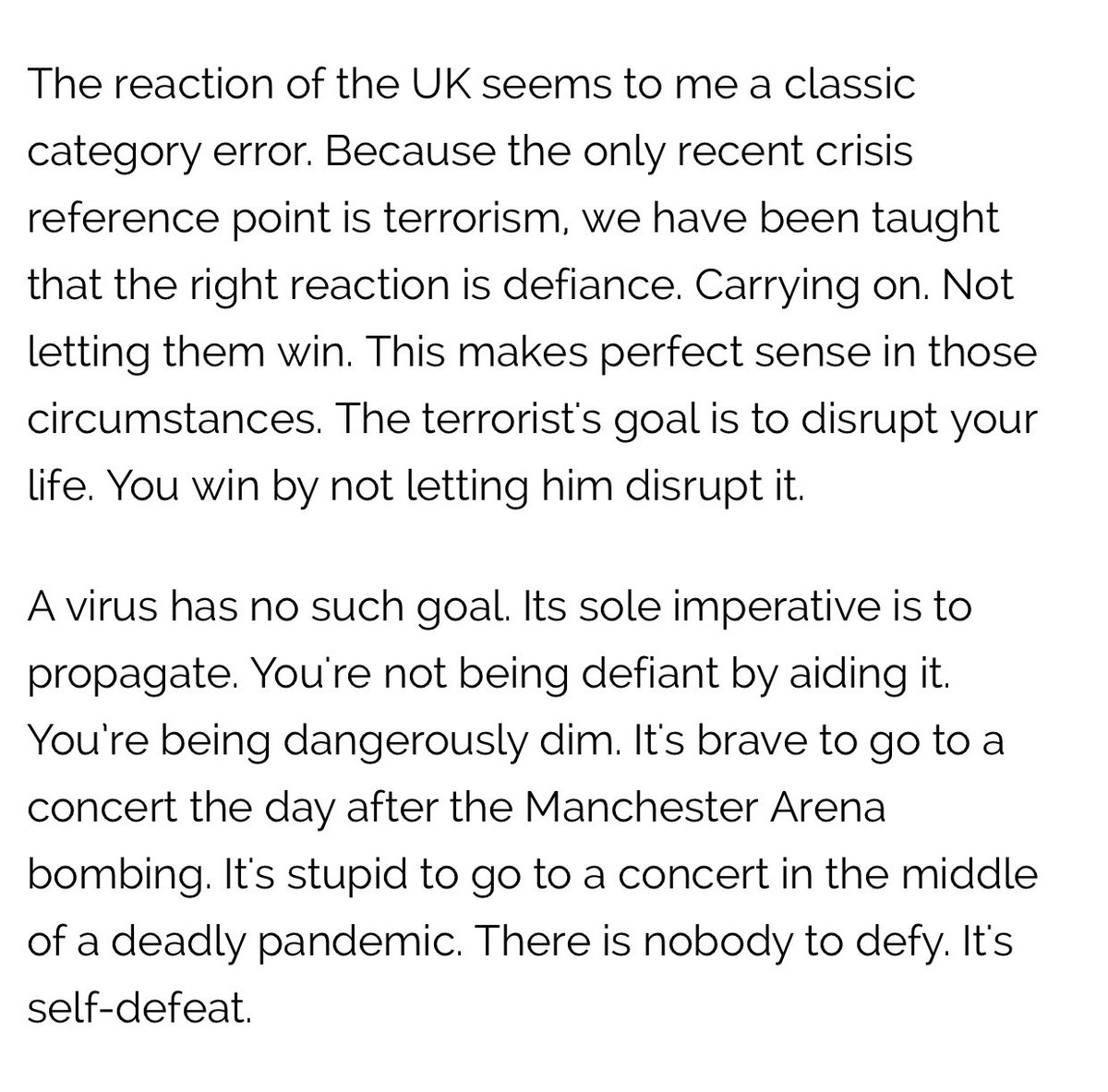
The details, including key statistics, have changed and mutated (at the end of June the two-metre social distancing rule was replaced by Boris Johnson’s advice to switch to ‘one metre plus’), the tactical positions adopted have pivoted and stalled, the advice has often been bewildering or contradictory. Underlying themes may have shown more consistency, but consistency can describe a dependency on metaphors which may be unhelpful or confusing – above all the reframing of attempts to contain and overcome the virus as a ‘war’, with ‘heroes’, ‘non-combatants’ and hapless, tragic victims*** – the virus itself personified as an ‘invisible mugger’ who can be ‘wrestled to the floor’ by ‘have a go’ heroism.
With no other way of influencing events experts and non-specialists have taken to social media to critique and mock the successive claims. Professor Elena Semino declared herself ‘puzzled that the UK Prime Minister keeps referring to his government’s covid-related policies as ‘putting our arms around the public’, adding ‘Embodied simulation would be uncomfortable at the best of times, but now?!?’ Manchester Professor of Government Colin Talbot countered a succession of official claims on Twitter:
We need more testing. We’ll do 100,000 tests a day. You’re failing to do that. We’ll do 200,000 tests a day. We need to track and trace. We’ll have an app to do that. It not working We’ll set up a service to do that You haven’t
We’ll set up a world beating…
It is not only the verbal cues and rhetorical devices that have been deployed to manipulate, to confuse and to evade, but the visual signals, displays and symbology used, consciously or not, to influence and convince.****
– Alex Andreou, on the ‘Stay Alert’ slogan
In a short interview last week I offered my own take on the evolution of covid-related language (as detailed in my two previous posts on this site) and a duty for linguists to become involved in scrutinising, clarifying and where necessary criticising the content of the present infodemic…
As was the case in the national conversation on Brexit the transmission and reception of official messages has been complicated by the role of some MSM (mainstream media) representatives, derided by their critics as ‘client journalists’, ‘courtier journalists’ and ‘stenographers’, in uncritically passing on information, seeming actively to endorse or promote the government line and failing to hold obfuscators or outright liars to account. This will be the subject of an upcoming article on this site.
*** linguists, among them my colleagues at King’s College London, have now begun to analyse the deeper implications of the figurative language employed in official discourse. I will be posting their findings once they become available. Here is one such report, from an Australian perspective…
A perhaps minor example of injudicious choice of words, and conflicting nuances of meaning and connotation, in July 2020. The bilateral travel agreements between states opening borders after lockdown were described by the UK government as air bridges. This term had until now more usually referred to a covered passage by which travellers can pass from an airport building to an aircraft. In more difficult times it had denoted a connection by air between locations divided by sea or by foreign occupation. It is just possible, too, that the phrase might prompt memories of the very expensive, ultimately abandoned ‘garden bridge’ proposed by PM Boris Johnson for the Thames in London, or even the fantasies alluded to by ‘castles in the air’. In the event two different lists of permitted connections were published by the government leading to angry confusion on the part of travellers, airlines and the tourist industry. Led I think by the Foreign Office, from July 3rd official messaging quietly began to substitute the more literal designation international travel corridors.
On July 13 the government launched a new publicity campaign designed to inform businesses and the public on how travel will change after Brexit. Their latest gnomic slogan ‘Check, Change, Go’ and jargon formulations such as ‘field force team’ (for one-to-one telephone consultations) provoked widespread disbelief and mockery on social media, and puzzled consternation from exporters, importers and others. The spoof newspaper the Daily Mash commented (rudely and irreverently)…
Later the same day erstwhile Tory-supporting Daily Mailjournalist Dan Hodges tweeted: ‘Got to be honest, I’ve no idea what Government guidance is on anything any more. Masks. Distancing. Numbers of friends you can meet. When and where you can meet them. Going back to work. None of it. Clear Ministers have basically given up on trying to agree a coherent line.’
Philip Seargeant of the Open University, with whom I have collaborated, has written here on the contradiction between populist narratives and the kind of communications required to manage a crisis such as the pandemic…
…in September I was going to update this page with comments on the latest government initiatives, but Imogen West-Knights beat me to it with this Guardian piece (which mentions the ludicrously named ‘Op Moonshot’ project)…
Pivoting and reassessments, rumours of upcoming changes and irregular official announcements continued through the autumn into the winter. Having introduced a system of three tiered categories of local restrictions the government announced a relaxing over the five days of Christmas festivities, then on 19 December leaks via obscure social media accounts suggested the placing of London into a new Tier 4, prompting irreverent comment on Twitter…
From Jonathan Nunn: “imagine inventing a tier system that divides the entire spectrum of conceivable events into three distinct categories, only to make a new tier to describe the unforeseen way you’ve fucked it”
From Piers Morgan: “We’re now at the stage of this pandemic where it’s safe to assume with 100% certainty that whatever Boris ‘U-turn’ Johnson promises about anything actually means the complete opposite will happen.”
From Becca Magnus: “Ah the good old days of waiting for press conferences while obsessively refreshing Twitter. Takes me back all those years ago to March.”
The new stipulations meant that in London and the South East four different Covid restriction policies had been imposed in 4 weeks…
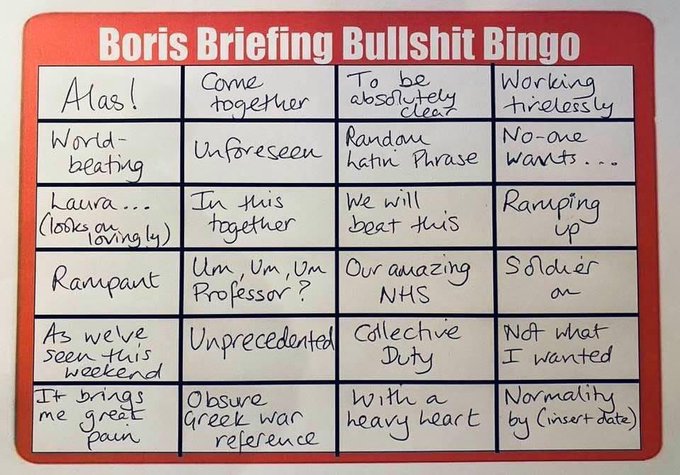
In January 2021, after more shifts and a last-minute volte-face, a new ‘tier 5’ nationwide lockdown was imposed. The Prime Minister’s briefings announcing this and other reverses and innovations were mocked in posts circulating on social media…
Also in January 2021 theGuardian offered a rare insight into the personalities involved, the prevailing ethos and the strategies pursued by the UK government in their attempts to manage communications…
In February 2021 this video (I’m not sure of the exact provenance) dramatising the government’s pivoting and conflicting advice was circulating on social media…
In February 2021 there was much debate, on Twitter and elsewhere, of the government’s roadmap out of lockdown, of what exactly a roadmap is and how it might differ from a plan. Roadmaps (the most influential probably being Donald Rumsfeld’s pathway out of the Middle East imbroglios in 2003) are used in corporate strategy, usually as statements of a series of achievements to be aimed for, without waystage dates or details, but that is not the point: ‘roadmap’ is a buzzword evoking a way ahead, a potential route and an intention to travel, all reassuring for those who are lost, adrift or stalled.
Many specialists and members of the public, too, were aghast at the government’s rhetoric around the notion of ‘Freedom Day’, a more or less complete, and overnight relaxation of protective restrictions proposed for July 19. The consistency of the chosen keywords characteristically began to unravel, as Professor Alice Roberts noted on July 11, ‘What does this actually mean? Is vigilant this year’s “alert”? How does vigilance help protect against an airborne virus when a government is not recommending and supporting effective mitigations…’ and Guardian journalist Sirin Kale commented two days later (quoted with her permission), ‘I see the government is trying to row back their Freedom Day messaging at the 11th hour just 2 weeks after senior ministers briefed they wouldn’t be wearing masks indoors any more. You’d think they’d have learned the dangers of conflicting messages after the Xmas fiasco but nope’
In September 2021, following revelations by government aide Dominic Cummings of his employers’ vacillation and incompetence, a second ousted advisor, Lee Cain, broke silence to excoriate the teams working on communications during the pandemic:
In the autumn of 2021 the public became aware of a ‘Plan B’, supposedly to be implemented in the event of a new surge (which was already, some said, happening). The exact details of this plan were not specified in any official communications and the press and public were left to speculate. A few new restrictions were introduced in late November, perhaps prompted by concern at still rising infection rates in schools and elsewhere, though ventilation in schools was not among them, then in the second week of December, as the Omicron variant spread to general alarm, Plans ‘C’ and ‘D’ implying successively stricter moves towards a lockdown were mooted. On 12 December emergency measures (presumed to be a version of Plan B) focusing on encouraging the takeup of booster shots were announced. On Twitter the next morning Russ Jones commented, ‘Plan B was drawn up 5 months ago. That’s how long they’ve had to plan for it. They gave the NHS 4 hours warning that they’d need to do 1 million tests a day, the booking website crashed cos nobody thought to upgrade it, and we ran out of lateral flow tests within 3 hours.’
In February 2023 Dr Philip Seargeant (with whom I have collaborated, notably on the Language of Lying project, featured elsewhere on this site) published his review of the UK government’s handling of the pandemic, focusing on its communications strategies and manipulation of public discourse:
At the beginning of March 2023 Isabel Oakeshott, ghostwriter of former UK Health Secretary Matt Hancock‘s pandemic diary, engineered the release of private messages exchanged by Hancock with then PM Boris Johnson, former Education Secretary Gavin Williamson and others at the beginning of the COVID crisis. The Daily Mail asked me to comment on the language used in these, and their article (punctuation errors and typos are not mine) is here:
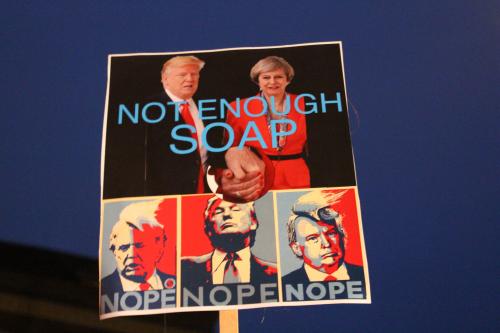
Demonstration against UK visit by Donald Trump, Cambridge, 2017
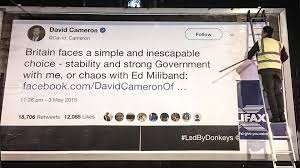
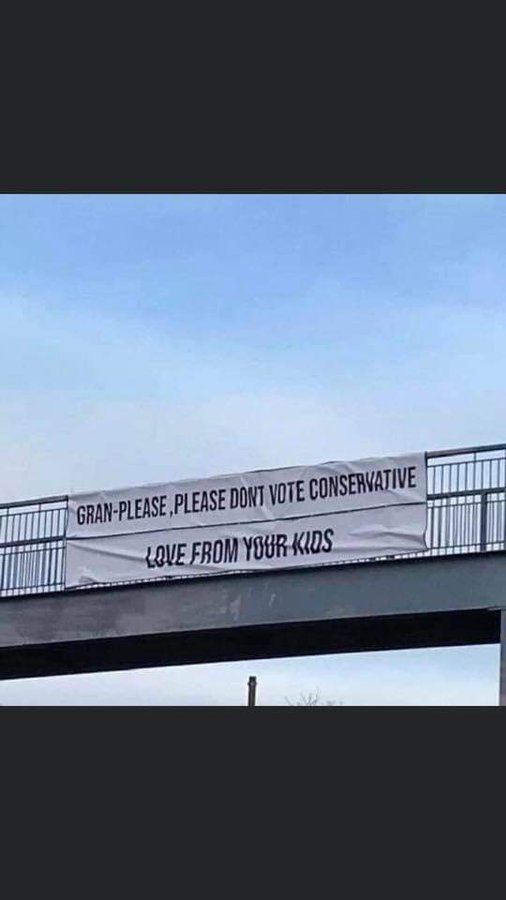
The juxtaposition of image and text in public protest has a long history. My previous post focused on demonstrators’ placards and on the ingenious visual displays staged by Led by Donkeys on hoardings and projections.
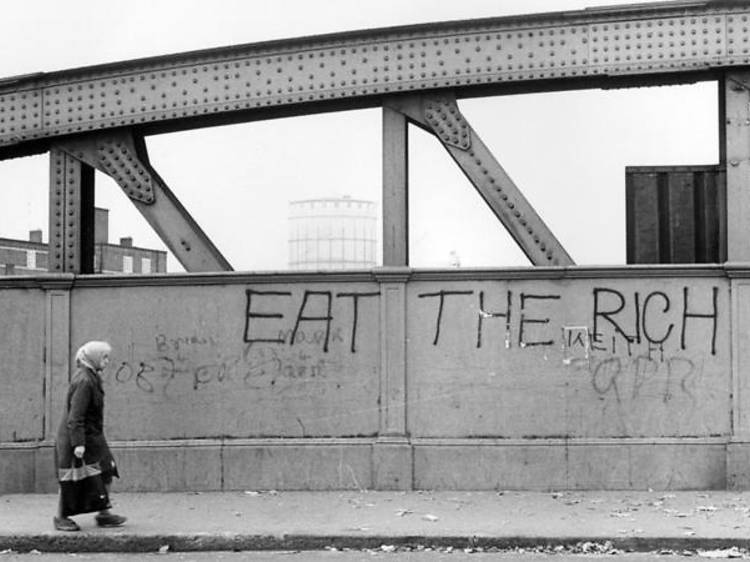
Here I offer the first sequence in a purely visual chronology, showing some famous and some lesser-known examples of subversion (whether overtly political or overtly absurdist) for public consumption…
Anti-Nazi photomontage by ‘John Heartfield’ (Helmut Herzfeld) 1936
Notting Hill, Westbourne Park and Grand Union Canal, London, 1970s, photos by Roger Perry
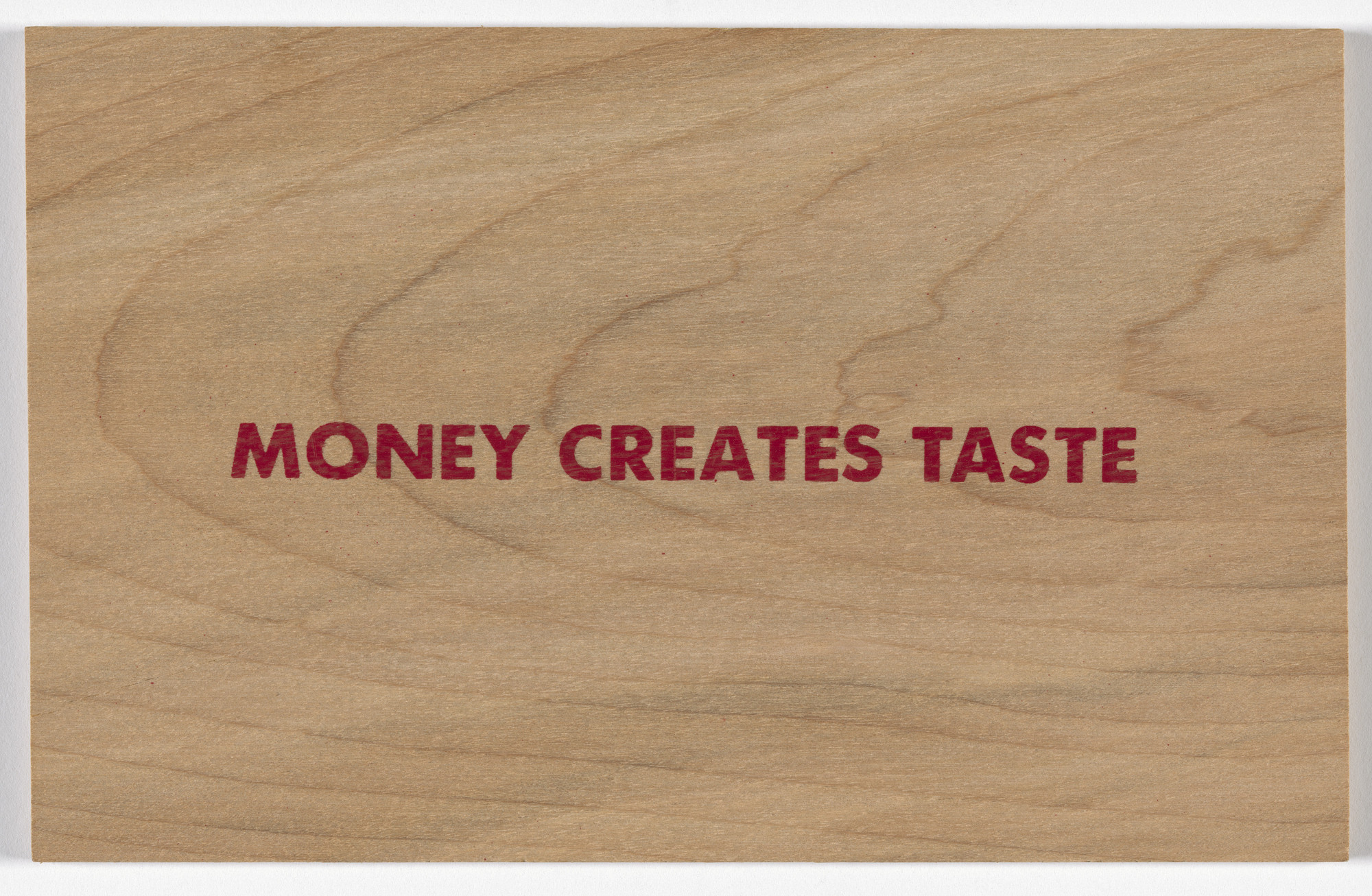
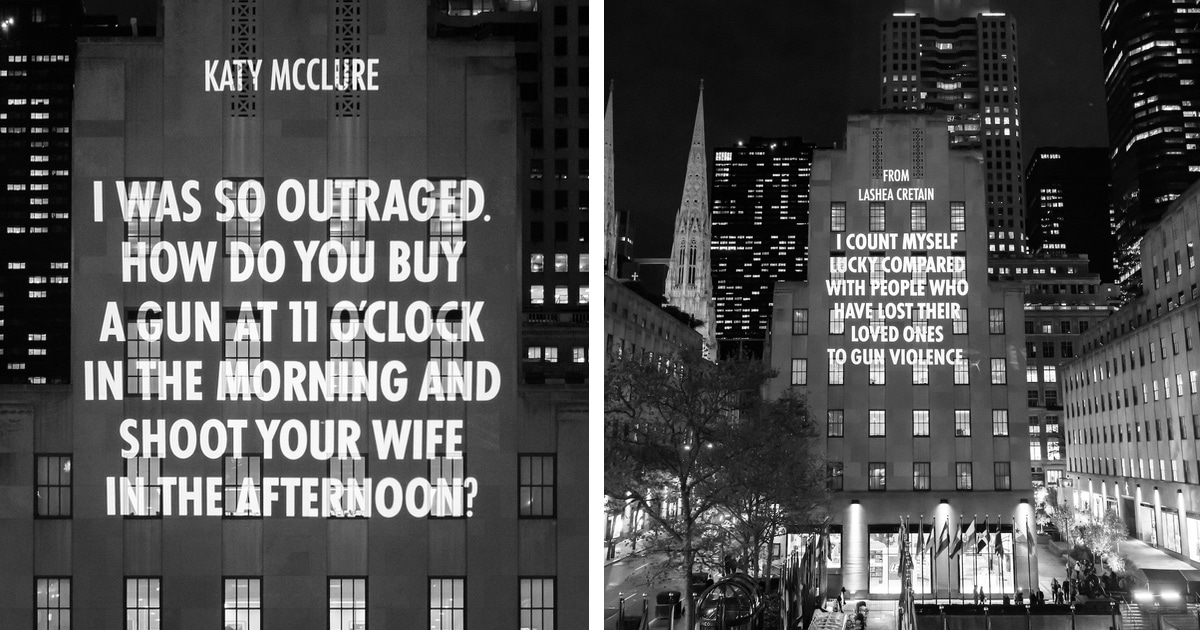
Conceptual artworks by US artist Jenny Holzer
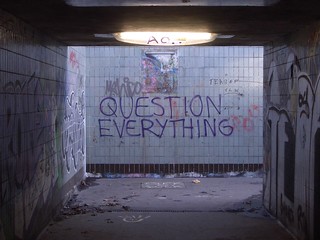
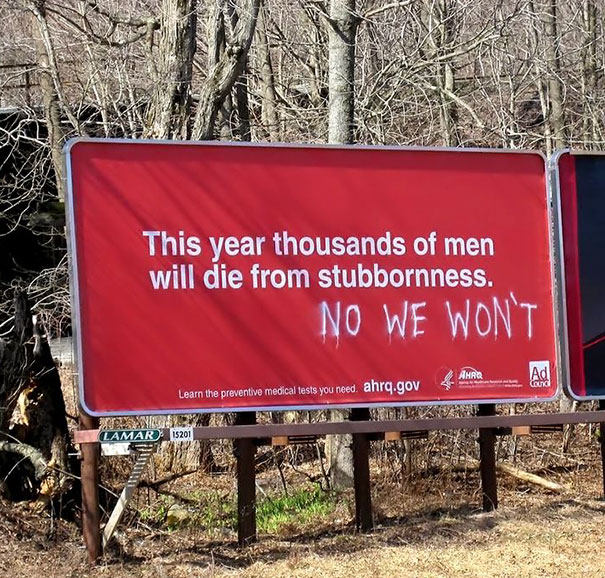
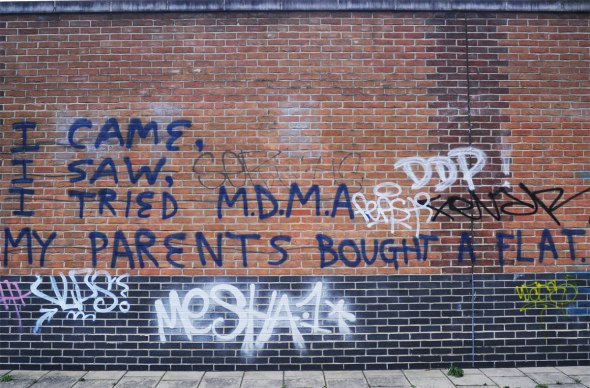
Anonymous graffiti, vandalism and alterations
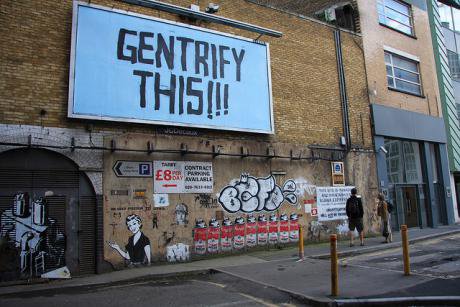
Anti-gentrification messages, East London
Protest as land art
A further (very well-chosen by Lyn McKelvie in 1996) selection of examples of photomontage, subvertising and ad-jamming follows here:
And Yet It Moves by John Heartfield
Rationalization Is On The March by John Heartfield
Creative print ads target plastic pollution
Powerful Environmental Ads
Creative print ads target plastic pollution…
Here, from Flashbak, are Richard Davis’ striking photos of Manchester in the 1980s and 90s, showing slogans and graffiti in their settings, alongside the people of Hulme:
For more examples of magazine texts, leaflets, posters and placards, see
Bamn (By Any Means Necessary): Outlaw Manifestos & Ephemera, 1965-1970 by Peter Stanstill and David Zane Mairowitz, Autonomedia 1999
And from April 2021:
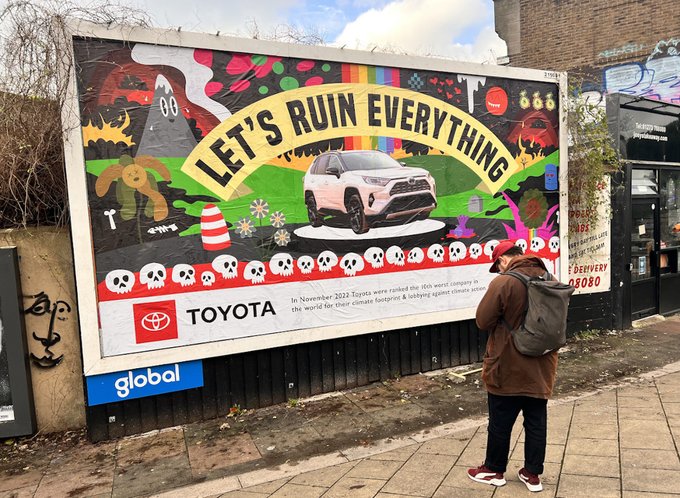
In January 2023 came news of another subvertising or ad-jamming campaign, this time by Brandalism UK and other teams across Europe. Toyota and BMW were targeted for their misleading adverts and anti-climate lobbying and 400 car billboards were hacked and replaced in 14 cities:








 You’re failing to do that. We’ll do 200,000 tests a day.
  – Alex Andreou, on the ‘Stay Alert’ slogan


 Anti-Nazi photomontage by ‘John Heartfield’ (Helmut Herzfeld) 1936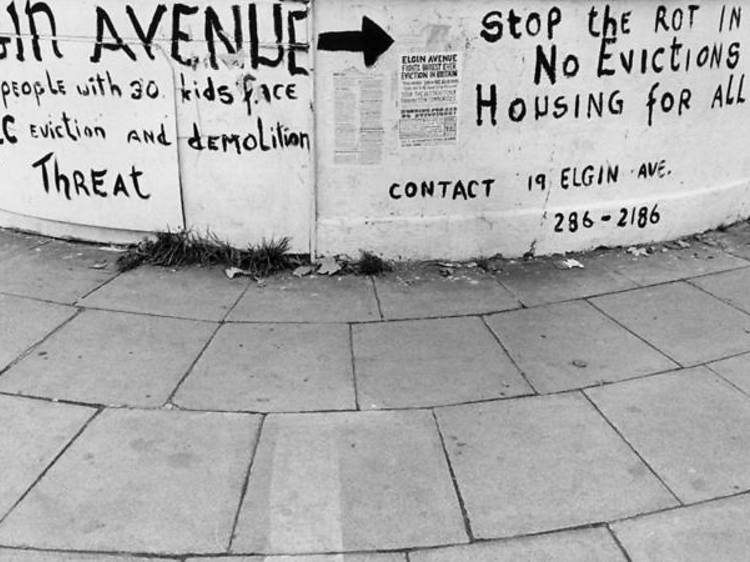




 tony thorne