AUTUMNAL UPDATES

The Autumn Equinox, and time for the latest perspectives on slang and youth language in the Anglosphere…

I‘m very grateful indeed for the latest data on the most popular slang terms – according to online searches – among younger people in the USA, provided once again by Randoh Sallihall of Unscramblerer.com

Most searched for slang words in America:

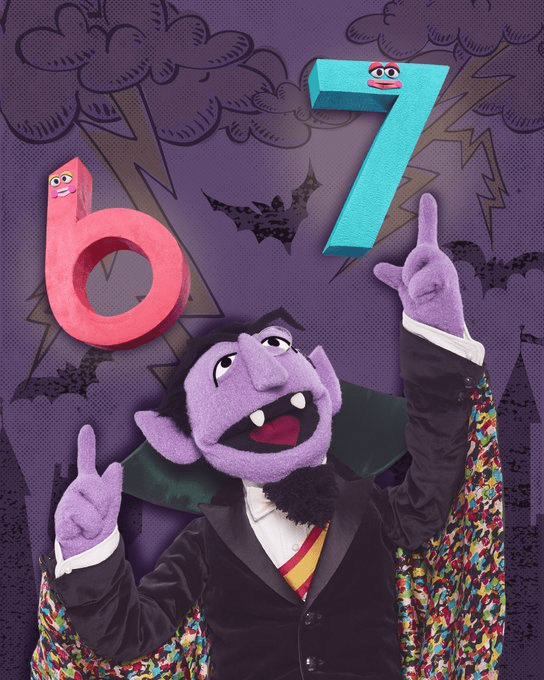
1.      6-7 (141 000 searches) – There is no literal meaning to six seven. Its absurdity is the point, making it a prime example of “brainrot” internet humor where the randomness itself becomes funny. It originates from the song “Doot Doot (6 7)” by Skrilla. LaMelo Ball a basketball player created a trending video about being 6 feet 7 inches tall using the song. Kids and teens scream and chant it often paired with exaggerated hand gestures. *See also below

2.      Bop (115 000 searches) – A person with many sexual partners (bops around from person to person). Someone who presents oneself online in a way that is thought of as immodest. A derogatory word often used in cyberbullying.

3.      Mogging (79 000 searches) – outclassing someone else by appearing more attractive, skillful or successful. Looksmaxxing (16 000 searches)  has a similar meaning that is also a trending slang word this year.

4.      Huzz (61 000 searches) – refers to attractive girl or a group of girls. A replacement for ‘boo’ and ‘pookie’. Somebody you want to impress. This slang had a more derogatory meaning ‘h–s’, but that has changed.

5.      Chopped (59 000 searches) – this term has become a synonym for something that is ugly, undesirable or unattractive.

6.      Big back (57 000 searches) – refers to someone with a large physique. Someone who is seen as gluttonous or out of shape. It’s less about literal size and more about poking fun at behavior, like hogging food or being sluggish.

7.      Glazing (49 000 searches) – means to praise someone excessively and insincerely. A way to call out behavior where excessive flattery is used.

8.      Zesty (44 000 searches) – someone who is lively, exciting or energetic.

9.      Fanum tax (36 000 searches) – playfully taking a portion of a friend’s food. The streamer Fanum began this trend.

10.   Green FN (34 000 searches) – refers to a guaranteed win. Describes something amazing and highly desirable. Often said after an exceptional shot or throw in basketball. The term originates from the NBA 2K video game series, where a perfectly timed shot is marked by the color green.

11.   Delulu (32 000 searches) – short for delusional. It describes someone with unrealistic expectations, especially about crushes, relationships, or fantasies (thinking a celebrity will date them).

12.   Clanker (29 000 searches) – is a derogatory term for robots and AI technology. An example would be “having to talk to a clanker” would mean talking with a chat bot.

13.   Ohio (24 000 searches) – refers to anything that is strange or absurd.

14.   Slop (21 000 searches) – describes low effort AI generated content.

15.   Aura farming (18 000 searches) -refers to a behavior (often referencing anime characters) where a person does something for the sake of looking cool.

A spokesperson for Unscramblerer.com commented on the findings: “Popular slang in 2025 continues to be heavily influenced by TikTok, Instagram, gaming, streaming, Gen Z and Alpha online communities. Trends from social media spread rapidly via memes and viral challenges. Fueled by technology our language adapts to new slang trends more rapidly than ever. Slang is a fascinating and fun mirror of our culture.”

Research was conducted by word finding experts at Unscramblerer.com.

We analyzed 01.01.2025 -19.09.2025 search data from Google Trends for terms related to slang words.

Methodology: We used Google Trends to discover the top trending slang terms and Ahrefs to find the number of searches. Americas most popular slang terms can be discovered in Google Trends through the keyword ‘meaning’. People will hear or read slang terms and search for the meaning of the term (example ‘mogging meaning’). Ahrefs shows many variations of meaning searches like ‘slang’ or ‘trend’ (example ‘mogging slang’) and similar keyword combinations (example ‘ what does demure mean’). We added up 150 search variations of top slang terms.

The words recorded in the US can be compared with this list of slang collected in UK schools by Teacher Tapp in August…

https://teachertapp.com/uk/articles/down-with-the-kids-slang-in-british-classrooms-2025/

Earlier this month I spoke to Avantika Bhuyan, Editor at India’s Mint Lounge magazine, about the youngest online cohort, Gen Alpha. She asked me how their interactions with technology and language differed from their predecessors…

Gen Alpha are of course the first generational cohort to have grown up wholly surrounded by digital technology, digital media and the online culture that accompanies them. They are adept at using the hardware – mobile phones, tablets, gaming gadgets – but also unlikely to be dazzled by these already dated mechanical devices. They have sometimes returned to old fashioned film cameras and Polaroids, wind-up watches, puzzles and pinballs as interesting relics (something which in older users is described by theorists as ‘haptic nostalgia’. For them AI isn’t a terrifying threat but just part of the digital landscape they navigate daily.

Gen Alpha are active on YouTube (short-form video by preference), Instagram and – especially – TikTok where they can participate and emulate, or react to influencers and content-creators and individual TikTok celebrities, This media reinforces accelerated performances, exaggerated poses and a pervading sense of self-consciousness, self-mockery, irony and absurdist humour, prompted partly by their collective anxiety at being on display, surveilled and judged 24/7.

Gen Alpha slang, like GenZ’s differs from that of older generations in that it’s not just language that arises ‘naturally’, escaping from the streets or disseminated by movies, TV and the music industry. The language they use has often been generated deliberately by techbros, influencers and microcelebrities who are not just trying to communicate but to gain prestige, kudos. The slang they use also differs from older versions in ways which are interesting to linguists like me: the ‘words’ are not just words but operate virally like memes and, like memes, they are ‘multimodal’, made up not just of writing or sounds like traditional words but accompanied by images, sound effects, references to other messages, in-jokes, puns, etc.

Older generations often find Gen Alpha’s vocabulary baffling, ridiculous or annoying – unsurprisingly since the language is used in part to project behaviour and values that are alien to parents, teachers. Key words – such as ‘skibidi’ – may actually be meaningless, more comic gestures than information-bearers and the passing visual fads and fashions that Gen Alpha (and Gen Z) indulge in – microtrends and looks and what they call ‘aesthetics’ or ‘vibes’- are not designed to last.

There may be serious effects to these innovations and new behaviours. Dating is much more fraught, more competitive when its potentially being exposed globally, and partners’ motives may be even more conflicted, contradictory and mutable when the rituals of romance are playing out in an environment already disrupted by older generations’ repertoire of ‘ghosting’,  ‘gaslighting’, ‘benching’ and ‘breadcrumbing’.

Above all we older people mustn’t underestimate Gen Alpha. They may sometimes be victims of the toxic aspects of digital culture, but they are also adept at coming to terms with it, manipulating it to their own advantage – or knowing when to reject it.

Avantika’s long feature on Gen Alpha is here…

Another way in which mainly younger creators and communicators are changing language is by way of Algospeak, the online code used to disguise messages and evade surveillance…

*In October I spoke to BBC Radio London about the phrase ‘six seven‘ (number one lookup in the US, above) which had now come to the attention of British media, having crossed over from TikTok performances and online posting to real-life irritation of UK teachers and parents. The meaningless phrase, unrelated to the very old expression ‘at sixes and sevens’ (in a state of confusion or disorder) which was used by Chaucer and Shakespeare, was being chanted with accompanying gestures (outstretched arms, palms upward) to tease, baffle and mock adults. Its young users were possibly unaware of its origins in the lyrics of a rap track by US artist Skrilla and its subsequent adoption by basketball stars and their followers.

Nobody as far as I know has yet mentioned – as my friend Nicky Hill reminded me – that the same numbers were already in use in South London in a more sinister context…

https://en.wikipedia.org/wiki/67_(group)

And, also on Twitter, from Celandine an intriguing tangential suggestion…

‘I saw something suggesting that parents take the opportunity to cite Deuteronomy 6:7! “You shall teach them (the Commandments) diligently to your children, and shall talk of them when you sit in your house, and when you walk by the way, and when you lie down, and when you rise.”’

On the eve of All Hallows Eve the Guardian continued the narrative…

https://www.theguardian.com/commentisfree/2025/oct/30/six-seven-meaning-slang

And for those who remember…

In November I was interviewed by Laura Cannon for BBC Bitesize, again about viral slang and trending youth language and its implications. Laura’s article is here…

6-7 and the ‘secret’ language of kids – BBC Bitesize

In December Dazed magazine featured its recommendations for Christmas gifts alongside a list of the year’s archetypes – the new identities which have replaced or reinforced the aesthetics, vibes and microtrends of 2024…

The 2025 Christmas archetype gift guide | Dazed

THE FIRST FEW WORDS

– of 2025

Back in December last year I wrote a second opinion piece on words of the year for the Conversation. You can find it here… *

At the end of January this year the Lexis Podcast team kindly invited me to discuss some of those words and why – if – they were really significant. We also looked at new terms recorded in 2025 so far, making a first attempt to explain and assess them, and to wonder which if any of them might endure. Our discussion, which went on for 40 minutes, is here…

…and, from February, a little puzzle for you. Can you unscramble and reassemble these two-word novelties? (Thanks to simplewordcloud.com)

It’s now July, and my attempts to go on recording this year’s wholly new, or reworked and updated terms and expressions have been interrupted by the need to react to the news-cycle – to the sinister euphemisms, avoidances and untruths perpetrated by war criminals, would-be dictators and their servants in the media. Examples of their language have been added my glossary of toxic terminology and the updated version is here…

John Belgrove reminded me that in May Donald Trump bragged of coming up with a new word – ‘a good word’, but the word in question was ‘equalising’. I have managed nonetheless, with the help of other friends and contacts on Twitter, BlueSky, Instagram and Facebook, to gather a few more examples of lexical innovation, candidates for an end-of year survey in due course…

But I would very much welcome suggestions of other new words and phrases, ideally together with their meanings and comments on their usage in context. All donations will be credited and donors thanked.

*https://theconversation.com/most-words-of-the-year-dont-actually-tell-us-about-the-state-of-the-world-heres-what-id-pick-instead-246190

QUIET QUITTING, TWO-TIMING OR DOUBLEDATING?

A (nearly) new lexicon describes new attitudes to work

I spoke last week to Financial Times journalist Emma Jacobs about so-called ‘Polygamous Working‘, part of the new vocabulary of the workplace generated by younger employees still coming to terms with a post-pandemic work-life balance. Holding a second job is not necessarily illegal providing it is disclosed, but recent reports describe hundreds of public sector workers in the UK illicitly receiving multiple salaries from simultaneous jobs. When the idea of a polyamorous workplace first surfaced three or so years ago, some business gurus hailed it as a positive trend: “Polygamous careers are giving workers the opportunity to hone new skills, fully leverage their knowledge, and pursue numerous interests at once. The emphasis is on contributing to various projects and roles, as opposed to working exclusively with a specific employer.”

In this context new expressions like “quiet quitting” and “task masking” are gaining traction. They are, says writer and lexicographer Tony Thorne, “self-consciously coined and promoted like memes”, designed to go viral. Thorne thinks this suggests the young people using them are not lazy, but “more resistant to accepting traditional notions of work, workplaces and work etiquette”. Perhaps no surprise, given they grew up in the aftermath of Brexit and the pandemic.

Gen Z in particular have a different take on work-life balance and really on the nature of work itself I think. They approach these things as part of a wider matrix of lifestyle modes, (self-help and self actualisation and curating relationships) what they call ‘vibes’ and ‘aesthetics’ and performative behaviour. We can’t forget also that their behaviour even at work often reflects their pervasive use of irony, sarcasm and self-parody.

This is reflected in the terminology they have adopted of course. I think another aspect which hasn’t been discussed much is the fact that GenZ have not been conditioned by the sort of corporate culture, office culture or lingering work ethic that Gen X and millennials were conditioned by. Add to this the fact that they more than anyone have undergone the disruption caused by Brexit, the aftermath of austerity and the pandemic and so may be more resistant to accepting traditional notions of work, workplaces and work etiquette.

There is yet another way in which things are different for younger cohorts. They exist in a globalised online reality where trends in behaviour are not driven by ‘authorities’ or ‘professionals’ but by influencers and content creators chasing clicks and clout. New expressions are not just words or phrases which spread by word of mouth but may be self consciously coined and promoted like memes. They may not simply exist as sounds and spellings but also accompany images and soundtracks (as on TikTok). Linguists might call them ‘multimodal‘.

Neither the notions they describe or the terms themselves are completely new. Back in 2005* I reported ironic office slang such as ‘FaceTiming’, just putting in an appearance to suggest dedication to the job, ‘Sunlighting’ (like moonlighting), aka ‘Dual Jobbing‘, doing a quite different job one day a week. ‘WFH‘, ‘Remote Working‘, ‘Hybrid Working‘ – and ‘Side Hustles‘ – were later coinages prompted by enforced flexibility. The end of the pandemic saw the ‘Great Resignation‘ of 2021 as disillusioned workers supposedly abandoned unfulfilling careers en masse. Employers were encouraged to promote ‘Cross-Skilling‘, training staff to perform a wider range of functions, and ‘Job-Crafting‘, allowing employees to design their own roles.

Emma’s article with contributions from Bobby Duffy, director of the Policy Institute at King’s College London, is here…

https://www.ft.com/content/e3349ea5-50f7-447b-b466-750e038f706b

*From Shoot the Puppy -A survival guide to the curious jargon of modern life

Writing in the Conversation, John-Paul Byrne has more on the ‘quiet quitting ‘phenomenon…

The trend for ‘quiet’ and ‘soft’ quitting is a symptom of our deteriorating relationship with work

GOING VIRAL, GOING GLOBAL

youth slang crosses world englishes

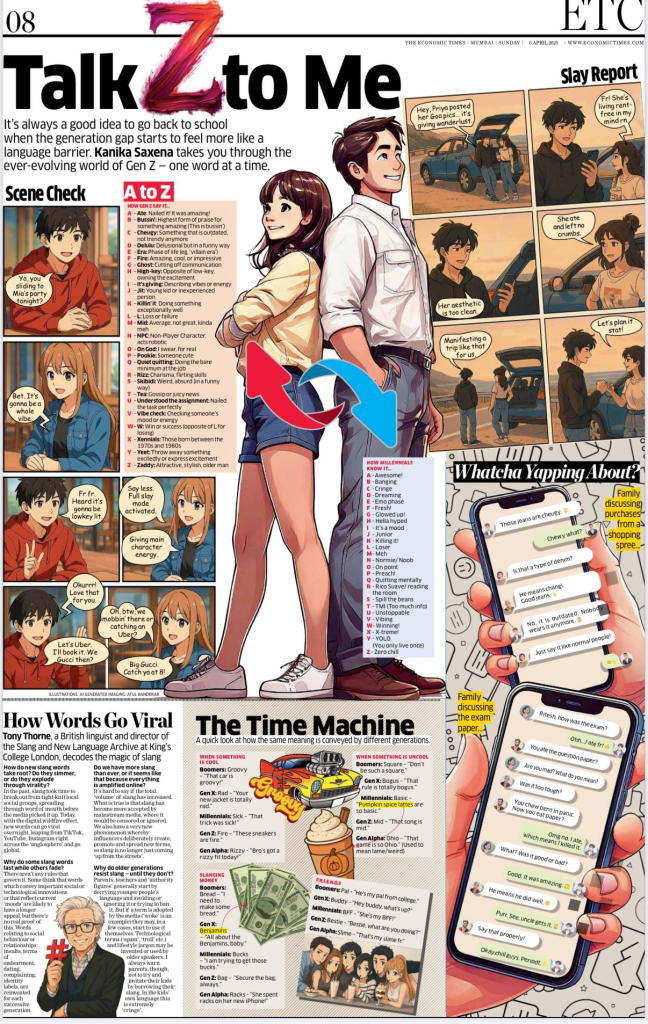
Last week I was interviewed by two young journalists about the pervasive slang generated by Gen Z and Gen Alpha. Interestingly both journalists are operating outside the US/UK matrix from which much of this language variety emanates. Interestingly too, both journalists asked similar questions about the latest linguistic novelties and how we might respond to them. Kanika Saxena‘s piece appeared in the Economic Times of India, and my contribution is here…

1. How do new slang words take root in a generation? Do they slowly build momentum, or does one viral moment suddenly put them everywhere?

In the past it could take some time for slang to escape from the local social group (‘in-group’ or ‘peer group’: a group of friends, a gang, fellow workers, etc.) where it originates into the outside world, then to spread by word of mouth into other parts of society, finally perhaps being picked up by the entertainment or print media. Nowadays this process has been massively speeded up by messaging and the internet, so that a novel term can go viral and reach beyond its original community almost instantaneously. New expressions can spread via social media and platforms like TikTok, Youtube, InstaGram right across the ‘anglosphere’ and go global.

2. Some words stick around for decades, while others vanish overnight. What makes certain slang words stand the test of time?

Linguists have tried to analyse why some terms become briefly fashionable and then disappear while others endure. There don’t seem to be any rules that govern why this happens. Some experts think that words which convey important social or technological innovations or that reflect current ‘moods’ or preoccupations are likely to have a longer appeal, but there’s no real proof of this. It could also be because a word relates to important social behaviour or relationships: insults, terms of endearment, ‘dating’ language, complaining, identity labels, for example, have to be reinvented for each successive generation, then persist until their users mature or grow older.

3. With social media throwing new words at us daily, are we actually creating more slang than before, or does it just feel that way because everything is amplified online?

It’s hard to say if the total ‘volume’ of slang has increased because, in the past at least, it was impossible to quantify it. What is definitely true is that slang has for some time become more accepted by mainstream media whereas it used to be censored or ignored. We also have the very new phenomenon whereby influencers, TikTok stars and content creators are using online resources to consciously, deliberately create, promote and spread new terms, so slang is no longer just coming ‘up from the streets’ (or spread via music, TV and movies) but is a commodity exchanged and pushed to gain prestige or sell oneself.

4. Older generations always seem skeptical of new slang—until, of course, they start using it too. What’s the secret to a word crossing generational lines?

Parents, teachers and ‘authority figures’ generally start by decrying younger people’s language and avoiding or ignoring it or trying to ban it. (This isn’t really justified by the way: slang may be seen as socially marginal but is not technically deficient or defective language and uses the same techniques as poetry or literature) But if a term is adopted by the media (‘woke’ is an example) they may in a few cases start to use it themselves. Technological terms (‘spam’, ‘troll’ etc.) and lifestyle jargon may be invented or used by older speakers. I always warn parents, though, not to try and imitate their kids by borrowing their slang. In the kids’ own language this is extremely ‘cringe’.

My second interview was with Austėja Zokaitė who is based in Lithuania and it appears in the online magazine Bored Panda, an arresting and anarchic daily roundup of the latest viral images, memes and commentary on internet culture. The whole report is here, with my comments interspersed with the succession of visual elements…

This IG Page Shares “Hard” Images, And Here’s 30 Of The Most Unhinged

Two weeks later I took part in a podcast on the subject of Slang, hosted by US students Sophie Xie and Andrea Lee. Our discussion is here…

Dang, What’s That Slang? by Andrea Lee

INITIAL FINDINGS

more updates on 2025’s language landscape

Once again, I’m very grateful indeed to Randoh Sallihall of Unscramblerer.com for sharing his data on language usage online. I previously posted his analysis of last year’s slang lookups (online searches)* and this time his findings reveal the most popular internet text abbreviation lookups in 2025 so far, for the UK and the USA. I was amused to see SMH (‘shaking my head‘) featuring high in both lists. A few years ago I confidently stated in a BBC radio interview that this stood for ‘same here’ – as I had just been informed by a group of schoolkids. I was immediately and publicly corrected – and shamed – by presenter Anne McElvoy and invited journalist Hannah Jane Parkinson and the bitter experience has stayed with me.** It may be culturally significant also that Britain’s favourite apology – in the form of SOZ – doesn’t feature at all on the American list.

“Analysis of Google search data for 2025 so far reveals the most searched for text abbreviations in the UK.”

Most searched for text abbreviations in the United Kingdom:

1.      POV (39 000 searches) – Point of view.

2.      SMH (34 000 searches) – Shake my head.

3.      PMO (28 000 searches) – Put me on.

4.      ICL (17 000 searches) – I Can’t Lie.

5.      OG (16 000 searches) – Original gangster.

6.      OTP (16 000 searches) – One true pairing.

7.      NVM (13 000 searches) – Never mind.

8.      TM (11 000 searches)- Talk to me.

9.      SN (7 000 searches) – Say nothing.

10.   BTW (6 000 searches) – By the way.

11.   KMT (6 000 searches) – Kiss my teeth.

12.   FS (6 000 searches) – For sure.

13.   WYM (6 000 searches) – What you mean.

14.   HRU (6 000 searches) – How are you?

15.   ATP (5 000 searches) – At this point.

16.   SYBAU (5 000 searches) – Shut your b—h ass up.

17.   IGHT (5 000 searches) – Alright.

18.   ONB (4 000 searches) – On bro.

19.   WSP (4 000 searches) – What’s up?

20.   TY (4 000 searches) – Thank you.

21.   SOZ (3 500 searches) – Sorry.

22.   IDC (3 000 searches) – I don’t care.

23.   LDAB (3 000 searches) –  Let’s do a b-tch.

24.   PFP (3 000 searches) – Picture for proof.

25.   IBR (3 000 searches) – It’s been real.

26.   IYW  (3 000 searches) – If you will.

27.   TB (2 500 searches) – Text back.

28.   FYI (2 500 searches) – For your information.

29.   GTFO (2 500 searches) – Get the f–k out.

30.   HY (2 000 searches) – Hell yeah.

Most searched for text abbreviations in the United States:

1.      FAFO (254 000 searches) – F–k around and find out.

2.      SMH (166 000 searches) – Shake my head.

3.      PMO (101 000 searches) – Put me on.

4.      OTP (95 000 searches) – One true pairing.

5.      TBH (93 000 searches) – To be honest.

6.      ATP (85 000 searches) – At this point.

7.      TS (79 000 searches) – Talk soon.

8.      WYF (76 000 searches) – Where are you from.

9.      NFS (75 000 searches) – New friends.

10.   ASL (65 000 searches) – As hell.

11.   POV (63 000 searches) – Point of view.

12.   WYLL (59 000 searches) – What you look like.

13.   FS (58 000 searches) – For sure.

14.   FML (56 000 searches) – F–k my life.

15.   DW (55 000 searches) – Don’t worry.

16.   HMU (54 000 searches) – Hit me up.

17.   ISO (53 000 searches) – In search of.

18.   WSG (50 000 searches) – What’s good?

19.   IMO (48 000 searches) – In my opinion.

20.   MK (45 000 searches) – Mmm, okay.

21.   ETA (40 000 searches) – Estimated time of arrival.

22.   ICL (37 000 searches) – I Can’t Lie.

23.   MB (37 000 searches) – My bad.

24.   STG (29 000 searches) – Swear to god.

25.   ION (28 000 searches) – In other media.

26.   PFP (27 000 searches) – Picture for proof.

27.   NTM (27000 searches) – Nothing much.

28.   DTM (26 000 searches) – Doing too much.

29.   TTM (26 000 searches)- Talk to me.

30.   MBN (25 000 searches) – Must be nice.

31.   ETC (24 000 searches) – And the rest.

32.   BTW (23 000 searches) – By the way.

33.   WFH (21 000 searches) – Work from home.

34.   GMFU (20 000 searches) – Got me f—-d up.

35.   NGL (19000 searches) – Not gonna lie.

36.   SYBAU (19 000 searches) – Shut your b—h ass up.

37.   BTA (17 000 searches) – But then again.

38.   SB (17 000 searches) – Somebody.

39.   HBD (16 000 searches) – Happy Birthday.

40.   PMG (15 000 searches) – Oh my god.

41.   HY (15 000 searches) – Hell yeah.

42.   TMB (11 000 searches) – Text me back.

43.   WYS (10 000 searches) – Whatever you say.

44.   GNG (9 000 searches) – Gang (close friends or family).

45.   IKTR (8 000 searches) – I know that’s right.

46.   IKR (7 000 searches) – I know, right?

47.   ARD (6 000 searches) – Alright.

48.   IFG (5 500 searches) – I f—–g guess.

49.   HN (4 000 searches) – Hell no.

50.   TTH (3 000 searches) – Trying too hard.

A spokesperson for Unscramblerer.com commented on the findings: “Text abbreviations are the secret language of the internet. You could even call them an integral part of social media culture. Snappy, always changing and hard to understand. Texting abbreviations is all about saving time and appearing cool. Keeping up to date with the newest trending abbreviations is no easy task. Old meanings can change while new abbreviations are created. A recent study found that abbreviations might not be as cool as people think. Using abbreviations makes the sender seem less sincere. This also leads to lower engagement and shorter responses. There is nothing wrong with using abbreviations in casual conversations with friends and family. However it is best do draw a line for professional conversations. Context matters.”

Research was conducted by word finding experts at Unscramblerer.com.

We analyzed 01.01.2025 -05.03.2025 search data from Google Trends for terms related to text abbreviations.

Methodology: We used Google Trends to discover the top trending text abbreviations and Ahrefs to find the number of searches. America’s most popular text abbreviations can be discovered in Google Trends through the keyword variations of ‘meaning text’. Abbreviations are used most often on social media and texting. The 2025 top trending abbreviations are the least understood. People have to search for their meaning (example ‘TBH meaning text’). Ahrefs shows many variations of meaning searches like ‘text meaning’ or ‘means in text'(example ‘PMO meaning in text’) and similar keyword combinations(example ‘what does SMH mean in text’). We added up 100 search variations of top text abbreviations.

I was very grateful, too, when Claire Martin-Tellis of content marketing and digital PR specialists North Star Inbound contacted me with an update, again from the USA, on attitudes to outdated slang

“As new slang terms like “Beta,” “GYAT,” and  “Skibidi,” continue to surface, it’s enough even to make Gen Z feel old! Language learning app Preply asked Americans of all ages to weigh in on their favorite era of slang. Here is what decade reigns supreme:

  • Over ⅓ of Americans say the 1990s is their favorite decade for slang.
  • Men surveyed preferred the 1970s while women preferred the 1990s.
  • “Baloney,” “take a chill pill,” and “bogus” are the three most popular slang terms Americans want to see come back.

*https://language-and-innovation.com/2024/11/18/the-search-for-slang/

**the embarrassment is still audible here…https://www.bbc.co.uk/programmes/b06vs6g2