GOING VIRAL, GOING GLOBAL

youth slang crosses world englishes

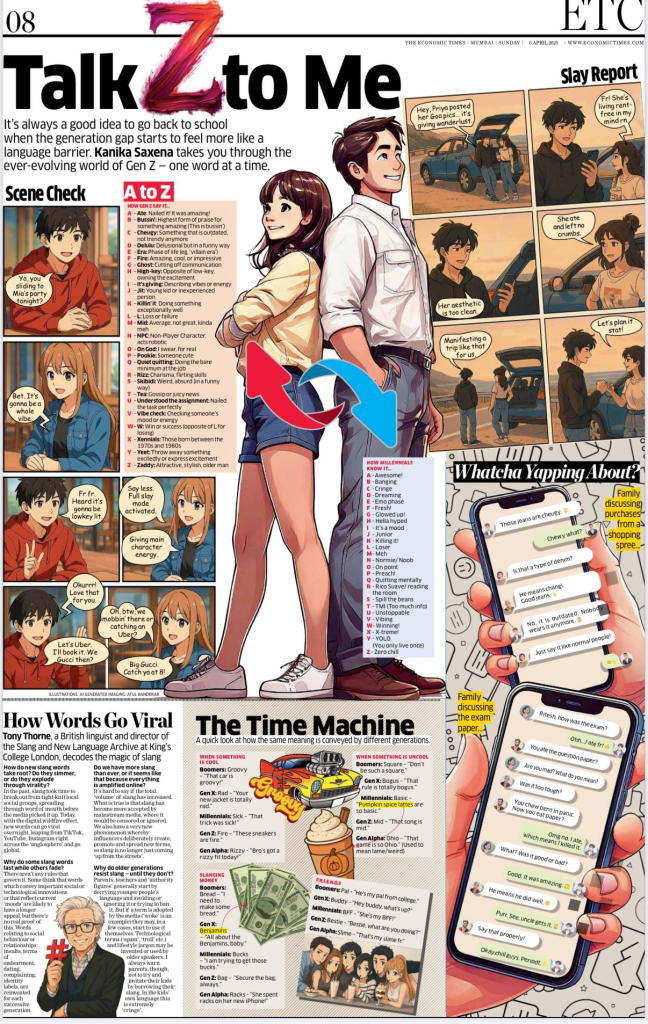
Last week I was interviewed by two young journalists about the pervasive slang generated by Gen Z and Gen Alpha. Interestingly both journalists are operating outside the US/UK matrix from which much of this language variety emanates. Interestingly too, both journalists asked similar questions about the latest linguistic novelties and how we might respond to them. Kanika Saxena‘s piece appeared in the Economic Times of India, and my contribution is here…

1. How do new slang words take root in a generation? Do they slowly build momentum, or does one viral moment suddenly put them everywhere?

In the past it could take some time for slang to escape from the local social group (‘in-group’ or ‘peer group’: a group of friends, a gang, fellow workers, etc.) where it originates into the outside world, then to spread by word of mouth into other parts of society, finally perhaps being picked up by the entertainment or print media. Nowadays this process has been massively speeded up by messaging and the internet, so that a novel term can go viral and reach beyond its original community almost instantaneously. New expressions can spread via social media and platforms like TikTok, Youtube, InstaGram right across the ‘anglosphere’ and go global.

2. Some words stick around for decades, while others vanish overnight. What makes certain slang words stand the test of time?

Linguists have tried to analyse why some terms become briefly fashionable and then disappear while others endure. There don’t seem to be any rules that govern why this happens. Some experts think that words which convey important social or technological innovations or that reflect current ‘moods’ or preoccupations are likely to have a longer appeal, but there’s no real proof of this. It could also be because a word relates to important social behaviour or relationships: insults, terms of endearment, ‘dating’ language, complaining, identity labels, for example, have to be reinvented for each successive generation, then persist until their users mature or grow older.

3. With social media throwing new words at us daily, are we actually creating more slang than before, or does it just feel that way because everything is amplified online?

It’s hard to say if the total ‘volume’ of slang has increased because, in the past at least, it was impossible to quantify it. What is definitely true is that slang has for some time become more accepted by mainstream media whereas it used to be censored or ignored. We also have the very new phenomenon whereby influencers, TikTok stars and content creators are using online resources to consciously, deliberately create, promote and spread new terms, so slang is no longer just coming ‘up from the streets’ (or spread via music, TV and movies) but is a commodity exchanged and pushed to gain prestige or sell oneself.

4. Older generations always seem skeptical of new slang—until, of course, they start using it too. What’s the secret to a word crossing generational lines?

Parents, teachers and ‘authority figures’ generally start by decrying younger people’s language and avoiding or ignoring it or trying to ban it. (This isn’t really justified by the way: slang may be seen as socially marginal but is not technically deficient or defective language and uses the same techniques as poetry or literature) But if a term is adopted by the media (‘woke’ is an example) they may in a few cases start to use it themselves. Technological terms (‘spam’, ‘troll’ etc.) and lifestyle jargon may be invented or used by older speakers. I always warn parents, though, not to try and imitate their kids by borrowing their slang. In the kids’ own language this is extremely ‘cringe’.
My second interview was with Austėja Zokaitė who is based in Lithuania and it appears in the online magazine Bored Panda, an arresting and anarchic daily roundup of the latest viral images, memes and commentary on internet culture. The whole report is here, with my comments interspersed with the succession of visual elements…

This IG Page Shares “Hard” Images, And Here’s 30 Of The Most Unhinged

Two weeks later I took part in a podcast on the subject of Slang, hosted by US students Sophie Xie and Andrea Lee. Our discussion is here…

Dang, What’s That Slang? by Andrea Lee

LONDON’S LANGUAGE

My exploration of the Language of London is a work in progress. Here is a fragment thereof, to be followed by others…

When on his Box the nodding Coachman snores,
And dreams of fancy’d Fares; when Tavern Doors
The Chairmen idly croud; then ne’er refuse
To trust thy busie Steps in thinner shoes…

…But when the swinging Signs your Ears offend
With creaking Noise, then rainy Floods impend;
Soon shall the Kennels swell with rapid Streams,
And rush in muddy Torrents to the Thames.
The Bookseller, whose Shop’s an open Square,
Foresees the Tempest, and with early Care
Of Learning strips the Rails; the rowing Crew
To tempt a Fare, cloath all their Tilts in Blue:

– John Gay, Trivia, 1716

Linguists know that language, public or private, is never singular but always pluralistic, in their words a shifting and evolving pattern of dialects, ‘sociolects’ and ‘idiolects’. An enduring myth is that Brits, Londoners among them, are ‘monoglots’ and always have been, imprisoned in the one-dimensional reality of a single language. This may have been true of some of us in recent years, but the Londoner of the past was as likely as not to be bi-, if not multi-lingual. The common inhabitants of Roman Londinium, if they wished to better themselves, would have been fluent in Latin as well as in their own Ancient British dialects. Dark-Age traders plying the Thames from Lundenwic had to negotiate the many varieties of Anglo-saxon spoken in England as well as Viking Norse and the ancestors of Dutch and French. For centuries after the Norman Conquest those working in the courts of law had to be tri-lingual as the proceedings were conducted simultaneously in Latin, French and Old English.

At any time in its history the city has resounded to all sorts of Englishes: the picturesque slangs of costermongers, butchers and pickpockets, the arcane jargon of bankers and lawyers, the polished verbal posturing of salon wits and the literati.

In London there I was bent,
I saw my-selfe, where trouthe shuld be ateynte;
Fast to Westminstar-ward I went
To a man of lawe, to make my complaynt.
I sayd, “For Marys love, that holy seynt,
Have pity on the powre, that would procede.
I would gyve sylvar, but my purs is faynt.”
For lacke of money, I may not spede.

– An anonymous man of Kent, London Lickpenny, c 1440

Of course the languages of London are not only varieties of English. From the earliest times other tongues have resonated around its hills and streams: the lost Celtic languages of Iron Age Britain, Caesar’s Latin and his legionaries’ vernaculars from around the Empire, the French of mediaeval court and convent, immigrant dialects from Huguenot French and sailor’s Dutch to Yiddish, yielding to the multinational, polyphonic buzz of the modern metropolis.

“If I hole up for a bit I won’t stand a chance of earning myself no more. You’ll have to sausage me a goose’s.” “Sausage you a goose’s? What the hell are you talking about?” Len had turned round from the window and was staring at Snowey. “Cash me a cheque, dopey.”

– James Curtis, You’re in the Racket Too, 1937

It was in London’s Westminster that English finally became a language in its own right, symbolically used for the first time by Edward III in 1362 at the opening of parliament. It was in London above all that the unparalleled marvel of Modern English, with its plunderings of other European tongues and borrowings from across the Empire, first evolved in the time of Jonson, Marlowe and Shakespeare. And now, five hundred years on, a wholly new hybrid, drawing on sources as disparate as Jamaican, Urdu, Arabic and Gaelic is set, some experts claim, to displace the native Cockney and Estuary dialects of London, even eventually transform Standard English itself into something strange and novel.

Statistics from the latest Census show that 78 per cent of the capital’s 7.8 million residents speak English as their main language. But the remaining 22 per cent — equivalent to just over 1.7 million people — have one of more than 300 first languages. Of these nearly 320,000 declare, rather worryingly, that they cannot speak English well or at all. The most striking revelation, however, is the scale of linguistic diversity. Overall there are 53 community or heritage languages in the capital spoken by at least 0.1 per cent of residents. There are also another 54 which include variants of established languages such as Chinese or those, such as Caribbean Creole, Cornish or Gaelic, spoken by a small number of people. The most common other language is Polish, spoken by nearly two per cent of residents, followed by Bengali, Gujarati, French, Urdu and Arabic. The most diverse borough is Hillingdon, where 107 languages defined by the Census are spoken, followed by Newham with 104. Tony Thorne’s own researches reveal that these ‘other’ languages themselves are undergoing weird transformations as they come into contact with one another and with native ‘white’ London usages.

A decade later and I still haven’t realised my wish to stage an exhibition, online or, preferably, IRL, to celebrate the language(s) of London. I was reminded by a news item this week recording the publication of a new and original  – and personal – account of South London words and sayings… 

https://www.richmondandtwickenhamtimes.co.uk/news/25408835.south-london-speaks-book-slang-sayings/?ref=twtrec