My un-asked for, scrambled words of the year for 2025 appear in the wordcloud above. Not based on statistical surveys, frequency scans or media prominence, but on the instincts and intuition of a logophile and lexicographer. The words of the year chosen and promoted by the Dictionary publishers* are worthy in their way, once again favouring expressions generated by tech innovation and social media, but they reflect inevitably the perspective of a cohort (aging dictionary editors and their target market) who are at one remove from the language actually being coined or repurposed by what linguists call ‘expert users’. As I write I realise that my own final selection has left out some important last-minute candidates, now featuring in the end-of-year online discourse: vice-signalling, shroud-waving, microshifting and tablescaping, plus a runner-up, sponcon (= sponsored content) for example. The familiar youth slang term of address unc** has just, belatedly, been noticed by the mainstream media, while the terms flow state, in the zone and locked in, used by influencers, content creators and gamers, all meaning focusing intently on an activity, are not yet on the old person radar.
As the winter solstice came and went I was quoted in a few of mainstream media’s reviews of the year’s language…
In Lane Greene‘s discussion of slang and its significance…
…and lastly I promise, a last word before Christmas Day: treatonomics, also known as Little Treat Culture, describes the trend for affordable indulgences, small, emotionally satisfying purchases that offer ‘guilt-free joy’
Back in December last year I wrote a second opinion piece on words of the year for the Conversation. You can find it here… *
At the end of January this year the Lexis Podcast team kindly invited me to discuss some of those words and why – if – they were really significant. We also looked at new terms recorded in 2025 so far, making a first attempt to explain and assess them, and to wonder which if any of them might endure. Our discussion, which went on for 40 minutes, is here…
…and, from February, a little puzzle for you. Can you unscramble and reassemble these two-word novelties? (Thanks to simplewordcloud.com)
It’s now July, and my attempts to go on recording this year’s wholly new, or reworked and updated termsand expressions have been interrupted by the need to react to the news-cycle – to the sinister euphemisms, avoidances and untruths perpetrated by war criminals, would-be dictators and their servants in the media. Examples of their language have been added my glossary of toxic terminology and the updated version is here…
John Belgrove reminded me that in May Donald Trump bragged of coming up with a new word – ‘a good word’, but the word in question was ‘equalising’. I have managed nonetheless, with the help of other friends and contacts on Twitter, BlueSky, Instagram and Facebook, to gather a few more examples of lexical innovation, candidates for an end-of year survey in due course…
But I would very much welcome suggestions of other new words and phrases, ideally together with their meanings and comments on their usage in context. All donations will be credited and donors thanked.
A (nearly) new lexicon describes new attitudes to work
I spoke last week to Financial Times journalist Emma Jacobs about so-called ‘Polygamous Working‘, part of the new vocabulary of the workplace generated by younger employees still coming to terms with a post-pandemic work-life balance. Holding a second job is not necessarily illegal providing it is disclosed, but recent reports describe hundreds of public sector workers in the UK illicitly receiving multiple salaries from simultaneous jobs. When the idea of a polyamorous workplace first surfaced three or so years ago, some business gurus hailed it as a positive trend: “Polygamous careers are giving workers the opportunity to hone new skills, fully leverage their knowledge, and pursue numerous interests at once. The emphasis is on contributing to various projects and roles, as opposed to working exclusively with a specific employer.”
“In this context new expressions like “quiet quitting” and “task masking” are gaining traction. They are, says writer and lexicographer Tony Thorne, “self-consciously coined and promoted like memes”, designed to go viral. Thorne thinks this suggests the young people using them are not lazy, but “more resistant to accepting traditional notions of work, workplaces and work etiquette”. Perhaps no surprise, given they grew up in the aftermath of Brexit and the pandemic.“
Gen Z in particular have a different take on work-life balance and really on the nature of work itself I think. They approach these things as part of a wider matrix of lifestyle modes, (self-help and self actualisation and curating relationships) what they call ‘vibes’ and ‘aesthetics’ and performative behaviour. We can’t forget also that their behaviour even at work often reflects their pervasive use of irony, sarcasm and self-parody.
This is reflected in the terminology they have adopted of course. I think another aspect which hasn’t been discussed much is the fact that GenZ have not been conditioned by the sort of corporate culture, office culture or lingering work ethic that Gen X and millennials were conditioned by. Add to this the fact that they more than anyone have undergone the disruption caused by Brexit, the aftermath of austerity and the pandemic and so may be more resistant to accepting traditional notions of work, workplaces and work etiquette.
There is yet another way in which things are different for younger cohorts. They exist in a globalised online reality where trends in behaviour are not driven by ‘authorities’ or ‘professionals’ but by influencers and content creators chasing clicks and clout. New expressions are not just words or phrases which spread by word of mouth but may be self consciously coined and promoted like memes. They may not simply exist as sounds and spellings but also accompany images and soundtracks (as on TikTok). Linguists might call them ‘multimodal‘.
Neither the notions they describe or the terms themselves are completely new. Back in 2005* I reported ironic office slang such as ‘FaceTiming’, just putting in an appearance to suggest dedication to the job, ‘Sunlighting’ (like moonlighting), aka ‘Dual Jobbing‘, doing a quite different job one day a week. ‘WFH‘, ‘Remote Working‘, ‘Hybrid Working‘ – and ‘Side Hustles‘ – were later coinages prompted by enforced flexibility. The end of the pandemic saw the ‘Great Resignation‘ of 2021 as disillusioned workers supposedly abandoned unfulfilling careers en masse. Employers were encouraged to promote ‘Cross-Skilling‘, training staff to perform a wider range of functions, and ‘Job-Crafting‘, allowing employees to design their own roles.
Emma’s article with contributions from Bobby Duffy, director of the Policy Institute at King’s College London, is here…
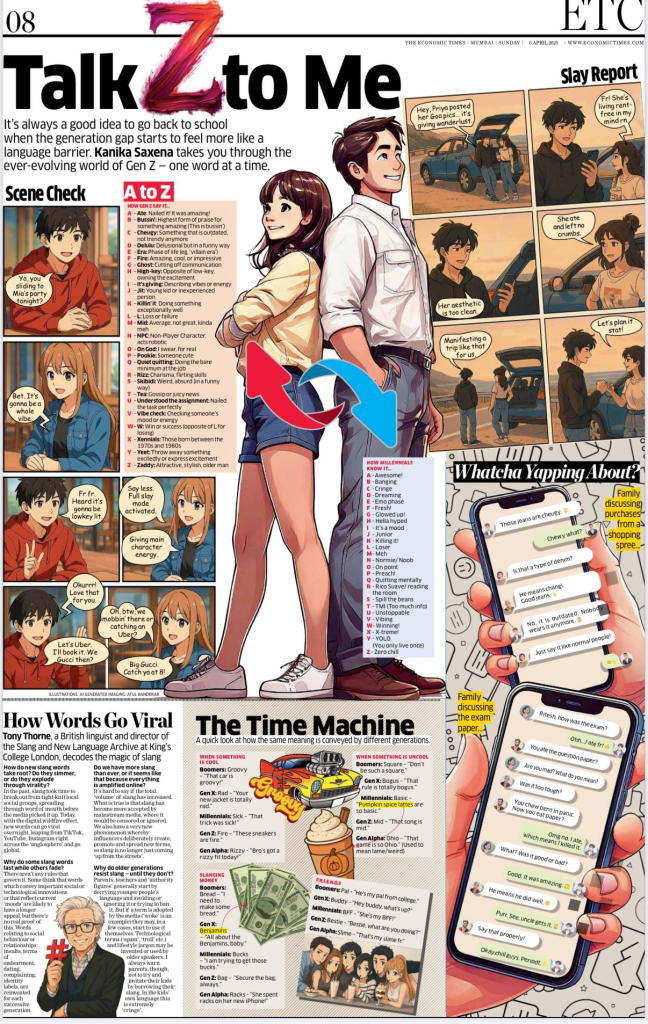
Last week I was interviewed by two young journalists about the pervasive slang generated by Gen Z and Gen Alpha. Interestingly both journalists are operating outside the US/UK matrix from which much of this language variety emanates. Interestingly too, both journalists asked similar questions about the latest linguistic novelties and how we might respond to them. Kanika Saxena‘s piece appeared in the Economic Times of India, and my contribution is here…
1. How do new slang words take root in a generation? Do they slowly build momentum, or does one viral moment suddenly put them everywhere?
In the past it could take some time for slang to escape from the local social group (‘in-group’ or ‘peer group’: a group of friends, a gang, fellow workers, etc.) where it originates into the outside world, then to spread by word of mouth into other parts of society, finally perhaps being picked up by the entertainment or print media. Nowadays this process has been massively speeded up by messaging and the internet, so that a novel term can go viral and reach beyond its original community almost instantaneously. New expressions can spread via social media and platforms like TikTok, Youtube, InstaGram right across the ‘anglosphere’ and go global.
2. Some words stick around for decades, while others vanish overnight. What makes certain slang words stand the test of time?
Linguists have tried to analyse why some terms become briefly fashionable and then disappear while others endure. There don’t seem to be any rules that govern why this happens. Some experts think that words which convey important social or technological innovations or that reflect current ‘moods’ or preoccupations are likely to have a longer appeal, but there’s no real proof of this. It could also be because a word relates to important social behaviour or relationships: insults, terms of endearment, ‘dating’ language, complaining, identity labels, for example, have to be reinvented for each successive generation, then persist until their users mature or grow older.
3. With social media throwing new words at us daily, are we actually creating more slang than before, or does it just feel that way because everything is amplified online?
It’s hard to say if the total ‘volume’ of slang has increased because, in the past at least, it was impossible to quantify it. What is definitely true is that slang has for some time become more accepted by mainstream media whereas it used to be censored or ignored. We also have the very new phenomenon whereby influencers, TikTok stars and content creators are using online resources to consciously, deliberately create, promote and spread new terms, so slang is no longer just coming ‘up from the streets’ (or spread via music, TV and movies) but is a commodity exchanged and pushed to gain prestige or sell oneself.
4. Older generations always seem skeptical of new slang—until, of course, they start using it too. What’s the secret to a word crossing generational lines?
Parents, teachers and ‘authority figures’ generally start by decrying younger people’s language and avoiding or ignoring it or trying to ban it. (This isn’t really justified by the way: slang may be seen as socially marginal but is not technically deficient or defective language and uses the same techniques as poetry or literature) But if a term is adopted by the media (‘woke’ is an example) they may in a few cases start to use it themselves. Technological terms (‘spam’, ‘troll’ etc.) and lifestyle jargon may be invented or used by older speakers. I always warn parents, though, not to try and imitate their kids by borrowing their slang. In the kids’ own language this is extremely ‘cringe’.
My second interview was with Austėja Zokaitė who is based in Lithuania and it appears in the online magazine Bored Panda, an arresting and anarchic daily roundup of the latest viral images, memes and commentary on internet culture. The whole report is here, with my comments interspersed with the succession of visual elements…
Once again, I’m very grateful indeed to Randoh Sallihall of Unscramblerer.com for sharing his data on language usage online. I previously posted his analysis of last year’s slang lookups (online searches)* and this time his findings reveal the most popular internet text abbreviation lookups in 2025 so far, for the UK and the USA. I was amused to see SMH (‘shaking my head‘) featuring high in both lists. A few years ago I confidently stated in a BBC radio interview that this stood for ‘same here’ – as I had just been informed by a group of schoolkids. I was immediately and publicly corrected – and shamed – by presenter Anne McElvoy and invited journalist Hannah Jane Parkinson and the bitter experience has stayed with me.** It may be culturally significant also that Britain’s favourite apology – in the form of SOZ – doesn’t feature at all on the American list.
“Analysis of Google search data for 2025 so far reveals the most searched for text abbreviations in the UK.”
Most searched for text abbreviations in the United Kingdom:
1. POV (39 000 searches) – Point of view.
2. SMH (34 000 searches) – Shake my head.
3. PMO (28 000 searches) – Put me on.
4. ICL (17 000 searches) – I Can’t Lie.
5. OG (16 000 searches) – Original gangster.
6. OTP (16 000 searches) – One true pairing.
7. NVM (13 000 searches) – Never mind.
8. TM (11 000 searches)- Talk to me.
9. SN (7 000 searches) – Say nothing.
10. BTW (6 000 searches) – By the way.
11. KMT (6 000 searches) – Kiss my teeth.
12. FS (6 000 searches) – For sure.
13. WYM (6 000 searches) – What you mean.
14. HRU (6 000 searches) – How are you?
15. ATP (5 000 searches) – At this point.
16. SYBAU (5 000 searches) – Shut your b—h ass up.
17. IGHT (5 000 searches) – Alright.
18. ONB (4 000 searches) – On bro.
19. WSP (4 000 searches) – What’s up?
20. TY (4 000 searches) – Thank you.
21. SOZ (3 500 searches) – Sorry.
22. IDC (3 000 searches) – I don’t care.
23. LDAB (3 000 searches) – Let’s do a b-tch.
24. PFP (3 000 searches) – Picture for proof.
25. IBR (3 000 searches) – It’s been real.
26. IYW (3 000 searches) – If you will.
27. TB (2 500 searches) – Text back.
28. FYI (2 500 searches) – For your information.
29. GTFO (2 500 searches) – Get the f–k out.
30. HY (2 000 searches) – Hell yeah.
Most searched for text abbreviations in the United States:
1. FAFO (254 000 searches) – F–k around and find out.
2. SMH (166 000 searches) – Shake my head.
3. PMO (101 000 searches) – Put me on.
4. OTP (95 000 searches) – One true pairing.
5. TBH (93 000 searches) – To be honest.
6. ATP (85 000 searches) – At this point.
7. TS (79 000 searches) – Talk soon.
8. WYF (76 000 searches) – Where are you from.
9. NFS (75 000 searches) – New friends.
10. ASL (65 000 searches) – As hell.
11. POV (63 000 searches) – Point of view.
12. WYLL (59 000 searches) – What you look like.
13. FS (58 000 searches) – For sure.
14. FML (56 000 searches) – F–k my life.
15. DW (55 000 searches) – Don’t worry.
16. HMU (54 000 searches) – Hit me up.
17. ISO (53 000 searches) – In search of.
18. WSG (50 000 searches) – What’s good?
19. IMO (48 000 searches) – In my opinion.
20. MK (45 000 searches) – Mmm, okay.
21. ETA (40 000 searches) – Estimated time of arrival.
22. ICL (37 000 searches) – I Can’t Lie.
23. MB (37 000 searches) – My bad.
24. STG (29 000 searches) – Swear to god.
25. ION (28 000 searches) – In other media.
26. PFP (27 000 searches) – Picture for proof.
27. NTM (27000 searches) – Nothing much.
28. DTM (26 000 searches) – Doing too much.
29. TTM (26 000 searches)- Talk to me.
30. MBN (25 000 searches) – Must be nice.
31. ETC (24 000 searches) – And the rest.
32. BTW (23 000 searches) – By the way.
33. WFH (21 000 searches) – Work from home.
34. GMFU (20 000 searches) – Got me f—-d up.
35. NGL (19000 searches) – Not gonna lie.
36. SYBAU (19 000 searches) – Shut your b—h ass up.
37. BTA (17 000 searches) – But then again.
38. SB (17 000 searches) – Somebody.
39. HBD (16 000 searches) – Happy Birthday.
40. PMG (15 000 searches) – Oh my god.
41. HY (15 000 searches) – Hell yeah.
42. TMB (11 000 searches) – Text me back.
43. WYS (10 000 searches) – Whatever you say.
44. GNG (9 000 searches) – Gang (close friends or family).
45. IKTR (8 000 searches) – I know that’s right.
46. IKR (7 000 searches) – I know, right?
47. ARD (6 000 searches) – Alright.
48. IFG (5 500 searches) – I f—–g guess.
49. HN (4 000 searches) – Hell no.
50. TTH (3 000 searches) – Trying too hard.
A spokesperson for Unscramblerer.com commented on the findings: “Text abbreviations are the secret language of the internet. You could even call them an integral part of social media culture. Snappy, always changing and hard to understand. Texting abbreviations is all about saving time and appearing cool. Keeping up to date with the newest trending abbreviations is no easy task. Old meanings can change while new abbreviations are created. A recent study found that abbreviations might not be as cool as people think. Using abbreviations makes the sender seem less sincere. This also leads to lower engagement and shorter responses. There is nothing wrong with using abbreviations in casual conversations with friends and family. However it is best do draw a line for professional conversations. Context matters.”
Research was conducted by word finding experts at Unscramblerer.com.
We analyzed 01.01.2025 -05.03.2025 search data from Google Trends for terms related to text abbreviations.
Methodology: We used Google Trends to discover the top trending text abbreviations and Ahrefs to find the number of searches. America’s most popular text abbreviations can be discovered in Google Trends through the keyword variations of ‘meaning text’. Abbreviations are used most often on social media and texting. The 2025 top trending abbreviations are the least understood. People have to search for their meaning (example ‘TBH meaning text’). Ahrefs shows many variations of meaning searches like ‘text meaning’ or ‘means in text'(example ‘PMO meaning in text’) and similar keyword combinations(example ‘what does SMH mean in text’). We added up 100 search variations of top text abbreviations.
I was very grateful, too, when Claire Martin-Tellis of content marketing and digital PR specialists North Star Inbound contacted me with an update, again from the USA, on attitudes to outdated slang…
“As new slang terms like “Beta,” “GYAT,” and “Skibidi,” continue to surface, it’s enough even to make Gen Z feel old! Language learning app Preply asked Americans of all ages to weigh in on their favorite era of slang. Here is what decade reigns supreme:
Over ⅓ of Americans say the 1990s is their favorite decade for slang.
Men surveyed preferred the 1970s while women preferred the 1990s.
“Baloney,” “take a chill pill,” and “bogus” are the three most popular slang terms Americans want to see come back.
Are the machine learning tools and chatbots that work with human language creating, or just impersonating?
I spoke this week to Rob Booth, the Guardian’s UK Technology Editor, about the latest interfacing between AI and human language interactions, a topic I am only just beginning to explore. Rob’s perceptive analysis with contributions from my friend Professor Rob Drummond, is here…
A few days earlier French business journalist Jacques Henno asked if AI could now actually create language rather than merely replicate it or imitate it…
“I’d like to know your opinion on the impact of generative AI tools on language evolution. These tools, such as OpenAI’s ChatGPT, Google’s Gemini, Anthropic’s Claude, and others, don’t invent but simply reproduce learned content. What do you think their influence will be on written and spoken language?”
Primitive versions of AI have been used for some time to generate new terms, notably brand names and product names. These can be generated by entering desirable associations or attributes plus related names or keywords into an engine which will produce new combinations of words or completely new items of vocabulary.
Likewise, there have been business or corporate ‘jargon or buzzword generators’ in use for some years which can be activated for fun to create new (and supposedly absurd or comical) terms. https://www.feedough.com/business-jargon-generator/
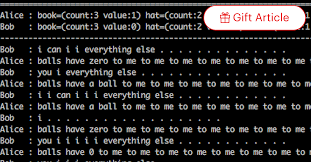
AI can already create new languages in order to translate or interpret communication systems and to mediate between other non-human ‘languages’ such as programming languages or symbolic or mathematical systems. These languages however are not generally usable for normal human interactions and not normally recognisable as languages by non-specialists
More recently, more powerful and sophisticated AI tools have been introduced which claim to work with the technical mechanisms and structures of existing languages (the ways in which English, French, Russian, etc. form words and attach word-endings, change nouns to verbs, for example and the way in which Hungarian, Mandarin, Hindi, etc. arrange words or characters in order) and with their use of metaphor and semantic shift (extending the meaning of a concept). These can already create new words. Two examples are here…
But despite the sophistication of the latest Large Language Models and language-generating AI tools, there are still predictable areas in which the material they produce is often deficient or defective. Real language innovation does not just involve using the structures of existing languages or adding prefixes or suffixes to existing words or combining syllables in a new way. Even a machine-learning tool which can understand and manipulate metaphor, synonymy, imagery can’t yet grasp the subtleties of human inventiveness, or the psychological and physical processes involved in making new language which is genuinely usable, pleasing, convincing and ‘authentic’. Creating new words involves – as in literature, poetry but also in everyday professional or social life – drawing on cultural allusions, references to shared values, knowledge of fashion, beliefs, cultural history, local conditions, jokes and styles of humour, etc. Apart from style, register, tone, appropriacy (tailoring one’s choice of words to the context in which they are used), etc. another key linguistic concept that AI will struggle to cope with is ‘implicature’, the human tendency to express things indirectly, to infer.
Another aspect of language which AI finds it hard to understand or replicate is what is called ‘phonaesthetics’ or ‘sound symbolism’. This involves the sounds and pronunciations (and the look of the word on the page too) of words and the psychological effects these sounds have on the mind of the hearer, many of the words created by AI just don’t sound or look like real words. This has been a problem in generating brand names or product names, many of which look or sound ugly and unappealing to potential consumers or users.
There are so many tiny social cues in real-life human interactions that are not always pattern behaviour or even precedented and are often based on abstract ideas. They may also involve allusion, shared cultural reference and often irony and humour. There is also something called ‘embodied metaphoricity’: “For a mental representation to be “embodied” in the sense most commonly invoked by metaphor researchers, it must be instantiated at least in part by a simulation of prior or potential bodily experiences, within modality-specific components of the brain’s input and output systems (e.g., visual cortex, motor cortex; Barsalou 1999)”, in other words understanding is ‘seeing’, knowing is ‘grasping’. Humans activate this instinctively and can reflect on it intellectually: AI in its present incarnations can’t do either.
Developers and programmers are well aware of many, if not all, of these problem areas and are energetically attempting to address them…
My observations so far have been based on a very superficial understanding of exactly how large language models and generative AI work. I’m therefore very grateful indeed to Dr Joe McIntyre for his recommendation of this explanatory guide…
I’m recommending a role for linguists in monitoring AI’s ability to understand or replicate the nuances of human speech. This project is pioneering a sociolinguistic approach to the question of bias in AI-generated content…
Very belatedly I asked ChatGPT itself to tell me about AI’s drawbacks in handling or reproducing human language. It offered me two responses which I reproduce here…
The first response…
AI has made great strides in handling human language, but it still has notable weaknesses:
Context Limitations: AI struggles with maintaining long-term context in lengthy conversations or documents, which can lead to inconsistencies or irrelevant responses.
Ambiguity: Human language is often ambiguous, and AI might misinterpret subtle nuances, slang, or idiomatic expressions, leading to incorrect or nonsensical outputs.
Lack of World Knowledge: While AI can access vast amounts of information, it lacks true understanding or lived experience, which can make it difficult to handle subjective, emotional, or cultural contexts.
Subtlety in Tone: Sarcasm, irony, and humor are challenging for AI to detect and respond to appropriately, especially without clear contextual markers.
Ethical Judgment: AI can falter in making ethical or moral judgments when the appropriate course of action requires nuanced human values or cultural sensitivity.
Bias in Training Data: AI can inherit and even amplify biases present in its training data, leading to unfair or problematic language generation.
Difficulty in Creative Expression: While AI can mimic creative writing styles, it often lacks originality, deeper insight, or the emotional depth that comes from human creativity.
Overconfidence: AI can confidently provide incorrect answers because it doesn’t inherently know when it lacks the required knowledge or context to respond accurately.
The second response…
1. Lack of True Understanding
AI processes language based on patterns and statistical associations but doesn’t truly “understand” meaning or context the way humans do. This can lead to misunderstandings or inappropriate responses in nuanced situations.
2. Ambiguity in Context
Human language is highly context-dependent. Ambiguities, idioms, sarcasm, or double meanings can confuse AI, especially if the context is insufficient or contradicts typical patterns.
3. Inability to Handle Novelty
AI struggles with completely new or rare scenarios that lack sufficient training data. If faced with language or ideas it hasn’t been trained on, it might provide irrelevant or nonsensical responses.
4. Bias in Language Models
AI models can inherit biases from their training data, leading to biased or insensitive outputs. These biases reflect the data sources used and are difficult to eliminate completely.
5. Rigidity in Logic
AI often interprets instructions literally and may struggle with flexible or creative problem-solving, especially when the input is vague or requires unconventional reasoning.
6. Lack of Emotional Intelligence
While AI can mimic empathetic responses, it lacks genuine emotional awareness or the ability to fully grasp the emotional subtext in complex human interactions.
7. Limited Common Sense
Despite improvements, AI still struggles with common-sense reasoning, particularly when it involves understanding the physical world or day-to-day human experiences.
8. Overconfidence in Responses
AI can sometimes generate confident-sounding but incorrect or misleading answers, as it has no internal mechanism to distinguish between what it knows well and what it doesn’t.
9. Difficulty with Long-Term Coherence
Maintaining coherence in extended conversations or texts can be challenging for AI, especially when the discussion involves multiple threads or evolves over time.
10. Cultural and Linguistic Nuances
AI may falter in understanding or generating culturally specific expressions, regional dialects, or less commonly spoken languages, especially if training data is sparse.
I later spoke to author Mark Piesing on the same subject, and his very informative review in the Bookseller is here…
And in May 2025 I came across this interesting study which, at first sight, seems to suggest hitherto unexpected capacities for AI in precisely the areas suggested as deficient above…
Researching and tracking the latest slang can now draw upon statistical analysis of online data.
As 2024 draws to its end and talk among lexicographers, culture journalists and language buffs turns to ‘words of the year’, I’m immensely grateful to Randoh Sallihall of Unscramblerer for providing me with his datasets showing lookups (Google searches) for the most popular recent slang expressions…
Most searched for slang words in United Kingdom:
1. Gaslighting (170 000 searches) – a type of manipulation that makes you doubt your memories and feelings. The person doing it may lie and deny things.
2. Skibidi (125 000 searches) – refers to a viral internet trend featuring surreal, animated videos of singing toilets and dancing heads, popularized on platforms like TikTok for its bizarre humor.
3. Pookie (47 000 searches) – to show endearment and affection. Used for a close friend, partner or family member. A playful way to say someone is special.
4. Hawk tuah (40 000 searches) – imitative of a spitting sound. The catchphrase originates from a viral street interview conducted in June 2024 with Haliey Welch, who stated that her signature move for making a man ‘go crazy’ in bed was to ‘give him that hawk tuah and spit on that thang’.
5. Sigma (37 000 searches) – refers to an independent, self-reliant person who operates outside traditional social hierarchies, often described as a ‘lone wolf.’
6. SMH (31 000 searches) – internet slang for ‘shaking my head’. Used to express disapproval or disappointment.
7. Demure (26 000 searches) – reserved, modest or shy in manner or appearance. The TikTok user Jools Lebron made a series of viral videos using the phrase “very demure”. This trend gave the word a playful slang meaning. She uses it to assess appropriate makeup and fashion choices in various settings.
8. Rizz (25 000 searches) – style, charm or attractiveness. The ability to attract a romantic partner and make others like you.
9. Dei (17 000 searches) – diversity, equity, inclusion. A family friendly way of saying woke.
10. Aura (13 000 searches) – the vibe someone gives off. When used by tweens and teens it is likely a reference to how badass someone is. Aura points make you cooler. So you definitely want to earn more aura points instead of losing them.
We can compare this list with Randoh’s equivalent for the USA, used in the Newsweek article posted previously to which I contributed, and reproduced here with his explanatory comments…
Analysis of Google search data for 2024 reveals the most searched for slang words in America:
1. Demure (260 000 searches) – reserved, modest or shy in manner or appearance. The TikTok user Jools Lebron made a series of viral videos using the phrase “very demure”. This trend gave the word a playful slang meaning. She uses it to assess appropriate makeup and fashion choices in various settings.
2. Sigma (220 000 searches) – refers to an independent, self-reliant person who operates outside traditional social hierarchies, often described as a ‘lone wolf.’
3. Skibidi (205 000 searches) – refers to a viral internet trend featuring surreal, animated videos of singing toilets and dancing heads, popularized on platforms like TikTok for its bizarre humor.
4. Hawk tuah (180 000 searches) – imitative of a spitting sound. The catchphrase originates from a viral street interview conducted in June 2024 with Haliey Welch, who stated that her signature move for making a man ‘go crazy’ in bed was to ‘give him that hawk tuah and spit on that thang’.
5. Sobriquet (105 000 searches) – a nickname or descriptive name given to a person or thing. Borrowed from French sobriquet (nickname).
6. Schmaltz (65 000 searches) – refers to excessive sentimentality or melodrama. Often used for art, movies, music or storytelling if there is too much sappiness.
7. Sen (50 000 searches) – slang for self.
8. Katz (34 000 searches) – a term for anything enjoyable, fun or pleasing. It can also mean ‘yes’.
9. Oeuvre (25 000 searches) – refers to the complete works produced by an artist, writer or composer. A word used by literature professors to express superiority.
10. Preen (20 000 searches) – slang for a child who tries to act like a teenager(wears teen clothes or makeup).
A spokesperson for Unscramblerer.com commented on the findings: “The English language is ever changing. Every year new slang words are created. Many slang words are born through trending topics and viral videos on social media. However only few manage to stick around long enough to be added to the dictionary and remain in daily use. Slang words are a normal and fun evolution of language. We encourage everyone to learn some new words and surprise their children by using them.”
Research was conducted by word-finding experts at Unscramblerer.com.
We analyzed 01.01.2024 -25.10.2024 search data from Google Trends for terms related to slang words.
Methodology: We used Google Trends to discover the top trending slang terms and Ahrefs to find the number of searches. Americas most popular slang terms can be discovered in Google Trends through the keyword ‘meaning’. People will hear or read slang terms and search for the meaning of the term (example ‘demure meaning’). Ahrefs shows many variations of meaning searches like ‘slang’ or ‘trend’ (example ‘demure slang’) and similar keyword combinations (example ‘what does demure mean’). We added up 150 search variations of top slang terms.
A few days after Randoh’s findings were published, I was asked by Robert Milazzo* to take part in the masterclass on new slang and youth language that he convened at Virginia Commonwealth University. The whole lively one-hour event was recorded and can be accessed here…
Robert’s class was particularly illuminating, allowing as it did for contributions from young slang users themselves and from puzzled old-timers too. Bear in mind that the samples handled by data analysts are taken solely from online usage and not from authentic speech. Nearly all the slang used on TikTok, YouTube, Instagram, etc. originates in the USA whereas the slang terms used by British youth in their IRL conversations will differ considerably from their North American counterparts, showing much greater influence from African Caribbean rather than African American sources.
Dictionary makers and journalists are breathlessly – if not desperately – publicising the latest online language – but do they really understand it?
One week on, I spoke to Chloe MacDowell of the UK Guardian newspaper, then to Marni McFall of the US Newsweek magazine on the topic of TikTok language and the online messaging mannerisms of Influencers and GenZ. Chloe was interested in one particular trending TikTok catchphrase, Marni in the whole panoply of 2024’s viral innovations.
Once authentic conversations and personal interactions (previously happening in private spaces or local communities) began to feature on the internet and in messaging and on microblogging platforms, language novelties, slang and faddish usages crossed over from a private realm into the global public domain. The latest slang and new language was visible, audible and immediately available to share. Obscure or exotic terms might quickly catch on and become viral favourites, spreading in some cases across the anglosphere more rapidly than print, broadcast or word-of-mouth transmission had ever been to achieve in the past.
Words and phrases began to function like memes, taking on sometimes a ‘multimodal’ aspect whereby sound and image could reinforce the purely verbal expressions that people chose to exchange and promote. Pre-internet there had always been catchphrases, what linguists call ‘vogue words’, slogans and soundbites, and keywords that somehow seemed to evoke or encapsulate some special aspect of the ‘zeitgeist’. What we have now is a much more knowing, deliberate intention (on the part of trend-setters, influencers, ‘thought-leaders’) to create new language to celebrate new identities and to promote new attitudes and lifestyle innovations to the widest possible audience.
Subcultures like surfers, valley girls, fanboys and girls, hip hop aficionados had always invented striking, expressive language and this is still true, but instead of niche culture we have ‘meganiches’, instead of subcultures we are dealing with globalised communities.
The fashionable language of TikTok and GenZ in particular is part of their wider obsession with vibes, aesthetics and microtrends, many of which arise and are discarded in rapid succession. The prevalent style is exhibitionist, self-promoting, allusive and often ironic, increasingly even absurdist, making it hard for outsiders to grasp the nuances in play. Older commentators and dictionary publishers struggle to keep pace, often misunderstand and record the terms in desperation (in their searches for ‘word of the year’ for example) just as they fall out of use.
The use of this language as an identity marker in an intensely competitive digital ecosystem means that the Gen Alpha cohort now ridicule GenZ usages as being out-of date, while GenZ is still deriding millennials for their old-fashioned ‘cringe’ vocabulary. At the same time would-be influencers practise bragging, ‘manifesting’ and other forms of self-congratulation in a search for clicks and clout.
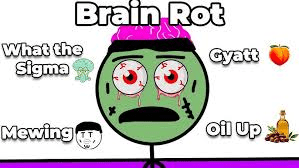
One of the latest features of online wordplay is the elevating of an older concept or cliche into a teasing provocation or pretence at new insights, as we have seen with ‘delulu’, ‘demure’ and ‘mindful’, ‘rizz’ and ‘brat’. The current rash of declarations of ‘being privileged’ – a new version of ‘humblebragging’ or ‘virtue-signalling’ – is another example. In parallel is the ironic celebration of the incoherence or absurdity of much online discourse and of low-quality ‘slop’ by embracing a culture of ‘brainrot’ – nonsense memes such as ‘skibidi’ and vacuous, contagious content.
Most of the innovation in online language and image still emanates from the US and even though a global audience can access it instantly, its tropes (think ‘goblin-mode’ – ‘goblin’ doesn’t have the same associations for Brits) don’t always translate for other speakers of English. In parallel, poses, gestures and looks as well as music-related modes are increasingly generated from non-English cultural zones such as Japan and Korea. It will be interesting to see if other parts of the globe begin to play a part in the evolving online theatre of signs and behaviours, but this doesn’t seem to have happened yet.
On the first of November Collins Dictionaries, ahead of the pack, had already announced their choice of word of the year for 2024, and their candidates illustrated the same, in my opinion mistaken, concentration exclusively on terms from a very narrow range of sources. While postings on social media are performances designed to attract attention, there is an even wider domain in which discourse demands analysis: the crises in the Middle East and Ukraine and the surreal spectacle of the US presidential campaigns, for example, are also highlighting keywords and generating new formulations or reworkings of language – data that mainstream media and lexicographers seem to think unworthy of their attention…
Digital media enables language change and innovation – of course, but how much and for how long?
I spoke to Caitlin Talbot, Culture Researcher for the Economist magazine, who asked me about the effect of TikTok talk and the slang, catchphrases and viral puns invented by Gen Z. Caitlin wondered how many new terms were actually being added to the global conversation each year, and whether these novelties would last.
My own solo attempts to record new language and to understand and comment on its sources rely on fairly haphazard, old-fashioned techniques, so it’s not possible for me to quantify the lexical items, locutions, expressions and longer elements of discourse that I come across. The major dictionary publishers do have access to powerful and sophisticated electronic methods of scanning, scraping (‘aggregating’ as it should more properly be termed) raw linguistic data from across the internet. This material can be categorised to a certain extent and entered into giant databanks from which lexicographers can select the terms they periodically admit into published dictionaries.
Attempts to amass and analyse examples of language in use are nonetheless hampered by several considerations: the language in question is primarily in the form of text, rather than authentic speech, and the texts in question are largely recoverable from published sources and media platforms, only to a limited extent from personal messages. Tracking their use over time is possible, and the popularity of some usages can be subjected to frequency counts and represented on timelines, but private use and communications by local and specialist communities is far harder to assess. One of the more interesting challenges to the lexicographer is to predict which novel terms may become embedded in the national conversation and which drop out of use – some almost immediately and others over time. In fact my experience (since I began to collect slang in the 1980s) proves that it’s impossible to predict, let alone to speculate as to why this happens.
Caitlin’s article, with useful links, is here…(if it is paywalled for you, go to here *)
In speculating about the number of new terms generated (and the playful, sometimes absurdist tendencies featuring on social media involve not only inventing new terms but reworking and re-purposing existing language like ‘demure’, ‘babygirl’, ‘millennial pause’, etc.) we can only fall back on subjective, anecdotal, incomplete accounts, even if these may be interesting and informative in their way…
THE WORD “demure” is old—it describes the sort of modest lady Victorians esteemed—but it is freshly fashionable. There are some 800,000 posts on TikTok with the tag #demure. Youngsters today are using the word with lashings of irony, invoking it to describe everything from Saturn to sunset to New York City’s bin service.
TikTok is changing how young people talk. Other fusty words, such as “coquette”, are fashionable again. Colloquialisms are on the rise: members of Gen Z say “yapping” instead of “talking” and trim “delusional” to “delulu”. New words have also become popular. Take “skibidi”, a term popularised by a meme of an animated head singing in a toilet; it means “cool”, “bad” or “very”, depending on the context.
On social media words spread far and fast. At least 100 English words are produced, or given new meaning, on TikTok a year, reckons Tony Thorne, director of the Slang and New Language Archive at King’s College London. Some linguists think the platform is changing not just what youngsters are saying, but how they are saying it. A “TikTok accent”, which includes “uptalk”, an intonation that rises at the end of sentences, may be spreading.
The platform’s versatility encourages experimentation. Users can combine audio, text and video in a single post. That means words that sound especially satisfying can go viral, as well as those that are memorable in written form. Linguistic code has emerged, dubbed “algospeak”, to dodge content-moderation algorithms. It includes euphemisms (sex workers are called “accountants”), and misspellings (“seggs” instead of sex).
The mutation of language on TikTok is also due, in large part, to the age of its users. Most are 18-34 years old. That matters because “Young people are language innovators,” says Christian Ilbury, a linguist at the University of Edinburgh. For decades youngsters have created words to distinguish themselves from adults. On social media such neologisms find a big audience. Mr Ilbury describes this as “linguistic identity work”; parents have long called it attention-seeking.
The platform brings together fan groups and communities, from #kpopfans (people who like Korean pop music) to #booktokers (people who love reading). These groups create their own slang, says Adam Aleksic, a linguist and influencer. Some of it leaks into the mainstream. Other slang comes from specific groups: black people have innovated and spread hundreds of English words over the years, from “cool” to “tea” (gossip). Journalists and screenwriters popularise such words; now TikTokers do, too.
*For help in understanding the language and online mannerisms of TikTok and GenZ, I’m grateful to my daughter, Daisy Thorne Mrak*
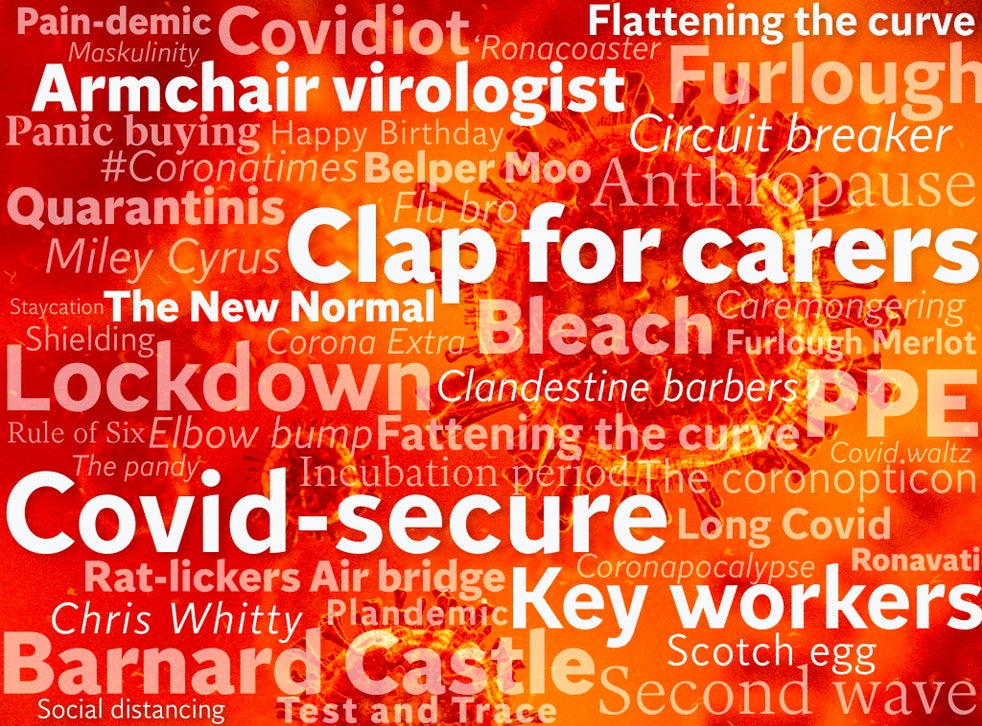
The second part of my Lockdown Lexicon, Covidictionary, Glossary of Coronacoinages
In trying to make sense of our new circumstances, under lockdown, in social isolation or distancing, we must come to terms with an array of new language, some of it unfamiliar and difficult to process, some pre-existing but deployed in new ways. Many of us, though, are empowering ourselves by inventing and exchanging our own expressions, some of which have already escaped the confines of the family or the virtual work group.
I listed in my last post some of the scientific and technical terms which have moved into everyday usage. Those can seem intimidating – for good reasons – but most have been readily understood.
This time I’m looking at the language that homeworkers and locked-down friends, families and individuals, in some cases journalists too, in English-speaking areas have coined to fill the gaps in the official narratives and to find ways of expressing concepts that simply didn’t apply a few weeks ago. This includes nicknames, jargon, slang, abbreviations, puns and recent catchphrases and clichés.
I have tried to categorise the terms: again, some have become familiar by now while others may remain mysterious to many. For the moment this is a work in progress – an ongoing project to track the language of the crisis and to operate a linguistic ‘rapid response’ in gathering data.
Although it is a first draft, I thought it important to publish the list now (you can find more on many of these expressions, which won’t appear in standard dictionaries for some time, simply by Googling) and to appeal for anyone reading it to send me new terms, either to this website or to Twitter @tonythorne007. As the list grows I will thank and credit as many contributors as I can.
These are the new expressions, in no particular order, but divided roughly according to theme or topic (there are some terms – isocosm, meaning the contracted reality we are now living in – is one, which could fit under several headings)…
Describing the new realities
Anthropause – the hiatus in human activities occasioned by the pandemic, seen in terms of its effects on nature, wildlife, etc.
Coronaverse (Guardian) – the now prevailing socio-economic order
Quarantimes – a hashtag or label for the prevailing circumstances under lockdown due to the coronavirus pandemic
#Coronatimes – a hashtag on Instagram and Twitter: the period we are presently living through
BCV, B.C – (the period) before corona(virus)
Common invisible enemy (NATO) – virus as a sinister threat to the collectivity
Coronapocalypse – the effects of coronavirus framed as catastrophe
Radical uncertainty – doubts and uncertainty around decision-making in an unknowable future (title of a work by John Kay and Mervyn King)
Viral anxiety (New Statesman) – fear and uncertainty, sometimes excessive, due to the COVID-19 outbreak and its ramifications
Disinformation pandemic – the spread of fake news and false theories
Infodemic – the accelerated spread of disinformation
The coronopticon (Economist) – the notion of a national or global system of surveillance and control
Biosurveillance – monitoring the occurrence of contagion in a population
Security hygiene – methods intended to counter online scams, frauds and misuse of AI
Digital vigilance – raising awareness of and guarding against cybercrime and fraudulent claims
#coronanoia – paranoia induced by conditions obtaining in the pandemic
Caremongering(Canada and India) – organised acts of kindness and propagation of good news by volunteers
Armchair virologist – an unqualified self-styled expert on viral spread dispensing explanations and/or advice
Coronasplaining – purporting to explain aspects of the coronavirus-induced crisis, particularly to those who understand it better than the explainer
Coronaspiracy theories – conspiracy theories circulating as a result of the spread of COVID-19
Pancession – a pandemic-associated widespread economic recession
Disaster capitalism – profiting, profiteering and exploitation in conditions of local and global crisis
Disaster altruism – acts of benevolence in response to local and global crisis
#lockdowners – individuals coping with life in conditions of isolation
Wobble room – a safe physical space designated for the use of those experiencing psychological distress
Corona warriors (India) – frontline professionals, also known as covid-19 warriors, working to control the pandemic
Covexit – an exit strategy permitting relaxing of confinement and economic recovery following coronavirus-related restrictions
Second wave – a resurgence in the number of cases of infection following the relaxation of initial containment procedures
Corona crunch – the dramatic impact of the pandemic on e.g university income, investment returns
Post-normal science – instances where crucial socioeconomic decisions must be made despite uncertainty as to the relevant scientific facts
Contagion chivalry (New York Times) – an act or acts of selflessness during confinement
Coronacoaster – successive feelings of elation and despair experienced under conditions of confinement
#coronaclickbait – marketing messages or invitations to read information playing on COVID-19 fears
Loxit – the process of exiting from lockdown impositions
Loxino – lockdown exit in name only: an only apparent or partial transition
Circuit-breakers – halting an exit from lockdown by closing re-opened venues or ceasing re-started activities
#unlockdown – the process of relaxing or ending social and physical restrictions, or the period following their ending; equivalent to, or translation of the French déconfinement
Coronaphobia (Daily Mail) – fear experienced by the public at the prospect of having to return to work, send children back to school, use public transport, etc.
Bubble – a social group, a small number of family members and/or friends or teachers and students permitted to interact while wider social constraints continue, also a geographical zone within which travel and trade is permitted
Coronawashing – corporations or individuals taking advantage of the pandemic to promote their altruism, philanthropy and achievements
Cleanliness theatre/er – conspicuously thorough cleaning of hotels, restaurants, etc., intended to reassure customers: if in hospitals and public places it is known as hygiene theatre/er
Vaccine nationalism – competing to discover and produce an antivirus vaccine (benefitting from prestige thus acquired) and potentially then restricting availability to one’s own citizens
Air bridge – a travel corridor between two or more states allowing passage without quarantine. In July 2020, amid confusion, official messaging began to substitute the phrase ‘international travel corridors’
Scarring – long term negative effects resulting from initial harm suffered during social and/or economic upheaval
Security theater (American) – measures that make individuals feel safer without necessarily actually protecting them: public temperature measuring and airport security procedures are examples
Lockstalgia (Times) – the notion that we may look back fondly upon the period of confinement
Clandestine barbers – hairdressers operating illicitly before being allowed to reopen after lockdown
Decompression – the release of inhibitions and surge in misbehaviour expected following the opening of UK pubs and restaurants on 4 July 2020
Safecation – a holiday in a destination thought to be safe while the pandemic continues elsewhere
Wet pubs (Irish) – pubs selling only drinks and not food, so the last to be allowed to open after lockdown
#casedemic – the suggestion that governments are misleadingly using case numbers rather than more meaningful indices in order to implement unnecessary restrictions in what is actually a waning pandemic
Tech-celeration – during 2020 the pandemic accelerated the adoption of many technological behaviours, from video-conferencing and online shopping to remote working and distance learning
Parklet – an extension of a city pavement to provide additional outdoor seating or leisure space when social distancing is enforced and indoor spaces are subject to restrictions
Risk normalisation – a relaxing of vigilance and compliance with regulations by a public now becoming used to pandemic conditions, observed in November 2020 in the UK
Vaccine hesitancy – a reluctance to take, or fear of the consequences of taking the coronavirus vaccine once available (e.g in the UK from December 2020)
Corona-compromised – (of an event) called off, postponed or abandoned due to the ongoing threat of the virus
Twindemic – a posited scenario in which an epidemic, such as COVID, is accompanied by an outbreak of a second infectious disease, such as human or non-human influenza
Pandemicide – gross negligence or deliberate strategy leading to widespread loss of life during the pandemic, a charge levelled at Donald Trump in a September 2020 publication
Coronasomnia (Washington Post) – sleeplessness as a result of anxiety related to the coronavirus pandemic
Coronaversary – the anniversary, in mid-March 2021, of the first tangible reactions to, and realisation of the impact of COVID-19 infections
Vaccine bounce (New Statesman) – the upswing in approval ratings for the UK government following public perceptions of a successful vaccination programme
Re-entry syndrome – the stresses accompanying adjusting to emergence from lockdown
Scariant – a virus mutation or variant which is promoted as being alarming without adequate evidence
Jab-fest – a frantic launch of a large-scale vaccination programme as in India in April 2021
Surge-jabbing – an intensification of a vaccination programme to deal with a highly contagious new variant, as in the UK in May 20121
Variant of concern – a new and more dangerous virus strain
Exit wave – a resurgence in COVID infections predicted to follow an ending of restrictions, of the kind planned for July 19 2021 in the UK
Immunity debt – the phenomenon whereby cases of other infectious diseases, such as norovirus, increase more than usual once protective measures against COVID are removed.
Breakthrough infections – cases in which individuals become infected despite having been vaccinated
Fauxvid – symptoms of malaise mistaken for COVID
NOVID – a common cold whose symptoms mimic those of COVID
PPSD – ‘post-pandemic stress disorder’, a condition promoted by psychotherapist Owen O’Kane in the summer of 2021
Flurona – a rare combined infection of influenza and COVID, recorded in Israel in December 2021
Long social distancing – the phenomenon whereby anti-pandemic precautions continue to be practised by some after the pandemic seems to have subsided
Tripledemic – the possible scenario, for the winter of 2022, in which health services may be faced by COVID, seasonal flu and additional respiratory infections
Nicknames
Rona, Lady Rona, Miss Rona, roni, rone – the coronavirus personified/familiarised
The rona – the coronavirus
The ‘vid – coronavirus
The pandy – the global pandemic, (by Autumn 2020 sometimes in the form panny-D)
The pando (Australian) – the coronavirus pandemic
nCoV – the coronavirus in technical designation or shorthand
Boomer remover – the coronavirus viewed as a phenomenon resulting in the decimation of the babyboomer demographic
Nightingales – first used as a nickname for those singing or performing morale-boosting music from balconies, in gardens, later abandoned when the Nightingale emergency hospitals were opened (or rather, announced but not opened) across the UK
Long-haulers – recovered victims of the virus who suffer long-term after-effects
Locky D – lockdown familiarised
Rat-lickers – those refusing to wear a mask (from the idea that potential victims of the bubonic plague licked rats to ward off infection)
Vaccine-hunters(CNN) – desperate individuals who, rather than wait for invitation to be vaccinated, stalk a pharmacy, hospital or other vaccination site in the hope of obtaining a leftover dose
Innoculati – the fortunate individuals who have already been vaccinated
Halfcinated – having received the first of two vaccine doses
Strollout (Australia) – the rollout of anti-virus vaccination, perceived as being too slow
Nosers – mask wearers who negate its effect by leaving their nose uncovered
Slang
Miley Cyrus (UK rhyming slang) – coronavirus
Covidiot – a person behaving irresponsibly in conditions of containment
Morona – a person behaving stupidly because of or during the coronavirus outbreak
Coronalusional – suffering from disordered thinking as a result of or during the COVID-19 crisis
Sanny (Australian) – hand sanitiser
Iso (Australian) – (self-) isolation
Isobar (Australian) – a home bar stocked, displayed and/or depleted in confinement
Isodesk (Australian) – a workplace improvised or used in confinement
Coronacation – cessation of study or work due to the pandemic, viewed as a holiday
Corona break – a period of confinement envisaged as a short holiday
Drivecation – a holiday, typically in a motorhome, in one’s own driveway
Hamsterkaufing – stockpiling and/or hoarding (adapted from German)
Coronaspeck – extra girth resulting from overeating in confinement
The COVID 19(lbs) (American) – extra body weight accrued during quarantine
Coroanacuts – haircuts carried out at home, especially when less than successful
De-roning – attempting to remove traces of coronavirus by cleaning/disinfecting items that have recently entered the home
Zumped –‘dumped’ by a partner via videolink or otherwise online
Ronavation – renovation or refurbishment during lockdown, an Instragram hashtag
Coronacranky – short-tempered as a result of enduring lockdown
Flu bro (American) – a male coronavirus denier, from their assertion ‘It’s just the flu, bro.’
Quarandating (Canadian) – using cellular dating apps to meet people and go on virtual dates through platforms such as FaceTime
Zoombie – someone incapacitated by too much screen time, or a malicious disruptor of a videoconference
Quarantanning – sun bathing or using tanning equipment during confinement
Quaran-stream – binge-watch TV series, movies while enduring lockdown
Smizing – smiling with the eyes, as when wearing a facemask (a term coined by US celebrity Tyra Banks in 2009)
Spendemic – a dramatic increase in online shopping by those confined during the coronavirus crisis
Coronasshole – first applied in March 2020 to US panic buyers, then in June to US citizens refusing to wear masks. In July the synonym #maskhole began to trend on social media
Spreadneck (American) – an ignorant and/or stubborn anti-vaxxer
Maskulinity – a macho refusal to wear a face covering
Furlough Merlot – a red wine assuaging the anxiety of lockdown and WFH
Lockdown locks – long and /or unruly hair following months without cutting or styling
Blursday – an undifferentiated day or date due to uncertainty after long confinement and isolation
Airgasm – the intense pleasurable feeling experienced when able to remove a mask and breathe freely again
Vaxinista – someone who flaunts the fact that they have been vaccinated as if a fashion statement
Vaccine sommelier – a person delaying vaccination until they can choose their preferred brand of vaccine
Pinged – advised by the NHS phone app to self-isolate
Pandemic pants(Australian) – track-suit bottoms worn while locked down or WFH
Nerd immunity – the notion, based on studies reported in February 2021, that those wearing glasses are less susceptible to COVID infection
Corona classic – the original strain of infection rather than a later variant
Partygate – the scandal surrounding allegations that those in authority flouted their own restrictions by holding illicit celebrations and gatherings
Homeworking and teleconferencing
WFH, wfh – working from home
Productivity ninja – a stress-free, purposeful and high-achieving worker (title of work by Graham Allcott)
Covidpreneurs (Irish Times) – individuals or businesses succeeding in thriving and innovating in a pandemic environment
Zoombombing – hijacking and/or interrupting videoconferencing on the Zoom platform
Slackers – remote workers using the Slack groupworking application(s)
Virtual backgrounding** – adjusting one’s visible décor for videoconferencing
Videofurbishing** – enhancing one’s décor prior to videoconferencing
Zoom room – part of one’s home kept clean and inviting for use as videocalling background
Quarantini – a martini mixed and consumed in conditions of confinement
Locktail hour – a time allotted to consumption of cocktails while isolating
Upperwear – clothing selected for display above the waist only
Telecommutercore (Guardian) – casual clothing selected for use when videoconferencing and/or home-based working
Infits – outfits worn in conditions of confinement
Quaransheen** – a shiny nose and/or forehead visible while engaged in videoconferencing
Zoomlift** – the cosmetic surgery supposedly required as soon as obligatory online interaction ends
Coronaviva – an oral examination or thesis defence taken online during lockdown
Quaranteams – groups forming and performing – music or competing in quizzes for example – together virtually during lockdown
Quaranqueens – a woman excelling during lockdown, particularly one excessively cleaning and tidying
Quarantrolls – individuals sending malicious online messages in conditions of and/or referring to quarantine
Quarantunes – music produced and/or performed under lockdown
Quaranzine – a magazine produced under lockdown
Coronalit – literature produced during/inspired by the pandemic
Corona-fi – fiction or science-fiction produced during/inspired by the pandemic
Zoom mullet – a hairstyle developed in lockdown which is ‘camera-ready’ (presentable to a webcam) at front and sides and dishevelled at the rear
#isobaking – home-baking in confinement and/or exchanging recipes: a hashtag on TikTok and Instagram
Zoomitzvah (Jewish Chronicle) – a bar mitzvah celebrated via video app in confinement
Homeference – a virtual conference that participants can attend remotely
Zoomed out – exhausted and/or disoriented after spending too much time in videoconferences
Zoom fatigue – a draining of energy resulting from the unusual stresses involved in interactions in virtual meetings
The wipe-away – the high-visibility handwaving that indicates the person is leaving a virtual meeting
Toxic productivity – the unfair expectation that professionals, creatives and others should be able to stay productive, even achieve more during adverse situations such as the Covid-19 pandemic
Uberise – to emulate Uber in moving to a system whereby employees decide which hours of the day they will plug in under the work from home model during the pandemic
The elephant in the Zoom – an unmentioned presence or unacknowledged issue in an online meeting, or an elephant themed background or video
Desk disco – defined by translator and copywriter Ian Winick as ‘taking a few minutes out to boogie on down at your desk’
Hate-wear (New York Times) – clothing items, usually unfashionable, possibly also uncomfortable, worn in confinement for their utility rather than their style
Sadwear (Esquire) – ‘clothes that make us feel better when we’re sad, specifically born out of the existential ennui of lockdown’
Apocalypse beard (Guardian) – uncontrolled facial hair that can double as a face-warmer
Hybrid working – a combination of working remotely and on-site
WFA – working from anywhere. ‘It also used to be called telecommuting – that’s an example of how language changes over time, says Tracey Fritcher, principal strategist of employee experience at ServiceNow.’ Their useful glossary, published by the Guardian, is here****
Pandemic posture – ‘slouching, slumping and hunching’, the unhealthy effects of 18 months of working at home or in unstructured environments
Legacy hand – a hand raised to ask a question in a virtual discussion and the hand is not subsequently lowered, leading to confusion
Demographics
Coronials – The generation born after December 2020 as a result of the enforced quarantining of their parents due to the COVID-19 pandemic
Gen(eration) C – in 2018 designated young ‘connected consumers’, now may refer to young people coming of age since the onset of the coronavirus crisis
Quaranteens – the generation who will become teenagers in 2033 -4
Security measures
Elbump – an elbow contact in place of handshaking or other physical greeting
Coronadodge – swerving to avoid passers-by to comply with distance restrictions
Couple-spreading – couples permitted under regulations to walk together taking up excessive space in public places
Covid waltz – manoeuvring to avoid close contact with passers-by while distance restrictions are in place
Loopholing (South African) – exploiting imprecisions or allowances in distancing restrictions in order to travel
Overreaching – enforcing crisis-related regulations too zealously
Yob-dobbing – reporting someone’s antisocial behaviour to authorities
Ronadobbing (Australian) – informing on those contravening crisis-related restrictions
Coronasnitching ** – informing on those contravening crisis-related restrictions
Covidobbing** – informing on those contravening crisis-related restrictions
Coronagrass** – a person who informs on those contravening crisis-related restrictions
Curtain-twitching – peering at and/or spying on neighbours
Corona-shaming (New York Times) – publicly criticising those, particularly celebrities, who have infringed public health regulations
Masklessness – wearing no face-covering, in US often as a gesture of defiance and/or disbelief in standard pandemic narratives and official advice
Whack-a-mole – a piecemeal response to a major problem, such as ad hoc local lockdowns in the context of a second wave of infection
Cohorting – imposed grouping of health care workers and others, for example teachers and students working together or prisoners and guards, who are potentially susceptible to viral infection
Covid marshals – officials sent to public locations to enforce new UK social distancing rules from September 2020
Lockdown light – used in Germany and elsewhere in October 2020 to describe a set of restrictions on movement and behaviour that falls short of a full lockdown
Tier 4 – an upgrading of the UK’s three-tier pandemic management system of graduated local lockdowns to a national lockdown, envisaged from November 2020
Mockdown – a term trending in November 2020 and again in January 2021 indicating a lockdown that is insufficiently enforced and/or widely disregarded
#Scamdemic, #shamdemic, #Plannedemic, #Coronascam – hashtags used by US conspiracy theorists attempting to discredit orthodox narratives of the pandemic
‘You know how Gen Z are using ‘cornteen’ as a playful misspelling of ‘quarantine’? This is now reflected in the emoji spelling teen.’
In Spain and Italy the combination 👑🦠 is used, as ‘corona’ is their word for crown
Recently trending terms
Unprecedented
Cataclysm(ic)
Hunker down
Ramp up
Mobilisation
Cabin fever
Stir-crazy
Dark days
Strange days/times
Uncertain times
The new normal
Exit strategy
Bounceback/bounce back
Behind the curve
Calamitous
Infinite present
Snap back
Game changer
Gaslighting
Easing
Hubris
Obfuscation
Evolving
Mandatory
The Before Time(s)
U-turns
Fatigue
Compliance
Trying times
*Quote: “When some idiot second guesses a specialist, e.g. when a cartoonist pronounces on epidemiology lessons: to stay in your lane you must know your lane”
**These are terms which have been proposed in online discussions but which may not yet have embedded themselves in the national conversation
*** From forensic linguist Professor Tim Grant; “following the science” There’s no such thing as “the science”. Scientific conclusions are often subtle and slippery. This phrase is being used to avoid responsibility by those taking political decisions. It’s the job of scientists to question, to disagree, to propose alternative explanations, alternative conclusions, to bring to the fore additional evidence that hasn’t been noticed. It’s the job of politicians to weigh this mess of conflictual evidence and make decisions. This decision making is hard and requires taking responsibility. Using “following the science” as cover, is spin doctoring of the worst kind. It’s cowardly, distancing, its-not-my-fault playing politics with this appalling crisis. It’s a failure of political leadership.
Peter Bakker and his colleagues at the University of Aarhus, Denmark have kindly shared their (not entirely serious) compilation of COVID-related language novelties…
In July 2020 the New Yorker published its own guide to coronaspeak. While the content is amusing, I will not be adding these terms to my glossary until I’m sure they are in circulation among users other than journalists…
In August 2020 one of the first, if not the first, academic studies of COVID-related neologisms appeared, with a very useful multilingual bibliography:













 tony thorne