My un-asked for, scrambled words of the year for 2025 appear in the wordcloud above. Not based on statistical surveys, frequency scans or media prominence, but on the instincts and intuition of a logophile and lexicographer. The words of the year chosen and promoted by the Dictionary publishers* are worthy in their way, once again favouring expressions generated by tech innovation and social media, but they reflect inevitably the perspective of a cohort (aging dictionary editors and their target market) who are at one remove from the language actually being coined or repurposed by what linguists call ‘expert users’. As I write I realise that my own final selection has left out some important last-minute candidates, now featuring in the end-of-year online discourse: vice-signalling, shroud-waving, microshifting and tablescaping, plus a runner-up, sponcon (= sponsored content) for example. The familiar youth slang term of address unc** has just, belatedly, been noticed by the mainstream media, while the terms flow state, in the zone and locked in, used by influencers, content creators and gamers, all meaning focusing intently on an activity, are not yet on the old person radar.
As the winter solstice came and went I was quoted in a few of mainstream media’s reviews of the year’s language…
In Lane Greene‘s discussion of slang and its significance…
…and lastly I promise, a last word before Christmas Day: treatonomics, also known as Little Treat Culture, describes the trend for affordable indulgences, small, emotionally satisfying purchases that offer ‘guilt-free joy’
Back in December last year I wrote a second opinion piece on words of the year for the Conversation. You can find it here… *
At the end of January this year the Lexis Podcast team kindly invited me to discuss some of those words and why – if – they were really significant. We also looked at new terms recorded in 2025 so far, making a first attempt to explain and assess them, and to wonder which if any of them might endure. Our discussion, which went on for 40 minutes, is here…
…and, from February, a little puzzle for you. Can you unscramble and reassemble these two-word novelties? (Thanks to simplewordcloud.com)
It’s now July, and my attempts to go on recording this year’s wholly new, or reworked and updated termsand expressions have been interrupted by the need to react to the news-cycle – to the sinister euphemisms, avoidances and untruths perpetrated by war criminals, would-be dictators and their servants in the media. Examples of their language have been added my glossary of toxic terminology and the updated version is here…
John Belgrove reminded me that in May Donald Trump bragged of coming up with a new word – ‘a good word’, but the word in question was ‘equalising’. I have managed nonetheless, with the help of other friends and contacts on Twitter, BlueSky, Instagram and Facebook, to gather a few more examples of lexical innovation, candidates for an end-of year survey in due course…
But I would very much welcome suggestions of other new words and phrases, ideally together with their meanings and comments on their usage in context. All donations will be credited and donors thanked.
A research portal for scholars, the press and the public
The Slang and New Language Archive was created in 1994 while I was Director of the Language Centre at King’s College London. The archive, consisting of a small library of books and periodicals and a number of databases and sub-directories, was designed as a repository for the collection, storage and dissemination of new language, in particular examples of nonstandard varieties of English such as slang, jargon and buzzwords. The archive was later expanded to take in examples of media language, political language, linguistic curiosities and etymologies. It remains a resource, unique in the UK and not-for-profit, assisting researchers, students, teachers and journalists, as well as non-specialists, in accessing information about aspects of contemporary language that are under-represented in traditional dictionaries and reference works.
This link will take you to the Archive webpage at King’s College, where there are further links to relevant articles and published sources…
Glossaries from the archive may be accessed on this site by entering keywords, such as slang, jargon, MLE (Multiethnic London English), familect (highly colloquial language used in the home), coronaspeak (language related to the COVID-19 pandemic) and weaponised words (the contentious language of Brexit, populism and biased reporting) and slurs (racist and misogynist terms) in the search box. Once you have accessed a post of interest, check the tags and categories at the foot of the page for other articles or glossaries on the same topic.
Two of the larger archive datafiles have now been revised and updated. You can access the glossary of current youth slang here…
To access the glossary of UK street slang, rap music and gang terminology please email me at tony.thorne@kcl.ac.uk to request a link.*
Please note that the King’s archive focuses principally on contemporary language, that is terms used from the twentieth century to the present day. If you are interested in historical slang, I strongly recommend the monumental work by my associate, the British lexicographer Jonathon Green. His dictionary, now generously freely available online, lists current and historical slang terms with timelines and citations illustrating their usage and development…
For more information, for queries, or to donate examples of language, contact me via this website or via the King’s College webpage. I’m on Twitter as @tonythorne007 and on Bluesky as @tonythorne007.bsky.social too.
In terms of new slang and nonstandard language there are few reliable resources online. In February 2025, however, US publisher Merriam-Webster launched their own slang dictionary. You can find it here…
Among the many more informal glossaries and wordlists of slang posted on the internet in 2025, this review of slang in English schools is unusually comprehensive and accurate…
A (nearly) new lexicon describes new attitudes to work
I spoke last week to Financial Times journalist Emma Jacobs about so-called ‘Polygamous Working‘, part of the new vocabulary of the workplace generated by younger employees still coming to terms with a post-pandemic work-life balance. Holding a second job is not necessarily illegal providing it is disclosed, but recent reports describe hundreds of public sector workers in the UK illicitly receiving multiple salaries from simultaneous jobs. When the idea of a polyamorous workplace first surfaced three or so years ago, some business gurus hailed it as a positive trend: “Polygamous careers are giving workers the opportunity to hone new skills, fully leverage their knowledge, and pursue numerous interests at once. The emphasis is on contributing to various projects and roles, as opposed to working exclusively with a specific employer.”
“In this context new expressions like “quiet quitting” and “task masking” are gaining traction. They are, says writer and lexicographer Tony Thorne, “self-consciously coined and promoted like memes”, designed to go viral. Thorne thinks this suggests the young people using them are not lazy, but “more resistant to accepting traditional notions of work, workplaces and work etiquette”. Perhaps no surprise, given they grew up in the aftermath of Brexit and the pandemic.“
Gen Z in particular have a different take on work-life balance and really on the nature of work itself I think. They approach these things as part of a wider matrix of lifestyle modes, (self-help and self actualisation and curating relationships) what they call ‘vibes’ and ‘aesthetics’ and performative behaviour. We can’t forget also that their behaviour even at work often reflects their pervasive use of irony, sarcasm and self-parody.
This is reflected in the terminology they have adopted of course. I think another aspect which hasn’t been discussed much is the fact that GenZ have not been conditioned by the sort of corporate culture, office culture or lingering work ethic that Gen X and millennials were conditioned by. Add to this the fact that they more than anyone have undergone the disruption caused by Brexit, the aftermath of austerity and the pandemic and so may be more resistant to accepting traditional notions of work, workplaces and work etiquette.
There is yet another way in which things are different for younger cohorts. They exist in a globalised online reality where trends in behaviour are not driven by ‘authorities’ or ‘professionals’ but by influencers and content creators chasing clicks and clout. New expressions are not just words or phrases which spread by word of mouth but may be self consciously coined and promoted like memes. They may not simply exist as sounds and spellings but also accompany images and soundtracks (as on TikTok). Linguists might call them ‘multimodal‘.
Neither the notions they describe or the terms themselves are completely new. Back in 2005* I reported ironic office slang such as ‘FaceTiming’, just putting in an appearance to suggest dedication to the job, ‘Sunlighting’ (like moonlighting), aka ‘Dual Jobbing‘, doing a quite different job one day a week. ‘WFH‘, ‘Remote Working‘, ‘Hybrid Working‘ – and ‘Side Hustles‘ – were later coinages prompted by enforced flexibility. The end of the pandemic saw the ‘Great Resignation‘ of 2021 as disillusioned workers supposedly abandoned unfulfilling careers en masse. Employers were encouraged to promote ‘Cross-Skilling‘, training staff to perform a wider range of functions, and ‘Job-Crafting‘, allowing employees to design their own roles.
Emma’s article with contributions from Bobby Duffy, director of the Policy Institute at King’s College London, is here…
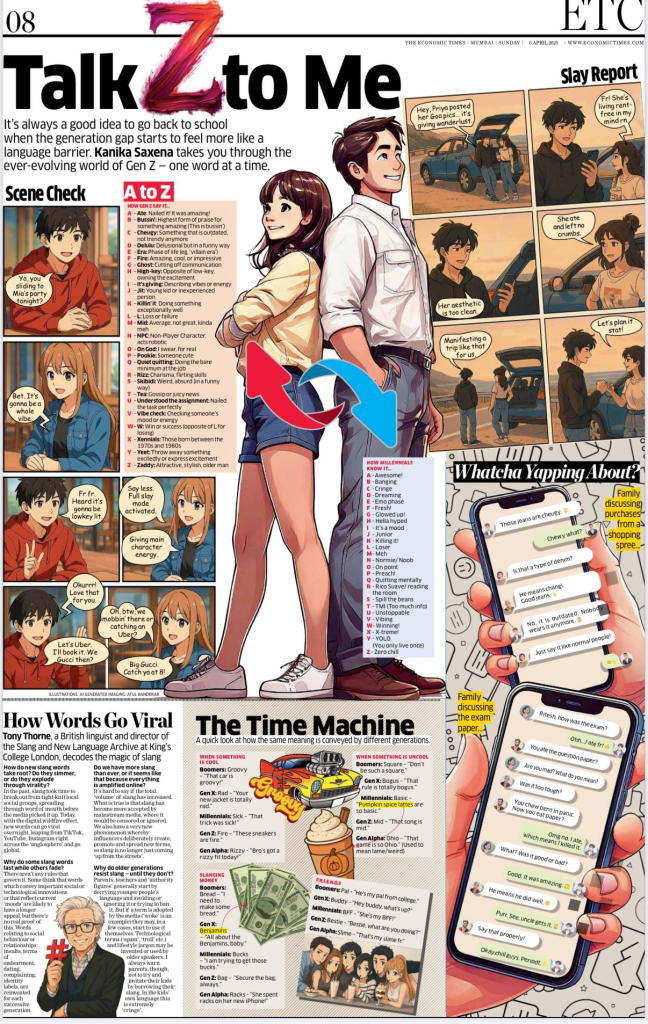
Last week I was interviewed by two young journalists about the pervasive slang generated by Gen Z and Gen Alpha. Interestingly both journalists are operating outside the US/UK matrix from which much of this language variety emanates. Interestingly too, both journalists asked similar questions about the latest linguistic novelties and how we might respond to them. Kanika Saxena‘s piece appeared in the Economic Times of India, and my contribution is here…
1. How do new slang words take root in a generation? Do they slowly build momentum, or does one viral moment suddenly put them everywhere?
In the past it could take some time for slang to escape from the local social group (‘in-group’ or ‘peer group’: a group of friends, a gang, fellow workers, etc.) where it originates into the outside world, then to spread by word of mouth into other parts of society, finally perhaps being picked up by the entertainment or print media. Nowadays this process has been massively speeded up by messaging and the internet, so that a novel term can go viral and reach beyond its original community almost instantaneously. New expressions can spread via social media and platforms like TikTok, Youtube, InstaGram right across the ‘anglosphere’ and go global.
2. Some words stick around for decades, while others vanish overnight. What makes certain slang words stand the test of time?
Linguists have tried to analyse why some terms become briefly fashionable and then disappear while others endure. There don’t seem to be any rules that govern why this happens. Some experts think that words which convey important social or technological innovations or that reflect current ‘moods’ or preoccupations are likely to have a longer appeal, but there’s no real proof of this. It could also be because a word relates to important social behaviour or relationships: insults, terms of endearment, ‘dating’ language, complaining, identity labels, for example, have to be reinvented for each successive generation, then persist until their users mature or grow older.
3. With social media throwing new words at us daily, are we actually creating more slang than before, or does it just feel that way because everything is amplified online?
It’s hard to say if the total ‘volume’ of slang has increased because, in the past at least, it was impossible to quantify it. What is definitely true is that slang has for some time become more accepted by mainstream media whereas it used to be censored or ignored. We also have the very new phenomenon whereby influencers, TikTok stars and content creators are using online resources to consciously, deliberately create, promote and spread new terms, so slang is no longer just coming ‘up from the streets’ (or spread via music, TV and movies) but is a commodity exchanged and pushed to gain prestige or sell oneself.
4. Older generations always seem skeptical of new slang—until, of course, they start using it too. What’s the secret to a word crossing generational lines?
Parents, teachers and ‘authority figures’ generally start by decrying younger people’s language and avoiding or ignoring it or trying to ban it. (This isn’t really justified by the way: slang may be seen as socially marginal but is not technically deficient or defective language and uses the same techniques as poetry or literature) But if a term is adopted by the media (‘woke’ is an example) they may in a few cases start to use it themselves. Technological terms (‘spam’, ‘troll’ etc.) and lifestyle jargon may be invented or used by older speakers. I always warn parents, though, not to try and imitate their kids by borrowing their slang. In the kids’ own language this is extremely ‘cringe’.
My second interview was with Austėja Zokaitė who is based in Lithuania and it appears in the online magazine Bored Panda, an arresting and anarchic daily roundup of the latest viral images, memes and commentary on internet culture. The whole report is here, with my comments interspersed with the succession of visual elements…
Digital media enables language change and innovation – of course, but how much and for how long?
I spoke to Caitlin Talbot, Culture Researcher for the Economist magazine, who asked me about the effect of TikTok talk and the slang, catchphrases and viral puns invented by Gen Z. Caitlin wondered how many new terms were actually being added to the global conversation each year, and whether these novelties would last.
My own solo attempts to record new language and to understand and comment on its sources rely on fairly haphazard, old-fashioned techniques, so it’s not possible for me to quantify the lexical items, locutions, expressions and longer elements of discourse that I come across. The major dictionary publishers do have access to powerful and sophisticated electronic methods of scanning, scraping (‘aggregating’ as it should more properly be termed) raw linguistic data from across the internet. This material can be categorised to a certain extent and entered into giant databanks from which lexicographers can select the terms they periodically admit into published dictionaries.
Attempts to amass and analyse examples of language in use are nonetheless hampered by several considerations: the language in question is primarily in the form of text, rather than authentic speech, and the texts in question are largely recoverable from published sources and media platforms, only to a limited extent from personal messages. Tracking their use over time is possible, and the popularity of some usages can be subjected to frequency counts and represented on timelines, but private use and communications by local and specialist communities is far harder to assess. One of the more interesting challenges to the lexicographer is to predict which novel terms may become embedded in the national conversation and which drop out of use – some almost immediately and others over time. In fact my experience (since I began to collect slang in the 1980s) proves that it’s impossible to predict, let alone to speculate as to why this happens.
Caitlin’s article, with useful links, is here…(if it is paywalled for you, go to here *)
In speculating about the number of new terms generated (and the playful, sometimes absurdist tendencies featuring on social media involve not only inventing new terms but reworking and re-purposing existing language like ‘demure’, ‘babygirl’, ‘millennial pause’, etc.) we can only fall back on subjective, anecdotal, incomplete accounts, even if these may be interesting and informative in their way…
THE WORD “demure” is old—it describes the sort of modest lady Victorians esteemed—but it is freshly fashionable. There are some 800,000 posts on TikTok with the tag #demure. Youngsters today are using the word with lashings of irony, invoking it to describe everything from Saturn to sunset to New York City’s bin service.
TikTok is changing how young people talk. Other fusty words, such as “coquette”, are fashionable again. Colloquialisms are on the rise: members of Gen Z say “yapping” instead of “talking” and trim “delusional” to “delulu”. New words have also become popular. Take “skibidi”, a term popularised by a meme of an animated head singing in a toilet; it means “cool”, “bad” or “very”, depending on the context.
On social media words spread far and fast. At least 100 English words are produced, or given new meaning, on TikTok a year, reckons Tony Thorne, director of the Slang and New Language Archive at King’s College London. Some linguists think the platform is changing not just what youngsters are saying, but how they are saying it. A “TikTok accent”, which includes “uptalk”, an intonation that rises at the end of sentences, may be spreading.
The platform’s versatility encourages experimentation. Users can combine audio, text and video in a single post. That means words that sound especially satisfying can go viral, as well as those that are memorable in written form. Linguistic code has emerged, dubbed “algospeak”, to dodge content-moderation algorithms. It includes euphemisms (sex workers are called “accountants”), and misspellings (“seggs” instead of sex).
The mutation of language on TikTok is also due, in large part, to the age of its users. Most are 18-34 years old. That matters because “Young people are language innovators,” says Christian Ilbury, a linguist at the University of Edinburgh. For decades youngsters have created words to distinguish themselves from adults. On social media such neologisms find a big audience. Mr Ilbury describes this as “linguistic identity work”; parents have long called it attention-seeking.
The platform brings together fan groups and communities, from #kpopfans (people who like Korean pop music) to #booktokers (people who love reading). These groups create their own slang, says Adam Aleksic, a linguist and influencer. Some of it leaks into the mainstream. Other slang comes from specific groups: black people have innovated and spread hundreds of English words over the years, from “cool” to “tea” (gossip). Journalists and screenwriters popularise such words; now TikTokers do, too.
*For help in understanding the language and online mannerisms of TikTok and GenZ, I’m grateful to my daughter, Daisy Thorne Mrak*
Teen talk continues to baffle older cohorts, but as autumn approaches the vibes shift – and Tiktok identities evolve…
In mid-August I talked to Mary McCarthy about the ever-changing patterns of youth language, and, with her kind permission, Mary’s article for the Irish Independent follows…
No cap, sigma and rizz? You’ll need more than Google Translate for teen talk now
Parents are supposed to be bemused by the slang words their children use, but the new summer vocab in our house has me totally flummoxed. This is particularly so with the younger two lads – eight and 11 – who walk around saying nonsense words like “sigma”, “no cap” “Skibidi Toilet” and “gyat” all the time.
I don’t mind them having in-jokes, and it’s nice to see them falling around laughing – I’ll take that over sullen moods any day. But what are they laughing about?
Are they being kind? I can see the pleasure of getting the giggles over absurd stuff. I used to have this thing with a school friend where we would say repeatedly “The dog is dead” in a Northern Ireland accent – no idea why. But there is so much coming at them now online. How can I know they won’t soak up the wrong messages? The Andrew Tate alpha-male rubbish, for example.
This week I hired my Gen Z 16-year-old to help me decode what his brothers were saying, and he pocketed his €5 before unhelpfully telling me that “it’s just little kids saying random, mental stuff”.
“It’s the internet, it’s TikTok language,” he said. But they don’t have TikTok, I reminded him. YouTube shorts are the same and they have a lot of that, he told me darkly.
So I asked the lads themselves, and they were fairly keen to enlighten me, which was reassuring. “No cap” means no lying, “sigma” just means cool (no Andrew Tate alpha-male link, thank goodness) and rizz is “charisma”.
My 11-year-old elaborated. “So, this would be a chat-up line like, ‘Are you from Tennessee? Because you’re the only ten I see’.” I’m unsure what to say. They refused to explain “gyat”, so I looked it up later.
It mostly seems fine. They’re getting it from pals and YouTube shorts, which I will limit more now. But what I’m most baffled about is the Skibidi Toilet YouTube show, and why they call everything Skibidi for no reason.
The show has amassed over 65 billion views over the last year, and I can’t see any pull factor. It’s about toilets with human heads engaged in a war with people who have CCTV cameras for heads, all set in a dystopian landscape. Apparently, there will be a TV show and a movie. I had a headache watching it after 30 seconds.
Youth slang can spread very quickly these days via online platforms and messaging
It’s everywhere. We were on holiday in Kerry a few weeks ago and had a few hours to kill in Kenmare, so we visited the Kenmare Stone Circle, which was erected some time between 2000 and 500 BC. If you clip a wish at the Hawthorn Fairy Tree, it comes true. That’s according to the man working there, who handed us a piece of paper and a pen.
Being my nosy self, I immediately started reading other people’s wishes, and among the pleas for health, happiness and planning permission there were lots of Skibidi.
“Sigma, sigma on the wall, who is the Skibiest of them all?” one card read.
“Desidere che i cani diventine Skibidy Toilet,” read another, which Google translate told me was “Wish that dogs become Skibidy toilets” in Italian. So it’s not just my children larking around. I’m sure it’s all just a silly phase, perhaps the same as my own “the dog is dead”.
Tony Thorne, director of the Slang and New Language Archive at King’s College London, said young people have always created their own language to keep outsiders like parents and teachers out. It just happens that there’s more around today.
“This language innovation, as linguists call it, used to take place in private spaces and only sometimes spread further – if, for example, the language was used in music or movies or TV comedies,” he said.
“Youth slang can spread very quickly these days via online platforms and messaging and so can become global. Terms often coined in the US rapidly move into the Anglosphere. We see that in the huge network of English speakers who converse excitedly in ‘mid-Atlantic’ accents.”
Thorne recommends the guide to teenage slang on the Gabb.com website. I soon discovered that “gyat” is a way to express admiration, usually for a woman’s backside. So I nipped that one in the bud.
It is a habit for parents and the older generation to laugh at teenagers for speaking in a frivolous way
Once you start researching the origins of these words, it gets interesting. According to a recent Forbes article on how Gen Z language is changing the workplace, to “slay” – which is something my 13-year-old daughter says, as in “You slayed that lasagne, Mammy” – means “high praise” and originated in black and LGBTQ+ communities before gaining popularity on TikTok.
I can’t remember using much slang as a teen, apart from the many violent descriptions we had for being drunk, among them flutered, slaughtered, battered and trollied.
My cousin would visit from Canada, and she loved hearing those terms. Today, though, there’s no difference between what a 15-year-old in Dublin and a 15-year-old in Toronto is exposed to, and they’re the more creative for this. After all, the way we learn to speak is from listening to other people, so we probably don’t really need to worry much about the slang.
Kevin Barry, former professor of English at the University of Galway, said that while adults can see it as foolish, there’s a wisdom to the newly minted words and phrases.
“It is a habit for parents and the older generation to laugh at teenagers for speaking in a frivolous way – to the adults it makes no sense. What they are seeing is the frontier of language change, which is a creative Wild West,” he said.
There’s no point trying to keep up. New slang will be coined as fast as I learn. We can’t police it. The only thing to do is role-model IRL (in real life) what it is to be a nice person. To not shout, to be kind, to make time for the children. To let them know you have high expectations for their behaviour by having high expectations for your own – no cap.
The dominance of memes and viral posts from the USA celebrating a brat summer was challenged in late August by a TikTok injunction to ‘be demure and mindful‘ in all one’s actions and representations. Alternative and mainstream media jumped quickly aboard the accelerating bandwagon – and Ellie Bramley of the Guardian asked me to comment…
‘Demure‘ is a seemingly prim and dated adjective, used recently only by rueful babyboomers and tabloid journalists, for whom it is code for ‘not completely undressed’ when describing female celebrities attending film festivals, tottering along red carpets and catwalks. In drag queen and ‘ballroom LGBT‘ circles, though, it has long featured as a self-mocking keyword when urging the outrageous, usually ironically and teasingly, to behave with modesty and decorum. It is in this spirit that ‘fierce divas’ and other influencers have relaunched the term, along with ‘mindful‘ in its older sense (before the advent of self-seeking ‘mindfulness’) of considerate, respectful and cautious. The Guardian piece is here…
It’s very easy to dismiss GenZ and TikTok fads as shallow, ephemeral provocations, unworthy of the attention of rational adults. Easy, too, to deride aged babyboomers like me who record them and attempt to analyse the thinking behind them. But as Ellie herself remarked, a keyword like ‘demure’, inasfar as it isn’t just an absurdist gesture, can not only signify a genuine shift in self-awareness on the part of a few influential online individuals, but can prompt reflection and even changes in behaviour among a much larger segment of the population.
With that in mind, from Laura Pitcher, here’s Dazed‘s perceptive take on the word of the moment…
During October I relished the chance to talk to the editors of DazedDigital, Serena Smith and Gunseli Yalcinkaya, and they told me about the most recent developments in online and digital communication and the new language varieties trending on social media. I have tried to make sense of a much younger generation’s performances and interactions and the notes I made follow here…
Language and the way we use it is now for the first time truly globalised. This means for example that new accents and intonations and vocal affectations take place across several cultures almost simultaneously. This gives us pronunciation and intonation novelties like Youtuber or Influencer accent, TikTok voice, etc. These are fluid, evolving and can blend more than one traditional source (UK and US linguistic styles and usages for example). The phenomenon is not new – the mid-Atlantic accent dates back many decades and both Valley Girls and users of Multiethnic London English – MLE – have played with new ways of pronouncing, but the platforms and apps of the 2020s – TikTok in particular – highlight these…
Obviously the way we consume and exploit media has changed radically with the internet and mobile technology and determines the kinds of messages we exchange and the words, sounds and visuals we actually use. Short attention-spans mean that messages need to be accelerated, brief and telling: the constraints of apps and platforms make for compressed and dense information packages. At the same time the imperative for innovation (something that has always been part of language evolution, but used to happen very gradually) – novelty, neologisms, new and more liberated attitudes to formality and informality and style in general – is integral to changing fashions, aesthetics, vibes. Even such basics as whether messages have to make sense have been destabilised by Gen Z‘s playful surrealism and absurdism and TikTok’s creative conventions.
One major change is the way that the distinction between written and spoken language has broken down since people began to type conversations and exchange rapid interactions electronically. Also Pre-existing words and expressions are hijacked, reversed, toxified, appropriated and modified as never before. And we all now have the power to do this via electronic media – we don’t need permission to publish and exchange our ideas and indulge our playful, mischievous or creative new usages.
Gunceli asked, There are so many memes joking about how we’ve ‘progressed past the need for language’. Obviously worth taking with a pinch of salt, but do you think there’s any truth to this?
We won’t evolve ‘beyond language’ since language is simply a label for human interaction and communicative practices, but the specifics of that language will continue to adapt and mutate along with our social needs and our technologies. Linguists do talk increasingly in terms of multimodality whereby both online and offline communication involves much more than speech or writing – ‘language’ as we have known it. The buzzword multimodality can refer to how IRL we blend all sorts of semiotics often simultaneously: stance and posture, facial expression, gesture, writing, speaking and using a communication device, but also refers to how online and app messages employ abbreviations, acronyms, audio, video, symbols, memes as well as or instead of words (…soon probably touch and smell as well!)
The NPC streamers phenomenon highlighted by Dazed is another example of what I described as GenZ and TikTokers’ minimalist, surrealist or absurdist treatment of language. NPC stands for ‘non-playable character(s)’, the digital background entities with a limited repertoire of utterances and repetitive actions encountered in video games, and the streaming is an online activity, primarily on the TikTok platform, whereby creators imitate these characters by livestreaming themselves, and viewers reward them with in-app gifts for doing it.
The new primacy of image (and audio) over simply text and conversation has resulted in a human imitation of cartoon sounds and seemingly meaningless bits of language that only followers and enthusiasts will recognise and be positively triggered by. Playing with identities by way of words, slogans, soundbites and catchphrases is as much influenced by the poses of cosplayers or Furries and the behaviour of video-gamers as it is by ‘traditional’ ways of using verbal and visual language.
How do you think the mainstreaming of emerging tech like AI is changing the way we communicate verbally with one another?
Algorithms being used for automated reasoning and the generating of persuasive messaging or content are already operating at sophisticated levels, but the linguistic aspect is just as much prey to error and detectable failures as, for example, deepfake images and impersonations of artistic productions. If we are digitally literate and managing to keep up, we can often see through the deception, and this is probably reassuring. AI has some interesting potential: for example, to allow us to communicate with people whose language we don’t share. But I think the limitations of AI(-its difficulties in interpreting or reproducing human nuance, implication, indirectness, etc) will lead to – is already leading to – new forms of incoherence and misunderstanding. I suspect we will soon be able to recognise a particular ‘AI style’ so that artificially generated messages can be recognised as such in some cases – at least I hope so! Translators and teachers are already grappling with potential of AI to assist, supplement or replace their work – and its limitations in doing so. More alarmingly AI is already inventing and using languages that we humans can’t understand: https://www.fastcompany.com/90132632/ai-is-inventing-its-own-perfect-languages-should-we-let-it
Gunceli’s fascinating review of all these themes and more is here…
Serena Smith spoke to me about the latest version of familect, the intimate, informal, often comical language invented in private domestic spaces, about which I’ve written before on this site. Her excellent account of TikTok’s #MarriageLanguage is here…
Fads, Fashions, Lifestyles and Vibes – thirty years on
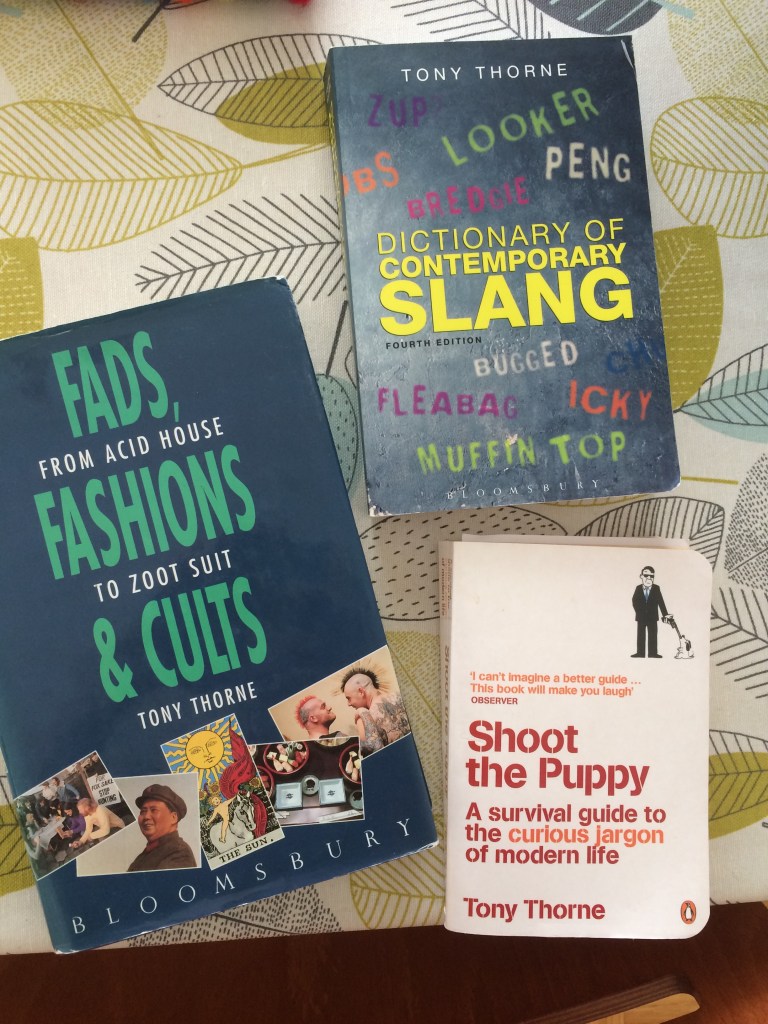
During 2022 I wrote several times about the new terminology that has been generated by younger generations’ (younger Millennials and so-called Gen Z or Zoomers) online celebration of an accelerated series of Fads, Fashions and Cults (the title of my book on the same topic published back in 1993). I was bemused, but not surprised that my articles and posts received little attention. Those over 40, even if active online or otherwise in touch with the wider culture, seem to pay no attention to what their children and grandchildren are saying, or perhaps just view their activities on social media as trivial, frivolous and ephemeral*. It’s slightly absurd that someone of my advanced age should be trying to record and comment on youth-based popular culture, but, just as back in the nineties, only a few fashionistas and influencers and a handful of style journalists manage to achieve any sort of critical perspective on the high-speed succession of poses, performances and pastiches that plays out on 21st century cyberspaces (and incidentally in teenagers’ bedrooms and college dorms too).
At the end of the year, however, I was asked to contribute to a major press review of these same phenomena, and discussed them with the MailOnline’s science reporter, Fiona Jackson. Fiona had picked up on recent mutations in slang and online jargon, in the novel use of emoji and punctuation, and changes, too, in the accents and intonations used on platforms such as TikTok – in particular the voice affectation known as ‘vocal fry.’
It’s interesting that Gen Z is seen as having a particularly exotic or impenetrable vocabulary, baffling and irritating parents, teachers, journalists and anyone too old to keep up. Inventing new words and changing the meanings of old ones, though, is something that each generation does (see UK millennials with their MLE – Multiethnic London English) and is a natural part of language. Accent is another essential component in curating and projecting one’s identity. ‘Vocal fry’ or ‘creaky voice’ first got noticed and was fiercely debated in the USA in 2015. The low, raspy growling voice tone favoured by female US celebrities has since been imitated by some younger people in the UK, and by British ‘influencers’ online, but not to the same extent. What I have noticed is not specifically vocal fry but something newer and more complex: a UK accent favoured by fashionable younger females which mixes a sort of high-pitched, lisping breathless ‘girly’ delivery with a lower-pitched drawl that can slide in and out of American intonations. Something like this is now prevalent, particularly on TikTok which is where Gen Z goes to influence and be influenced.
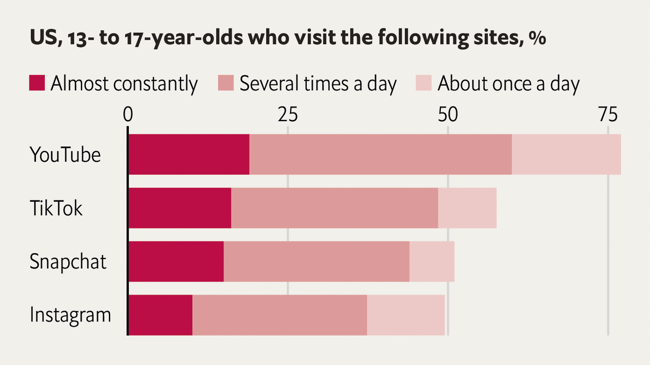
In the US now 63% of people aged 13 to 17 use TikTok weekly, a rate that now tops both Snapchat and Instagram. TikTok is also the go-to environment for the celebration of youth fads, fashions and lifestyle trends, not to mention the parodies, mash-ups, spoofs and in-jokes which are central to its video performances. Older people trying to keep up or simply to comprehend what is happening on TikTok or understand what Gen Z is saying and messaging should however beware: I have a suspicion, shared by a few other commentators, that many of the fads, fashions and trends they celebrate (they call them ‘vibes’ or ‘aesthetics’) are not really taken seriously at all by most of them, are passing fancies or simply spoofs perhaps designed to mock the tedious concerns of outdated millennials. Fashionable new ‘looks’ like so-called ‘goblin-mode’ which has, unusually, been noticed and publicised in the mainstream, have been appearing and disappearing on Gen Z platforms with a bewildering speed (see ‘cottagecore’, ‘blokecore’, ‘hag chic’, ‘frazzled English woman’, etc.).
Gen Z, as they come of age and begin to access power and influence in mainstream society, will inevitably affect the way we collectively behave and of course communicate. But there is an interesting phenomenon that those like me who try to track slang and new language have to face up to. That is that it’s quite impossible to predict exactly how language is going change. No so-called linguistic authorities have ever been able to guess how technology and society is going to mutate, or how fast, or which aspects of human behaviour will come to predominate in the future – even in the near-future. Gen Z may settle down into family life and work and become distracted by adult responsibilities, just as we once-radical Boomers, muted, tortured Gen X and much misunderstood millennials have done before them. Or perhaps they will not, and will manage to realise the boomers’ dream of staying radical, innovative and young forever? How their destiny plays out will dictate what they say and how they say it (and they will have to find ways to negotiate their obsessions and describe their changing environments), but I, for one, don’t dare to hazard any more than that.
*She’s much younger than 40, but journalist Marie le Conte struck a contrarian note in the New Statesman, suggesting that we shouldn’t be interested in Gen Z’s predilections…
Its finger still on the pulse of the zeitgeist, the Mail followed up with a warning to older generations that Gen Z disapprove not only of their language and their emoji use, but of their gesturing too (unsurprisingly the hand-signals castigated are all part of my own sad repertoire)…
At the end of January I talked to Karyn Hay of Radio New Zealand about Generation Zed (the preferred term in Wellington and Auckland), their language and online activities…
In February 2023 King’s College London Faculty of Arts and Humanities, host to my Slang and New Language Archive, featured my activities in their Net Gains series…
Following fashions is an exhausting task. And has become more exhausting still.
I have been recording the fads, fashions, cults and trends that energise popular culture, and the labels by which they register themselves on our collective consciousness, for more than thirty years. With the advent of the Internet and messaging the lifestyle innovations, aesthetic novelties and personal badges of allegiance are nowadays free to go viral, go global, and in many cases to disappear, virtually instantaneously. I talked to Olive Pometsey of The Face magazine (itself an iconic vehicle for the propagation of new ideas and images) about the latest, accelerated, overheated iterations of micro and macro-identities competing on online platforms. The equally frenzied quality of much comment and analysis is perhaps conveyed by the notes I made before we spoke…
A crowdsourced, online, free-for-all, 24/7 source of slang, catchphrases and new terminology is my friend Aaron Peckham‘s Urban Dictionary. As the Face article was going to press this was its phrase of the day…
Coined by trend forecaster Sean Monahan, a vibe shift describes the emergence of a “new era of cool.”
Fashion is a realm that experiences frequent vibe shifts, especially with the arrival of a new decade. Gone are the days when frosted tips and low-rise jeans and Abercrombie & Fitch were in.
We’re in the midst of a vibe shift right now with the widespread lifting of Covid-19 protocols and restrictions. We’re going out again and adapting in new ways to our environment; some will survive the shifting tides, and some won’t.
Yeah I’m in my vibe shift right now. You won’t catch me in the club now that things are opening back up again. I’m all about going to the Home Depot, renovating my home and hearth, yknow? Once I tried topless gardening things changed a lot for me.
Those once-thriving subjects, Cultural Studies and Media Studies, which I used to teach in the 1990s, are nowhere to be found in today’s educational landscape, and the cultural practices we used to analyse are these days ignored by most commentators, the subcultures (and microniches, hyperlocal communities) if they are mentioned at all are dismissed by older cohorts as trivial, frivolous and ephemeral. I doggedly persist, in solidarity with The Face, Wire, Dazed, i-D, TikTok, nanoinfluencers and microcelebrities, in finding them fascinating and significant.
Just a few days after the Face article appeared, the MailOnline announced the latest look for Summer 2022…
















 tony thorne