THE LANGUAGE OF YOUTH – 1

DSC_0100 (630x800)

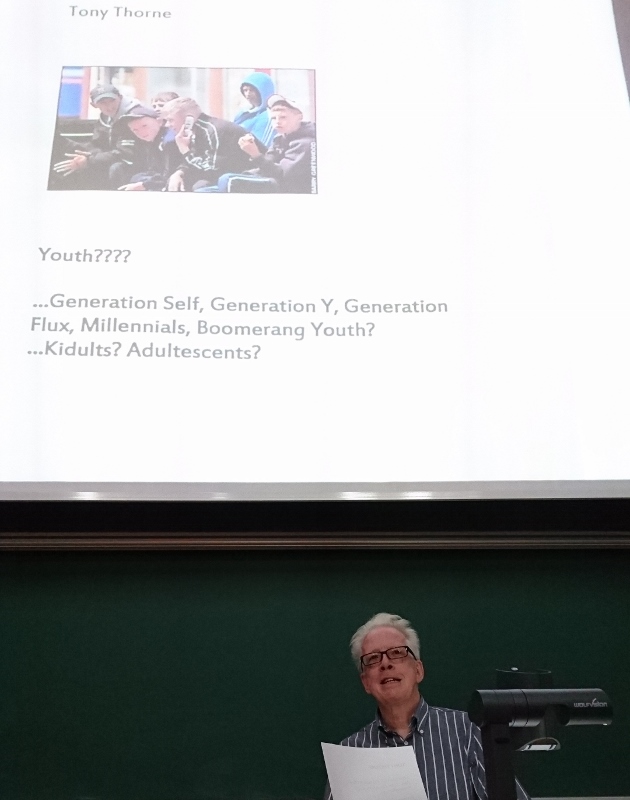
NOTES ON SLANG AND THE LANGUAGE OF YOUNG PEOPLE


This is a sort of aide-memoire that I use with secondary and undergraduate students and teachers as a starting point in talking about youth language, stating the obvious by way of question-and-answer:

  1. Which recent social and economic developments in British society have affected the attitudes and behaviour of young people?

In the last three decades the UK has seen, according to some commentators, a spectacular breakdown in social cohesion, with high divorce rate/single-parenting/alcohol and drug use/teenage pregnancies/obesity, etc. Especially significant for young people is the absence of authority figures and traditional social constraints. This also contributes to youth crime and gang culture (where the gang may function as a substitute family). Economic turbulence and the peculiarities of the UK property market mean that teenagers may not be able to afford to leave home and may suffer unemployment, but attitudes among teenagers and school-leavers in some cases appear to reflect an indifference to work and lack of aspiration coupled with a sense of entitlement and ‘adult’ desire to consume...

  1. Why do young people invent and use slang?

Slang functions for transgressive in-groups such as street gangs as a secret code which allows them to describe and celebrate their illicit activities and keep them from the attention of authority figures. Young people who may not be transgressing may imitate this ‘deviant’ usage as they see it as glamorous, but in any case slang also serves more innocently as a way for young people to establish a ‘cool’ identity, confirm allegiances within peer-groups and micro-niches and claim ownership of a set of symbols (not only vocabulary but appearance, etc.) that gives them social capital and glamour while they may lack real economic power…

  1. Are text messaging and slang use by young people really affecting their ability to communicate in more formal situations?

‘Experts’ disagree: some government advisors and employers declare and assume that use of unorthodox language is associated with limited vocabulary, lack of communication skills and negative attitudes. Some academic linguists – and this writer – point out that abbreviated codes associated with electronic media are nothing new and that slang usage can be creative rather than destructive. Some research indicates that those who text or use social networking sites actually tend to have improved or possess higher literacy rates. ‘Appropriacy’ – knowing how to fit your style of language to context – may be a problem for some, but many young people are adept at ‘code-switching’ – moving between different language varieties according to who they are communicating with and why. BUT while slang cannot be disapproved of technically – it functions like poetry and literature – we must recognise that for many adults it provokes strong emotional reactions and is associated with serious crime and social breakdown…

  1. What social factors in the UK have contributed to the appearance of a so-called ‘MLE’ (multiethnic London English) or ‘Urban British English’?

Afrocaribbean, and to a lesser extent East and South Asian music and popular culture have high status among youth. In inner city schools across the UK British English is not the mother tongue for many students, while the shared code outside the classroom is for some a multiethnic youth slang rather than local or standard forms of English. Some linguists claim that an emerging generalised dialect spreading from London and developed by young people is displacing previous localised dialects and traditional slang and may impact on mainstream English in the future, possibly in terms of vocabulary, but more probably in terms of accent and intonation. Mixed urban dialects are not only a feature of the UK but have evolved in other European countries where elements of Arabic, Turkish and other ‘minority’ languages have affected colloquial usage and phonology.

CRISIS-TALK

I’m now collecting examples of exotic, disturbing or infuriating post-Brexit language (and welcome contributions from readers, which will be gratefully acknowledged). Back in 2010 I reviewed the new terms generated by the recession that then afflicted us.


THE YEAR IN JARGON


We’re all familiar by now with quantitative easing, and bemused by all those recessionistas practising chiconomics…but the bizwords kept on coming…

Tony Thorne looks back at the terminology born of the downturn/meltdown


While things were going well it was commonplace to refer complacently to the hidden hand that Adam Smith claimed was quietly regulating the mechanisms of capitalism. Nowadays that concept seems as inappropriate as combining the two words ‘city’ and ‘gent’: the current sense of crisis requires a new set of metaphors and some picturesque contenders are duly emerging. Foremost among them is creative destruction, a phrase first popularised by Austrian economist Joseph Schumpeter in 1942. A much more radical version of the familiar shakeout, this has come to refer to the demolition of monopolies and economic structures by revolutionary innovation – including ‘revolutionary’ financial instruments and their resultant collateral/fallout.

Another term that has come into its own is boiling frog syndrome, apparently coined by one Leopold Stomm (described as a ‘political and economic theorist, amateur naturalist, and sadist’ but possibly fictional). This can be illustrated by the image of ‘frog’ X (insert the name of any major car manufacturer) ‘sitting in shallow water and denying that the temperature is rising’ – right up to the moment when it boils to death.

And what of the victims of economic turmoil, those senior professionals who have been Pluto’d (demoted, like the planet), lateralled (i.e kicked sideways; they are said to be suffering from adjacency), checked out (serving notice) or simply exited (which has replaced all those euphemisms formerly used in HR circles); what of the recently retired who have become the returned – in other words have been forced back into work? One humbling-but-uplifting option may be to take one of the thousands of green-collar jobs that the US and UK governments have promised to create. Successor to the white, blue and pink-collar (the last denoting supposedly ‘feminine’ jobs like beautician –sorry, cosmetologist – care assistant or florist), green-collar describes manual jobs in the ecological economy, usually involving cleaning up pollution or installing energy-saving devices. A quite different sort of comfort might be provided by going on a Ponzi crawl. Highlighted recently by the Madoff débâcle, the latest Ponzi scheme (named after an early 20th-century pyramid scamster of Italian origin) is a serial bar crawl in which the last to join has to treat all his/her fellow drinkers – and gets exactly nothing in return.

In trying to keep track of this year’s blizzard of buzzwords I’ve been helped out by readers of my previous offerings. From the US Nick Harrison writes to signal a new usage: the noun shutter has suddenly become a verb, signifying both closing down and boarding up, as in ‘Madam K’s is soon to shutter’, or ‘Granco has shuttered its operations’. He spotted four examples within four days from the Seattle Times, ‘…sole remaining daily paper in this town since the 150 year-old Post Intelligencer itself shuttered a month or so ago.’ Another novel Americanism yet to cross the oceans is shovel-ready, referring to a major project that is all set to go but awaiting public funding which may not now materialize.

In times of turmoil an upsurge in acronyms and abbreviations is only to be expected, and examples noted by correspondents include GFC (the Australian government’s own shorthand for global financial crisis) and CC which can stand for credit-crunch or current climate. Irish informant Ros Waverley has picked up on the fact that R.I.F, the euphemistic reduction in force(s) (aka downsizing) from a year or so ago, has first become an acronym pronounced ‘riff’, and more recently a verb, as in ‘we’re riffing’/’we’ve been riffed.’

Several readers were amused when Lord Mandelson testily insisted that his £2.5bn rescue package for the UK car industry was not a bailout (Merriam-Webster’s word of the year for 2008), but a greening initiative. Others were tickled by the portentous language governments have come up with to boost their anti-recessionary credentials: a little too late perhaps Australia has embraced countercyclicality, which simply means anticipating periodic economic downturns, while Britain has been promoting flexibilism; adapting your working practices to cope with unexpected crises.

I can’t help chuckling cynically at the latest catchphrases circulating among the cheerfully desperate – or desperately cheerful – flat is the new up is one such, while I heard someone the other day assert in all seriousness that we’ve got to take the HAV (high-altitude view) and look beyond the beyond. Thankfully professional trendspotters also remain resolutely upbeat, promoting something they call innovation jubilation, celebrating nimbleness (marketing’s successor to agility) and announcing the imminent appearance of the unlikely Generation G (for generous).


PERCEPTIONS OF THE YOUNG

Image result for annoying young people


                                                  How are British Youth described? 


Over the last few years I have been collecting articles in the UK press (from tabloids, broadsheets and online sources) which seek to characterise young people. The following, in no particular order, except perhaps for the sake of ironic contrast, are the salient characteristics which emerge from an informal analysis of these articles’ claims:


  • Narcissistic with an unfounded sense of entitlement
  • Experiencing unprecedented levels of anxiety and depression
  • Identifying with celebrity culture
  • Prone to ‘drug abuse, alcohol-fuelled pregnancy or law-breaking,’
  • Clean-living, ambitious and competitive
  • ‘…growing up without boundaries, thinking they can do as they please… No adult will intervene to stop them.’ (David Cameron in 2009: the discourse of ‘broken Britain’)
  • More socially liberal and accepting than previous generations on issues such as gay marriage and euthanasia
  • More politically right-wing than parents or grandparents at the same age
  • Digitally literate and globally empowered
  • Suffering from literacy problems and economic disempowerment
  • Speaking a different language


UrBEn-ID is an ethnographic linguistic research project being carried out at Manchester Metropolitan University, funded by The Leverhulme Trust. UrBEn stands for Urban British English, reflecting the project’s aim to investigate ways in which young people in an urban environment use language in the construction, negotiation and performance of their identities.

Some of their recent findings can be accessed here:


http://www.urben-id.org/attitudes-survey/


Three years on, and those labels; Babyboomer, Generation X, Millennial and Gen Z are still contentious, still contested. This from Marketing Week in April 2019:

Are terms like ‘millennial’ actually useful?


BANTER

TOP BANTZ

Tony Thorne

B2

Banter noun good natured raillery, badinage, chaffing, teasing repartee, clever chit-chat, laddish drollery, facetious, ironic verbal to-and-fro

 verb to converse teasingly, chaff, rib

A national sport? An elaborate private joke between likeminded people? A healthy bonding, a celebration of mateyness?

Banter matters, not least because of its links with bullying, sporting slurs, even rape. In more subtle ways it keys into topical issues like diversity, gender relations and class. Its subversive humour is central to our national identity. A proper investigation is overdue.

For someone like me who suffers long enforced absences in humourless territories overseas, it’s an important pleasure to keep in touch with our own vibrant national conversation, online via Twitter, MumsNet, Popbitch, etc. then to return in person and join in for real. But what a conversation. The soundtrack to modern Britain is made up of non-stop punning, teasing, riffing on catchphrases and clichés, knowing references to pop-culture tropes, gossip and ribaldry and sustained abuse of the privileged and pretentious.

Coming back to the UK, I’m always struck by the native wit immediately on offer from strangers, whether shop assistants, taxi drivers, football fans or simply anonymous citizens waiting in a checkout queue. Banter is absolutely central to an English sense of self and others. For us it’s a default setting. Only the English among all the peoples of the planet are required to be funny, about everything, all the time. It reflects both the worst – the strident endless chippiness – and the best – our cheerful fellow-feeling – of us as a people. In fact I think that where it was once the upside of the reserve and insularity that used to afflict us as a nation, those things no longer apply, leaving only a free-for-all by a newly empowered, insolent and fantastically talkative public.

cluedont @cluedont

I remember the first time I heard a man use the word ‘bantz’ as an abbreviation for ‘banter’, and he’s got the scars to prove it.


We should look more closely at the fascinating history of banter, consider its components: wit, facetiousness, irony, wordplay, sarcasm, looking at examples and analysing its uses:  bonding, bullying, self-defence – and seduction. Examining both sides of this double-edged weapon, we have to consider both the cruelty (when black teenager Stephen Lawrence’s killers were questioned by reporter Martin Bashir about their racist video rant they replied ‘Harmless banter, Martin. Harmless banter’) and the poignancy associated with the practice (ex-players invariably cite it as what they most miss when they retire from sport; hard-pressed police officers I interviewed said that they measured a station by whether the team there ‘had good banter’).

Twitflup ‏@Twitflup 

“Whenever I see my husband naked he reminds me of a beautifully coloured bird”

“Peacock?”

“Well it’s more like a baby carrot to be honest”

The fun started in earnest, or, another view has it, the rot began to set in, when in October 2007 UKTV relaunched its UKTV G2 channel under the name of Dave. ‘Everyone knows a bloke called Dave’ the press release quipped. The channel’s slogan was, and is, ‘The Home of Witty Banter.’ It was thus that a national pastime which hitherto had gone unnoticed, or had been taken for granted, was highlighted, commercialised and sold back to its legions of fans. By 2012 the b-word was all over t-shirts, posters, mugs and websites, namechecked in radio and TV broadcasts and arraigned over and over again by right-thinking (or sanctimonious) journalists in the ‘quality’ press.

David Stokes ‏@scottywrotem 

Hate it when I’m ironing and people say “can you do my shirt” & “iron these trousers” and “you’re going to have to leave sir, this is Ikea”.

Mutating from a mildly amusing tic into a divisive social issue, where did banter come from, and where is it going? It has come to be our defining characteristic, beloved of the football dressing room and Sky Sports, student bedsittees and Twitter devotees, loathed by Guardianistas, feminists and right-thinking metrosexuals…debated by the chattering classes, but practised – unusually – by all the classes, and, despite what some claim, all the genders, too.

Banter is a catch-all word for idiocy that warns the rest of us that Here Be Lads. Banter is Soccer AM. It is Andy Gray. It is middle-aged men on Top Gear pretending that they are edgy outsiders by mocking society’s weakest, then going home to Chipping Norton where they live two doors down from the Prime Minister. It is an English stag do in Dublin or Amsterdam with matching T-shirts

– Lizzy Porter, Daily Telegraph

Banter is arguably part of a very ancient tradition that takes in ‘flyting’, the ritual exchange of insults practised by Norse and Scottish poets in the fifth century. The word itself, though, is not so very old and its origins are unusually obscure. When bantering appeared, first as verb then as noun, in the street slang of the late seventeenth century it referred to exchanges that were more aggressive and vicious than the mild, playful and friendly exchange of teasing remarks, often preceded in descriptions by ‘harmless’, ‘good-natured’ or ‘witty’, that it had become by the twentieth century. It first meant to trick or bamboozle somebody, to hold them up to ridicule and to give them a ‘roasting’, in a term of the day we still possess. The first recorded instance of the verb is in Madam Fickle, an otherwise unremarkable play of 1676 by Thomas D’Urfey, in which Zechiel cries to his brother: ‘Banter him, banter him, Toby. ’Tis a conceited old Scarab, and will yield us excellent sport — go play upon him a little — exercise thy Wit.’ A letter of 1723 equated banter with ‘Billingsgate’, the foul and vituperative language used by the porters at the London fish market of that name. Banter became notorious because of a spirited attack on it by Jonathan Swift in a famous article he wrote for The Tatler in 1710. In it he attacked what he called ‘the continual corruption of our English tongue’:

‘The third refinement observable in the letter I send you, consists in the choice of certain words invented by some pretty fellows; such as banterbamboozlecountry put, and kidney, as it is there applied; some of which are now struggling for the vogue, and others are in possession of it. I have done my utmost for some years past to stop the progress of mob and banter, but have been plainly borne down by numbers, and betrayed by those who promised to assist me.’

In the same year he referred to the term in his Apology to The Tale of a Tub writing that ‘This polite word of theirs was first borrowed from the bullies in White-Friars, then fell among the footmen, and at last retired to the pedants; by whom it is applied as properly to the productions of wit, as if I should apply it to Sir Isaac Newton’s mathematics.’ Linguists have failed to identify the ultimate origin of the word, but I think it’s very probably from rural dialect, in which ‘banty’ can still mean small, aggressive and irritating.

In the nineteenth and twentieth centuries banter most usually denoted fairly gentle ribbing by friends, acquaintances and workmates. Its connotations have subtly changed again more recently, moving closer perhaps to its original edgier senses, but with added nuances. My survey of recent references from the US shows that there it is nowadays most often linked to the language of would-be seduction – invariably by hapless males of females – or to sales talk or business slogans. In the UK on the other hand it is most likely to be associated with sports fans (where it may be allied to the tradition of ‘sledging’), students (with their ‘neknomination’ drinking rituals and ‘violation nite’ initiation ceremonies) and of course with a myriad amateur and professional humourists, from the wannabe standups and scriptwriters competing for attention on social media sites to the established big guns firing off salvoes in Mock the Week, QI and the like.

Liza Thompson ‏@LizaJThompson 

Today, in celebration of Kierkegaard’s birthday, I’m slumped in a chair in a state of existential despair #curtainsclosedandeverything

 from Camberwell

B2

Shortly after I published this Ben Jagoda explained the term for an American readership…

“Banter”

Update from June 2017: I talked to Archie Bland about this subject and here is his long read in the Guardian this week…

https://www.theguardian.com/society/2017/jun/30/the-age-of-banter

And now, in May 2019, Billy Bragg comments on the visual banter that got Danny Baker fired by the BBC…


BALKANISATION

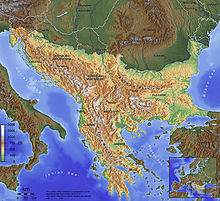
A word that is bandied about – recently by Boris Johnson among many others – yet rarely examined closely. I have tried to unravel its connotations in two different contexts, once fairly flippantly, once a little more seriously…

Image result for the balkans

Once used to describe the weakness of tiny, mutually hostile nations with changing borders, this invocation of the troubled Balkan region is now fashionably applied to the banking sector. Balkanisation refers to, in the words of the FT‘s Patrick Jenkins, “the breakdown of cross-border banking as nervous lenders retreat… from the more troubled parts of the Eurozone.”

It is part of the trend towards deglobalisation, financial fragmentation, renationalisation and domestication of debt caused primarily by economic turbulence, prompting banks to introduce more effective safeguards against cyclical changes, aka buffering (another buzzword du jour), but increasingly also due to tighter official regulation. National regulators may now stop banks using deposits in one area to fund debts in another (the ability to shift capital or asset-swap from country to country is known as fungibility), and regulatory intervention can result in the breaking up, or Balkanisation, of the big, diversified financial entities themselves.


Here is a more detailed consideration…(long read) 

Click to access Thorne.pdf


Image result for balkanisation


WEASEL WORDS

A propos of nothing in particular, some thoughts on doubletalk, hypocrisy and evasions…

Image result for weasel

In 1982, during negotiations on a peacekeeping force for the Sinai peninsula, the British Foreign Secretary of the time, patrician Tory smoothie Lord Carrington, was damned by then US Secretary of State Alexander Haig, (using an adjective so rare as to cause some to doubt its existence) as ‘a duplicitous bastard’, and it’s fair to ask whether duplicity, in its various manifestations and like its better-known sibling, hypocrisy, is not a very fundament of the English way of life. Again, it is by our language that ye shall know us and for our language that we are – nowadays – regularly taken to task. For the frequently foulmouthed Haig, this was a mild imprecation; what Carrington had been saying has never been revealed, but ‘the British lied through their teeth’ according to Haig’s aides’. As serious practitioners of the art of insult, the British probably dismissed Haig’s testy comment on Carrington as hardly in the same world class as the invective of Lloyd George, who said that Winston Churchill would ‘make a drum out of the skin of his own mother in order to sound his own praises’; of Haig’s namesake, the World War I Field Marshal, that he ‘was brilliant to the top of his army boots’; or of Lord Derby that he was ‘like a cushion who always bore the impress of the last man who sat on him.’ Devastating ad libs and insults are carefully crafted in Britain; Haig’s was an impulsive throwaway.

One way of characterising language which is self-serving, empty and/or evasive is by damning it as ‘weasel words’. As Plain English Campaign veterans Chrissie Maher and Simon Cutts assert, ‘…in step with managerial thinking, opinion polls and an impossibly demanding media, our political leaders employ this new language of clichés, jargon, platitudes and weasel words to hide or twist the truth.’

Weasel words is an expression that appeared in the USA in the late 19th century, and in print in Stewart Chaplin’s short story Stained Glass Political Platform (published in 1900 in The Century Magazine), deriving not from the furtive sneakiness of Mustela nivalis, but from its habit of sucking out the contents of eggs, hence draining words of their real meaning. Weasel itself comes from an extremely ancient Indo–European word denoting a slimy liquid or poison which may also be the origin of ‘virus’. More recently it has featured in popular metaphor: ‘weaselly’ meaning devious and evasive with overtones of malice, while in the slang of the 1950s a ‘weasel’ could refer to a railway porter’s tip, an amphibious military vehicle or in rhyming slang to one’s coat (from ‘weasel-and–stoat’); weak tea in Yorkshire was ‘weasel-pee’ and wits replaced Shell’s petrol slogan of 1965, ‘Put a Tiger in Your Tank’, with ‘Put a Weasel in Your Diesel.’ Poor Willy Weasel didn’t listen to the advice given by the Tufty the Squirrel and was hit by a car when he tried to buy an ice-cream: as the voiceover (Bernard Cribbins) reminded us, in those poignant road safety cartoons of the 1970s, ‘Now Willy has been hurt. And all because he didn’t ask his mummy to go with him to the ice cream van.’ But what is it that makes it so very clear that Willy Weasel is bad news? You just know that he’s going to come to a nasty end. Is it because he’s a weasel, a by-word for a sneak? Is it because his neck is so long and he doesn’t therefore look quite as cute and human as a squirrel? Is it his stripy jumper with its connotations of criminality? Today in cyberslang weasel can designate both a penis and a home-made hashish pipe.

More pertinently, our then Poet Laureate, Carol Ann Duffy, in 1990 used Weasel Words as the title of a sonnet skewering the political cynicism of the Thatcherite era by parodying parliamentary rhetoric as reported in Hansard:

Let me repeat that we Weasels mean no harm.
You may have read that we are vicious hunters,
but this is absolutely not the case. Pure bias
on the part of your Natural History Book.
(Hear, hear).

We are long, slim-bodied carnivores with exceptionally
short legs and we have never denied this.
Furthermore, anyone here today could put a Weasel
down his trouser-leg and nothing would happen.
(Weasel laughter).

Which is more than can be said for the Ferrets opposite…


LONDON’S LANGUAGE

My exploration of the Language of London is a work in progress. Here is a fragment thereof, to be followed by others…

When on his Box the nodding Coachman snores,
And dreams of fancy’d Fares; when Tavern Doors
The Chairmen idly croud; then ne’er refuse
To trust thy busie Steps in thinner shoes…

…But when the swinging Signs your Ears offend
With creaking Noise, then rainy Floods impend;
Soon shall the Kennels swell with rapid Streams,
And rush in muddy Torrents to the Thames.
The Bookseller, whose Shop’s an open Square,
Foresees the Tempest, and with early Care
Of Learning strips the Rails; the rowing Crew
To tempt a Fare, cloath all their Tilts in Blue:

– John Gay, Trivia, 1716

Linguists know that language, public or private, is never singular but always pluralistic, in their words a shifting and evolving pattern of dialects, ‘sociolects’ and ‘idiolects’. An enduring myth is that Brits, Londoners among them, are ‘monoglots’ and always have been, imprisoned in the one-dimensional reality of a single language. This may have been true of some of us in recent years, but the Londoner of the past was as likely as not to be bi-, if not multi-lingual. The common inhabitants of Roman Londinium, if they wished to better themselves, would have been fluent in Latin as well as in their own Ancient British dialects. Dark-Age traders plying the Thames from Lundenwic had to negotiate the many varieties of Anglo-saxon spoken in England as well as Viking Norse and the ancestors of Dutch and French. For centuries after the Norman Conquest those working in the courts of law had to be tri-lingual as the proceedings were conducted simultaneously in Latin, French and Old English.

At any time in its history the city has resounded to all sorts of Englishes: the picturesque slangs of costermongers, butchers and pickpockets, the arcane jargon of bankers and lawyers, the polished verbal posturing of salon wits and the literati.

In London there I was bent,
I saw my-selfe, where trouthe shuld be ateynte;
Fast to Westminstar-ward I went
To a man of lawe, to make my complaynt.
I sayd, “For Marys love, that holy seynt,
Have pity on the powre, that would procede.
I would gyve sylvar, but my purs is faynt.”
For lacke of money, I may not spede.

– An anonymous man of Kent, London Lickpenny, c 1440

Of course the languages of London are not only varieties of English. From the earliest times other tongues have resonated around its hills and streams: the lost Celtic languages of Iron Age Britain, Caesar’s Latin and his legionaries’ vernaculars from around the Empire, the French of mediaeval court and convent, immigrant dialects from Huguenot French and sailor’s Dutch to Yiddish, yielding to the multinational, polyphonic buzz of the modern metropolis.

“If I hole up for a bit I won’t stand a chance of earning myself no more. You’ll have to sausage me a goose’s.” “Sausage you a goose’s? What the hell are you talking about?” Len had turned round from the window and was staring at Snowey. “Cash me a cheque, dopey.”

– James Curtis, You’re in the Racket Too, 1937

It was in London’s Westminster that English finally became a language in its own right, symbolically used for the first time by Edward III in 1362 at the opening of parliament. It was in London above all that the unparalleled marvel of Modern English, with its plunderings of other European tongues and borrowings from across the Empire, first evolved in the time of Jonson, Marlowe and Shakespeare. And now, five hundred years on, a wholly new hybrid, drawing on sources as disparate as Jamaican, Urdu, Arabic and Gaelic is set, some experts claim, to displace the native Cockney and Estuary dialects of London, even eventually transform Standard English itself into something strange and novel.

Statistics from the latest Census show that 78 per cent of the capital’s 7.8 million residents speak English as their main language. But the remaining 22 per cent — equivalent to just over 1.7 million people — have one of more than 300 first languages. Of these nearly 320,000 declare, rather worryingly, that they cannot speak English well or at all. The most striking revelation, however, is the scale of linguistic diversity. Overall there are 53 community or heritage languages in the capital spoken by at least 0.1 per cent of residents. There are also another 54 which include variants of established languages such as Chinese or those, such as Caribbean Creole, Cornish or Gaelic, spoken by a small number of people. The most common other language is Polish, spoken by nearly two per cent of residents, followed by Bengali, Gujarati, French, Urdu and Arabic. The most diverse borough is Hillingdon, where 107 languages defined by the Census are spoken, followed by Newham with 104. Tony Thorne’s own researches reveal that these ‘other’ languages themselves are undergoing weird transformations as they come into contact with one another and with native ‘white’ London usages.

A decade later and I still haven’t realised my wish to stage an exhibition, online or, preferably, IRL, to celebrate the language(s) of London. I was reminded by a news item this week recording the publication of a new and original  – and personal – account of South London words and sayings… 

https://www.richmondandtwickenhamtimes.co.uk/news/25408835.south-london-speaks-book-slang-sayings/?ref=twtrec

THE (SLANG) WORD ON THE STREET

Here City University student Jasmin Ojalainen writes about the UK’s urban slang…

As the melting pot heats up, multiculturalism isn’t only shaping the way we live but the way we speak. Jasmin Ojalainen investigates the /twæŋ/of London street /slæŋ/

LONDON with DAN 🇬🇧 | ✓”Wagwan” is a ...

”Yo, what’s good?” asks a young man in a greeting. While the more conventional ”I’m good thanks, how are you?” may be the natural response for most, it is not often heard amongst the London youth today. Particularly not with Andy Djaba, a 19 year-old chemical engineering student at Imperial College. ”I use quite a lot of slang, but not anything that someone that’s not from London wouldn’t be able to follow,” he says.

London slang and its varieties are constantly changing with diverse cultural nuances. Tony Thorne, language and innovation consultant at King’s College London, notes that the speech pattern amongst London youth has shaped over the years. “In the past London slang displayed certain distinct features – the obvious one of referring to places in the city and of course rhyming which is particularly associated with a London origin even if it is now used elsewhere,” he explains. “Today the slang associated with London youth is not actually confined to London and it is difficult to determine which specific parts of its vocabulary originated there.”

He refers to Multicultural London English, generally known as MLE, which features new words borrowed from outside the UK – exactly the variety of slang that Andy, of West African origin, is talking about. MLE is often linked to recently emerged multicultural hybrid “Jafaican,” or fake Jamaican, with West African and Asian undertones. Jafaican surfaced to the popular culture most notably through Ali G, a parody of a white man adopting slang as a stylistic preference in order to appear more “street.” Although Jafaican is a London creation, the modern youth slang is an urban vernacular saturated with a mixture of ethnic imprints. “The predominantly ’white working-class native Londoner’ slang of the past has been replaced to a large extent by a multiethnic set of codes retaining some local features, such as glottal-stopping or the criminal lexicon, but strongly influenced by external, especially Caribbean varieties,” explains Thorne.

Talking to Andy, these features are present. “Londoners drop the t’s,” he says, referring to glottal-stopping. “There’s little phrases that Londoners will say at the end, ‘d’you know what I mean?’, ‘you get me?’ and ‘innit?’” he says – again, characteristic of the Jafaican dialect. “It’s a nice way to round up a sentence.”

Thorne notes that whereas slang used to be condemned and resisted, it is now publicly recorded and celebrated as new words surface all the time. “There is an obvious need for linguistic renewal and innovation to keep pace with technological and social change and reflecting new influences such as immigration by outside linguistic groups,” he explains. “Within exclusive minority communities, such as street gang members, music genre aficionados and fashionistas, there is also a desire for novelty, originality and authenticity.”

The hip hop culture in particular has popularised modern slang, and Andy says that many words amongst the young today originate from the popular culture and contemporary phenomena, such as rap lyrics, videos and TV programmes – even people themselves. “I started saying ‘roll safe’ quite a lot because of the documentary. It just means you’re leaving somewhere,” Andy says referring to Hood Documentary, a series of documentary episodes released by a South London actor Kayode Ewumi last October. “Also ‘suck your mum’, but that’s like an insult – you hear rappers say it now, so you hear people say it a lot more now,” he adds. These lyrics have most recently been heard in a WickedSkengman, a release by London rapper Stormzy late last year. Andy explains that some of this slang develops in context through repetitive use, often in a group of friends. “Once people hear it, people start saying it, and eventually you understand what it means,” he says.

Because slang is a subversion that sits alongside what is considered correct use of language, a debate around its use in formal contexts persists. In 2013, the Harris Academy in South London’s Upper Norwood introduced a ban on slang to improve standards of English amongst students. Simon Heffer, author of Strictly English, is not against slang but he believes that it doesn’t belong to professional environments.  ”Educated people avoid slang in formal settings, such as a job interview, so someone who does not know to do this will be assumed to be uneducated,” he says. Heffer suggests that the use of slang can point to underlying social inequalities in certain situations. “Slang is often used by those who don’t have a lot of power in society, so it serves those people best. This is most striking in London, with its persistent class system.”

“Where people use slang because they are incapable of reverting to correct speech when necessary, that does suggest at least educational marginalisation,”Heffer says. To Andy, this is something he pays attention to – very much for that same reason. ”I don’t include any slang, or as little slang as possible, when talking to older people or lecturers, tutors, stuff like that,” he says. ”I pronounce my t’s when talking to them.” He agrees that the use of slang could suffer a sociocultural stigma in a professional environment. “If you drop a lot of slang in a formal setting, they’re not gonna understand what you’re talking about. Secondly, if you do it, I think they’ll think you’re just a bit dumb. That you don’t have a wide range to your vocabulary,” he says. “You have to try and be a bit more sophisticated with the way you speak.”

Thorne agrees that slang bears an inherent stereotype. ”High status on the street implies low status in the capitalist economy,” he says. “There is nothing inherently, linguistically deficient about slang and slang users are not necessarily incompetent in standard literacies, but slang is associated with marginal or transgressive groups and activities and is viewed by many as embodying a threat to mainstream values.”

There is a concern that discarding slang at schools would further alienate young people, and some academics have sought alternative methods to bridge the linguistic gap. A former London schoolteacher Tim Woods started the London Dictionary Project as an attempt to catalogue and understand the slang his pupils were using, which was made public in 2014. “There is a common narrative that says that it’s the slang itself which is the problem, which is ridiculous,” Woods says and suggests that the choice should be up to young people themselves. “People respond to incentives, so if you put someone in a great school where many graduates end up running the country, they’ll be happy to adapt to the requirements of the system,” he says.

While Woods thinks that slang itself isn’t harmful, he believes in encouraging young people to use proper grammar and vocabulary to improve their language skills.

“It’s like taking a class in a foreign language and not being allowed to speak your native tongue. It’s not the native tongue itself which is harmful, but there can be a benefit to learning the way that other groups speak,” he says. “Language is very powerful and that makes people nervous. Often what people are saying is symptomatic of things rather than causal – but people would often rather the symptoms, such as inequality or hate, would just go away.”

Why the use of slang should face such controversy comes down to its stamp of exclusivity. Jonathon Green, a lexicographer of slang, notes that the use of slang has been linked to the marginal of society throughout history. “Slang was, is and will remain the language of the street,” he says. “A bottom-up creation that is associated with the working or lower class, even the modern underclass. There is little upper class slang, and such individuals are far more likely to ape the usage their social inferiors.”

Criminal jargon associated with slang may make this even more so, and Andy notes that the use of slang points to deeply rooted issues even today. “You don’t hear white people say London slang as much as black people,” he says. “There’s a thing that people think that if you speak with a lot of slang that you’re talking black. It’s ridiculous – I can understand why people say it, but it’s a generalisation. And it makes you think that in saying that, you’re implying that black people aren’t educated or white people are more educated.”

Green agrees that the ties with slang are socioculturally bound, and says that because of Jafaican infused MLE “we all speak black American to one degree or another.” He suggests, however, that the stereotypes that come with the use of slang are now met with an element of humour. “Slang is not as taboo nor as looked-down upon as once was the case. Look at dictionary definitions: for many years slang was defined as ‘low’ or ‘criminal’. These days the dictionary focus is on its wit and playfulness,” he says.

Despite the historically negative connotation of slang, in today’s society it inevitably merges multicultural identities past the stereotypic notion. ”Slang is used to construct alternative affiliations and identities, some of which may be multiethnic or even considered post-ethnic,” Thorne notes. “There may be grounds for disapproval but they are social or subjective, not linguistic or objective. Some terms in standard English, such as mob, gay, and bus, originated in slang.” Green also agrees that slang is a powerful social instrument that above all forges collective identities. “It all depends where you stand. If you see yourself as an upholder of establishment values, then slang is symptomatic of the ‘dangerous classes‘,” he says. “If you are young, criminal or in some other way socially marginal, then slang can both reinforce you as part of a group, and exclude those who are placed outside that group.”

Historically, London slang has seen the rise of many additional localisms and Thorne notes that even now, there are local dialects – although they largely overlap – within London youth slang ”so that slightly different terms are fashionable in different zones.”Andy, who was born and raised in North West London, notes that the geographical and social differences play a key role in what slang is used. ”Where you’re from and what school you went to definitely affects the way you speak,” he says. “I’ve got mates that are from south London and some of the stuff they say I don’t understand.”

The expanding tentacles of London slang and its diverse branches seem to have eclipsed the traditional Cockney over time. Green, however, thinks that the traditional East End dialect is not entirely gone. “Cockney is not brown bread*, but it is a very different creature from that which was first recorded in 1856,” he says and suggests that the old slang has become something of an iconic trademark.

“The last twenty years and more have seen a major change. It has become little more than another illustration on the tourist map of London. Like black cabs and red telephone kiosks – neither of which really exist – it is inextricable from traditional London. In fact it is yet another badge awarded the Z-list celebrity, along with tabloid scandals and appearances on reality TV shows,” Green says.

Even so, the rhyming slang has escaped the tongues of the younger generation. “I don’t understand Cockney slang,” Andy says straight away. “I think it is dying out – to be fair, I don’t live in the Cockney area, but I haven’t heard people my age talk any Cockney slang.” And he is not alone. A study published by the Museum of London in 2012 already showed that the East London dialect may be fading out as majority of the 2,000 participants failed to recognise traditional phrases associated with the rhyming slang.

In an article written for the Independent, however, Thorne points out that Cockney isn’t a shared dialect but a word game not meant to be understood immediately by everyone. So, no one actually talks in Cockney anymore, but Thorne notes that even when the rhyming part is left out, the heritage of the slang is still present in our everyday discourse. Many phrases have been simply trimmed from their originals, such as “taking the mick” that used to be known as “Mickey Bliss.”

Dynamics of slang from rapid change in meaning to widely recognised words that stick around for decades may be as complex as the sociolect itself, and what makes some slang effective is difficult to pinpoint. “It’s not possible to predict or to be sure in retrospect which slang terms persist or cross over into everyday usage and which don’t. This may occur if a term fills a lexical gap in the language – if it encodes something which previously lacked a name,” Thorne explains. ”Slang by definition carries a charge of novelty, exoticism, transgression and topicality which may account for its power,” he says and adds: ”It’s also untrue that all slang is short-lived: even the vogue terms of youth slang, such as ’solid’, ‘cool’, or ‘wicked’, tend to stay in use for several to many years, though they may migrate from the high status expert users to less fashionable speakers.”

Green notes that the initial secrecy of slang may have accounted for its fast-paced change. ”When a term became known outside the group, it was necessary to replace it. And while linguistic secrecy, if it even exists, is much shorter-lived today, that principle still obtains,” he says. And perhaps the magic of slang and why it works is its constant revision that accounts for some personal influence. The idea of a shared identity boosts the personal significance slang has on its user, and Woods suggests that it is indeed that kind of social power that makes slang so popular and effective.

“A few times when I was a student myself I gave someone a nickname and it stuck. Everyone would start calling this person by the new name, but only the people in our group knew where it had come from and what it was implying,” he says. “There was always a bit of a hidden meaning behind it. The person with the nickname felt like they were really part of the group too, but of course a nickname often only lasts a month or something.”

“I think slang is similar. If you can use the right words, if you know the words, you know you’re in the group and other people are reminded that you’re in the group,” Woods thinks. Andy says that to him, slang has exactly that function, sometimes to the point where it replaces actual names. “I don’t even call my brother by his name anymore, I just call him ‘bruv‘,” he says.

Thorne reminds that other historical slangs in London, such as Polari, which West End version was used in theatre whereas the East End equivalent was heard in the Docklands, both mainly by gays, worked as a stamp of identification. As a social means, slang fosters an exclusive sense of belonging and equality between the speaker and the listener. ”All peer-groups or communities of practice operating in clearly defined and restricted settings and valuing exclusivity are likely to generate their own sociolects – nonstandard varieties of language related to location, class, ethnicity and/or activity,” he says.

Andy says that he uses slang especially with his friends, and confirms that “there’s an identity to it.” Additionally, he thinks that London slang itself has a widespread sense of tribalism amongst its speakers in the city. “It’s quite clear that Londoners speak in a different way to everyone else,” he says and shows that people take pride in the use of slang with a playful us-them mentality. “If I heard a non-Londoner saying a lot of London slang, I’d be like, what are you doing, just trying to copy how we speak.”

In the UK, London is naturally the cradle of all slang and according to Green, the capital’s strong slang base is “vastly outweighing any rival.” But even so, the countless possibilities unleashed by the digital world and multiculturalism, the original London slang – the language of the working class, underworld, traders, and gays – has since lost its primacy. Whereas cultures and multidimensional identities are constantly forged together, so is new slang.

Contemporary millennials and today’s youth ensure that slang keeps flourishing, which means it changes often – and perhaps the secrecy of modern slang is in the fact that it can be hard to keep up with. ’Styll’, perhaps the most peculiar of recent slang words, is something Andy finishes the occasional sentence with. It doesn’t really have a meaning, or it is one of a varying degree, and yet it somehow seems to encapsulate the youth slang with its growing popularity and slight absurdity.

“It doesn’t mean anything, you just say it. Like when you’re watching a football match, you go: ‘Oh yeah, that was a good match styll,” Andy says. “I picked it up on Twitter.” And that’s how slang seems to work. It forms in the mouths of the young, the contemporary and the influential, it spreads through peer groups and celebrities, and most importantly, it develops through life and conversation – and nowadays, even social media.

And while the era of global digitalisation has already had its footprint on youth slang, Andy says it’s difficult to remain self-aware with the overwhelming exposure of new slang and emerging influences. “It’s not that deep,” Andy sums it up with a phrase that has surfaced in his speech in regular intervals. ‘It’s not that deep’ or ‘the situation at hand does not require such desperate actions,’ as defined by Urban Dictionary – or perhaps in this context, a suggestion that Andy doesn’t want to overthink the possibly layered reasons behind the way he speaks. “You just pick these things up and it gets assimilated into how you talk,” he explains, and it seems perfectly plausible.

Slang and varying patterns in speech are contagious, at least to some. As a natural response to ever-evolving language, our primary means of communication and understanding our surroundings, we tend to pick up and imitate changes in style all the time. After all, it’s bare colloquialism. Innit?

allow (verb) – to forget about sth; to dismiss the topic of discussion

bait (adj) – obvious

bare (adv) – a lot of, very

big man ting (adv) – to be honest

bitz (n) – neighbourhood

bruv (n) – brother

com (adj) – cool

dinter (n) – male

deece (adj) – nice, decent

gassed (adj) – excited, full of oneself

gwop (n) – money

innit (excl) – isn’t it

long (adj) – boring

mandem (n) – a group of male friends

moist (adj) – soft

man’s (n) – I, I am

neek (ad) – nerd

peak (n) – bad luck

roadboy, roadman (n) – local; someone who knows the area well

roll safe (excl) – goodbye

skeen (adj) – understood

styll (adv) – though

wagwan (excl) – what’s up

wasteman (adj) – loser; someone who does nothing with their life

Adam and Eve (verb) – to believe
Barney Rubble (n) – trouble

Brahms and Liszt (adj) – pissed (drunk)
bees and honey (n) – money
brown bread (adj) – dead
butcher’s hook (n) – a look
China plate (n) – mate (friend)
dog and bone (n) – phone
half-inch (verb) – to pinch (steal)

Hank Marvin (adj) – starving

laugh ‘n a joke (n) – smoke

Mickey Bliss (verb) – to take the piss
pig’s ear (n) – beer

rabbit and pork (verb) – to talk

Todd Sloane (adj) – alone

graff (261x193)

STUDENT SLANGUAGE 2.0

Image result for the young ones


‘Old Georgie’s chucked a Benny: she’s a real spackafish sometimes.’ ‘Well san fairy-ann: she always weirds out after a couple of Britneys.’

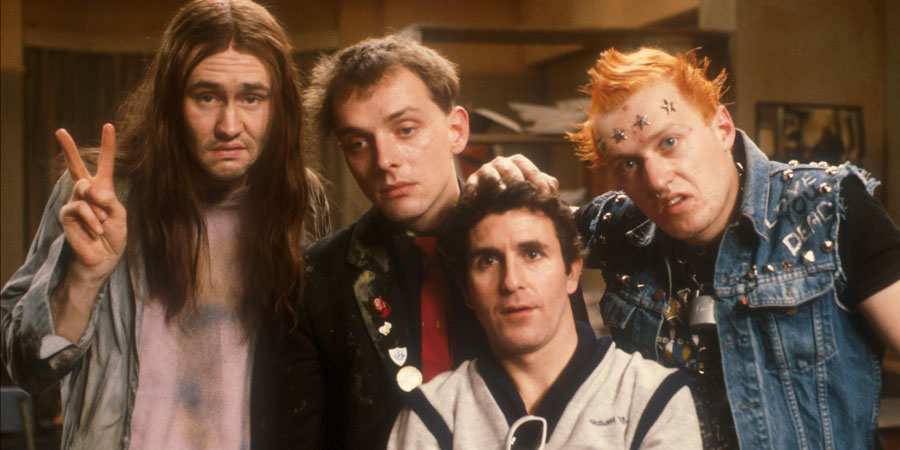
Translation: ‘Young Georgina has had a tantrum: she can be socially awkward on occasions.’ ‘It doesn’t really matter: she tends to lose control whenever she has drunk a couple of glasses of beer.’ This exchange took place on a university campus and students in higher education, in recent years at least, have been some of the most enthusiastic users of slang, a language variety identified with irreverence, exuberance and youth. It’s recognised that adolescents are responsible for a great deal of lexical innovation – the creation of new words and phrases – in English, and by rights students, in theory the most linguistically gifted and aware members of their age group, should be at the forefront. Institutions such as prisons, army barracks and schools have always been breeding grounds for new language. In-groups often like to invent a new lexicon or vocabulary (often in fact by adapting and playing with existing language) to describe afresh their surroundings, their experiences and obsessions. They also use their special terminology as a badge of identity, and as a way of excluding outsiders from their conversations. The university campus is a social space that allows extraordinary freedom from all forms of authority and is a temporary haven from the responsibility to earn or conform. It is also a nexus, a point where many different influences come together. The language of babyhood and the primary and secondary school playground is mixed in with words picked up from parents, grannies, uncles and aunts, military jargon from Officer Training Corps, sporting colloquialisms from players and fans and, of course, the online cyberslang traded by geeks of all ages.


Within one campus there are dozens of cliques, each little speech community, (microscene, microculture or microniche are alternative designations) with its own sociolect, as the technical terminology has it. One person’s colourful turn of phrase is, in technical terms, part of their idiolect – their private language – and it’s there that new slang first appears. Somewhere an anonymous individual tries out a new witticism, insult or notion and, providing that their conversation partner (their interlocutor) grasps and accepts the novelty, it has a chance of catching on, first within the group and later perhaps in the wider world.


Words vary from place to place; shimmy means hurry up in Leicester, in Newcastle it’s get a bolt on, and in London it’s duss, but of course all this could change in three years or so as the intakes come and go. To the extent that they still move away from home to attend colleges, students also bring together expressions from around the country. In London you may hear chill your bills (to relax) from South Wales, gallus (good) from Scotland. Local language finds its way on to the campus. The all-purpose cry of approval of the rural farmhand or truck driver, proper job! can be heard at Exeter and Bristol and the rhyming slang of greater London (having a tin bath, Turkish bath, giraffe or bobble(hat) and scarf is ‘having a laugh’, an Eiffel tower is a shower) has spread across the South and beyond – hence Britney (Spears) for ‘beers’. Overseas Englishes will feature in any multinational student group: US feening or jonesing for craving or obsessing, to flake meaning to drop out of a social engagement or Australian coming the pork chop which means getting agitated, for example.


One way of finding out what a particular social group is interested in is to classify the expressions they use according to meaning. These clusters of related terms are known as semantic fields. If we count the terms in each field, we get an idea of what is most important to that group of speakers. For students across the country these broad categories seem remarkably consistent. I have recorded many words connected with flirting; chirpsing, lipsing, synching, joining, sharking, macking or smacking among them. Jewish students may use their own equivalents, shoms or rowsing. Going out with someone is fashionably termed linking or dealing.


Sneering at un-cool contemporaries makes use of words like flamboy, topshopper, mutt, bumbass, kev, woodentop, duffer, moose and cruit. Spackafish denotes someone clumsy or inept. An unattractive person is called butterballs, anchor, (both versions of the earlier, probably Jamaican, adjective butters). Unsightly bulges at the waistline are bacon-bands, muffin-tops, or lurve-handles, on the upper arms are bingo-wings. Mahoodally, heard in London, is interesting in that it means ugly but seems to be a pure invention, unrelated to any other word, something that happens very rarely in English even in slang usage.


Few chavs, it seems, make it on to the campus, at least legitimately, but many poshos do, there’s a whiff of snobbishness about terms like village or tramp, both adjectives meaning poor, second-rate or shabby. Bush doesn’t denote the former US president, but is an adjective meaning backward and primitive, like the Asian students’ jungli.


There are, though, plenty of ways of indicating approval. Cutting, standard, raar, bom and thug all mean good; confusingly shabby can mean good, too, but so can not so shabby. Legend is an adjective or an exclamation also meaning ‘great’, but a ledge is a show-off, shortened from ‘a legend in his/her own mind.’ BMOC (pronounced ‘bee-mok’) derides a ‘big-man-on-campus’. Physically attractive fellow-students are described, using Black British slang, as chung (also chong or choong –there are no rules for spelling slang) or peng. The main ‘ethnic’ influence on British slang used to be exclusively Caribbean, but now we are beginning to hear ‘Hinglish’ – Indian English – as well as words from Bengali like nang, meaning good.


Mercifully, there’s none of the gang-related slang describing guns and knives, mugging and humiliation which I have heard in secondary school playgrounds – traded gleefully by kids who are probably quite innocent of these things themselves. If there’s one defining characteristic of university slang it’s probably facetiousness. Students can, and very much do, indulge in frivolity, or as they put it, fanny-toots. ‘Excellent’ becomes excrement, ‘fair enough’ mutates into furry muff; thanks are expressed by spank your very crotch, and a common term of endearment on all campuses is You Big Gay Bear! Blatant! or Blates! are exclamations of sheer high spirits and goodbyes can be expressed by laters! Bless! or a cheery over and out, rainbow trout! Some of the verbal oddities would baffle outsiders: for a while whenever someone was showing off or fishing for compliments King’s students would chant Trunky wants a bun! The phrase was apparently inspired by an elephant in a zoo somewhere who would do tricks in return for buns from his keeper.


Overdoing things (not work, though) is caning it; losing control is, as we saw earlier, chucking a Benny, or alternatively spinning out, ragging out, going raggo, weirding, zoning, being on a hype or hissing (from the colloquial hissy-fit). There are plenty of terms for relaxing: chill, cotch and kick back are widespread, and bimble is a nice Leicester term for ‘gently ambling about aimlessly’, but very significantly there seem to be no expressions at all which relate to studying, and this goes for all the campuses I have investigated. Students have to work hard these days, but talking about it is apparently taboo. When they say j.d! (for ‘job done’), it just means ‘I feel OK/everything is fine!’ Twenty years ago money was rarely mentioned by impoverished students, but in these times of student debt and the scramble for future jobs it crops up frequently in the form of squillas, squidlets, cheddar, peas, pebbles, pondos, beer-tokens and spon. The cash dispenser is known as the drink-link and cashback! is a general cry of joy or success.


As this is, even more than standard English, an unregulated lawless variety, it often isn’t possible to be certain where slang terms originate. Trolleyed is a common term for drunk, but should it perhaps be spelled trollied? Does it come from the well-know ‘off one’s trolley’ meaning crazy or out of control (probably from the image of a hospital patient running amok), or from trollies meaning underpants?


Of ‘intellectual’ slang there is not much evidence beyond a little punning with foreign words. The direct French translation action gagnée may be used instead of ‘winning action’, itself a euphemism or disguise for a successful seduction or crafty trick. ‘Thank you very much’ now becomes Saint Cloud Paris Match, while san fairy ann, quoted earlier, is an anglicising of ça ne fait rien dating from World War I. Students still occasionally invent mock-learned words like bosfoculated, meaning baffled or confused. They may loftily observe that someone fastidious and nostalgic is being ‘a bit Proustian’, or if anguished, ‘having a Dostoyevsky moment’, but these cultural or literary allusions are just passing comments and don’t become embedded in the common vocabulary.


What is ‘youth’ slang for? Forming relationships, bonding, expressing solidarity – these, along with establishing one’s prestige as a member of the group are what sociolinguists seize upon – but slang also functions as part of pure play: a stylistic choice employed in mischief, banter, mocking, joshing. It’s just for fun, to express one’s joie de vivre. In every student environment I have come across the number one topic of conversation, the prime activity celebrated in slang is the same. It is getting willied, gattered, hamstered, mullered, laggered, blazed, dribbly, seized and dozens more, in other words ‘becoming intoxicated by alcohol’.


Should we fear for the future of the country? A high frequency of terms for drunkenness proves only that students like to talk about an activity that is emblematic (both symbolic and evoking feelings) of sociability and shared pleasures. Despite the boasting of being completely wombled night after night, most students pass their exams and achieve their degrees. Does a love for this non-standard code undermine students’ ability to use the other kinds of English they need – academic for essays and dissertations, technical for research projects, formal for interviews or applying for loans? Probably not: in my own experience most students, even if they can no longer spell properly– and these days that includes some of  the English majors – are sharply attuned to the difference between appropriacy and inappropriate language: they know when ‘yes sir’ works and when aye-aye, shepherd’s pie! sounds right.


While academic linguists in Britain have tended to steer clear of slang analysis, Professor Connie C. Eble at the University of North Carolina at Chapel Hill, USA, has been keeping a tally of current campus slang, donated by her students, for more than two decades. Her collection formed the basis for her 1996 book, Slang and Sociability, probably still the most accessible and comprehensive treatment of the subject. At Leicester University in the UK students have compiled their own dictionary of terms used on campus and in the UK and USA it’s students themselves, rather than their teachers who are the most enthusiastic researchers into slang, some extending their projects into secondary schools, where pupils are at last being taught about the language they themselves create and use. I have also set up a modest resource at King’s College London for anyone interested in slang and other novelties and exoticisms. The Archive of Slang and New Language contains a database of current slang and jargon along with a selection of articles and a small library, and welcomes contributions from you, your friends, family members and fellow students.

* * *

A version of this article first appeared in e-magazine in November 2007

While this Guardian article from seven years earlier recorded the findings of Professor Tony McEnerny with comments by me…

https://www.theguardian.com/education/2000/dec/19/highereducation.theguardian

Image result for students partying