P.O.V SEPTEMBER – A SUMMER RETROSPECTIVE

A language update as the heat and drought recedes
Summer’s geopolitical turmoils together with the highest temperatures on record have pushed discussions of linguistic and cultural innovation to the sidelines. At the outset of the new semester I can begin to post again, thanks to collaborators and colleagues, with updates on the language of youth (I have also been adding items of contentious political and media jargon to my glossary of weaponised words and will comment on these separately).

Data specialist Randoh Sallihall has published his latest lists of the slang terms most often searched online in 2026 and has once again kindly shared these...

UK’s most searched slang words (monthly searches):

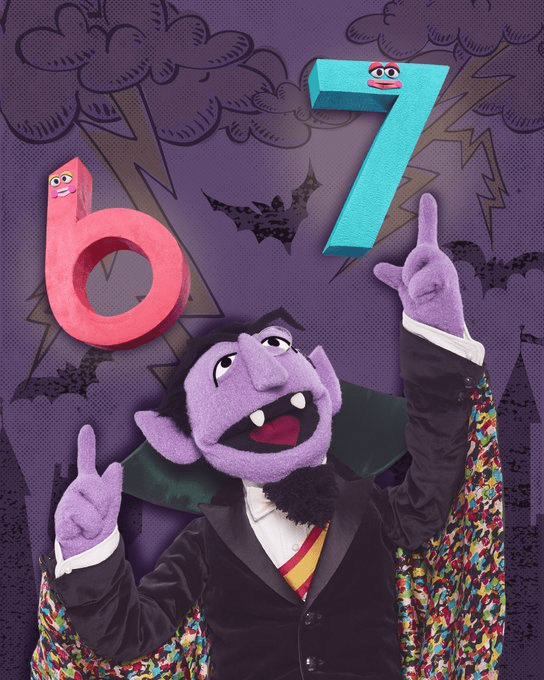
1.      67 (185 500 searches) – There is no literal meaning to six seven. Its absurdity is the point, making it a prime example of “brainrot” internet humor where the randomness itself becomes funny. It originates from the song “Doot Doot (6 7)” by Skrilla. LaMelo Ball a basketball player created a trending video about being 6 feet 7 inches tall using the song. Kids and teens scream and chant it often paired with exaggerated hand gestures.

2.      Mogging, mogged, mog (41 300 searches) – outclassing someone else by appearing more attractive, skillful or successful.

3.      Gooning (40 200 searches) – primarily used in certain online communities to describe a prolonged session of self-stimulation. The term has evolved to casually refer to becoming overly obsessed about something. Essentially losing oneself in enthusiasm for an activity or interest.

4.      Rizz (38 200 searches) – style, charm or attractiveness. The ability to attract a romantic partner and make others like you.

5.      Larping, larper (27 200 searches) – a synonym to poser, fraud and try-hard. Someone who pretends to be something they are not. Faking a lifestyle. Acting for attention.

6.      Chud (22 600 searches) – a fool, troll or jerk. Often used to insult internet trolls and describe an obnoxious person who is unlikable or rude.

7.      Huzz (22 400 searches) – refers to attractive girl or a group of girls. A replacement for “boo” and “pookie”. Somebody you want to impress. This slang had a more derogatory meaning “h–s”, but that has changed.

8.      Unc (19 900 searches) – short for uncle. Used humorously to indicate old age(unc status). Anyone perceived as old, out of touch or past their prime.

9.      Foid (18 300 searches) – short for “femoid” (a blend of “female” and “humanoid”). A derogatory and misogynistic slang term for women. Used to express resentment, insult women and reduce individuals to objects.

10.   Cap, no cap (16 700 searches) – a lie, a fake claim or an exaggeration. Whereas no cap is means the opposite: I’m telling the truth, seriously, no lie.

11.   Chopped (16 100 searches) – this term has become a synonym for something that is ugly, undesirable or unattractive. Looking very rough.

12.   Aura, aura points, aura farming (14 800 searches) –

13.   Clock it (13 300 searches) – strongly agree with a sharp and truthful observation. Calling out the truth.

14.   Futz (11 000 searches) – waste time or idle. Mess around aimlessly.

15.   Charge it (10 100 searches) – short for charge it to the game. Accepting a minor loss. Letting go of a frustrating situation and moving on.

UK’s most searched word definition by region:

·        Scotland – 67.

·        England – Mogging.

·        Northern Ireland – Larping.

·        Wales – Chud.

These can be compared with data from the USA, also recording searches by Gen Alpha and other youth cohorts…

America’s most searched slang words (monthly searches):

1.      6-7 (1 602 200 searches) – There is no literal meaning to six seven. Its absurdity is the point, making it a prime example of “brainrot” internet humor where the randomness itself becomes funny. It originates from the song “Doot Doot (6 7)” by Skrilla. LaMelo Ball a basketball player created a trending video about being 6 feet 7 inches tall using the song. Kids and teens scream and chant it often paired with exaggerated hand gestures.

2.      Chud (184 900 searches) – a fool, troll or jerk. Often used to insult internet trolls and describe an obnoxious person who is unlikable or rude.

3.      Rizz (171 100 searches) – style, charm or attractiveness. The ability to attract a romantic partner and make others like you.

4.      Gooning (158 700 searches) – primarily used in certain online communities to describe a prolonged session of self-stimulation. The term has evolved to casually refer to becoming overly obsessed about something. Essentially losing oneself in enthusiasm for an activity or interest.

5.      Cap, No cap (96 600 searches) – a lie, a fake claim or an exaggeration. Whereas no cap is means the opposite: I’m telling the truth, seriously, no lie.

6.      Mogging, Mogged, Mog, Framemog (82 800 searches) – outclassing someone else by appearing more attractive, skillful or successful.

7.      Bop (78 300 searches) – a person with many sexual partners(bops around from person to person). Someone who presents oneself online in a way that is thought of as immodest. A derogatory word often used in cyberbullying.

8.      Larping, Larper (74 400 searches) – a synonym to poser, fraud and try-hard. Someone who pretends to be something they are not. Faking a lifestyle. Acting for attention.

9.      Aura, aura points, aura farming (66 400 searches) – a person’s cool factor, swagger or presence. Aura points are essentially coolness points that you can gain or lose by doing cool or cringe worthy actions. Aura farming refers to a behavior (often referencing anime characters) where a person does something for the sake of looking cool.

10.   Sigma (65 400 searches) – refers to an independent, self-reliant person who operates outside traditional social hierarchies, often described as a “lone wolf”.

11.   Crash out (60 500 searches) – losing total emotional control and throwing a major tantrum. An extreme an reckless destructive outburst. A synonym for snapping or freaking out.

12.   Glazing (59 600 searches) – praising someone excessively and insincerely(sucking up). The term is often used as a way to call out behavior where excessive flattery is used.

13.   Huzz (57 300 searches) – refers to attractive girl or a group of girls. A replacement for “boo” and “pookie”. Somebody you want to impress. This slang had a more derogatory meaning “h–s”, but that has changed.

14.   Chopped (53 600 searches) – this term has become a synonym for something that is ugly, undesirable or unattractive. Looking very rough.

15.   Based (51 400 searches) – being unapologetically yourself. An authentic person who is confident in their beliefs. Someone who does not care how others feel about their actions and opinions.

16.   Clanker (42 300 searches) – is a derogatory term for robots, bots, chat and AI technology. An example would be “having to talk to a clanker” would mean talking with a chat bot.

17.   Maxxing (41 100 searches) – to maximize and optimize. Go all in on improving a specific part of your life. Doing something to an extreme and obsessive degree. This slang words has become a flexible suffix you can add to any noun. Common examples are: looks maxxing, fibermaxxing, friction maxxing, cortisol maxxing, chud maxxing, nonna maxxing, mogging maxxing, jestermaxxing, melt maxxing, sleep maxxing, token maxxing.

18.   Unc (37 400 searches) – short for uncle. Used humorously to indicate old age(unc status). Anyone perceived as old, out of touch or past their prime.

19.   Ate (35 100 searches) – expressing admiration for someone who just did something like a boss. Looking amazing while winning.

20.   Cheugy (33 100 searches) – outdated and uncool. Trying too hard to follow past trends.

21.   Foid (31 200 searches) – short for “femoid” (a blend of “female” and “humanoid”). A derogatory and misogynistic slang term for women. Used to express resentment, insult women and reduce individuals to objects.

22.   Mid (29 200 searches) – short for mediocre or that something is of disappointing quality.

23.   Crine, son im crine (27 600 searches) – laughing so hard I am crying. A short and fun way to say that something is very funny.

24.   Delulu (25 800 searches) – short for delusional. It describes someone with unrealistic expectations, especially about crushes, relationships, or fantasies (thinking a celebrity will date them).

25.   Quiet on the creek (14 600 searches) – a fun way to tell somebody to not be so loud or to keep a secret. The phrase originating from a Saucy Santana TikTok Live stream, where he recalled childhood fishing advice: “I used to go fishing when I was a little girl, you got to be real quiet on the creek.”

Randoh Sallihall a spokesperson for Word Unscrambler (Unscramblerer.com) commented on the findings: “The most searched slang words of 2026 give insight into the cultural conversations happening in America. Using slang is a social signal. What people search for can tell us something about what they are trying to understand and participate in culturally. Slang may look like a collection of throwaway jokes from the internet, but psychology suggests it is doing something much more interesting. Using slang helps people navigate identity and belong to a community. Research highlighted by the American Psychological Association, including the work of psychologist Ryan Boyd, shows that our language choices can act as signals of who we are, who we identify with and how we relate to other people. Research by Alice Damirjian (post-doctoral Department of Philosophy) similarly describes slang as a way of identifying group affiliation, distinguishing insiders from outsiders and reinforcing social cohesion. Today new slang terms can spread like wildfire around the world thanks to big online communities on social media like TikTok, Instagram, gaming chats, streaming and so on. The popularity of trending slang words can change quickly, but the psychological need behind them stays the same. People want to understand one another and belong.”

Research was conducted by word unscrambling experts at Unscramblerer.com.

We analyzed 01.01.2026 -17.08.2026 search data from Google Trends for terms related to slang words.

Methodology: We used Google Trends to discover the top trending slang terms and Ahrefs to find the number of searches. America’s most popular slang terms can be discovered in Google Trends through the keyword ‘meaning’. People will hear or read slang terms and search for the meaning of the term(example ’67 meaning’). Ahrefs shows many variations of meaning searches like ‘slang’ or ‘means'(example ‘chud slang’) and similar keyword combinations(example ‘ what does rizz mean’). We added up 150 search variations of top slang terms.

It’s important to remember that these invaluable records are recording only look-ups – terms searched for probably because hearers or readers are unsure of their exact meanings or spelling. Words which are familiar to their users, such as neighbourhood slang, family slang or local dialect do not feature. The look-up list will also inevitably show a very high proportion of expressions originating in the US, as the common language of the Internet, influencers and content-creators, rap music and entertainment media is still American English.

A number of other glossaries of youth language have been published during the summer, and links to them are here…

https://www.theguardian.com/film/2026/jun/25/bello-minions-speak-gen-alpha-language?CMP=share_btn_url

Gabb Com and Axis Parent Guide updated their 2025 US glossaries with the latest teen usages…

https://gabb.com/blog/teen-slang

https://axis.org/resource/a-parent-guide-to-teen-slang

Gaming terms are an important element in both everyday slang and tech-talk, as the Guardian described in June…

https://www.theguardian.com/games/2026/jun/21/from-pwned-to-kiting-an-a-to-z-of-the-gaming-terms-you-need-to-know?CMP=share_btn_url

My impression, supported by the Unscramblerer data and by anecdotal evidence from my young informants, is that the high turnover in ‘aesthetics’ and ‘vibes’ (fads, new looks and new poses) previously promoted by Gen Z, influencers and TikTokers, along with the new terms generated (featuring in earlier posts on this site), has slowed and there are relatively few recent additions to the shared vocabulary prevailing in 2025. One exception would be the use of the combining form ‘-maxxing’, first employed by incels, now adopted by a very wide range of cultural ‘stakeholders’…

A range of new expressions inevitably failed to make the lists, among them ‘wam’ meaning large (if in capitals can mean ‘walking-around money’), ‘baddie’, an admiring or affectionate term of address or description of an attractive person, ‘glitch-walking’, moving awkwardly like a video game character, ‘lore-dumping’, explaining one’s whole backstory at once in a post or message, ‘high-cortisol’ or ‘cortisol-coded’, exuding or suggesting stress.

Examples of the latest tech slang and jargon were noted by the Guardian in August…
https://www.theguardian.com/technology/2026/aug/18/dickovers-baggravation-botiquette-18-new-words-tech-hellscape?CMP=share_btn_url

Misogyny, Masculinity and Messaging

Language, Ideology and Zeitgeist Updates

Much online discussion this year has addressed the baleful influence of the manosphere and incels on new language, and perhaps also on new attitudes and digital behaviour. Lucy Knight gathered together the strands of the debates for a feature in the Guardian, and asked me to contribute. Her article is here…

https://www.theguardian.com/science/2026/jun/06/mogging-is-suddenly-everywhere-is-that-a-problem?CMP=share_btn_url

In May I was contacted by Dazed magazine for a piece on the same subject, but I declined in deference to the acknowledged authority on these cultural mutations. Author Thom Waite duly took his cues from Adam Aleksic rather than me…

https://www.dazeddigital.com/life-culture/article/69637/1/language-looksmaxxing-jestergooning-incel-4chan-clavicular-adam-aleksic

The Lexis Podcast, to which I have been lucky enough to contribute to in the past, had a very interesting episode on the digital rhetoric emanating from these same dubious sources…

https://creators.spotify.com/pod/profile/lexispodcast/episodes/Episode-85—Rob-Topinka–digital-rhetoric-e3iv6js

Despite the focus on looksmaxxing and biohacking, chads and chuds and mogging, the slang of young people who may not be radicalised or posing as influencers, especially when used online or on platforms such as TikToK, continues to intrigue, if not baffle and provoke older generations. I spoke to Amy Wild about this for her piece in the Telegraph and it was significant I think that the experts consulted did not in their quoted remarks actually endorse the negative thrust of the article…

https://www.telegraph.co.uk/news/2026/02/20/internet-speak-changing-english-language

LAST WORDS

…and afterthoughts

My un-asked for, scrambled words of the year for 2025 appear in the wordcloud above. Not based on statistical surveys, frequency scans or media prominence, but on the instincts and intuition of a logophile and lexicographer. The words of the year chosen and promoted by the Dictionary publishers* are worthy in their way, once again favouring expressions generated by tech innovation and social media, but they reflect inevitably the perspective of a cohort (aging dictionary editors and their target market) who are at one remove from the language actually being coined or repurposed by what linguists call ‘expert users’. As I write I realise that my own final selection has left out some important last-minute candidates, now featuring in the end-of-year online discourse: vice-signalling, shroud-waving, microshifting and tablescaping, plus a runner-up, sponcon (= sponsored content) for example. The familiar youth slang term of address unc** has just, belatedly, been noticed by the mainstream media, while the terms flow state, in the zone and locked in, used by influencers, content creators and gamers, all meaning focusing intently on an activity, are not yet on the old person radar.

As the winter solstice came and went I was quoted in a few of mainstream media’s reviews of the year’s language…

In Lane Greene‘s discussion of slang and its significance…

https://www.economist.com/interactive/christmas-specials/2025/12/18/what-street-talk-reveals-about-anglophone-civilisation

In Eleanor Noyce‘s piece for Metro

And Lauren Robinson‘s for ABC News Australia

https://www.news.com.au/lifestyle/parenting/kids/slang-term-that-baffled-parents-more-than-any-other-in-2025/news-story/98bf508d85ded5f2428a90188eba937e

I also discussed with Lauren Cochrane of I-D magazine how a keyword from critical theory had been repurposed – more than once – in online discourse…

*https://theconversation.com/slop-vibe-coding-and-glazing-ai-dominates-2025s-words-of-the-year-269688?utm_medium=article_native_share&utm_source=theconversation.com

**https://www.dailymail.co.uk/sciencetech/article-15408445/younger-person-unc-meaning-explained.html

…and lastly I promise, a last word before Christmas Day: treatonomics, also known as Little Treat Culture, describes the trend for affordable indulgences, small, emotionally satisfying purchases that offer ‘guilt-free joy’

AUTUMNAL UPDATES

The Autumn Equinox, and time for the latest perspectives on slang and youth language in the Anglosphere…

I‘m very grateful indeed for the latest data on the most popular slang terms – according to online searches – among younger people in the USA, provided once again by Randoh Sallihall of Unscramblerer.com

Most searched for slang words in America:

1.      6-7 (141 000 searches) – There is no literal meaning to six seven. Its absurdity is the point, making it a prime example of “brainrot” internet humor where the randomness itself becomes funny. It originates from the song “Doot Doot (6 7)” by Skrilla. LaMelo Ball a basketball player created a trending video about being 6 feet 7 inches tall using the song. Kids and teens scream and chant it often paired with exaggerated hand gestures. *See also below

2.      Bop (115 000 searches) – A person with many sexual partners (bops around from person to person). Someone who presents oneself online in a way that is thought of as immodest. A derogatory word often used in cyberbullying.

3.      Mogging (79 000 searches) – outclassing someone else by appearing more attractive, skillful or successful. Looksmaxxing (16 000 searches)  has a similar meaning that is also a trending slang word this year.

4.      Huzz (61 000 searches) – refers to attractive girl or a group of girls. A replacement for ‘boo’ and ‘pookie’. Somebody you want to impress. This slang had a more derogatory meaning ‘h–s’, but that has changed.

5.      Chopped (59 000 searches) – this term has become a synonym for something that is ugly, undesirable or unattractive.

6.      Big back (57 000 searches) – refers to someone with a large physique. Someone who is seen as gluttonous or out of shape. It’s less about literal size and more about poking fun at behavior, like hogging food or being sluggish.

7.      Glazing (49 000 searches) – means to praise someone excessively and insincerely. A way to call out behavior where excessive flattery is used.

8.      Zesty (44 000 searches) – someone who is lively, exciting or energetic.

9.      Fanum tax (36 000 searches) – playfully taking a portion of a friend’s food. The streamer Fanum began this trend.

10.   Green FN (34 000 searches) – refers to a guaranteed win. Describes something amazing and highly desirable. Often said after an exceptional shot or throw in basketball. The term originates from the NBA 2K video game series, where a perfectly timed shot is marked by the color green.

11.   Delulu (32 000 searches) – short for delusional. It describes someone with unrealistic expectations, especially about crushes, relationships, or fantasies (thinking a celebrity will date them).

12.   Clanker (29 000 searches) – is a derogatory term for robots and AI technology. An example would be “having to talk to a clanker” would mean talking with a chat bot.

13.   Ohio (24 000 searches) – refers to anything that is strange or absurd.

14.   Slop (21 000 searches) – describes low effort AI generated content.

15.   Aura farming (18 000 searches) -refers to a behavior (often referencing anime characters) where a person does something for the sake of looking cool.

A spokesperson for Unscramblerer.com commented on the findings: “Popular slang in 2025 continues to be heavily influenced by TikTok, Instagram, gaming, streaming, Gen Z and Alpha online communities. Trends from social media spread rapidly via memes and viral challenges. Fueled by technology our language adapts to new slang trends more rapidly than ever. Slang is a fascinating and fun mirror of our culture.”

Research was conducted by word finding experts at Unscramblerer.com.

We analyzed 01.01.2025 -19.09.2025 search data from Google Trends for terms related to slang words.

Methodology: We used Google Trends to discover the top trending slang terms and Ahrefs to find the number of searches. Americas most popular slang terms can be discovered in Google Trends through the keyword ‘meaning’. People will hear or read slang terms and search for the meaning of the term (example ‘mogging meaning’). Ahrefs shows many variations of meaning searches like ‘slang’ or ‘trend’ (example ‘mogging slang’) and similar keyword combinations (example ‘ what does demure mean’). We added up 150 search variations of top slang terms.

The words recorded in the US can be compared with this list of slang collected in UK schools by Teacher Tapp in August…

https://teachertapp.com/uk/articles/down-with-the-kids-slang-in-british-classrooms-2025/

Earlier this month I spoke to Avantika Bhuyan, Editor at India’s Mint Lounge magazine, about the youngest online cohort, Gen Alpha. She asked me how their interactions with technology and language differed from their predecessors…

Gen Alpha are of course the first generational cohort to have grown up wholly surrounded by digital technology, digital media and the online culture that accompanies them. They are adept at using the hardware – mobile phones, tablets, gaming gadgets – but also unlikely to be dazzled by these already dated mechanical devices. They have sometimes returned to old fashioned film cameras and Polaroids, wind-up watches, puzzles and pinballs as interesting relics (something which in older users is described by theorists as ‘haptic nostalgia’. For them AI isn’t a terrifying threat but just part of the digital landscape they navigate daily.

Gen Alpha are active on YouTube (short-form video by preference), Instagram and – especially – TikTok where they can participate and emulate, or react to influencers and content-creators and individual TikTok celebrities, This media reinforces accelerated performances, exaggerated poses and a pervading sense of self-consciousness, self-mockery, irony and absurdist humour, prompted partly by their collective anxiety at being on display, surveilled and judged 24/7.

Gen Alpha slang, like GenZ’s differs from that of older generations in that it’s not just language that arises ‘naturally’, escaping from the streets or disseminated by movies, TV and the music industry. The language they use has often been generated deliberately by techbros, influencers and microcelebrities who are not just trying to communicate but to gain prestige, kudos. The slang they use also differs from older versions in ways which are interesting to linguists like me: the ‘words’ are not just words but operate virally like memes and, like memes, they are ‘multimodal’, made up not just of writing or sounds like traditional words but accompanied by images, sound effects, references to other messages, in-jokes, puns, etc.

Older generations often find Gen Alpha’s vocabulary baffling, ridiculous or annoying – unsurprisingly since the language is used in part to project behaviour and values that are alien to parents, teachers. Key words – such as ‘skibidi’ – may actually be meaningless, more comic gestures than information-bearers and the passing visual fads and fashions that Gen Alpha (and Gen Z) indulge in – microtrends and looks and what they call ‘aesthetics’ or ‘vibes’- are not designed to last.

There may be serious effects to these innovations and new behaviours. Dating is much more fraught, more competitive when its potentially being exposed globally, and partners’ motives may be even more conflicted, contradictory and mutable when the rituals of romance are playing out in an environment already disrupted by older generations’ repertoire of ‘ghosting’,  ‘gaslighting’, ‘benching’ and ‘breadcrumbing’.

Above all we older people mustn’t underestimate Gen Alpha. They may sometimes be victims of the toxic aspects of digital culture, but they are also adept at coming to terms with it, manipulating it to their own advantage – or knowing when to reject it.

Avantika’s long feature on Gen Alpha is here…

Another way in which mainly younger creators and communicators are changing language is by way of Algospeak, the online code used to disguise messages and evade surveillance…

*In October I spoke to BBC Radio London about the phrase ‘six seven‘ (number one lookup in the US, above) which had now come to the attention of British media, having crossed over from TikTok performances and online posting to real-life irritation of UK teachers and parents. The meaningless phrase, unrelated to the very old expression ‘at sixes and sevens’ (in a state of confusion or disorder) which was used by Chaucer and Shakespeare, was being chanted with accompanying gestures (outstretched arms, palms upward) to tease, baffle and mock adults. Its young users were possibly unaware of its origins in the lyrics of a rap track by US artist Skrilla and its subsequent adoption by basketball stars and their followers.

Nobody as far as I know has yet mentioned – as my friend Nicky Hill reminded me – that the same numbers were already in use in South London in a more sinister context…

https://en.wikipedia.org/wiki/67_(group)

And, also on Twitter, from Celandine an intriguing tangential suggestion…

‘I saw something suggesting that parents take the opportunity to cite Deuteronomy 6:7! “You shall teach them (the Commandments) diligently to your children, and shall talk of them when you sit in your house, and when you walk by the way, and when you lie down, and when you rise.”’

On the eve of All Hallows Eve the Guardian continued the narrative…

https://www.theguardian.com/commentisfree/2025/oct/30/six-seven-meaning-slang

And for those who remember…

In November I was interviewed by Laura Cannon for BBC Bitesize, again about viral slang and trending youth language and its implications. Laura’s article is here…

6-7 and the ‘secret’ language of kids – BBC Bitesize

In December Dazed magazine featured its recommendations for Christmas gifts alongside a list of the year’s archetypes – the new identities which have replaced or reinforced the aesthetics, vibes and microtrends of 2024…

The 2025 Christmas archetype gift guide | Dazed

THE FIRST FEW WORDS

– of 2025

Back in December last year I wrote a second opinion piece on words of the year for the Conversation. You can find it here… *

At the end of January this year the Lexis Podcast team kindly invited me to discuss some of those words and why – if – they were really significant. We also looked at new terms recorded in 2025 so far, making a first attempt to explain and assess them, and to wonder which if any of them might endure. Our discussion, which went on for 40 minutes, is here…

…and, from February, a little puzzle for you. Can you unscramble and reassemble these two-word novelties? (Thanks to simplewordcloud.com)

It’s now July, and my attempts to go on recording this year’s wholly new, or reworked and updated terms and expressions have been interrupted by the need to react to the news-cycle – to the sinister euphemisms, avoidances and untruths perpetrated by war criminals, would-be dictators and their servants in the media. Examples of their language have been added my glossary of toxic terminology and the updated version is here…

John Belgrove reminded me that in May Donald Trump bragged of coming up with a new word – ‘a good word’, but the word in question was ‘equalising’. I have managed nonetheless, with the help of other friends and contacts on Twitter, BlueSky, Instagram and Facebook, to gather a few more examples of lexical innovation, candidates for an end-of year survey in due course…

But I would very much welcome suggestions of other new words and phrases, ideally together with their meanings and comments on their usage in context. All donations will be credited and donors thanked.

*https://theconversation.com/most-words-of-the-year-dont-actually-tell-us-about-the-state-of-the-world-heres-what-id-pick-instead-246190

THE SLANG AND NEW LANGUAGE ARCHIVE

A research portal for scholars, the press and the public

The Slang and New Language Archive was created in 1994 while I was Director of the Language Centre at King’s College London. The archive, consisting of a small library of books and periodicals and a number of databases and sub-directories, was designed as a repository for the collection, storage and dissemination of new language, in particular examples of nonstandard varieties of English such as slang, jargon and buzzwords. The archive was later expanded to take in examples of media language, political language, linguistic curiosities and etymologies. It remains a resource, unique in the UK and not-for-profit, assisting researchers, students, teachers and journalists, as well as non-specialists, in accessing information about aspects of contemporary language that are under-represented in traditional dictionaries and reference works.

This link will take you to the Archive webpage at King’s College, where there are further links to relevant articles and published sources…

https://www.kcl.ac.uk/research/slang-and-new-language

Glossaries from the archive may be accessed on this site by entering keywords, such as slang, jargon, MLE (Multiethnic London English), familect (highly colloquial language used in the home), coronaspeak (language related to the COVID-19 pandemic) and weaponised words (the contentious language of Brexit, populism and biased reporting) and slurs (racist and misogynist terms) in the search box. Once you have accessed a post of interest, check the tags and categories at the foot of the page for other articles or glossaries on the same topic.

Two of the larger archive datafiles have now been revised and updated. You can access the glossary of current youth slang here…

https://emckclac-my.sharepoint.com/:w:/g/personal/stts6157_kcl_ac_uk/IQCblYlHEtvlRIVKGWSubnIAAWI8jcl2cgXUCLC4pr6Dph4?e=kEcWI3

To access the glossary of UK street slang, rap music and gang terminology please email me at tony.thorne@kcl.ac.uk to request a link.*

Please note that the King’s archive focuses principally on contemporary language, that is terms used from the twentieth century to the present day. If you are interested in historical slang, I strongly recommend the monumental work by my associate, the British lexicographer Jonathon Green. His dictionary, now generously freely available online, lists current and historical slang terms with timelines and citations illustrating their usage and development…

https://greensdictofslang.com/

For more information, for queries, or to donate examples of language, contact me via this website or via the King’s College webpage. I’m on Twitter as @tonythorne007 and on Bluesky as @tonythorne007.bsky.social too.

In terms of new slang and nonstandard language there are few reliable resources online. In February 2025, however, US publisher Merriam-Webster launched their own slang dictionary. You can find it here…

https://www.merriam-webster.com/slang

Among the many more informal glossaries and wordlists of slang posted on the internet in 2025, this review of slang in English schools is unusually comprehensive and accurate…

https://teachertapp.com/uk/articles/down-with-the-kids-slang-in-british-classrooms-2025/

* My own glossary of street slang is very usefully supplemented by this excellent dictionary/manual published by the Children’s Society in 2024…

GOING VIRAL, GOING GLOBAL

youth slang crosses world englishes

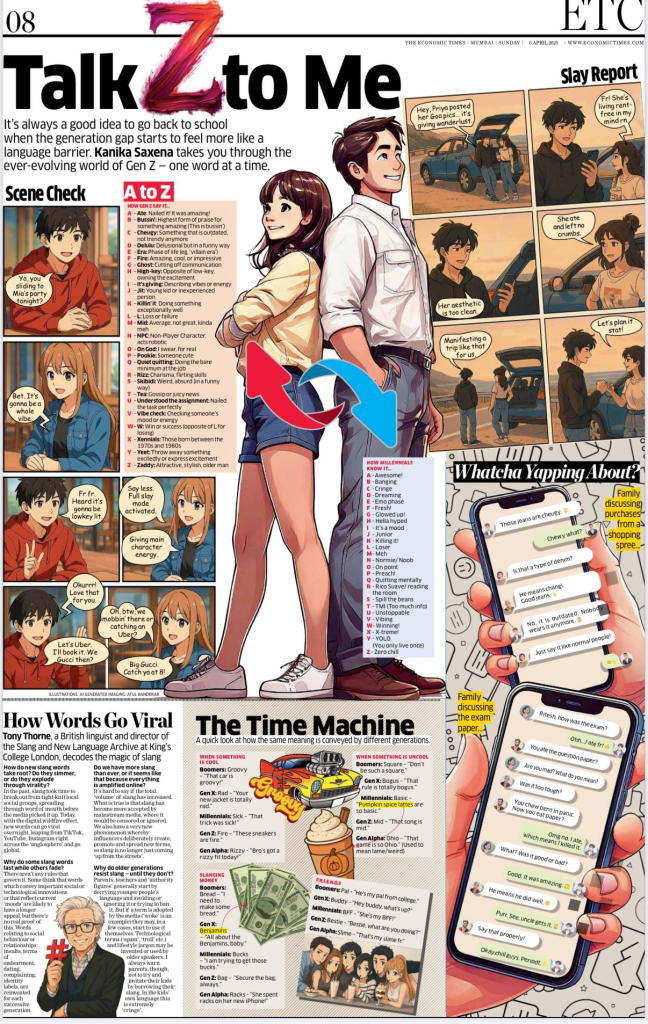
Last week I was interviewed by two young journalists about the pervasive slang generated by Gen Z and Gen Alpha. Interestingly both journalists are operating outside the US/UK matrix from which much of this language variety emanates. Interestingly too, both journalists asked similar questions about the latest linguistic novelties and how we might respond to them. Kanika Saxena‘s piece appeared in the Economic Times of India, and my contribution is here…

1. How do new slang words take root in a generation? Do they slowly build momentum, or does one viral moment suddenly put them everywhere?

In the past it could take some time for slang to escape from the local social group (‘in-group’ or ‘peer group’: a group of friends, a gang, fellow workers, etc.) where it originates into the outside world, then to spread by word of mouth into other parts of society, finally perhaps being picked up by the entertainment or print media. Nowadays this process has been massively speeded up by messaging and the internet, so that a novel term can go viral and reach beyond its original community almost instantaneously. New expressions can spread via social media and platforms like TikTok, Youtube, InstaGram right across the ‘anglosphere’ and go global.

2. Some words stick around for decades, while others vanish overnight. What makes certain slang words stand the test of time?

Linguists have tried to analyse why some terms become briefly fashionable and then disappear while others endure. There don’t seem to be any rules that govern why this happens. Some experts think that words which convey important social or technological innovations or that reflect current ‘moods’ or preoccupations are likely to have a longer appeal, but there’s no real proof of this. It could also be because a word relates to important social behaviour or relationships: insults, terms of endearment, ‘dating’ language, complaining, identity labels, for example, have to be reinvented for each successive generation, then persist until their users mature or grow older.

3. With social media throwing new words at us daily, are we actually creating more slang than before, or does it just feel that way because everything is amplified online?

It’s hard to say if the total ‘volume’ of slang has increased because, in the past at least, it was impossible to quantify it. What is definitely true is that slang has for some time become more accepted by mainstream media whereas it used to be censored or ignored. We also have the very new phenomenon whereby influencers, TikTok stars and content creators are using online resources to consciously, deliberately create, promote and spread new terms, so slang is no longer just coming ‘up from the streets’ (or spread via music, TV and movies) but is a commodity exchanged and pushed to gain prestige or sell oneself.

4. Older generations always seem skeptical of new slang—until, of course, they start using it too. What’s the secret to a word crossing generational lines?

Parents, teachers and ‘authority figures’ generally start by decrying younger people’s language and avoiding or ignoring it or trying to ban it. (This isn’t really justified by the way: slang may be seen as socially marginal but is not technically deficient or defective language and uses the same techniques as poetry or literature) But if a term is adopted by the media (‘woke’ is an example) they may in a few cases start to use it themselves. Technological terms (‘spam’, ‘troll’ etc.) and lifestyle jargon may be invented or used by older speakers. I always warn parents, though, not to try and imitate their kids by borrowing their slang. In the kids’ own language this is extremely ‘cringe’.

My second interview was with Austėja Zokaitė who is based in Lithuania and it appears in the online magazine Bored Panda, an arresting and anarchic daily roundup of the latest viral images, memes and commentary on internet culture. The whole report is here, with my comments interspersed with the succession of visual elements…

This IG Page Shares “Hard” Images, And Here’s 30 Of The Most Unhinged

Two weeks later I took part in a podcast on the subject of Slang, hosted by US students Sophie Xie and Andrea Lee. Our discussion is here…

Dang, What’s That Slang? by Andrea Lee

INITIAL FINDINGS

more updates on 2025’s language landscape

Once again, I’m very grateful indeed to Randoh Sallihall of Unscramblerer.com for sharing his data on language usage online. I previously posted his analysis of last year’s slang lookups (online searches)* and this time his findings reveal the most popular internet text abbreviation lookups in 2025 so far, for the UK and the USA. I was amused to see SMH (‘shaking my head‘) featuring high in both lists. A few years ago I confidently stated in a BBC radio interview that this stood for ‘same here’ – as I had just been informed by a group of schoolkids. I was immediately and publicly corrected – and shamed – by presenter Anne McElvoy and invited journalist Hannah Jane Parkinson and the bitter experience has stayed with me.** It may be culturally significant also that Britain’s favourite apology – in the form of SOZ – doesn’t feature at all on the American list.

“Analysis of Google search data for 2025 so far reveals the most searched for text abbreviations in the UK.”

Most searched for text abbreviations in the United Kingdom:

1.      POV (39 000 searches) – Point of view.

2.      SMH (34 000 searches) – Shake my head.

3.      PMO (28 000 searches) – Put me on.

4.      ICL (17 000 searches) – I Can’t Lie.

5.      OG (16 000 searches) – Original gangster.

6.      OTP (16 000 searches) – One true pairing.

7.      NVM (13 000 searches) – Never mind.

8.      TM (11 000 searches)- Talk to me.

9.      SN (7 000 searches) – Say nothing.

10.   BTW (6 000 searches) – By the way.

11.   KMT (6 000 searches) – Kiss my teeth.

12.   FS (6 000 searches) – For sure.

13.   WYM (6 000 searches) – What you mean.

14.   HRU (6 000 searches) – How are you?

15.   ATP (5 000 searches) – At this point.

16.   SYBAU (5 000 searches) – Shut your b—h ass up.

17.   IGHT (5 000 searches) – Alright.

18.   ONB (4 000 searches) – On bro.

19.   WSP (4 000 searches) – What’s up?

20.   TY (4 000 searches) – Thank you.

21.   SOZ (3 500 searches) – Sorry.

22.   IDC (3 000 searches) – I don’t care.

23.   LDAB (3 000 searches) –  Let’s do a b-tch.

24.   PFP (3 000 searches) – Picture for proof.

25.   IBR (3 000 searches) – It’s been real.

26.   IYW  (3 000 searches) – If you will.

27.   TB (2 500 searches) – Text back.

28.   FYI (2 500 searches) – For your information.

29.   GTFO (2 500 searches) – Get the f–k out.

30.   HY (2 000 searches) – Hell yeah.

Most searched for text abbreviations in the United States:

1.      FAFO (254 000 searches) – F–k around and find out.

2.      SMH (166 000 searches) – Shake my head.

3.      PMO (101 000 searches) – Put me on.

4.      OTP (95 000 searches) – One true pairing.

5.      TBH (93 000 searches) – To be honest.

6.      ATP (85 000 searches) – At this point.

7.      TS (79 000 searches) – Talk soon.

8.      WYF (76 000 searches) – Where are you from.

9.      NFS (75 000 searches) – New friends.

10.   ASL (65 000 searches) – As hell.

11.   POV (63 000 searches) – Point of view.

12.   WYLL (59 000 searches) – What you look like.

13.   FS (58 000 searches) – For sure.

14.   FML (56 000 searches) – F–k my life.

15.   DW (55 000 searches) – Don’t worry.

16.   HMU (54 000 searches) – Hit me up.

17.   ISO (53 000 searches) – In search of.

18.   WSG (50 000 searches) – What’s good?

19.   IMO (48 000 searches) – In my opinion.

20.   MK (45 000 searches) – Mmm, okay.

21.   ETA (40 000 searches) – Estimated time of arrival.

22.   ICL (37 000 searches) – I Can’t Lie.

23.   MB (37 000 searches) – My bad.

24.   STG (29 000 searches) – Swear to god.

25.   ION (28 000 searches) – In other media.

26.   PFP (27 000 searches) – Picture for proof.

27.   NTM (27000 searches) – Nothing much.

28.   DTM (26 000 searches) – Doing too much.

29.   TTM (26 000 searches)- Talk to me.

30.   MBN (25 000 searches) – Must be nice.

31.   ETC (24 000 searches) – And the rest.

32.   BTW (23 000 searches) – By the way.

33.   WFH (21 000 searches) – Work from home.

34.   GMFU (20 000 searches) – Got me f—-d up.

35.   NGL (19000 searches) – Not gonna lie.

36.   SYBAU (19 000 searches) – Shut your b—h ass up.

37.   BTA (17 000 searches) – But then again.

38.   SB (17 000 searches) – Somebody.

39.   HBD (16 000 searches) – Happy Birthday.

40.   PMG (15 000 searches) – Oh my god.

41.   HY (15 000 searches) – Hell yeah.

42.   TMB (11 000 searches) – Text me back.

43.   WYS (10 000 searches) – Whatever you say.

44.   GNG (9 000 searches) – Gang (close friends or family).

45.   IKTR (8 000 searches) – I know that’s right.

46.   IKR (7 000 searches) – I know, right?

47.   ARD (6 000 searches) – Alright.

48.   IFG (5 500 searches) – I f—–g guess.

49.   HN (4 000 searches) – Hell no.

50.   TTH (3 000 searches) – Trying too hard.

A spokesperson for Unscramblerer.com commented on the findings: “Text abbreviations are the secret language of the internet. You could even call them an integral part of social media culture. Snappy, always changing and hard to understand. Texting abbreviations is all about saving time and appearing cool. Keeping up to date with the newest trending abbreviations is no easy task. Old meanings can change while new abbreviations are created. A recent study found that abbreviations might not be as cool as people think. Using abbreviations makes the sender seem less sincere. This also leads to lower engagement and shorter responses. There is nothing wrong with using abbreviations in casual conversations with friends and family. However it is best do draw a line for professional conversations. Context matters.”

Research was conducted by word finding experts at Unscramblerer.com.

We analyzed 01.01.2025 -05.03.2025 search data from Google Trends for terms related to text abbreviations.

Methodology: We used Google Trends to discover the top trending text abbreviations and Ahrefs to find the number of searches. America’s most popular text abbreviations can be discovered in Google Trends through the keyword variations of ‘meaning text’. Abbreviations are used most often on social media and texting. The 2025 top trending abbreviations are the least understood. People have to search for their meaning (example ‘TBH meaning text’). Ahrefs shows many variations of meaning searches like ‘text meaning’ or ‘means in text'(example ‘PMO meaning in text’) and similar keyword combinations(example ‘what does SMH mean in text’). We added up 100 search variations of top text abbreviations.

I was very grateful, too, when Claire Martin-Tellis of content marketing and digital PR specialists North Star Inbound contacted me with an update, again from the USA, on attitudes to outdated slang

“As new slang terms like “Beta,” “GYAT,” and  “Skibidi,” continue to surface, it’s enough even to make Gen Z feel old! Language learning app Preply asked Americans of all ages to weigh in on their favorite era of slang. Here is what decade reigns supreme:

  • Over ⅓ of Americans say the 1990s is their favorite decade for slang.
  • Men surveyed preferred the 1970s while women preferred the 1990s.
  • “Baloney,” “take a chill pill,” and “bogus” are the three most popular slang terms Americans want to see come back.

*https://language-and-innovation.com/2024/11/18/the-search-for-slang/

**the embarrassment is still audible here…https://www.bbc.co.uk/programmes/b06vs6g2

THE SEARCH FOR SLANG

Researching and tracking the latest slang can now draw upon statistical analysis of online data.

As 2024 draws to its end and talk among lexicographers, culture journalists and language buffs turns to ‘words of the year’, I’m immensely grateful to Randoh Sallihall of Unscramblerer for providing me with his datasets showing lookups (Google searches) for the most popular recent slang expressions…

Most searched for slang words in United Kingdom:

1.      Gaslighting (170 000 searches) – a type of manipulation that makes you doubt your memories and feelings. The person doing it may lie and deny things.

2.      Skibidi (125 000 searches) – refers to a viral internet trend featuring surreal, animated videos of singing toilets and dancing heads, popularized on platforms like TikTok for its bizarre humor.

3.      Pookie (47 000 searches) – to show endearment and affection. Used for a close friend, partner or family member. A playful way to say someone is special.

4.      Hawk tuah (40 000 searches) – imitative of a spitting sound. The catchphrase originates from a viral street interview conducted in June 2024 with Haliey Welch, who stated that her signature move for making a man ‘go crazy’ in bed was to ‘give him that hawk tuah and spit on that thang’.

5.      Sigma (37 000 searches) – refers to an independent, self-reliant person who operates outside traditional social hierarchies, often described as a ‘lone wolf.’

6.      SMH (31 000 searches) – internet slang for ‘shaking my head’. Used to express disapproval or disappointment.

7.      Demure (26 000 searches) – reserved, modest or shy in manner or appearance. The TikTok user Jools Lebron made a series of viral videos using the phrase “very demure”. This trend gave the word a playful slang meaning. She uses it to assess appropriate makeup and fashion choices in various settings.

8.      Rizz (25 000 searches) – style, charm or attractiveness. The ability to attract a romantic partner and make others like you.

9.      Dei (17 000 searches) – diversity, equity, inclusion. A family friendly way of saying woke.

10.   Aura (13 000 searches) – the vibe someone gives off. When used by tweens and teens it is likely a reference to how badass someone is. Aura points make you cooler. So you definitely want to earn more aura points instead of losing them.

We can compare this list with Randoh’s equivalent for the USA, used in the Newsweek article posted previously to which I contributed, and reproduced here with his explanatory comments…

Analysis of Google search data for 2024 reveals the most searched for slang words in America:

1.      Demure (260 000 searches) – reserved, modest or shy in manner or appearance. The TikTok user Jools Lebron made a series of viral videos using the phrase “very demure”. This trend gave the word a playful slang meaning. She uses it to assess appropriate makeup and fashion choices in various settings.

2.      Sigma (220 000 searches) – refers to an independent, self-reliant person who operates outside traditional social hierarchies, often described as a ‘lone wolf.’

3.      Skibidi (205 000 searches) – refers to a viral internet trend featuring surreal, animated videos of singing toilets and dancing heads, popularized on platforms like TikTok for its bizarre humor.

4.      Hawk tuah (180 000 searches) – imitative of a spitting sound. The catchphrase originates from a viral street interview conducted in June 2024 with Haliey Welch, who stated that her signature move for making a man ‘go crazy’ in bed was to ‘give him that hawk tuah and spit on that thang’.

5.      Sobriquet (105 000 searches) – a nickname or descriptive name given to a person or thing. Borrowed from French sobriquet (nickname).

6.      Schmaltz (65 000 searches) – refers to excessive sentimentality or melodrama. Often used for art, movies, music or storytelling if there is too much sappiness.

7.      Sen (50 000 searches) – slang for self.

8.      Katz (34 000 searches) – a term for anything enjoyable, fun or pleasing. It can also mean ‘yes’.

9.      Oeuvre (25 000 searches) – refers to the complete works produced by an artist, writer or composer. A word used by literature professors to express superiority.

10.   Preen (20 000 searches) – slang for a child who tries to act like a teenager(wears teen clothes or makeup).

A spokesperson for Unscramblerer.com commented on the findings: “The English language is ever changing. Every year new slang words are created. Many slang words are born through trending topics and viral videos on social media. However only few manage to stick around long enough to be added to the dictionary and remain in daily use. Slang words are a normal and fun evolution of language. We encourage everyone to learn some new words and surprise their children by using them.”

Research was conducted by word-finding experts at Unscramblerer.com.

We analyzed 01.01.2024 -25.10.2024 search data from Google Trends for terms related to slang words.

Methodology: We used Google Trends to discover the top trending slang terms and Ahrefs to find the number of searches. Americas most popular slang terms can be discovered in Google Trends through the keyword ‘meaning’. People will hear or read slang terms and search for the meaning of the term (example ‘demure meaning’). Ahrefs shows many variations of meaning searches like ‘slang’ or ‘trend’ (example ‘demure slang’) and similar keyword combinations (example ‘what does demure mean’). We added up 150 search variations of top slang terms.

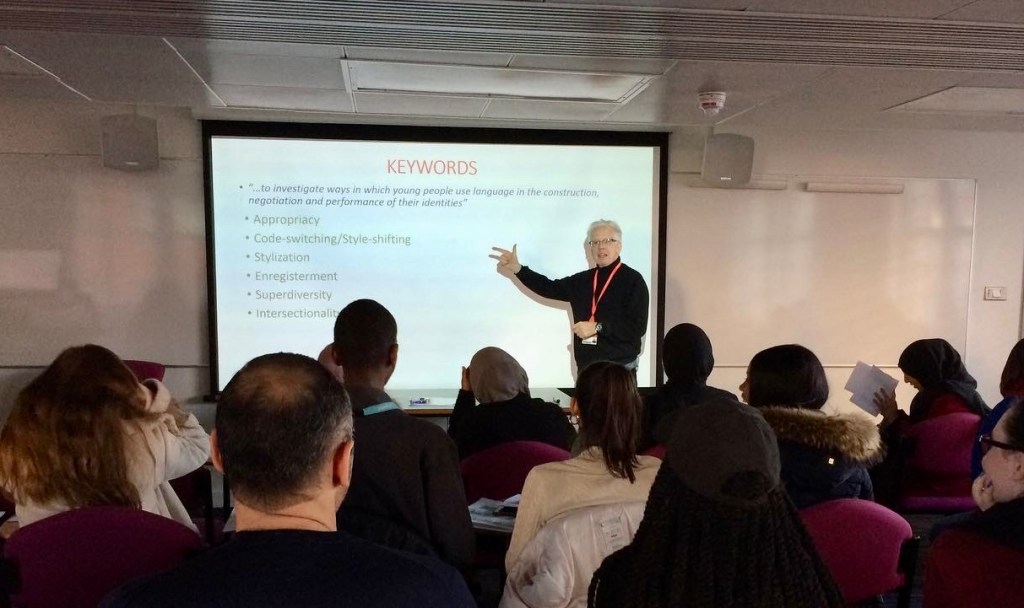
A few days after Randoh’s findings were published, I was asked by Robert Milazzo* to take part in the masterclass on new slang and youth language that he convened at Virginia Commonwealth University. The whole lively one-hour event was recorded and can be accessed here…

https://drive.google.com/file/d/1yYlV7LkKdEf5AqFF-bJQAfIE5s5PUpGi/view?usp=sharing

Robert’s class was particularly illuminating, allowing as it did for contributions from young slang users themselves and from puzzled old-timers too. Bear in mind that the samples handled by data analysts are taken solely from online usage and not from authentic speech. Nearly all the slang used on TikTok, YouTube, Instagram, etc. originates in the USA whereas the slang terms used by British youth in their IRL conversations will differ considerably from their North American counterparts, showing much greater influence from African Caribbean rather than African American sources.

*https://www.linkedin.com/in/robert-milazzo-3a8860116/

LANGUAGE AND LONGEVITY – 2

Dictionary makers and journalists are breathlessly – if not desperately – publicising the latest online language – but do they really understand it?

One week on, I spoke to Chloe MacDowell of the UK Guardian newspaper, then to Marni McFall of the US Newsweek magazine on the topic of TikTok language and the online messaging mannerisms of Influencers and GenZ. Chloe was interested in one particular trending TikTok catchphrase, Marni in the whole panoply of 2024’s viral innovations.

Once authentic conversations and personal interactions (previously happening in private spaces or local communities) began to feature on the internet and in messaging and on microblogging platforms,  language novelties, slang and faddish usages crossed over from a private realm into the global public domain. The latest slang and new language was visible, audible and immediately available to share. Obscure or exotic terms might quickly catch on and become viral favourites, spreading in some cases across the anglosphere more rapidly than print, broadcast or word-of-mouth transmission had ever been to achieve in the past.

Words and phrases began to function like memes, taking on sometimes a ‘multimodal’ aspect whereby sound and image could reinforce the purely verbal expressions that people chose to exchange and promote. Pre-internet there had always been catchphrases, what linguists call ‘vogue words’, slogans and soundbites, and keywords that somehow seemed to evoke or encapsulate some special aspect of the ‘zeitgeist’. What we have now is a much more knowing, deliberate intention (on the part of trend-setters, influencers, ‘thought-leaders’) to create new language to celebrate new identities and to promote new attitudes and lifestyle innovations to the widest possible audience.

Subcultures like surfers, valley girls, fanboys and girls, hip hop aficionados had always invented striking, expressive language and this is still true, but instead of niche culture we have ‘meganiches’, instead of subcultures we are dealing with globalised communities.

The fashionable language of TikTok and GenZ in particular is part of their wider obsession with vibes, aesthetics and microtrends, many of which arise and are discarded in rapid succession. The prevalent style is exhibitionist, self-promoting, allusive and often ironic, increasingly even absurdist, making it hard for outsiders to grasp the nuances in play. Older commentators and dictionary publishers struggle to keep pace, often misunderstand and record the terms in desperation (in their searches for ‘word of the year’ for example) just as they fall out of use.

The use of this language as an identity marker in an intensely competitive digital ecosystem means that the Gen Alpha cohort now ridicule GenZ usages as being out-of date, while GenZ is still deriding millennials for their old-fashioned ‘cringe’ vocabulary. At the same time would-be influencers practise bragging, ‘manifesting’ and other forms of self-congratulation in a search for clicks and clout.

One of the latest features of online wordplay is the elevating of an older concept or cliche into a teasing provocation or pretence at new insights, as we have seen with ‘delulu’, ‘demure’ and ‘mindful’, ‘rizz’ and ‘brat’. The current rash of declarations of ‘being privileged’ – a new version of ‘humblebragging’ or ‘virtue-signalling’ – is another example. In parallel is the ironic celebration of the incoherence or absurdity of much online discourse and of low-quality ‘slop’ by embracing a culture of ‘brainrot’ – nonsense memes such as ‘skibidi’ and vacuous, contagious content.

Most of the innovation in online language and image still emanates from the US and even though a global audience can access it instantly, its tropes (think ‘goblin-mode’ – ‘goblin’ doesn’t have the same associations for Brits) don’t always translate for other speakers of English. In parallel, poses, gestures and looks as well as music-related modes are increasingly generated from non-English cultural zones such as Japan and Korea. It will be interesting to see if other parts of the globe begin to play a part in the evolving online theatre of signs and behaviours, but this doesn’t seem to have happened yet.

Chloe’s piece is here…

https://www.theguardian.com/media/2024/nov/02/what-a-privilege-trend-catches-on-as-gratitude-makes-social-media-comeback?CMP=share_btn_url

And the Newsweek article is here…

https://www.newsweek.com/2024-most-popular-internet-slang-words-revealed-1978732

On the first of November Collins Dictionaries, ahead of the pack, had already announced their choice of word of the year for 2024, and their candidates illustrated the same, in my opinion mistaken, concentration exclusively on terms from a very narrow range of sources. While postings on social media are performances designed to attract attention, there is an even wider domain in which discourse demands analysis: the crises in the Middle East and Ukraine and the surreal spectacle of the US presidential campaigns, for example, are also highlighting keywords and generating new formulations or reworkings of language – data that mainstream media and lexicographers seem to think unworthy of their attention…

https://twitter.com/CollinsDict/status/1852139743112208794