FAMILY LANGUAGE

“STOP PLOITERING AND GRAB THE MELLY!”

I’ve long been interested by the inventive, jokey, sometimes ludicrous expressions that arise within the family and only very occasionally emerge into the speech of the wider community. This variety is sometimes known as family slang or familect, otherwise, by the English Project at Winchester University, as kitchen-table lingo.

The following article gives some examples of these lighthearted, eccentric expressions…

http://www.dailymail.co.uk/news/article-2571693/Fancy-blish-Its-new-slang-nice-cuppa-New-list-gibberish-words-used-families-country-published.html

PR specialist Hamish Thompson has been working on his own glossary of family language and was kind enough to send me his introduction, acknowledgements and a selection of entries:

Most families have an invented vocabulary – the words that grow out of mishearing, misspelling, kids’ early attempts at talking or things that you might have seen that have become folkloric.

One of my kids coined the term ‘argubating’, which means arguing a point in a self-indulgent, unproductive way.  We also have ‘wookthack’, which for complicated reasons means ‘a rucksack from Derbyshire’.

And then there’s ‘scrapey’, which is a disappointing texture, named for the moment that my daughter, aged about 5, jumped the fence at the Postman Pat Village at Longleat to touch Mrs Goggins’ hair.

I asked people on Facebook last week whether they had any words that were part of their family vocabulary and I got some lovely responses.

I like the idea of a new dictionary, which I’m going to call ‘Famguage’ (thanks Alex Johnson).  I heard my son talking to his girlfriend about some of our words the other day. Clanguage is something that you’re eventually introduced to when you really enter a family.

I’d love to hear yours and add them to this list.  Tweet me at @HamishMThompson or email me at hthompson@houstonpr.co.uk and I’ll add them here.  Acknowledgements below.’

‪Alligator – a moving staircase.

‪Angipodes – crawly insect

‪Apogetic – opposite of energetic

‪Argubating – self indulgent row

‪Bantry – basement pantry

‪Bisgusting – poor personal habits

‪Bishee bishee Barnarbee – ladybird

Bleenger – someone who keeps losing something

‪Bonger – TV remote control)

‪Boop and bamwhiches – nutritious lunch

Cake Out – a stake out with bought cakes

‪Calm chowder – popular meal for kids in New England

‪Cat-flap – have a big panic or over fussy reaction to something

‪Chish and fips – Fish and Chips

Cluckston – generic term for chicken, hen, rooster, cockrell etc. “It’s some kind of cluckston.” See also, crucially, ‘Quackston’

‪Complify – opposite of simplify

‪Daddy’s soda – beer

‪Dinger- TV remote control

‪Embuggery – embroidery

‪Fi (pronounced like hi) plural of foxes

‪Forgettabox. Floatycoat. Windy man (fart)

‪Goggy for the favorite blankets the boys used when they were little.

‪Graunch – the scraping of furniture on a wooden floor when moving it improperly.

Gruncle and Graunt – great uncle and aunt

‪Gruntled – happy

Hairochopter – helicopter

‪Hangry – annoyed because of lack of food.

‪’Have you forgotten how to English?’

Iforloafer – falling over

In a little minute – buying a bit more time before bed

‪Industriocity – busy / va va voom “hoy lad, it’s time you showed a bit of industriocity”

‪Marshmellons – soft sweet

‪Merangutans – Meringues

‪Miseratating – so constantly miserable you are irritating

Nicknames – Lewie, Boogle, Doodie, Moomin

Nommelin – omelette

‪Nonk – milk

‪On the roof – imminent danger

Ploitering about – piddling about and loitering

‪Pokey pola – Coca-cola

Quackston – a duck (see also ‘cluckston’)

Scrapey – unpleasant texture (after jumping the fence at the Longleat Postman Pat Village to touch Mrs Goggins’ hair)

‪Sidey the table – sit around the table for dinner

Sluggerbaths – kids that dawdle in the bath until the water gets cold

‪Smaggy – horrible

Spudy – a spare bedroom that doubles as a study

‪Stinging lentils – weeds to be avoided

‪Swimpamool – the place you go for a swim in the summer

Tahairnairhair – proximity of a friend called Tahir

‪The Feli – two Felixes – my son and his best friend

‪The Ho Ho Hos – the seven dwarves

‪Till donk – the thing supermarkets use to separate your shopping from another customer on the conveyor at the register.

Tootles – toilets

Tryer trick – trousers falling down to a point that makes walking difficult

‪Veggybubbles – veg

Voulez-vous –  vol au vent.

Wice – wood lice

‪Wish dosher – a machine for cleaning crockery

Wookthack – rucksack from Derbyshire

“Yes then!” – exclamation when receiving good news or when a cunning plan is formed

‪Yippers – indoor footwear

With thanks (so far) to: Kellie Evans, Nicola Texeira, Tamzin Benjamin, Shaun Andrews, David Johnson, Clare Corbet, Vanessa Potts, Michael Cullen, Nick Higham, Michael Moran, Rene Wright, Lynne Clark, Cam Ross, Steve Dring, Alex Johnson, Dawn Murray, Chris Winstanley, Helen Hobbs, Jean Harbilas, Tracey Holmes-Reynolds, Elizabeth Varley, Jenny Hodge, Caroline Lavelle, Andy Ravenscroft, Vivien Patterson, Sharon Rasker, Leroy Bingham, Alex Thomson, Donal McCabe, Duncan Wisbey, Gina Jones, Jim Boulden, Joanna Oliver, Peppi Wilson, Mark Webb, Susanna Voyle, MoiOfRa, Jane Symons, Tyler Massie, Rebecca McKie, Dr Decadence Marple.

More from 2013 in the Guardian

https://www.theguardian.com/media/mind-your-language/2013/jul/19/mind-your-language-family-slang

…and January 2018, an excellent article that includes personal reflections by Caroline Baum also in the Guardian newspaper…

https://www.theguardian.com/lifeandstyle/2018/jan/03/shnibble-gunzle-dolltalk-share-your-familys-invented-words

In August 2020 the BBC appealed for examples of family-only expressions. They received a good response on Twitter…

@BBCRadio4
Is there a word, or phrase, that only you or your family use?

Bruce Hiscock
@BruceHiscock

Replying to

‘Boys names’ – whenever one of us can’t be bothered to answer. Our youngest son c 4 and a half on returning from his first day at school was asked whether he had a nice day. He said ‘yes’ . Did you make some friends ‘yes’ . What are their names? Answer ‘boys names’!

Sarah Hagger-Holt
@SarahHaggerHolt

Replying to

Coolth (opposite of warmth)

Lord Tim Moon of Glencoe
@TimMoonMusic

Replying to

More betterer.

Sue Goldman
@SueGoldman1

Replying to

Cowlets = calves
Alastair Schwarz
@riot_salad

Replying to

‘bangers’ – not fit for purpose

Reynold Forman, M.Ed.
@ReynoldLeTreaux

Replying to

Dawn squirt, bagel peel
Jackie Smith
@alassmith

Replying to

Eggy-weggy

Kellie Fisher
@Coastineer
Replying to

We used to live in Australia and were fascinated by the way ‘o’ gets added to the end of words. As a result we invented the term ‘umbo’ for umbrella. Even though it’s made up and not Australian at all we still use it!

Alex.Robinson
@_Star_Tron
Replying to

GIF
alan hendrix
@Siralanhe

Replying to

shambolic

boardman
@hawkstonpark

Replying to

Nor
It’s interesting that some of these words are actually in widespread colloquial usage, though those donating them think that they, their family members or friends invented them. Four years on and the topic was attracting renewed interest, from my friend Professor Richard Norquist for one…

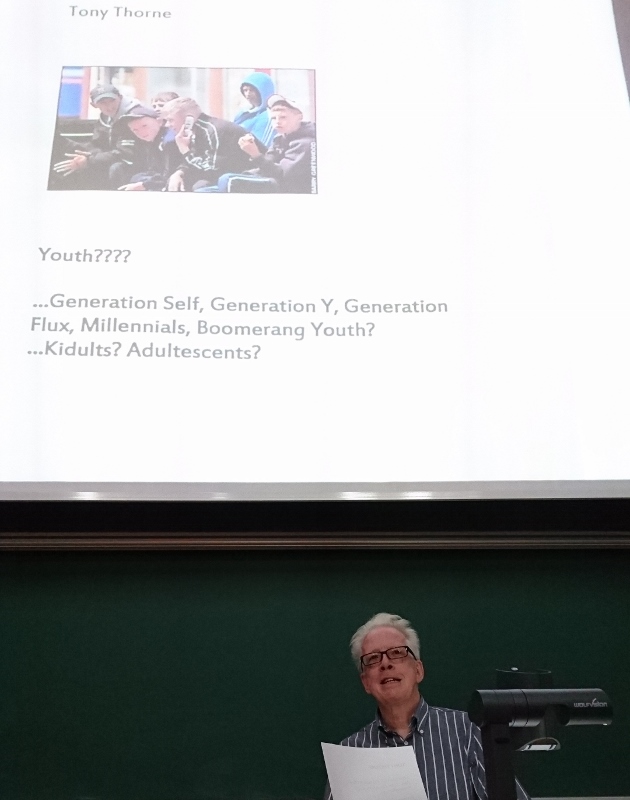
THE LANGUAGE OF YOUTH – 1

DSC_0100 (630x800)

NOTES ON SLANG AND THE LANGUAGE OF YOUNG PEOPLE


This is a sort of aide-memoire that I use with secondary and undergraduate students and teachers as a starting point in talking about youth language, stating the obvious by way of question-and-answer:

  1. Which recent social and economic developments in British society have affected the attitudes and behaviour of young people?

In the last three decades the UK has seen, according to some commentators, a spectacular breakdown in social cohesion, with high divorce rate/single-parenting/alcohol and drug use/teenage pregnancies/obesity, etc. Especially significant for young people is the absence of authority figures and traditional social constraints. This also contributes to youth crime and gang culture (where the gang may function as a substitute family). Economic turbulence and the peculiarities of the UK property market mean that teenagers may not be able to afford to leave home and may suffer unemployment, but attitudes among teenagers and school-leavers in some cases appear to reflect an indifference to work and lack of aspiration coupled with a sense of entitlement and ‘adult’ desire to consume...

  1. Why do young people invent and use slang?

Slang functions for transgressive in-groups such as street gangs as a secret code which allows them to describe and celebrate their illicit activities and keep them from the attention of authority figures. Young people who may not be transgressing may imitate this ‘deviant’ usage as they see it as glamorous, but in any case slang also serves more innocently as a way for young people to establish a ‘cool’ identity, confirm allegiances within peer-groups and micro-niches and claim ownership of a set of symbols (not only vocabulary but appearance, etc.) that gives them social capital and glamour while they may lack real economic power…

  1. Are text messaging and slang use by young people really affecting their ability to communicate in more formal situations?

‘Experts’ disagree: some government advisors and employers declare and assume that use of unorthodox language is associated with limited vocabulary, lack of communication skills and negative attitudes. Some academic linguists – and this writer – point out that abbreviated codes associated with electronic media are nothing new and that slang usage can be creative rather than destructive. Some research indicates that those who text or use social networking sites actually tend to have improved or possess higher literacy rates. ‘Appropriacy’ – knowing how to fit your style of language to context – may be a problem for some, but many young people are adept at ‘code-switching’ – moving between different language varieties according to who they are communicating with and why. BUT while slang cannot be disapproved of technically – it functions like poetry and literature – we must recognise that for many adults it provokes strong emotional reactions and is associated with serious crime and social breakdown…

  1. What social factors in the UK have contributed to the appearance of a so-called ‘MLE’ (multiethnic London English) or ‘Urban British English’?

Afrocaribbean, and to a lesser extent East and South Asian music and popular culture have high status among youth. In inner city schools across the UK British English is not the mother tongue for many students, while the shared code outside the classroom is for some a multiethnic youth slang rather than local or standard forms of English. Some linguists claim that an emerging generalised dialect spreading from London and developed by young people is displacing previous localised dialects and traditional slang and may impact on mainstream English in the future, possibly in terms of vocabulary, but more probably in terms of accent and intonation. Mixed urban dialects are not only a feature of the UK but have evolved in other European countries where elements of Arabic, Turkish and other ‘minority’ languages have affected colloquial usage and phonology.

PERCEPTIONS OF THE YOUNG

Image result for annoying young people


                                                  How are British Youth described? 


Over the last few years I have been collecting articles in the UK press (from tabloids, broadsheets and online sources) which seek to characterise young people. The following, in no particular order, except perhaps for the sake of ironic contrast, are the salient characteristics which emerge from an informal analysis of these articles’ claims:


  • Narcissistic with an unfounded sense of entitlement
  • Experiencing unprecedented levels of anxiety and depression
  • Identifying with celebrity culture
  • Prone to ‘drug abuse, alcohol-fuelled pregnancy or law-breaking,’
  • Clean-living, ambitious and competitive
  • ‘…growing up without boundaries, thinking they can do as they please… No adult will intervene to stop them.’ (David Cameron in 2009: the discourse of ‘broken Britain’)
  • More socially liberal and accepting than previous generations on issues such as gay marriage and euthanasia
  • More politically right-wing than parents or grandparents at the same age
  • Digitally literate and globally empowered
  • Suffering from literacy problems and economic disempowerment
  • Speaking a different language


UrBEn-ID is an ethnographic linguistic research project being carried out at Manchester Metropolitan University, funded by The Leverhulme Trust. UrBEn stands for Urban British English, reflecting the project’s aim to investigate ways in which young people in an urban environment use language in the construction, negotiation and performance of their identities.

Some of their recent findings can be accessed here:


http://www.urben-id.org/attitudes-survey/


Three years on, and those labels; Babyboomer, Generation X, Millennial and Gen Z are still contentious, still contested. This from Marketing Week in April 2019:

Are terms like ‘millennial’ actually useful?


THE (SLANG) WORD ON THE STREET

Here City University student Jasmin Ojalainen writes about the UK’s urban slang…

As the melting pot heats up, multiculturalism isn’t only shaping the way we live but the way we speak. Jasmin Ojalainen investigates the /twæŋ/of London street /slæŋ/

LONDON with DAN 🇬🇧 | ✓”Wagwan” is a ...

”Yo, what’s good?” asks a young man in a greeting. While the more conventional ”I’m good thanks, how are you?” may be the natural response for most, it is not often heard amongst the London youth today. Particularly not with Andy Djaba, a 19 year-old chemical engineering student at Imperial College. ”I use quite a lot of slang, but not anything that someone that’s not from London wouldn’t be able to follow,” he says.

London slang and its varieties are constantly changing with diverse cultural nuances. Tony Thorne, language and innovation consultant at King’s College London, notes that the speech pattern amongst London youth has shaped over the years. “In the past London slang displayed certain distinct features – the obvious one of referring to places in the city and of course rhyming which is particularly associated with a London origin even if it is now used elsewhere,” he explains. “Today the slang associated with London youth is not actually confined to London and it is difficult to determine which specific parts of its vocabulary originated there.”

He refers to Multicultural London English, generally known as MLE, which features new words borrowed from outside the UK – exactly the variety of slang that Andy, of West African origin, is talking about. MLE is often linked to recently emerged multicultural hybrid “Jafaican,” or fake Jamaican, with West African and Asian undertones. Jafaican surfaced to the popular culture most notably through Ali G, a parody of a white man adopting slang as a stylistic preference in order to appear more “street.” Although Jafaican is a London creation, the modern youth slang is an urban vernacular saturated with a mixture of ethnic imprints. “The predominantly ’white working-class native Londoner’ slang of the past has been replaced to a large extent by a multiethnic set of codes retaining some local features, such as glottal-stopping or the criminal lexicon, but strongly influenced by external, especially Caribbean varieties,” explains Thorne.

Talking to Andy, these features are present. “Londoners drop the t’s,” he says, referring to glottal-stopping. “There’s little phrases that Londoners will say at the end, ‘d’you know what I mean?’, ‘you get me?’ and ‘innit?’” he says – again, characteristic of the Jafaican dialect. “It’s a nice way to round up a sentence.”

Thorne notes that whereas slang used to be condemned and resisted, it is now publicly recorded and celebrated as new words surface all the time. “There is an obvious need for linguistic renewal and innovation to keep pace with technological and social change and reflecting new influences such as immigration by outside linguistic groups,” he explains. “Within exclusive minority communities, such as street gang members, music genre aficionados and fashionistas, there is also a desire for novelty, originality and authenticity.”

The hip hop culture in particular has popularised modern slang, and Andy says that many words amongst the young today originate from the popular culture and contemporary phenomena, such as rap lyrics, videos and TV programmes – even people themselves. “I started saying ‘roll safe’ quite a lot because of the documentary. It just means you’re leaving somewhere,” Andy says referring to Hood Documentary, a series of documentary episodes released by a South London actor Kayode Ewumi last October. “Also ‘suck your mum’, but that’s like an insult – you hear rappers say it now, so you hear people say it a lot more now,” he adds. These lyrics have most recently been heard in a WickedSkengman, a release by London rapper Stormzy late last year. Andy explains that some of this slang develops in context through repetitive use, often in a group of friends. “Once people hear it, people start saying it, and eventually you understand what it means,” he says.

Because slang is a subversion that sits alongside what is considered correct use of language, a debate around its use in formal contexts persists. In 2013, the Harris Academy in South London’s Upper Norwood introduced a ban on slang to improve standards of English amongst students. Simon Heffer, author of Strictly English, is not against slang but he believes that it doesn’t belong to professional environments.  ”Educated people avoid slang in formal settings, such as a job interview, so someone who does not know to do this will be assumed to be uneducated,” he says. Heffer suggests that the use of slang can point to underlying social inequalities in certain situations. “Slang is often used by those who don’t have a lot of power in society, so it serves those people best. This is most striking in London, with its persistent class system.”

“Where people use slang because they are incapable of reverting to correct speech when necessary, that does suggest at least educational marginalisation,”Heffer says. To Andy, this is something he pays attention to – very much for that same reason. ”I don’t include any slang, or as little slang as possible, when talking to older people or lecturers, tutors, stuff like that,” he says. ”I pronounce my t’s when talking to them.” He agrees that the use of slang could suffer a sociocultural stigma in a professional environment. “If you drop a lot of slang in a formal setting, they’re not gonna understand what you’re talking about. Secondly, if you do it, I think they’ll think you’re just a bit dumb. That you don’t have a wide range to your vocabulary,” he says. “You have to try and be a bit more sophisticated with the way you speak.”

Thorne agrees that slang bears an inherent stereotype. ”High status on the street implies low status in the capitalist economy,” he says. “There is nothing inherently, linguistically deficient about slang and slang users are not necessarily incompetent in standard literacies, but slang is associated with marginal or transgressive groups and activities and is viewed by many as embodying a threat to mainstream values.”

There is a concern that discarding slang at schools would further alienate young people, and some academics have sought alternative methods to bridge the linguistic gap. A former London schoolteacher Tim Woods started the London Dictionary Project as an attempt to catalogue and understand the slang his pupils were using, which was made public in 2014. “There is a common narrative that says that it’s the slang itself which is the problem, which is ridiculous,” Woods says and suggests that the choice should be up to young people themselves. “People respond to incentives, so if you put someone in a great school where many graduates end up running the country, they’ll be happy to adapt to the requirements of the system,” he says.

While Woods thinks that slang itself isn’t harmful, he believes in encouraging young people to use proper grammar and vocabulary to improve their language skills.

“It’s like taking a class in a foreign language and not being allowed to speak your native tongue. It’s not the native tongue itself which is harmful, but there can be a benefit to learning the way that other groups speak,” he says. “Language is very powerful and that makes people nervous. Often what people are saying is symptomatic of things rather than causal – but people would often rather the symptoms, such as inequality or hate, would just go away.”

Why the use of slang should face such controversy comes down to its stamp of exclusivity. Jonathon Green, a lexicographer of slang, notes that the use of slang has been linked to the marginal of society throughout history. “Slang was, is and will remain the language of the street,” he says. “A bottom-up creation that is associated with the working or lower class, even the modern underclass. There is little upper class slang, and such individuals are far more likely to ape the usage their social inferiors.”

Criminal jargon associated with slang may make this even more so, and Andy notes that the use of slang points to deeply rooted issues even today. “You don’t hear white people say London slang as much as black people,” he says. “There’s a thing that people think that if you speak with a lot of slang that you’re talking black. It’s ridiculous – I can understand why people say it, but it’s a generalisation. And it makes you think that in saying that, you’re implying that black people aren’t educated or white people are more educated.”

Green agrees that the ties with slang are socioculturally bound, and says that because of Jafaican infused MLE “we all speak black American to one degree or another.” He suggests, however, that the stereotypes that come with the use of slang are now met with an element of humour. “Slang is not as taboo nor as looked-down upon as once was the case. Look at dictionary definitions: for many years slang was defined as ‘low’ or ‘criminal’. These days the dictionary focus is on its wit and playfulness,” he says.

Despite the historically negative connotation of slang, in today’s society it inevitably merges multicultural identities past the stereotypic notion. ”Slang is used to construct alternative affiliations and identities, some of which may be multiethnic or even considered post-ethnic,” Thorne notes. “There may be grounds for disapproval but they are social or subjective, not linguistic or objective. Some terms in standard English, such as mob, gay, and bus, originated in slang.” Green also agrees that slang is a powerful social instrument that above all forges collective identities. “It all depends where you stand. If you see yourself as an upholder of establishment values, then slang is symptomatic of the ‘dangerous classes‘,” he says. “If you are young, criminal or in some other way socially marginal, then slang can both reinforce you as part of a group, and exclude those who are placed outside that group.”

Historically, London slang has seen the rise of many additional localisms and Thorne notes that even now, there are local dialects – although they largely overlap – within London youth slang ”so that slightly different terms are fashionable in different zones.”Andy, who was born and raised in North West London, notes that the geographical and social differences play a key role in what slang is used. ”Where you’re from and what school you went to definitely affects the way you speak,” he says. “I’ve got mates that are from south London and some of the stuff they say I don’t understand.”

The expanding tentacles of London slang and its diverse branches seem to have eclipsed the traditional Cockney over time. Green, however, thinks that the traditional East End dialect is not entirely gone. “Cockney is not brown bread*, but it is a very different creature from that which was first recorded in 1856,” he says and suggests that the old slang has become something of an iconic trademark.

“The last twenty years and more have seen a major change. It has become little more than another illustration on the tourist map of London. Like black cabs and red telephone kiosks – neither of which really exist – it is inextricable from traditional London. In fact it is yet another badge awarded the Z-list celebrity, along with tabloid scandals and appearances on reality TV shows,” Green says.

Even so, the rhyming slang has escaped the tongues of the younger generation. “I don’t understand Cockney slang,” Andy says straight away. “I think it is dying out – to be fair, I don’t live in the Cockney area, but I haven’t heard people my age talk any Cockney slang.” And he is not alone. A study published by the Museum of London in 2012 already showed that the East London dialect may be fading out as majority of the 2,000 participants failed to recognise traditional phrases associated with the rhyming slang.

In an article written for the Independent, however, Thorne points out that Cockney isn’t a shared dialect but a word game not meant to be understood immediately by everyone. So, no one actually talks in Cockney anymore, but Thorne notes that even when the rhyming part is left out, the heritage of the slang is still present in our everyday discourse. Many phrases have been simply trimmed from their originals, such as “taking the mick” that used to be known as “Mickey Bliss.”

Dynamics of slang from rapid change in meaning to widely recognised words that stick around for decades may be as complex as the sociolect itself, and what makes some slang effective is difficult to pinpoint. “It’s not possible to predict or to be sure in retrospect which slang terms persist or cross over into everyday usage and which don’t. This may occur if a term fills a lexical gap in the language – if it encodes something which previously lacked a name,” Thorne explains. ”Slang by definition carries a charge of novelty, exoticism, transgression and topicality which may account for its power,” he says and adds: ”It’s also untrue that all slang is short-lived: even the vogue terms of youth slang, such as ’solid’, ‘cool’, or ‘wicked’, tend to stay in use for several to many years, though they may migrate from the high status expert users to less fashionable speakers.”

Green notes that the initial secrecy of slang may have accounted for its fast-paced change. ”When a term became known outside the group, it was necessary to replace it. And while linguistic secrecy, if it even exists, is much shorter-lived today, that principle still obtains,” he says. And perhaps the magic of slang and why it works is its constant revision that accounts for some personal influence. The idea of a shared identity boosts the personal significance slang has on its user, and Woods suggests that it is indeed that kind of social power that makes slang so popular and effective.

“A few times when I was a student myself I gave someone a nickname and it stuck. Everyone would start calling this person by the new name, but only the people in our group knew where it had come from and what it was implying,” he says. “There was always a bit of a hidden meaning behind it. The person with the nickname felt like they were really part of the group too, but of course a nickname often only lasts a month or something.”

“I think slang is similar. If you can use the right words, if you know the words, you know you’re in the group and other people are reminded that you’re in the group,” Woods thinks. Andy says that to him, slang has exactly that function, sometimes to the point where it replaces actual names. “I don’t even call my brother by his name anymore, I just call him ‘bruv‘,” he says.

Thorne reminds that other historical slangs in London, such as Polari, which West End version was used in theatre whereas the East End equivalent was heard in the Docklands, both mainly by gays, worked as a stamp of identification. As a social means, slang fosters an exclusive sense of belonging and equality between the speaker and the listener. ”All peer-groups or communities of practice operating in clearly defined and restricted settings and valuing exclusivity are likely to generate their own sociolects – nonstandard varieties of language related to location, class, ethnicity and/or activity,” he says.

Andy says that he uses slang especially with his friends, and confirms that “there’s an identity to it.” Additionally, he thinks that London slang itself has a widespread sense of tribalism amongst its speakers in the city. “It’s quite clear that Londoners speak in a different way to everyone else,” he says and shows that people take pride in the use of slang with a playful us-them mentality. “If I heard a non-Londoner saying a lot of London slang, I’d be like, what are you doing, just trying to copy how we speak.”

In the UK, London is naturally the cradle of all slang and according to Green, the capital’s strong slang base is “vastly outweighing any rival.” But even so, the countless possibilities unleashed by the digital world and multiculturalism, the original London slang – the language of the working class, underworld, traders, and gays – has since lost its primacy. Whereas cultures and multidimensional identities are constantly forged together, so is new slang.

Contemporary millennials and today’s youth ensure that slang keeps flourishing, which means it changes often – and perhaps the secrecy of modern slang is in the fact that it can be hard to keep up with. ’Styll’, perhaps the most peculiar of recent slang words, is something Andy finishes the occasional sentence with. It doesn’t really have a meaning, or it is one of a varying degree, and yet it somehow seems to encapsulate the youth slang with its growing popularity and slight absurdity.

“It doesn’t mean anything, you just say it. Like when you’re watching a football match, you go: ‘Oh yeah, that was a good match styll,” Andy says. “I picked it up on Twitter.” And that’s how slang seems to work. It forms in the mouths of the young, the contemporary and the influential, it spreads through peer groups and celebrities, and most importantly, it develops through life and conversation – and nowadays, even social media.

And while the era of global digitalisation has already had its footprint on youth slang, Andy says it’s difficult to remain self-aware with the overwhelming exposure of new slang and emerging influences. “It’s not that deep,” Andy sums it up with a phrase that has surfaced in his speech in regular intervals. ‘It’s not that deep’ or ‘the situation at hand does not require such desperate actions,’ as defined by Urban Dictionary – or perhaps in this context, a suggestion that Andy doesn’t want to overthink the possibly layered reasons behind the way he speaks. “You just pick these things up and it gets assimilated into how you talk,” he explains, and it seems perfectly plausible.

Slang and varying patterns in speech are contagious, at least to some. As a natural response to ever-evolving language, our primary means of communication and understanding our surroundings, we tend to pick up and imitate changes in style all the time. After all, it’s bare colloquialism. Innit?

allow (verb) – to forget about sth; to dismiss the topic of discussion

bait (adj) – obvious

bare (adv) – a lot of, very

big man ting (adv) – to be honest

bitz (n) – neighbourhood

bruv (n) – brother

com (adj) – cool

dinter (n) – male

deece (adj) – nice, decent

gassed (adj) – excited, full of oneself

gwop (n) – money

innit (excl) – isn’t it

long (adj) – boring

mandem (n) – a group of male friends

moist (adj) – soft

man’s (n) – I, I am

neek (ad) – nerd

peak (n) – bad luck

roadboy, roadman (n) – local; someone who knows the area well

roll safe (excl) – goodbye

skeen (adj) – understood

styll (adv) – though

wagwan (excl) – what’s up

wasteman (adj) – loser; someone who does nothing with their life

Adam and Eve (verb) – to believe
Barney Rubble (n) – trouble

Brahms and Liszt (adj) – pissed (drunk)
bees and honey (n) – money
brown bread (adj) – dead
butcher’s hook (n) – a look
China plate (n) – mate (friend)
dog and bone (n) – phone
half-inch (verb) – to pinch (steal)

Hank Marvin (adj) – starving

laugh ‘n a joke (n) – smoke

Mickey Bliss (verb) – to take the piss
pig’s ear (n) – beer

rabbit and pork (verb) – to talk

Todd Sloane (adj) – alone

graff (261x193)

STUDENT SLANGUAGE 2.0

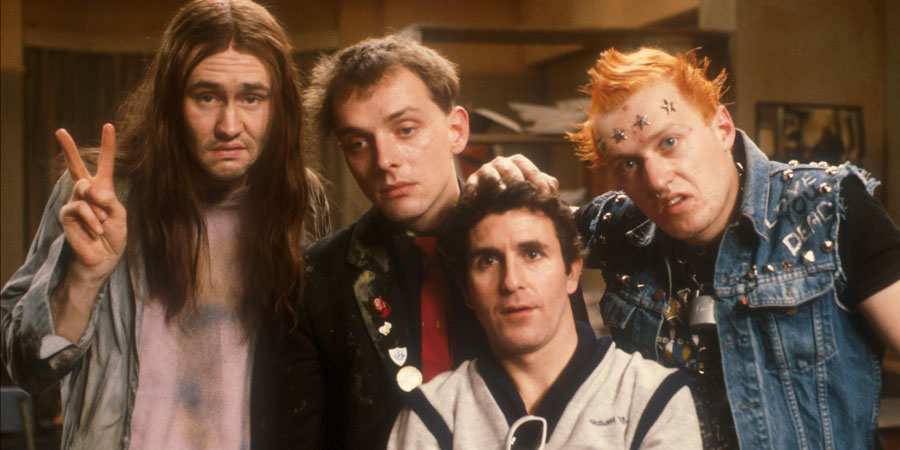
Image result for the young ones


‘Old Georgie’s chucked a Benny: she’s a real spackafish sometimes.’ ‘Well san fairy-ann: she always weirds out after a couple of Britneys.’

Translation: ‘Young Georgina has had a tantrum: she can be socially awkward on occasions.’ ‘It doesn’t really matter: she tends to lose control whenever she has drunk a couple of glasses of beer.’ This exchange took place on a university campus and students in higher education, in recent years at least, have been some of the most enthusiastic users of slang, a language variety identified with irreverence, exuberance and youth. It’s recognised that adolescents are responsible for a great deal of lexical innovation – the creation of new words and phrases – in English, and by rights students, in theory the most linguistically gifted and aware members of their age group, should be at the forefront. Institutions such as prisons, army barracks and schools have always been breeding grounds for new language. In-groups often like to invent a new lexicon or vocabulary (often in fact by adapting and playing with existing language) to describe afresh their surroundings, their experiences and obsessions. They also use their special terminology as a badge of identity, and as a way of excluding outsiders from their conversations. The university campus is a social space that allows extraordinary freedom from all forms of authority and is a temporary haven from the responsibility to earn or conform. It is also a nexus, a point where many different influences come together. The language of babyhood and the primary and secondary school playground is mixed in with words picked up from parents, grannies, uncles and aunts, military jargon from Officer Training Corps, sporting colloquialisms from players and fans and, of course, the online cyberslang traded by geeks of all ages.


Within one campus there are dozens of cliques, each little speech community, (microscene, microculture or microniche are alternative designations) with its own sociolect, as the technical terminology has it. One person’s colourful turn of phrase is, in technical terms, part of their idiolect – their private language – and it’s there that new slang first appears. Somewhere an anonymous individual tries out a new witticism, insult or notion and, providing that their conversation partner (their interlocutor) grasps and accepts the novelty, it has a chance of catching on, first within the group and later perhaps in the wider world.


Words vary from place to place; shimmy means hurry up in Leicester, in Newcastle it’s get a bolt on, and in London it’s duss, but of course all this could change in three years or so as the intakes come and go. To the extent that they still move away from home to attend colleges, students also bring together expressions from around the country. In London you may hear chill your bills (to relax) from South Wales, gallus (good) from Scotland. Local language finds its way on to the campus. The all-purpose cry of approval of the rural farmhand or truck driver, proper job! can be heard at Exeter and Bristol and the rhyming slang of greater London (having a tin bath, Turkish bath, giraffe or bobble(hat) and scarf is ‘having a laugh’, an Eiffel tower is a shower) has spread across the South and beyond – hence Britney (Spears) for ‘beers’. Overseas Englishes will feature in any multinational student group: US feening or jonesing for craving or obsessing, to flake meaning to drop out of a social engagement or Australian coming the pork chop which means getting agitated, for example.


One way of finding out what a particular social group is interested in is to classify the expressions they use according to meaning. These clusters of related terms are known as semantic fields. If we count the terms in each field, we get an idea of what is most important to that group of speakers. For students across the country these broad categories seem remarkably consistent. I have recorded many words connected with flirting; chirpsing, lipsing, synching, joining, sharking, macking or smacking among them. Jewish students may use their own equivalents, shoms or rowsing. Going out with someone is fashionably termed linking or dealing.


Sneering at un-cool contemporaries makes use of words like flamboy, topshopper, mutt, bumbass, kev, woodentop, duffer, moose and cruit. Spackafish denotes someone clumsy or inept. An unattractive person is called butterballs, anchor, (both versions of the earlier, probably Jamaican, adjective butters). Unsightly bulges at the waistline are bacon-bands, muffin-tops, or lurve-handles, on the upper arms are bingo-wings. Mahoodally, heard in London, is interesting in that it means ugly but seems to be a pure invention, unrelated to any other word, something that happens very rarely in English even in slang usage.


Few chavs, it seems, make it on to the campus, at least legitimately, but many poshos do, there’s a whiff of snobbishness about terms like village or tramp, both adjectives meaning poor, second-rate or shabby. Bush doesn’t denote the former US president, but is an adjective meaning backward and primitive, like the Asian students’ jungli.


There are, though, plenty of ways of indicating approval. Cutting, standard, raar, bom and thug all mean good; confusingly shabby can mean good, too, but so can not so shabby. Legend is an adjective or an exclamation also meaning ‘great’, but a ledge is a show-off, shortened from ‘a legend in his/her own mind.’ BMOC (pronounced ‘bee-mok’) derides a ‘big-man-on-campus’. Physically attractive fellow-students are described, using Black British slang, as chung (also chong or choong –there are no rules for spelling slang) or peng. The main ‘ethnic’ influence on British slang used to be exclusively Caribbean, but now we are beginning to hear ‘Hinglish’ – Indian English – as well as words from Bengali like nang, meaning good.


Mercifully, there’s none of the gang-related slang describing guns and knives, mugging and humiliation which I have heard in secondary school playgrounds – traded gleefully by kids who are probably quite innocent of these things themselves. If there’s one defining characteristic of university slang it’s probably facetiousness. Students can, and very much do, indulge in frivolity, or as they put it, fanny-toots. ‘Excellent’ becomes excrement, ‘fair enough’ mutates into furry muff; thanks are expressed by spank your very crotch, and a common term of endearment on all campuses is You Big Gay Bear! Blatant! or Blates! are exclamations of sheer high spirits and goodbyes can be expressed by laters! Bless! or a cheery over and out, rainbow trout! Some of the verbal oddities would baffle outsiders: for a while whenever someone was showing off or fishing for compliments King’s students would chant Trunky wants a bun! The phrase was apparently inspired by an elephant in a zoo somewhere who would do tricks in return for buns from his keeper.


Overdoing things (not work, though) is caning it; losing control is, as we saw earlier, chucking a Benny, or alternatively spinning out, ragging out, going raggo, weirding, zoning, being on a hype or hissing (from the colloquial hissy-fit). There are plenty of terms for relaxing: chill, cotch and kick back are widespread, and bimble is a nice Leicester term for ‘gently ambling about aimlessly’, but very significantly there seem to be no expressions at all which relate to studying, and this goes for all the campuses I have investigated. Students have to work hard these days, but talking about it is apparently taboo. When they say j.d! (for ‘job done’), it just means ‘I feel OK/everything is fine!’ Twenty years ago money was rarely mentioned by impoverished students, but in these times of student debt and the scramble for future jobs it crops up frequently in the form of squillas, squidlets, cheddar, peas, pebbles, pondos, beer-tokens and spon. The cash dispenser is known as the drink-link and cashback! is a general cry of joy or success.


As this is, even more than standard English, an unregulated lawless variety, it often isn’t possible to be certain where slang terms originate. Trolleyed is a common term for drunk, but should it perhaps be spelled trollied? Does it come from the well-know ‘off one’s trolley’ meaning crazy or out of control (probably from the image of a hospital patient running amok), or from trollies meaning underpants?


Of ‘intellectual’ slang there is not much evidence beyond a little punning with foreign words. The direct French translation action gagnée may be used instead of ‘winning action’, itself a euphemism or disguise for a successful seduction or crafty trick. ‘Thank you very much’ now becomes Saint Cloud Paris Match, while san fairy ann, quoted earlier, is an anglicising of ça ne fait rien dating from World War I. Students still occasionally invent mock-learned words like bosfoculated, meaning baffled or confused. They may loftily observe that someone fastidious and nostalgic is being ‘a bit Proustian’, or if anguished, ‘having a Dostoyevsky moment’, but these cultural or literary allusions are just passing comments and don’t become embedded in the common vocabulary.


What is ‘youth’ slang for? Forming relationships, bonding, expressing solidarity – these, along with establishing one’s prestige as a member of the group are what sociolinguists seize upon – but slang also functions as part of pure play: a stylistic choice employed in mischief, banter, mocking, joshing. It’s just for fun, to express one’s joie de vivre. In every student environment I have come across the number one topic of conversation, the prime activity celebrated in slang is the same. It is getting willied, gattered, hamstered, mullered, laggered, blazed, dribbly, seized and dozens more, in other words ‘becoming intoxicated by alcohol’.


Should we fear for the future of the country? A high frequency of terms for drunkenness proves only that students like to talk about an activity that is emblematic (both symbolic and evoking feelings) of sociability and shared pleasures. Despite the boasting of being completely wombled night after night, most students pass their exams and achieve their degrees. Does a love for this non-standard code undermine students’ ability to use the other kinds of English they need – academic for essays and dissertations, technical for research projects, formal for interviews or applying for loans? Probably not: in my own experience most students, even if they can no longer spell properly– and these days that includes some of  the English majors – are sharply attuned to the difference between appropriacy and inappropriate language: they know when ‘yes sir’ works and when aye-aye, shepherd’s pie! sounds right.


While academic linguists in Britain have tended to steer clear of slang analysis, Professor Connie C. Eble at the University of North Carolina at Chapel Hill, USA, has been keeping a tally of current campus slang, donated by her students, for more than two decades. Her collection formed the basis for her 1996 book, Slang and Sociability, probably still the most accessible and comprehensive treatment of the subject. At Leicester University in the UK students have compiled their own dictionary of terms used on campus and in the UK and USA it’s students themselves, rather than their teachers who are the most enthusiastic researchers into slang, some extending their projects into secondary schools, where pupils are at last being taught about the language they themselves create and use. I have also set up a modest resource at King’s College London for anyone interested in slang and other novelties and exoticisms. The Archive of Slang and New Language contains a database of current slang and jargon along with a selection of articles and a small library, and welcomes contributions from you, your friends, family members and fellow students.

* * *

A version of this article first appeared in e-magazine in November 2007

While this Guardian article from seven years earlier recorded the findings of Professor Tony McEnerny with comments by me…

https://www.theguardian.com/education/2000/dec/19/highereducation.theguardian

Image result for students partying

STUDENT SLANG


TRUNKY WANTS A BUN


Do you know your bangin’ from your slammin’, your

Desmond from your Douglas? Student slang is now the

subject of serious academic attention.


 Tony Thorne, the former Head of the

Language Centre at King’s College London

and compiler of the Dictionary of Contemporary Slang,

has made a special study of the language of

students, and King’s students in particular.

The Archive of Slang and New Language at

King’s brings together printed publications

from the 17th century to the present day, and

includes an electronic database of new usage

from across the English-speaking world. With

all the Americanisms, Australianisms, and

South Africanisms taken out, the database

now numbers over 10,000 separate items of

contemporary usage and student vernacular.


It’s not always easy to carry out a survey of

authentic, non-standard usage. Eavesdropping

is problematic, and the mere presence of a

stranger in a group, especially one armed with

a tape recorder, is likely to inhibit the use of

slang, or lead to slang-users playing to the

gallery. So for several years now, students at

King’s have been asked simply to make a note

of the phrases that they use or hear, and to

contribute them as part of an ongoing project.


But why is it so important to study slang?

‘Among linguists, this area is not quite as

neglected as it was,’ says Tony. ‘Thirty or

forty years ago slang was barely discussed.

But there’s a realisation now that youth

language may be more important than

previously thought.’

Historically, key student slang words have

tended to be taken-up by a much wider range

of users. For several centuries the jargon of

Oxford and Cambridge, in particular, has

found its way into mainstream English. ‘Mob’,

‘bus’, ‘toff’ and ‘posh’ (which does not after

all derive from ‘Port Out, Starboard Home’)

all probably originated as student slang.

And if anything, ‘future generations may be

less likely to abandon slang as they get older.

There’s less social pressure now to do so.

Slang will probably have more of an influence

on mainstream English than it does now.’

So there’s a social reason to take slang more

seriously. ‘And looking at it nonjudgementally,

as a linguist, you can also see

that it’s technically very interesting. This is

a highly inventive style of language.’


Like other forms of cant used by specific

groups in society, student slang is both a

prestige way of speaking (conferring status

within a particular sub-culture), and one that

is stigmatised by the mainstream. It is a highly

specialised, exclusive form of language, which

strengthens the sense of belonging within

a group, while being – deliberately – barely

intelligible to outsiders.


But is King’s slang different from other

types of student jargon? Some phrases are

specific to the College – if a student says

Trunky wants a bun, for example, they’re

probably accusing one of their peers of

sucking-up to their tutors, the modern

equivalent of saying apple for teacher.

Apparently the original Trunky was an

elephant who would perform tricks for

a confectionery reward.


According to Tony, ‘King’s slang is often

quite theatrical, with a number of different

terms for hissy-fits and stroppy behaviour.

It’s generally very creative and articulate.

And a large amount of King’s slang

celebrates living in London.’ There’s a

strong liking for rhyming slang, for example,

including the College’s principal gift to the

world of student slang, through one of our

most illustrious alumni – Desmond (Tutu;

a 2:2 degree).


Given the nature of slang, new words have

a constant habit of appearing, to take the

place of older ones. With new influences –

currently from the Caribbean and Asia in

particular, as well as from things like texting –

come new ways of saying things. And as

with other types of slang, student cant seems

to be able to generate an endless number of

words that mean pretty much the same

thing. For ‘very good,’ yesterday’s ace, brill

and fab become today’s standard and solid.

There are hundreds of words for being drunk

(mullered, gurning), and dozens of synonyms

for ‘exciting’, such as (kicking, slamming).

The ruder ones you’ll have to look up in the

Dictionary.


Should we be worried that our favourite

in-phrases when we were at College

probably won’t impress today’s students?

For Tony Thorne, ‘even conservative

commentators like Johnson and Swift spoke

about the generation of new expressions,

and acknowledged that it’s inevitable and

enriching. Language can’t stand still –

you can’t legislate for it.’


And it’s still crucial to fit language to its

social context. ‘Maybe in years to come it

will be acceptable for you to use slang words

in a job interview, but for that to happen slang

itself would have to change radically. It’s not

true that the language is degenerating, or that

anything goes. I think we can relax about

slang, and enjoy it for what it is.’


To help you understand the youth of

today, we’ve given you a short glossary

of contemporary terms that are currently

popular with King’s students. But be warned

– using slang in the wrong context, or

trying to sound like you’re down with the kids

when you aren’t, can make you sound like

a real spanner.


Were there unusual slang words and phrases

that had a particular meaning for you when

you were at College? Send your examples to

tony.thorne@kcl.ac.uk – contributors are

acknowledged by name in publications.


Glossary


Catalogue man – someone who is

unfashionable, who buys their clothes

from a catalogue


Desmond (Tutu, a 2:2 degree, one class

above a Douglas Hurd: a first is a Raging (Thirst))


Down with the kids – in touch with the

younger generation


Ledge – a conceited student (from ‘legend

in his own lunchtime’)


Pants – disappointingly poor or low quality


Pukka – excellent


Spanner – a foolish or contemptible person


Standard, solid, molly – very good


Throw a bennie – lose one’s temper


Tonk – physically attractive


Tough, uggers – very unattractive


Trust, squids – money


Vamping, flexing – showing off


A version of this article first appeared in In Touch, King’s College’s alumnus magazine in 2012


MILLENNIALS 2.0

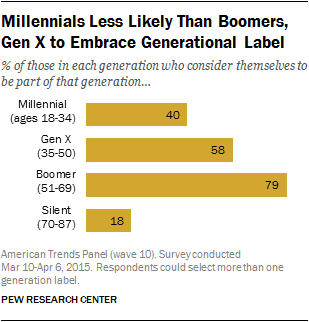
Most Millennials Resist the 'Millennial' Label | Pew Research Center

Only four years ago I was introducing a new demographic to readers of British Airways’ BUSINESS LIFE magazine…

“We’ve seen the rise of babyboomers and yuppies, then of the former slackers known as Generation X. This newest generational label (aka Generation Y or the Echo Boomers) refers to youngsters born between 1981 and 1999. Their coming of age has spawned a slew of articles in both specialist journals and popular media. Commentators detail how they differ from predecessors in their collective attitudes, and describe how to manage them in the workplace. What’s provable is that millennials are the most ethnically diverse, digitally aware and empowered group yet to emerge. On their other characteristics, though, opinions differ sharply. In the UK some employers have castigated them as workshy, semiliterate, needy and narcissistic while US behavioural ‘experts’ laud their ability to multitask, their skill in balancing work and leisure, their respect for elders and leaders and their trust in institutions and allegiance to teams.”

Here, in the Independent, Mollie Goodfellow and I continue this year’s exploration of millennials’ language

http://www.independent.co.uk/arts-entertainment/the-five-things-millennials-will-never-say-a6820751.html

While (by kind permission of Marketing Week magazine) Mark Ritson offers a business perspective

https://www.marketingweek.com/2015/11/11/mark-ritson-millennials-are-out-blah-blahs-are-your-next-target-group/

MILLENNIALS?

I’ve had an argument with my 17 year-old son who says that some millennials – he cites comments sections, blogs and discussions online – are not the empowered, enlightened consumers of marketing myth, but among the worst racists, misogynists and homophobes. The problem is that millennial as a label covers a huge demographic which strictly speaking should include LadBible devotees, gamergate fascists and anti-immigrationists as well as fashionistas, the gender-fluid and Vloggers.

Image result for millennials

If we can realistically generalise about them it goes without saying (but it’s constantly repeated) that their generation is the first whose experience of life has been so profoundly influenced by electronic media and messages and the accelerated globalised interactions that come with them. For a babyboomer like me the difference is that they have unfettered access to information and also the means to explore and express the widest range of views – but they also sometimes display an unquestioning consumerist instinct, ruthless competitiveness (taking in the shaming culture and vindictive peer-pressure mentioned previously) and hyperindividualism bordering on narcissism. Oh, and – another generalisation – I forgot millennials’ awful tendency to gush/use hyperbole (totes devs/I’m dying/can’t evn… etc).

Here are some further thoughts on millennials and language, in a piece by Zoe Henry for Inc.com (…and more will follow)

http://www.inc.com/zoe-henry/words-millennials-use-youth-slang.html?updatezh

ADVERTISING LANGUAGE

How brands get it wrong – and occasionally right: an article from 2015…

THE WORD ON THE STREET? ADVERTISERS SHOULD MIND THEIR LANGUAGE IF THEY WANT TO CONNECT

Image result for honda keep up

Aiming at the widest possible audience means, logically enough, that advertising usually goes for the most accessible kind of language. It’s when it doesn’t do this, and heads off-piste towards the wilder realms of slang, text-speak or dialect that especially interests a linguist like me. Some recent examples show how a focus on language can work when it’s done judiciously and targeted properly. Honda’s speed-reading captions (‘Keep pushing and get to better faster.’) that go with the slogan ‘Keep Up’ have drawn admiring comments from its target audience. The ad uses highly conversational catchphrases rather than street slang and challenges viewers to keep pace with its high-speed delivery.

The Royal Navy’s latest recruitment ads feature a voiceover in strong Geordie accent, colloquial phrases like ‘up my game’, but work since their fictional speaker looks and sounds authentic, not condescending or trying too hard. Adidas, too, gets it right with its ‘haters’ ad: hiphop beats and street catchphrases like ‘take you out’, ‘score all the girls’ delivered in a multi-ethnic accent go with a message – haters will envy you, but you don’t care – that a youngish demographic is sure to embrace. Using both slang and hashtag Money Supermarket’s #epic strut car insurance campaign works because the visuals  – hapless Dave struts his stuff in hotpants and heels – are so silly you fall for it. Soundtrack is once again hiphop, but street-speak is kept to the bare minimum ‘Dave feels epic.’

Image result for dave feels epic

Other recent attempts to combine funky speech and street style have prompted mixed reactions. Sport England’s This Girl Can campaign, aimed at empowering women to exercise, featured phrases like ‘feelin like a fox,’ ‘damned right I look hot’ and ‘knackered’ to a soundtrack of Missy Elliott’s Get Ur Freak On. Judging by online comments it impressed many of its target group but was blasted by Guardian feminists for calling women ‘girls’ and focusing on close-ups of flesh.

Perceived ‘bad language’ is still an issue for UK consumers, as witness Booking.com’s 2015 TV and cinema ad, scrutinised by the ASA after it received 2345 complaints that ‘booking’ had been substituted for ‘f***ing’ in its voiceover, ‘…you got it booking right…it doesn’t get any booking better…exactly what you booking needed…’ The ASA ruling cleared the brand of wrongdoing: ‘Although we acknowledged that the placement of the word was redolent of the use of expletives, we noted that the ad did not expressly use any explicit language and therefore concluded that, although some viewers might find the connotation and word-play distasteful, it was unlikely that the ad would cause serious or widespread offence.’ Burger King’s 2010 ‘King Great’ slogan was allowed too, but furniture outlet Sofa King’s ‘Sofa King Low (prices)’ was banned. Lloyds Pharmacy wasn’t sanctioned but upset more than a few London underground commuters in 2013 with its poster campaign picturing a defensive line of uncomfortable-looking footballers above the double-entendre ‘Harder Tackle’. The ads were promoting erectile dysfunction treatment with pills ‘for better keepy-uppie.’

Another travel brand, Expedia this time, tried imitating rhyming slang and regional dialect in a 2012 campaign, provoking derision from professional linguists and not a few consumers, too. A trip to London was described in cringe-making ‘cockney’ as follows; ‘I booked in a Bob Murray so I saved maw bees an oney’ (supposedly translating as ‘I booked in a hurry so I saved more money’). Another ad reported on visiting Dublin in a bizarre attempt at Irish pronunciation; ‘It cast nex ter nuttin an we ad a tap noight oyt.’ What were they thinking?

Image result for tourism australia where the bloody hell are you

There have been other campaigns over the years in which using unorthodox language has had mixed results. Tourism Australia’s ‘Where the bloody hell are you?’ slogan bombed in the conservative US. Jaguar, in its New Zealand billboard campaign, mystifyingly used the line ‘WTXF?’ to advertise its XF model. The abbreviation was highlighted in city centres across New Zealand and on online banners, presumably to the mystification of the brand’s mainly middle-aged and elderly targets. Jaguar nonetheless insists that the tactic did help to raise its profile in a new market. Back in the UK the official Twitter feed for London’s Victoria Line managed to offend many customers when it used texting slang to apologise for serious delays. Their tweet: ‘Hi all, just a quick chirp to let you know Victoria Line is all good this morning. Soz about yesterday! Hope you’re commute/journey goes well.’ Prompted one customer to tweet back: ‘Soz??? Are you kidding? Soz isn’t an appropriate word when your screwup causes thousands of people to get home from work late.’

In the US, where advertisers pioneered casual speech as in Budweiser’s ‘Whassup?’, McDonald’s ‘I’m Lovin’ It,’ Apple’s ‘Think Creative’ and the Dairy industry’s ‘Got Milk?’, it’s commonplace now to reach out to the youth market by using teen-talk and text-speak in campaigns. Brandwatch this year recorded 17000 recent mentions by brands of the key teen slang terms ‘bae’ (sweetheart) and ‘fleek’ (cool, successful), among them Taco Bell, Burger King, Pizza Hut and AT&T. It’s interesting to track reactions from young consumers, who, surprisingly to this Brit cynic, seem largely to accept their elders getting down with the kids, judging the brands on their merits rather than the lingo used.

Image result for ads with fleek

O2 did the same thing successfully in the UK, surprising many when it started to talk to its social media consumers in their own language. When @Tunde24_7 tweeted ‘@O2 b*****d big man ting I swear direct me to your owner what happened to my internet connection fam – mans having to use wifi and dat’, O2 replied: “@Tunde24_7 Have you tried to reset the router ting fam, so mans can use the wifi and dat?’ The exchanges went viral, with 90% of comments positive.

While using slang or internet abbreviations on traditional platforms can be fraught with danger for advertisers, it seems that digital slang in narratives and conversations can pay off if used on the right social channels in the right way. But there are other ways to exploit the public’s fascination with exotic language, and here the noble Brit tradition of spoof and parody comes into play again. I was involved with three separate media campaigns last year which used slang and quirky lingo in original ways to engage a range of audiences.

Spitfire Ale, whose ads had previously featured Armstrong and Millers’ slang-speaking RAF pilots, took over the posh Horse and Groom pub in London’s Belgravia and refitted it with graffiti, street slang signage and menus translated into the latest argot: the pilots made personal appearances and broadcasts, and takeaway consisted of a free e-dictionary of street slang, published to coincide with the event. In the same way, Lucozade published a ‘Festival Dictionary’ for the summer season containing youth language, musicians’ slang and technical terminology, packaged either as a wearable camping accessory or online e-book. Authenticity was guaranteed not by me, an ancient babyboomer, but with co-curating by DJs, street stylists and kids. Captain Morgan Rum, meanwhile, used International Talk Like a Pirate Day, which falls in October, to translate a range of the latest tech terms into pirate–speak in a manual (electronic and free to access) resembling a ship’s log.

Image result for lucozade yes dictionary

Street slang, local dialect, yoofspeak or teen-talk, initials and hashtags are what linguists call ‘nonstandard varieties’ of English: by definition not part of the mainstream, they must be deployed with care and skill, if at all. My own research suggest that sweary ads amuse momentarily but don’t leave a lasting positive impression of a brand. My respondents confirm that the odd example of bad grammar (‘Eat Fresh’) will be excused as long as it’s not too flagrant, and pop culture catchphrases (‘Go For The Burn,’ ‘Make It Real’) do confer impact and authenticity, but only when used sparingly. The UK teens I have worked with are more suspicious than their US counterparts, wary of an older generation trying to replicate their private, intimate slang (so shun any use of #YOLO –type abbreviations, Xtreme-type re-spellings). Against this there is evidence that Generation Y and Z members actually view brands online as the equivalent of people they can trust, so it’s the sincerity of the message they value above all else – hence O2’s success. Proliferating blogs, vlogs and print articles highlight the fact that, in a hyper-self-aware market, language itself is a hot topic across all segments right now. There is vast potential for advertisers to move beyond slogans and straplines, to key into the debates about good and bad grammar, fascination with accents, curiosity about dialects and slang, exploiting the digital ecosystem of new platforms and channels as well as traditional media and established push/pull techniques.

This article first appeared in the Beak Street Bugle


And another more recent example of misjudged language…


http://www.telegraph.co.uk/technology/2016/07/08/microsoft-apologises-after-calling-interns-bae-and-recommending/