Following fashions is an exhausting task. And has become more exhausting still.
I have been recording the fads, fashions, cults and trends that energise popular culture, and the labels by which they register themselves on our collective consciousness, for more than thirty years. With the advent of the Internet and messaging the lifestyle innovations, aesthetic novelties and personal badges of allegiance are nowadays free to go viral, go global, and in many cases to disappear, virtually instantaneously. I talked to Olive Pometsey of The Face magazine (itself an iconic vehicle for the propagation of new ideas and images) about the latest, accelerated, overheated iterations of micro and macro-identities competing on online platforms. The equally frenzied quality of much comment and analysis is perhaps conveyed by the notes I made before we spoke…
A crowdsourced, online, free-for-all, 24/7 source of slang, catchphrases and new terminology is my friend Aaron Peckham‘s Urban Dictionary. As the Face article was going to press this was its phrase of the day…
Coined by trend forecaster Sean Monahan, a vibe shift describes the emergence of a “new era of cool.”
Fashion is a realm that experiences frequent vibe shifts, especially with the arrival of a new decade. Gone are the days when frosted tips and low-rise jeans and Abercrombie & Fitch were in.
We’re in the midst of a vibe shift right now with the widespread lifting of Covid-19 protocols and restrictions. We’re going out again and adapting in new ways to our environment; some will survive the shifting tides, and some won’t.
Yeah I’m in my vibe shift right now. You won’t catch me in the club now that things are opening back up again. I’m all about going to the Home Depot, renovating my home and hearth, yknow? Once I tried topless gardening things changed a lot for me.
Those once-thriving subjects, Cultural Studies and Media Studies, which I used to teach in the 1990s, are nowhere to be found in today’s educational landscape, and the cultural practices we used to analyse are these days ignored by most commentators, the subcultures (and microniches, hyperlocal communities) if they are mentioned at all are dismissed by older cohorts as trivial, frivolous and ephemeral. I doggedly persist, in solidarity with The Face, Wire, Dazed, i-D, TikTok, nanoinfluencers and microcelebrities, in finding them fascinating and significant.
Just a few days after the Face article appeared, the MailOnline announced the latest look for Summer 2022…
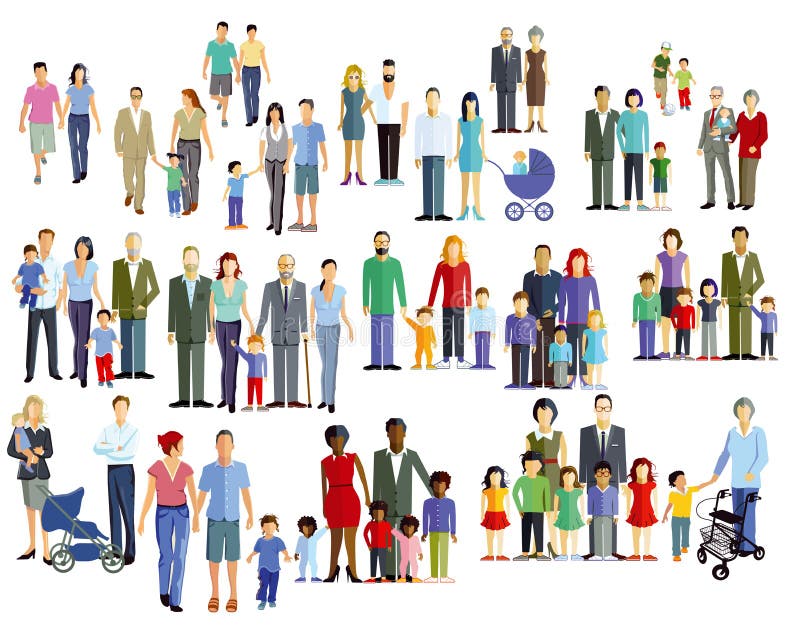
In 2016 I wrote about so-called familect, the ‘microdialect’ originating in the home*. Also known as ‘family slang’ and ‘kitchen table lingo’, this is one of those underappreciated, under-researched varieties of ‘in-group’ language which, like slang and jargon, make use of the same techniques (metaphor, irony, analogy – alliteration, rhyme, assonance, reduplication) as poetry and literature and at the same time offer a window into the private worlds of ordinary people: their preoccupations, pleasures and ways of bonding. Familect can also be a sharing ritual within the household whereby humour and creativity and inventiveness are enjoyed across generations. Kids are adept in creating new words from an early age and at playing with existing language to create new and colourful expressions, while older family members have their own ways of coining expressions and recycling or reworking the language of their youth, so the home is also a laboratory in which to cultivate new literacies.
Just recently the cApStAn Translation Team reviewed the topic and provided a useful link-fest and bibliography…
Familect can provide a useful subject for research and field work as part of exploring word creation and language innovation for school or college projects. Its users can be encouraged to look more carefully at the words and phrases they have invented themselves or shared or just heard, and asked to consider…
Why was the expression invented? (usually because the object, idea or feeling described is precious or important or super-familiar. Sometimes because there isn’t an existing word or a memorable word to describe it in standard English)
What is it that makes these words funny, understandable, memorable? Is it that they sound like something else, remind you of something already familiar? Or is it the spelling and sound of them itself that makes them amusing?
In fact the school itself may be a source of similar novelties, as Tabitha McIntosh wrote in the TES this summer…
At the very end of September this year came another example of a UK school seeking to police its students’ language and to ban the use of slang and colloquialisms. I have been writing about youth slang since 1990 (there are numerous articles on this site, accessible by entering slang, youth or MLE in the search box) and about such interventions for more than a decade: this time I spoke to the Guardian‘s Social Affairs Correspondent Rob Booth and his article is here…*
September 2021 also saw the fruition, or culmination (portentous words) of a long-term project of mine dealing with the same topic: the rich, creative, controversial use of highly informal language by younger speakers. I have collected the multicultural slang, traded among younger people and used especially in urban centres across the UK. I have listed authentic examples of this language variety gathered from conversations, messaging, fieldwork interviews and donations and stored these in the Archive of Slang and New Language which I have curated at King’s College London.
Looking for a way to make this data available to the widest possible readership – whether students, teachers, researchers, fellow lexicographers or simply individuals fascinated by language change and novelty – I decided against traditional publishing in hardcopy in favour of putting the material online and so was gratified when, a year ago, the University of Aston’s Institute for Forensic Linguistics agreed to host an extract from the Archive, an up-to-date Glossary of UK Youth Slang, in its Forensic Linguistics Databank. This lexicon, very modest in its format but unique in the UK and I think in the wider Anglosphere, has just been made accessible. I hope it will be helpful for interested parties and I urge anyone consulting it to comment, criticise and, above all, send me additions for inclusion in future versions (rights to the content are restricted, so please don’t circulate it or republish it without full acknowledgement). I am constantly updating and expanding this and other datasets of nonstandard and socially significant language as well as teaching and broadcasting about them.
I am very grateful indeed to all the collaborators, colleagues, students, parents, youth workers and many others who have helped me to record and analyse this exciting, inventive, sophisticated and technically innovative language – and to celebrate it rather than decry and stigmatise it in doing so.
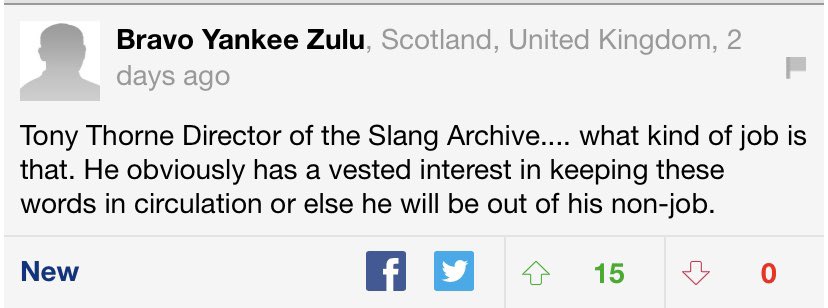
* Rob Booth’s Guardian article was rewritten very slightly and republished by the Daily Telegraph and the Daily Mail. I think the last word on my contribution to the subject, and indeed my career, should go to the anonymous poster of a comment following the Mail‘s piece…
One of my tasks during this strange summer of 2021 was to try to recover old files and folders, deleted in error from my archive at King’s CollegeLondon during a redesign of the website. Among them was a tour d’horizon of the characteristics and significance of Slang, written in 1997. Now an antique curio, I thought nevertheless it might be worth reproducing here for anyone teaching or learning about slang, or simply interested in that variety of language, so that comparisons could be made and conclusions might be drawn.
SLANG AND THE DICTIONARY
Tony Thorne
‘Slang … an attempt of common humanity to escape from bald literalism, and express itself illimitably … the wholesome fermentation or eructation of those processes eternally active in language, by which froth and specks are thrown up, mostly to pass away, though occasionally to settle and permanently crystallise.‘
–Walt Whitman, 1885
What is slang?
Most of us think that we recognise slang when we hear it or see it, but exactly how slang is defined and which terms should or should not be listed under that heading continue to be the subject of debate in the bar-room as much as in the classroom or university seminar. To arrive at a working definition of slang the first edition of the Bloomsbury Dictionary of Contemporary Slang approached the phenomenon from two slightly different angles. Firstly, slang is a style category within the language which occupies an extreme position on the spectrum of formality. Slang is at the end of the line; it lies beyond mere informality or colloquialism, where language is considered too racy, raffish, novel or unsavoury for use in conversation with strangers … So slang enforces intimacy. It often performs an important social function which is to include into or exclude from the intimate circle, using forms of language through which speakers identify with or function within social sub-groups, ranging from surfers, schoolchildren and yuppies, to criminals, drinkers and fornicators. These remain the essential features of slang at the end of the 1990s, although its extreme informality may now seem less shocking than it used to, and its users now include ravers,rappers and net-heads along with the miscreants traditionally cited.
There are other characteristics which have been used to delimit slang, but these may often be the result of prejudice and misunderstanding and not percipience. Slang has been referred to again and again as ‘illegitimate’, ‘low and disreputable’ and condemned by serious writers as ‘a sign and a cause of mental atrophy’(Oliver Wendell Holmes), ‘the advertisement of mental poverty’(James C. Fernal). Its in-built unorthodoxy has led to the assumption that slang in all its incarnations (metaphors, euphemisms, taboo words, catchphrases, nicknames, abbreviations and the rest) is somehow inherently substandard and unwholesome. But linguists and lexicographers cannot (or at least, should not) stigmatise words in the way that society may stigmatise the users of those words and, looked at objectively, slang is no more reprehensible than poetry, with which it has much in common in its creative playing with the conventions and mechanisms of language, its manipulation of metonymy, synechdoche, irony, its wit and inventiveness. In understanding this, and also that slang is a natural product of those ‘processes eternally active in language’, Walt Whitman was ahead of his time.
More recently some writers (Halliday being an influential example) have claimed that the essence of slang is that it is language used in conscious opposition to authority. But slang does not have to be subversive; it may simply encode a shared experience, celebrate a common outlook which may be based as much on (relatively) innocent enjoyment (by, for instance, schoolchildren, drinkers, sports fans, Internet-users) as on illicit activities. Much slang, in fact, functions as an alternative vocabulary, replacing standard terms with more forceful, emotive or interesting versions just for the fun of it: hooter or conk for nose, mutt or pooch for dog, ankle-biter or crumb-snatcher for child are instances. Still hoping to find a defining characteristic, other experts have seized upon the rapid turnover of slang words and announced that this is the key element at work; that slang is concerned with faddishness and that its here-today-gone-tomorrow components are ungraspable and by implication inconsequential. Although novelty and innovation are very important in slang, a close examination of the whole lexicon reveals that, as Whitman had noted, it is not necessarily transient at all. The word punk, for example, has survived in the linguistic underground since the seventeenth century and among the slang synonyms for money – dosh, ackers, spondulicks, rhino, pelf – which were popular in the City of London in the early 1990s are many which are more than a hundred years old. A well-known word like cool in its slang sense is still in use (and has been adopted by other languages, too), although it first appeared around eighty years ago.
Curiously, despite the public’s increasing fascination for slang, as evinced in newspaper and magazine articles and radio programmes, academic linguists in the UK have hitherto shunned it as a field of study. This may be due to a lingering conservatism, or to the fact that it is the standard varieties of English that have to be taught, but whatever the reasons the situation is very different elsewhere. In the US and Australia the study of slang is part of the curriculum in many institutions, in France, Spain, Holland, Scandinavia and Eastern Europe slang, and especially the slang of English, is the subject of more and more research projects and student theses; in all these places slang is discussed in symposia and in learned journals, while in Russia, China and Japan local editions of British and American slang dictionaries can be found on school bookshelves and in university libraries.
Slang Lexicographers
The first glossaries or lexicons of European slang on record were lists of the verbal curiosities used by thieves and ne’er-do-wells which were compiled in Germany and France in the fifteenth century. A hundred years later the first English collections appeared under the titles The Hye Waye to the Spytell House, by Copland, Fraternite of Vacabondes, by Awdeley, and Caveat for Common Cursetours, by Harman. Although dramatists and pamphleteers of seventeenth-century England made spirited use of slang in their works, it was not until the very end of the 1600s that the next important compilation, the first real dictionary of slang, appeared. This was A New Dictionary of the Terms ancient and modern of the Canting Crew by ‘B. E. Gent’, a writer whose real identity is lost to us. In 1785, Captain Francis Grose published the first edition of his Classical Dictionary of the Vulgar Tongue, the most important contribution to slang lexicography until John Camden Hotten’s Dictionary of Modern Slang, Cant and Vulgar Words, 1859, which was overtaken its turn by Farmer and Henley’s more sophisticated Slang and its Analogues in 1890. All these were published in Britain and it was the New Zealander Eric Partridge’s single-handed masterwork A Dictionary of Slang and Unconventional English, also published in London, in 1937, that, despite its lack of citations and sometimes eccentric etymologies, became the yardstick of slang scholarship at least until the arrival of more rigorously organised compendiums from the USA in the 1950s. Since then several larger reference works have been published, usually confining themselves to one geographical area and based mainly on written sources, together with a number of smaller, often excellent specialist dictionaries dealing with categories such as naval slang, Glaswegian slang, rhyming slang, the argot of police and criminals and the jargon of finance and high technology.
The Bloomsbury Dictionary Of Contemporary Slang
The Bloomsbury Dictionary of Contemporary Slang was first produced with the idea of combining the enthusiasms and instincts of a user of slang – someone who had been part of the subcultures and milieux where this language variety has flourished ( and in later life still ventures into clubs, bars, music festivals, football matches and, on occasion, homeless shelters) – with the methods of the modern lexicographer (earlier work on the Longman Dictionary of Contemporary English being a particular influence) and applied linguist. The first edition set out to record the 6,000 or so key terms and 15,000-odd definitions which formed the core of worldwide English language slang from 1950 to 1990: the new, updated edition, published in Autumn 1997, extends the time-frame almost to the millennium and expands the number of entries by two thousand, losing a few obscure, doubtfully attested or just plain uninteresting terms in the process. The dictionary aims to pick up the elusive and picturesque figures of speech that really are in use out there in the multiple anglophone speech communities, and many terms which appear in its pages have never been recorded before. In keeping with the modern principles of dictionary-making, the headwords which are listed here are defined as far as possible in natural, discursive language. The modern dictionary ideally moves beyond mere definition and tries to show how a term functions in the language, who uses it and when and why, what special associations or overtones it may have, perhaps even how it is pronounced. Where possible a history of the word and an indication of its origin will be included and its usage illustrated by an authentic citation or an invented exemplary phrase or sentence.
As with all similar dictionaries, the Bloomsbury volume is based to some extent on consulting written sources such as newspapers, magazines, comic books, novels and works of non-fiction. Other secondary sources of slang are TV and radio programmes, films and song lyrics. Existing glossaries compiled by researchers, by journalists and by Internet enthusiasts were also checked, but treated, like fictional texts and broadcasts, with caution; investigators may be misled by their informants and, as society becomes more self-conscious in its treatment of new and unorthodox language, varieties of so-called slang appear that are only partly authentic, such as the gushing ‘teen-talk’ (a variety of journalese) appearing in UK magazines like Just Seventeen, My Guy or Sugar directed by twenty- and thirty-something journalists at their much younger readers, or the argot developed by writers for cult movies such as Bill and Ted’s Bogus Journey, Wayne’s World and Clueless. The embellishing or inventing of slang is nothing new; Damon Runyon, Raymond Chandler and P. G. Wodehouse all indulged in it, as did British TV comedy writers for Porridge, Minder, Only Fools and Horses, etc., over the last three decades. For the Bloomsbury dictionary terms have been admitted if they can be verified from two or more sources, thereby, sadly, shutting out examples of idiolect (one person’s private language), restricted sociolects (terms shared by very small groups) and nonce terms (one-off coinages).
Any description of slang that is based purely on secondary or written sources (and most still are) cannot hope to do justice to a language which is primarily transmitted orally. Slang terms may exist in spoken usage for many years, even for centuries, before being written down; some are never committed to paper, so there is an absolute need for work ‘in the field’ with primary sources; eavesdropping on and interviewing the users of slang themselves, and, where they are not able to report objectively on the words and phrases they are using, their neighbours, parents, colleagues, fellow-students and friends must be mobilised. This is the most exciting part of lexicography, if sometimes the most risky. The modern language researchers going undercover to listen in on conversations or setting up networks of informants at street-level can imagine themselves as successors to the pioneering anthropologists of the last century, rather than ‘harmless drudges’ (Dr Johnson’s memorable definition of the lexicographer) toiling alone in dusty libraries or staring at flickering screens.
Slang at the Millennium
The traditional breeding grounds of slang have always been secretive, often disenfranchised social groups and closed institutions with their rituals and codes. This has not changed, although the users in question have. Where once it was the armed forces, the public schools and Oxbridge that in Britain dominated socially and linguistically, now it is the media, the comprehensive playground and the new universities which exercise most influence on popular language: the office, the trading-floor and the computer-room have replaced the workshop, the factory and the street-market as nurturing environments for slang. The street gang and the prison, whence came nearly all the ‘cant’ that filled the early glossaries, still provide a great volume of slang, as do the subcultures of rave, techno and jungle music, crusties and new agers, skaters and snowboarders. Football metaphors and in-jokes have long since ousted the cricketing imagery of yesteryear. Some special types of slang including pig-latin, infixing, and backslang (reversal, as in yob) seem virtually to have disappeared in the last few years, while the rhyming slang which arose in the early Victorian age continues to flourish in Britain and Australia, replenished by succeeding generations, and the even older parlyaree or polari (a romance/romany/yiddish lingua franca) lingers on in corners of London’s theatre-land and gay community. The effect of the media and more recently of the Internet means that slang in English can no longer be seen as a set of discrete localised dialects, but as a continuum or a bundle of overlapping vocabularies stretching from North America and the Caribbean through Ireland and the UK on to South Africa, South and East Asia and Australasia. Each of these communities has its own peculiarities of speech, but instantaneous communications and the effect of English language movies, TV soaps and music means that there is a core of slang that is common to all of them and into which they can feed. The feeding in still comes mainly from the US, and to a lesser extent Britain and Australia; slang from other areas and the slang of minorities in the larger communities has yet to make much impression on global English, with one significant exception. That is the black slang which buzzes between Brooklyn, Trenchtown, Brixton and Soweto before, in many cases, crossing over to pervade the language of the underworld, teenagers ( – it is the single largest source for current adolescent slang in both the UK and US), the music industry and showbusiness. Within one country previously obscure local slang can become nationally known, whether spread by the bush telegraph that has always linked schools and colleges or by the media: Brookside, Coronation Street, Rab C. Nesbitt and Viz magazine have all helped in disseminating British regionalisms. This mixing-up of national and local means that past assumptions about usage may no longer hold true: the earnest English traveller, having learned that fag and bum mean something else in North America, now finds that in fashionable US campus-speak they can actually mean cigarette and backside. In the meantime the alert American in Britain learns that cigarettes have become tabs or biffs and backside is now often rendered by the Jamaican batty .
Speakers of English everywhere seem to have become more liberal, admitting more and more slang into their unselfconscious everyday speech; gobsmacked, O.T.T, wimp and sorted can now be heard among the respectable British middle-aged; terms such as horny and bullshit which were not so long ago considered vulgar in the extreme are now heard regularly on radio and television, while former taboo terms, notably the ubiquitous British shag , occur even in the conversation of young ladies. In Oakland, California, the liberalising process reached new extremes late in 1996 with the promotion of so-called Ebonics : black street speech given equal status with the language of the dominant white culture.
Youthspeak
The greatest number of new terms appearing in the new edition of the dictionary are used by adolescents and children, the group in society most given to celebrating heightened sensations, new experiences and to renaming the features of their world, as well as mocking anyone less interesting or younger or older than themselves. But the rigid generation gap which used to operate in the family and school has to some extent disappeared. Children still distance themselves from their parents and other authority figures by their use of a secret code, but the boomers – the baby boom generation – grew up identifying themselves with subversion and liberalism and, now that they are parents in their turn, many of them are unwilling either to disapprove of or to give up the use of slang, picking up their children’s words (often much to the latters’ embarrassment) and evolving their own family-based language (helicopters, velcroids, howlers, chap-esses are examples).
The main obsessions among slang users of all ages, as revealed by word counts, have not changed; intoxication by drink or drugs throws up (no pun intended) the largest number of synonyms; lashed, langered, mullered and hooted are recent additions to this part of the lexicon. These are followed by words related to sex and romance –copping off, out trouting, on the sniff and jam, lam, slam and the rest – and the many vogue terms of approval that go in and out of fashion among the young (in Britain ace, brill, wicked and phat have given way to top, mint, fit and dope which are themselves on the way out at the time of writing). The number of nicknames for money, bollers, boyz, beer-tokens, squirt and spon among them, has predictably increased since the materialist 1980s and adolescent concern with identity-building and status-confirming continues to produce a host of dismissive epithets for the unfortunate misfit, some of which, like wendy, spod, licker, are confined to the school environment while others, such as trainspotter, anorak and geek, have crossed over into generalised usage.
Other obsessions are more curious; is it the North American housewife’s hygiene fetish which has given us more than a dozen terms (dust-bunny, dust-kitty, ghost-turd, etc.) for the balls of fluff found on an unswept floor, where British English has only one (beggars velvet)? Why do speakers in post-industrial Britain and Australia still need a dozen or more words to denote the flakes of dung that hang from the rear of sheep and other mammals, words like dags, dangleberries, dingleberries, jub-nuts, winnets and wittens? Teenagers have their fixations, finding wigs (toop, syrup, Irish, rug) and haemorrhoids (farmers, EmmaFreuds, nauticals) particularly hilarious. A final curiosity is the appearance in teenage speech fashionable vogue terms which are actually much older than their users realise: once again referring to money, British youth has come up with luka ( the humorous pejorative “filthy lucre” in a new guise), Americans with duckets (formerly “ducats”, the Venetian gold coins used all over Renaissance Europe).
This introductory article is adapted from the Bloomsbury Dictionary of Contemporary Slang, 2nd edition, 1997.
For other articles on Slang on this site see below or enter keyword (slang, MLE, youth language) in the search box
I have been trying to tell the world for a long time that slang is a rich, creative and complex feature of language, and one which has great social and cultural significance. I have argued (again and again) against those who want to ban or censor it and have advocated instead teaching young people about it so that they can judge for themselves its qualities and refine their own usage of it where necessary. What I have hesitated to do is to actually ‘teach slang’ to younger learners, knowing that it is still a controversial (linguists use terms like ‘stigmatised’ and ‘transgressive’) variety which makes many parents, teachers and authority figures uncomfortable. Connie Chang, writing for the National Geographic asked me whether it could ever be possible to teach slang to younger children without risk. In her published article, quoting experts in the field, she describes some interesting developments which suggest a positive answer.
Here is Connie’s article, followed by some further thoughts and some links which illustrate and explore the issues raised. I hope these, along with other articles on this site (put ‘slang‘, ‘MLE‘, ‘youth language‘ into the search box or check the tags at the foot of the page) will help students and teachers, and language-buffs, too, who are ready to explore the language ecosystem in which slang flourishes and operates…
Experimenting with language and inventing new language begins naturally in children as soon as they move from making noises to uttering more complex sounds. The creation by babies of seemingly meaningful sound combinations and, soon after, approximations of words is known as jargoning. Toddlers will make up words, participate in babytalk and banter and soon join their older siblings and other family members in inventing nicknames for objects in the home – part of the private domestic language known as familect. As young people encounter new experiences in growing up – dating, grappling with parents and teachers, following fashions and admiring celebrities, and experiment with new behaviour – they often feel they need a new language to describe these things and to convey the novel and intense feelings they have. Adults don’t have a vocabulary for ‘jumping up and grabbing someone’s sweater from behind’, (‘glomping’) or ‘coolest boy in the class’, (‘peng-ting’) so kids need to create their own. Young people also don’t want adults to know what they are up to or what they are feeling, hence the online and messaging codes and abbreviations (‘POS’ for ‘parent over shoulder’, ‘FOMO’ for fear of missing out) and the new, exotic and, for parents and teachers, impenetrable language. In the UK and the US there have been many not-entirely-serious guides for parents to help them…
Slang’s power and resonance is that it’s an alternative, subversive language and that for people who don’t understand it, slang can make them uncomfortable and can feel like a violation of social norms. The 19th century US author Ambrose Bierce defined slang in his Devil’s Dictionary as follows: ‘The grunt of the human hog (Pignoramus intolerabilis) with an audible memory. The speech of one who utters with his tongue what he thinks with his ear, and feels the pride of a creator in accomplishing the feat of a parrot. A means (under Providence) of setting up as a wit without a capital of sense.’ He may have been being ironic but this was certainly the view of many at that time, witness this report of a Victorian lecture…
Strong disapproval of slang continues in the 21st century. Some years ago I debated with Lindsey Johns, at that time campaigning publicly against those like me who he accused of promoting ‘ghetto grammar’ in the UK…
An update on the unusual role of an ‘expert linguist witness’
Elsewhere on this site I have written about the ‘street slang‘ used by gang members and other young people in the UK, a variety of language also featuring in the lyrics of Drill and other rap music genres. In October 2020 I was invited by the Aston Institute for Forensic Linguistics to talk about my role in translating and commenting on this language in the context of criminal investigations and trials.
My contribution to this event, with those of other specialists, together with some answers to follow-up questions from the virtual audience can be accessed here…
The prosecution of actual or supposed gang members, many of whom are from disadvantaged backgrounds and are victims themselves of coercion, trafficking, even modern slavery, is hugely controversial, as are attempts by some law enforcers to criminalise Drill music, its performers and its enthusiasts and the language that it uses.*
Rap lyrics appear to be poetic or literary texts, and may be fictional, but many professional rappers and their amateur imitators routinely mix creative fiction conventions, metaphors and imagery with real-life facts, introducing real names and references to real places, incidents and actions for ‘authenticity’ and effect. They also frequently borrow or steal images, words and whole sequences from other rappers, and impersonate actors in the real world such as killers or drug dealers who they have learned about from media reports or by word of mouth on the street.
Even more confusingly, many young rap enthusiasts nowadays use the language of rap and its lyrical conventions when they are communicating in quite different contexts. I have encountered many examples of messages between friends, entries in journals or prison notebooks, editing an online persona for chatting in forums, etc. that use words, phrases and references familiar from lyrics as used in audio/video music performances.
There are now academics and activists seeking to question official attitudes to the policing of youth crime and to question the validity of presenting rap or rap-related lyrics as evidence of wrongdoing.* There are also currently many agencies, charities and other stakeholders working with young victims, young perpetrators and their families and friends in order to analyse, publicise and seek solutions for the social stresses that foster gang culture. For my small part, I’m concerned, though, that these efforts, even the well organised periodic campaigns by police to control and reduce ‘knife crime,’ are still piecemeal and only partially coordinated across the country.
In November I talked on the same subject at Warwick University‘s Applied Linguistics Seminar…
One month on, and a small sign that mainstream media may be paying a little more attention to gang realities…
Thus is rappers Krept and Konan’s 2019 commentary on the driller’s culture and attempts to ban drill lyrics. Essential reading/listening for anyone struggling to untangle the unresolved complexities of the issue…
Ironically, the self-isolation I have been practising for the last seven months did not mean that I was without work. Periods of WFH alternated with forays into an empty city. Youth crime subsided at first but did not disappear during the pandemic: importantly for me the gathering and analysis of evidence and preparations for trials involving gang violence continued, and I continued to help defence teams and prosecutors to interpret the language used in messaging and Drill lyrics generated by suspects living in gang environments (as described in earlier posts on this site). In April I wrote an article for the Magistrates Association about the relationships between language, youth and crime*
During my time in quarantine I continued to record and comment on the language of the pandemic itself as well as the toxic terminology of populist politics and racism. At the beginning of September the team at LexisPodcast gave me a fresh opportunity to talk about these topics (my comments are in the second half of the recording)…
‘Bad language’ and why you should really try to keep up
Studies have shown that the language of the court can be intimidating and perplexing for some of those who pass through it. We naturally hope that all of those involved in legal proceedings have sufficient command of a language in common to conduct their business successfully. There are times, however, when language barriers become apparent and it becomes necessary to interpret, to translate – foreign tongues used by other nationalities of course – but also new and unfamiliar language originating in our own communities.
Language is something that we tend to take for granted; it’s a facility that every human possesses and uses constantly. In the workplace we have to depend on a shared understanding of language, whether formal, legalistic or conversational. Professional linguists, however, see language differently and distinguish not only between informal, conversational speech and formal or technical language, but between a ‘dialect’ – the language of a region, a ‘sociolect’ – the language of a particular group such as a specific profession, ethnic group, age-group or social class, and even an ‘idiolect’, the words, phrases and turns of speech favoured by a single individual.
The closer we look at the language people are using, the more potential there is for misunderstanding. There is the problem of keeping abreast of rapid changes – of learning new terms, making sense of popular entertainment catchphrases and reality TV references, for example (‘Love Island’ springs to mind). Perhaps the problem is most acute when it’s the language of another generation. Parents, teachers, police officers, too, struggle to make sense of the latest playground slang, gamers’ terminology and the bizarre expressions uttered by music fans, fashionistas and YouTube stars. Abbreviations used in texting and on social media – YOLO, FOMO, SMH (‘you only live once’, ‘fear of missing out’, ‘shaking my head’) can also be baffling for older observers – not surprisingly because this sort of language is not designed to be understood by outsiders. Insiders use slang as a badge of identity to show that they belong to a particular group, equally it is used to exclude the people they don’t want to associate with; the old, the boring, the unfashionable and the unglamorous. Many users of slang, though, are surprisingly sensitive to what linguists call ‘appropriacy’ – matching their choice of language to the social situation – and wouldn’t employ a highly informal style in a formal setting such as a court. Problems arise when evidence involves language recorded in very different contexts.
If you struggle to understand the teenagers and young people around you when they call their schoolfriend a ‘durkboi’ or a ‘wasteman’ (both mean useless male) and try to cadge some ‘p’s’, ‘gwop’ or ‘Lizzies’ (all slang for money), you are not alone. There is a shared slang vocabulary that has established itself throughout the UK, often replacing colourful older usages (such as rhyming slang: ‘once a week’, a synonym of ‘beak’ or magistrate has disappeared) or local dialect. Popular words include ‘piff’, ‘peng’, ‘dench’, ‘gully’, all used to express admiration, ‘bare’ meaning many (as in ‘bare feds’ or ‘bare jakes‘, lots of police), ‘bait’ meaning obvious, ‘bruv’ and ‘fam’ denoting one’s friends or group. ‘Chirpsin’, ‘linkin’ and ‘lipsin’ refer to flirting, dating and kissing respectively.
New terms are being coined all the time because novelty is what gives the words their edgy, progressive quality, but, contrary to what many people assume, slang doesn’t fall out of use for years, it just moves from an older to a younger cohort; as it’s abandoned by the most self-consciously ‘cool’ it is picked up by the latecomers. A few parents and some teachers have managed to learn some of these terms, but trying to use them will inevitably provoke ridicule. In a 2017 survey only 4% of parents were able to successfully translate messaging slang, while 65% tried but repeatedly failed or misunderstood.
Slang, whether used covertly or out in the open, is a feature of all societies and languages and of all age-groups, too. It’s well established that those engaged in criminal activity, lawlessness or antisocial behaviour develop their own secret languages in order to communicate privately and to prevent outsiders from understanding these communications. Teenagers and young adults likewise develop their own slangs and restricted terminologies and often include vocabulary coined by gang members and criminals because it seems glamorous and daring. In the US and the UK highly informal youth-based dialects have arisen and the terminology in question is also used in music lyrics and on social media. The language of US rap and hip-hop music and UK–based varieties such as Grime or Drill music mixes AfricanCaribbean influences, especially Jamaican ‘patois’, with local colloquial speech and will be familiar to many young people, even those who are not engaged in antisocial or criminal activity. This kind of language is very rarely picked up by mainstream media, is not normally recorded in standard dictionaries and is difficult for linguists to collect. I do so by monitoring online messaging and online discussions among slang enthusiasts or slang users, examining music lyrics and, most importantly, by interviewing slang users themselves (as slang is still more a spoken than written variety) and asking them to give or send me examples of language used by them and their peers. Slang is not deficient language; it performs its functions efficiently in conveying meaning. However, because it is an underground, alternative code it is not subject to rules and authorities. This can often result in the same slang term having multiple meanings (hood, for example can refer to a criminal ‘hoodlum’ or to the neighbourhood in which they operate) and in meanings varying to some extent between one group of users and another. It also means that (because they are based on speech and not on written sources) the spellings of slang terms may vary and may be used inconsistently.
I have been collecting the slangs of adults and of younger speakers operating in all sorts of contexts, publishing a succession of dictionaries and articles over the years and teaching and broadcasting about these and other ‘nonstandard’ and controversial areas of language. As a linguist I became fascinated by a kind of language that, although exotic, anti-social, irreverent and frequently offensive is technically as complex and as creative as poetry or literature. It’s only by deciphering and understanding this sort of language – or rather these languages – that we can hope to enter the world of teenage cliques, young-adult in-groups and gangs, to come to make sense of their rituals and obsessions, their thoughts and feelings.
For more than a decade, and increasingly over the last five years I have been helping the police forces who are trying to control street crime and the lawyers who are defending those accused (nearly all of them still in their teens or early twenties). My task as a language analyst and an expert witness is to translate and comment on the slang terminology found on confiscated mobile phones, obtained by surveillance and electronic intercepts, or used in the course of live interviews. I’ve found that the officers in question and the legal representatives are dedicated, unprejudiced, painstaking and privately distressed by what they witness day-to-day. They may become familiar with the exotic, shocking language they are exposed to, but they require an expert objectively to interpret and assess the written or recorded evidence they work with, if necessary, too, an expert who can stand in court and testify on their or their clients’ behalf.
In looking at recordings of gang member’s conversations, for example, it’s crucial to know that a ‘burner’ or a ‘mash’ is a handgun; ‘dotty’ means shotgun, ‘Rambo’,‘ramsay’, ‘cutter’, ‘shank’ or ‘nank’ is knife. When looking at jottings in a teenager’s notebook or listening to a hardcore Drill track recorded by a gang associate it’s essential to identify ‘trap’ as a term for selling drugs or the location where it takes place, ‘plug’ as a drug source, ‘dip’ as stab, ‘op’ as enemy, ‘duppy’ as kill, ‘dasheen’ as run away. The same words, catchphrases and slogans are shared across London and into other UK centres: the same gang culture with its obsession with status and respect, its territorial feuding and its violent tendencies seems to apply everywhere.
Nobody expects the average adult, even if an educated, articulate professional to be fluent either in the language of innocent teenagers or the criminal codes used by gang members. Where, then, can a legal professional or law enforcer go in order to get help with slang and street language? Standard published dictionaries do not offer much assistance, even dictionaries specialising in slang do not usually manage to keep up to date and to define and explain the latest terms. Magazine features purporting to explain what millennials and Generation Z are saying are invariably frivolous and inaccurate. One valuable resource is the online Urban Dictionary (www.urbandictionary.com) a collection of language posted on the internet by real people. Its entries are up to date and usually authentic, but more than half of the expressions on the site originate in the USA and some of the posts are private jokes or local nicknames. There is a small dictionary of the language of rappers and gangsters on my own website (https://language-and-innovation.com/2018/04/19/a-drill-dictionary/), and I can answer general slang enquiries at The King’s College Archive if contacted at tony.thorne@kcl.ac.uk.
The latest in a long series of moral panics (the term used by sociologists since the 1970s) exploited by the UK press and now subject of rancorous political debate, the issue of knife-crime and killings by street gangs, mainly in London, is genuinely concerning and is only now receiving the attention and analysis it demands. A side-effect of media interest is that the language used by the gang members and by the music genres that celebrate them is being recorded – haphazardly and not always accurately – for the first time. The musical genre in question is UK Drill, a successor to the ultra-hard-edged Trap Rap (from The Trap, slang nickname for the local area where drugs are dealt) that appeared first in Chicago in the 2000s. Drill (the word can signify shooting but has many other slang senses) has been adopted and adapted by hyperlocal urban communities in the poorer parts of London and, despite their claims, doesn’t just evoke the harsh realities of life on inner-city estates, but often glamorises it and seems to promote an ethos of territoriality, boastful masculinity and murderous retaliatory violence.
So far only very few reporters have managed to penetrate the groups whose members occupy and fiercely defend their microzones, fighting for control, too, of economies based on drug trading. The rappers emerging from the same postcode- or estate-defined enclaves compete and feud electronically, dissing and threatening their rivals in their lyrics – and in a few cases have actually been implicated in killings or woundings on the street.
In May 2018 the Metropolitan Police intensified attempts to ban videos associated with the music genre and the gangs caught up in street violence:
Since beginning this project I have managed to engage with some members of this subculture and find out more about their values and the way they encode them. In the meantime I have begun to assemble a lexicon of the most significant key terms they use, in a slang which mixes US hiphop argot and Caribbean expressions transposed to or reinvented in London (harking back to the Yardie gang culture of the 1980s). So far just a glossary, my list is far from complete, so please help me add more items if you can, or correct my mistakes. Here is this work in progress as it stands, now updated for March 2025, followed by some relevant links…
125 – scooter
3 – free (call to free a respected associate or known person)
Active – dependable associate
– involved in gang activities
Ahk, Akhi – brother, friend (from Arabic)
Axe – ask
Amm – cannabis (abbreviation of Amnesia, a potent strain)
Askari – police (from Arabic and other African languages)
Back out – draw (a weapon)
Bagged – caught by the police
Bagging – stabbing in the lower body
Bally, Bali – balaclava
Bando – abandoned property
Bands – coloured elastic bands tying batches of cash
Banger – hit, successful song
Bap – the sound of a shot or gunfire
– to fire (a gun)
Bars – lyrics
Battle – strength, competitiveness
Bean – head
(A) bean – honest(ly), truthful(ly)
Beef – dispute, feud
Bells – bullets
Bend – patrol(a neighbourhood)
Binned – shot
Birded off, birded up – imprisoned
Bite – steal
– copy
Bitz – one’s neighbourhood
– drugs weighing more than 7 grams
Blam – shoot
Blitz – raid, attack
Blow – leave, escape
– ‘take off’, achieve career success
Blunt – cannabis ‘spliff’
Bones – dead
Booj, buj – heroin
Bookie, buki – suspicious
Bora, borer – knife
Botty – firearm
Bout it – competent, skilled, authentic
Box – prison
Boxed, boxed in, boxed up – imprisoned
Bozz – leader
– excellent
Breeze off – leave town, disappear
Bruck, bruk – broken (down), broke
Bruckshot – sawn-off shotgun
Buj – obnoxious person
Bun – light up (a cannabis cigarette)
– shoot, eliminate
Burner – gun
Burst – shoot
Cabby– cigarette containing cannabis and cocaine or cannabis and crack mix
Cake – crack or cocaine
Cally – cannabis
Can – prison
Car, cah – because
Cat – drug user and/or drug purchaser
CBO – criminal behaviour order
Cheffed (up) – stabbed, killed
Chete – machete
Ching – knife
– to stab
Chinging – chilling and hanging out
– stabbing
Civilian – non-gang-member, non-combatant
Clap – attack, shoot
– steal drugs
Click – shoot
Codes – ‘postcode areas’, zones where gangs dominate
Corn – ammunition
Crash – raid, invade
– shoot
Crashing corn – shooting your gun
Crib – home
Cro – cannabis
Cunch – out-of-town locations where drugs can be sold
Cutter – knife
Cuttin – leaving, running away
– mixing or adulterating illicit drugs
Darg, dargie, dawg – male friend, ‘homie’, male active on the street, gang member
Dark – heroin
Dash – throw
– run (away)
Dasheen – running away, fleeing
Diligent – admirable, brave, cool
– dependable associate
Ding dong – dispute, brawl
also dinger, dinga, ding – cheap car
Dipped – stabbed
Dipper – knife
Don – respected person
Dottie, Dotty, Dotz – shotgun
Doughnut – idiot
Drawn out – involved in gang culture, under pressure from street crime
– lured, rendered vulnerable
Drenched – stabbed
Driller – shooter, gang member
Drilling – attacking, aggressing, invading
Dumpy – shotgun
Dun – kill(ed), punish(ed)
Dunn – friend
Duppy – kill, dead
Eating – succeeding, profiting
Elizabeth – money
Endz – one’s neighbourhood
Factor – important associate
4-door – saloon car
Febreze – spray a place to remove the smell of cannabis
– get rid of evidence of illicit activities
Feds – police
Field – danger-zone, combat area
Fishing – looking for victims
Flake – cocaine
Flashed – stopped, pulled over e.g by police
Flicky – switchblade knife
Flow – fluency, verbal skill
Food – drugs
Fry – shoot (at)
Gassed – excited
g-check – aggressively check someone’s gang credentials
Gem – weak person
Get the drop – acquire necessary information
Giraffe – £1000
Glide – drive into enemy territory
GM – (fellow) gang member
Go cunch/country – leave the city to sell drugs in rural/seaside locations
Got – attacked, robbed
Grubby – authentic, tough (neighbourhood)
Guv – prison officer
Gwop – money
Habsi, hapsi – black person
Hand ting – pistol
Hitter – gunman
Hottie – SIM card
Iron – gun
Jakes – police
Joint – gun
Jump out – undercover police on patrol
– emerge from a vehicle
Juiced – confident, energised
– bloodstained
Khala – black person
Khalas!– ‘that’s enough’, stop!
Ketchup – blood
Kick down doors, kick in doors, kick door – raid a domestic location
Kwef –violence
Kweff, Queff – kill with gun or knife, harm, attack
Kweng – cut, stabbed
Laces – ammunition
Lacking – caught unawares, without backup
Landing – prison, cell
Lane – main street, urban area
Layers – protective clothing
Leggin (it) – escaping, running away
Leng – gun
Let rip – fire a bullet or discharge a firearm
Light – cocaine, crack
Line – a drug-dealing operation or network
Link – contact, source for drugs
– make contact with, meet, collect
Lizzies – money
– mobile phones
Loud – cannabis
– impressive
Lurk – stalk a victim, prowl around
M – murder
Machine – gun
Mac(k) – automatic firearm, Mac -9 or Mac-10 small machine gun
Mains – close companions
– streets, urban zone
Marinate – relax
Mash – gun
Matic – gun
Matrixed – placed on the London Met police gang database
Matta – head
– main focus
Mazza, Mazzaleen – madness, crazy situation
Ments – mental, crazy
Milly – a 9mm pistol
Moist – disgusting, pathetic
– cowardly, weak, afraid
Monkey – £500
Mop – large gun
Motive – activity
Move – criminal operation, raid or attack
Munch – desperate, obsessive person
Nank – knife, stab
Nap nap – kidnap
Need – cannabis
Niff – cocaine
No face – masked, with identity concealed
OJ – ‘on job’, productive and successful in street activities
Old Bill – the police
On papers – on parole or probation
On road – outdoors, active in the streets/neighbourhood(s), eg engaged in selling drugs
On tag – fitted with an electronic surveillance device
On volts – intent on or engaged in violence
Ooters – shooters
– loyal associates
Opps – enemies
Opp-block – enemy territory
OT – ‘out trapping’, ‘out there’ or ‘out of town’, away on business, dealing in urban or country locations
Ox – razor, blade
Pagan, paigon – untrustworthy person, enemy
Paper, papes – money, cash
Passa – dispute, dramatic event
Patch – territory
Pattern – arrange, sort out, set up
Patty – slow-witted, ‘clueless’ or deluded person
– (white) female
Pave – streets
Pay – profitable activity, reward
Pebs, pebbles – pellets or deals of heroin, crack or steroids
Ped – moped
Pen – prison
Pepper – spray with shotgun pellets or bullets, shoot
Plot – plan, set up
– hang around
– conceal
Plug – a contact for drugs
Plugging – hiding drugs in rectum
Poke – stab
Pole – shotgun, gun
Popo – police
Posted up – hanging around, positioned to sell drugs
Pree – to check out, assess (a person)
Proper – excellent, admirable
Ps – money
Push, pusha – bicycle
Put in/on a spliff – killed
Rack – quantity of money, £1000
Rambo – large knife or machete
Rams, Ramsay – knife
Rep – promote or publicly declare for (one’s area, gang)
Ride out for (someone) – to defend, even if guilty
Riding dirty – going out armed and/or in possession of drugs
Rise – aim (a weapon)
Riz – cigarette papers
Rizzle – real
Road – street-smart, active in street culture
Rotty – firearm
Rusty – antique or old firearm
Sam, sams – samurai sword or large knife
Score – kill or injure an enemy
Scoreboard, scorecard – list of enemies killed, injured or defeated
Scram – gun
Scrub – worthless male
Scrum – attractive female, sex
Shank – knife
Sh, shh – ‘don’t mention this’, censored item
Shaved – insulted, humiliated, punished
– stabbed
Sheets – cigarette papers
Shneaky – discreet, secretive
Shoes – guns
Shot – buyer of drugs
Shotting – dealing drugs
Shouts – greetings, acclaim
Skate, skeet – run away
Skeng – knife, gun, weapon
Skududu – rapid gunfire
Slammer – prison
Slatt – cry of affection, respect
Slew – ruin, defeat
Sliding – driving into enemy territory
Slime – friend, associate
Smoke – kill
– disappear
– conflict, violence, hostility
Snitch – informer
Soak – stab
Special K – ketamine
Spinner, spin-ting – revolver
Spinners – petite females
Spitting – rapping
Splash, splash up, splash down – stab
Squirt – spray acid (over someone)
Stacks – large quantities of money
Stain – rob
– an armed robbery
– robbery victim
Stepping on toes – trespassing on or attacking enemy territory
Throwing up signs – making gang-related gestures with fingers
Ting – girl
– gun
Trap – neighbourhood, ‘ghetto’, area where drugs are sold, temporary location for dealing drugs
Trapping – hanging out, selling drugs or waiting for buyers to contact
Treesh – promiscuous person
Trey, tre – pistol
Trill – deserving respect, dependable, authentic
Tum-tum – gun
Tweed – cannabis
24s – all day
V – vehicle
Violating – behaving outrageously
Wap – gun
Warhead – cigarette containing a drug
Wass – stupid person
Weston – handgun
Wetter(s) – knife
Wetting – stabbing, killing
Whip – car
– break down (a drug) into smaller parts
Wok, wok house – prison
Woosh – shoot
Worksy – busy, diligent
Yammed – robbed
Yard – home
Yat – girl
Yay – crack
Yé – personal style, skill
Y.I.C – ‘youngest in charge’, young gang member taking or given responsibility
Yute – young person or young people on the street
Zombie – zombie knife
Zoot – cannabis cigarette
I’m keen to add more authentic terms and for my list to be corrected or commented on by those in the know. I’m very grateful indeed to all those who have already contributed, in particular Josh Jolly, Creative Director for PressPlay Media, Farhaz Janmohamed, George Baker and Nelson Bayomy and to the many students and Drill and Grime aficionados who have donated language.
You can find a dictionary of multi-ethnic London slang and other examples of so called MLE (Multicultural London English) here on my site. I have extensive files of youth language, available to researchers, journalists, etc. on request, and here are some more street slang terms from the UK Rap and Grime milieu, many also used by Drill aficionados:
Developing further some of the ideas in Sanjana’s article, and based on our exchanges, here are some more thoughts on the subject of multiethnic language, in a ‘question-and-answer’ format:
1. What exactly is ‘MLE’?
The term MLE, coined in connection with Paul Kerswill and Jenny Cheshire’s research on dialect in 2004, describes a ‘social dialect’, ‘sociolect’ or informal spoken style of UK English used initially by ‘younger’ speakers and first identified in and first associated with London. This way of speaking is characterised by a vocabulary reflecting a high degree of ‘black’ (Caribbean English, terms possibly coined by afrocaribbean speakers in the UK, to a lesser extent US black ‘street’ language and hip hop terminology) influences and by intonation patterns and certain pronunciations which differ markedly from standard UK English and differ also from ‘traditional white working class’ accents although they retain some features such as glottal stops and ‘f’ instead of ‘th’. In lay terms, MLE appears to have a ‘lilting’, more regular intonation, resembling Caribbean and also South Asian speech, with some noticeable ‘cockney’ elements too. Its structure and syntax (‘grammar’) may display ‘deviations’ from traditionally ‘correct’ taught forms and the prestige dialects of ‘standard’ English and RP (received pronunciation). In terms of vocabulary, samples I have collected can contain up to 80% of Caribbean (so-called ‘patois’, but this is a slightly contentious term; it can be used dismissively by whites, though is happily employed by Jamaicans themselves) or other BAME lexis such as Somali, South Asian and in some isolated cases a few Turkish and Polish terms.
The designation MLE is well-known and widely used but, especially since this kind of speech (it is still largely a spoken variety of language, though increasingly appearing in writing in music lyrics and TV scripts and online forums and messaging) is no longer restricted to London and the core vocabulary in particular has spread to speakers all across the UK, some linguists prefer to call it Urban British English (UBE) or Urban Vernacular(s) or refer to it as a ‘multiethnolect’. It is now understood that mixed varieties of the same type have appeared in other European centres, and those in Germany (influenced by Turkish), France (influenced by North African and Arabic language) and Scandinavia (Turkish, Arabic, Somali) in particular are the subject of research. These forms of language tend to include a high level of what can also be termed ‘slang’, ie very informal and deliberately opaque codes generated by peer groups, gangs and ‘microniches’ such as gamers, skaters, cosplayers.
2. How has it managed to pervade British youth culture?
In the 60s and 70s Caribbean English was only encountered in subcultures and popular culture via Calypso and Ska and Reggae music. Younger black speakers tended to be ‘ghettoised’ and tended to reinforce their own exclusivity by not mixing much with other subcultures – even the mods and skinheads who admired their music, so there was little spreading of black language. This began to change with the Two-Tone movement of the early 1980s, while in school playgrounds, on the street and in clubs, black speech began to gain social – at least subcultural – prestige, with young black males seen as the most resistant to the dominant culture. By the 1990s this tendency had combined with the rise of breakdancing, rap and its associated style displays (headgear, footwear, ‘bling’, etc.) USA to make it an overriding fashionable ‘wave’ carrying with it its own terminology. At street level in London I recorded white working class schoolkids in the 1990s using more and more ‘Jafaican’ (horrible pejorative term though it is) – crossing and codeswitching with what teachers called ‘creole’, ‘recreolised lexis’ or ‘patois’ in their conversations. By the later 1990s Sacha Baron Cohen’s character Ali G was satirising this speech and the poses and style affectations that went with it. In the 2000s the ascent of UK Grime music along with influences and buzzwords from US hip hop reinforced the same tendencies, while in subsequent years social media and showbiz played a part, though the essential language was still coming from the street, particularly in London from gang culture and spreading by word of mouth. Although the tabloid press and broadcast has picked up on the phenomena they have not contributed significantly to actually propagating MLE.
3. Why has MLE attracted so much attention when other kinds of dialect change are common?
MLE is associated with social unrest, crime and what in the 60s was called transgression and ‘deviancy’, therefore lends itself to sensationalising (and mockery too) by the media and displays of staged disapproval by representatives of the status quo (see for instance statements – and prohibitions – by educationalists, politicians, conservative journalists). ‘MLE’ is also much more important and pervasive in bestowing subcultural capital than any other instances of dialect change (which tend to operate in the regional margins and away from the attention of metropolitans), so in its own milieux and nationally it has overwhelmed other – relatively minor – changes in the lexicon or in phonology. Other forms of language change which are significant are the abbreviated codes (YOLO, FOMO, smh, obvs, etc.) and US slang (‘slay’, ‘woke’, ‘lit’, ‘(on) fleek’) used by young people on social media, and the faux-fashionable journalese use of jargon (‘Brexit’, ‘yummy-mummy’, ‘silver surfers’, etc.)
4. Is MLE unique to London and to English?
As noted above the same language phenomena are being observed in all global urban environments, most similarly in other diverse European capitals. In the UK MLE-like language is being studied particularly in Manchester (see e.g the work of Dr Rob Drummond and the Manchester Centre for Youth Studies) and Birmingham, but even in rural villages many kids are now familiar with the core terms (‘bare’, ‘peng’, ‘allow it’, ‘hench’ etc). Sadly, too, many entirely innocent British teenagers are familiar with the latest slang names of knives, guns and drugs.
5. Why are the borrowings in MLE overwhelmingly from Jamaica?
The Ali G persona was satirising what were then derided on the street as ‘wannabes’ or ‘wiggas’ (white niggas), pretending to be black, therefore cool. Gautam Malkani’s novel ‘Londonstani’ drew upon hybridity to mock a white boy pretending to be a cool Asian – actually a much rarer occurrence. Although Bhangra and Bhangramuffin music were briefly popular, as were musicians such as Apache Indian, Asian Dub Foundation and Jazzy B, South Asian pop culture, music and language has not challenged the domination of Afrocaribbean influence on MLE, hasn’t really crossed over despite Malkani.
The South Asian and Chinese and Japanese communities, Turkish and Somali and Polish communities for example just don’t have the same subcultural glamour and image of resistance and transgression, and therefore linguistic prestige as those with links to the Caribbean. It’s also very important that Caribbean speech is a variety of English, not a ‘foreign’ language, therefore very accessible and closely related, albeit with a very different sound.
6. Can the growth of this kind of multiethnolect be attributed solely to immigration?
The emergence of this type of mixed code, with accompanying informal lexicon and novel pronunciations is also about the dwindling within the UK of traditional social, cultural and linguistic authorities, the conditions of superdiversity in which people live and a new assertion of ‘minority’ identities, new access to media and communication. There are no longer power-groups within society or cultural influencers who have the capability of stemming or proscribing language change or enforcing disapproval of informal, provocative behaviour. Even when particular schools ban the use of slang, they are only momentarily affecting a very small segment of society.
7. Should we be worried by this particular aspect of language change?
From a purely objective linguistic perspective, language change, variation and innovation is not worrying. It’s a natural process, indeed a fascinating process and worthy of study. For someone like me, a lexicographer collecting slang and new language, new forms and new usages, as in the very dynamic and complex MLE matrix, are illustrations of the established workings of the language – the technical potential of English to create novel forms and combinations, also managing the well-known functions of language – to judge, to categorise, to help bonding and reinforce identities; the stylistic performance of language in terms of rhetoric, irony, poetics, etc.
BUT anything that is seen as part of a culture of crime, violence, drug abuse, family breakdown, even if it is more a product than a cause, will worry many people. Any significant changes in language will disturb and destabilise many people for whom their grasp of and usage of language is a fundamental part of their identity (often seen as something essential and unchanging, even if it isn’t really). For these reasons it’s not enough for linguists (or any liberals, ‘progressives’, descriptivists, etc.) simply to dismiss the concerns of traditionalists and conservatives – and ordinary worried parents, teachers and others. Given that you can’t legislate against such language, it’s important to study it, debate and discuss it and see it for what it is.
One possible reassurance is that MLE has been seen as a temporary, developmental, transitional practice, just as youth slang has been assumed to be something that young people grow out of once they enter the adult world of work, family and other responsibilities. I have written that the vocabulary of multiethnic slang is inherently unlikely to persist into adulthood, dealing as it does with adolescent concerns: dating, sex, experimentation, illicit practices and managing prestige and competition within teenage gangs for instance. My colleague at King’s College London, sociolinguist and discourse specialist Professor Ben Rampton has, however, shown in small-scale studies that some of the features of MLE, in particular the practice of ‘crossing’ or code-switching between languages in mid conversation, may not be confined to ‘youth’ and may not be discarded in that way*. For me, this possibility most obviously relates to its intonation and pronunciation which I think may well come to have a pervasive influence in many circles in the UK, possibly changing ‘mainstream’ English in years to come. This can already be seen not just in young white and Asian people consciously imitating the sound of Jamaican, but in a new rhythm and emphasis in everyday speech which is shared by a wide variety of young adults, so that if you hear but can’t see the speaker, it’s impossible to determine their ethnicity. This was nicely satirised by the TV comedy series PhoneShop but is now really the case in diverse communities like Croydon, the fictional setting for the show, and a few elements of which are showing up in reality TV abominations like Love Island.
For most linguists the yardsticks by which we judge language are not ‘correctness’ or association with prestige – ‘poshness’ in other words, but just two criteria: ‘intelligibility’ (is it mutually comprehensible?) and more importantly ‘appropriacy’ (is it the right kind of language to fit the social context?). If you apply the notion of appropriacy there’s nothing inherently bad about MLE, or slang, providing it is used in a suitable setting, such as a school playground, club, on the street, in private banter, and not in school essays, exams, job interviews, formal encounters, in front of your Gran, etc.
*Some sociolinguists think that focusing on ‘youth language’ itself is discriminatory and is creating false categories. I have been criticised myself, both by conservatives for celebrating ‘ghetto language’ and one or two linguists who accused me of labelling the young and their behaviour. All I can say is that young people I have interviewed have very often referred to multi-ethnic slang as ‘our language’, the language of ‘the youth’.
Three years later, in 2020, I talked to Audrey Damier about MLE, slang and London youth.
In April 2023Dr Christian Ilburymade freely available (and kindly gave permission for this link to) his hugely important article describing the ‘roadman’ persona as a central feature of MLE:
In May 2024 Dr Johanna Gerwin published her analysis of the UK press reporting on MLE and its construction and manipulation of ideologies and identities:
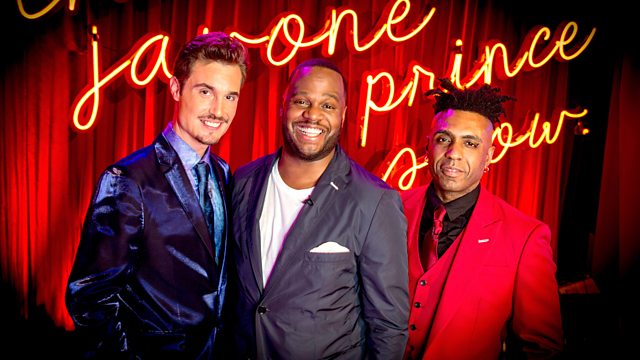
Of the TV series that have featured Urban Slang (or so-called MLE, ‘Multiethnic London English’) for me none surpassed, in authenticity, ingenuity and hilarity, the sitcom PhoneShop*, broadcast on Channel 4 between 2010 and 2013. Writer and producer of the series, Phil Bowker tells me ‘Like you, slang’s something that has fascinated me since I was a kid growing up in Liverpool.’ It’s a great privilege to be able to print here, with Phil’s blessing, the script of this sequence intended for his follow-up satire on multicultural Britain for BBC2 The Javone Prince Show**, but never broadcast. Phil explains, ‘I wanted to spoof the kind of BBC London style of hack news reporting but instead of the usual fayre of drugs and knives, I wanted to make it about slang.’ Relish now for the first time this exposé of …Real Talk ‘Slang’…
EXT. URBAN STREET
Andrew Milligan (Jason Barnett) is on a walk and talk.
ANDREW MILLIGAN
“Why is my man Parrin’ me?” “Dat Gyal is pengalicious” “Watcha me come and lick off a ya headtop” Words and phrases that you wouldn’t particularly want to hear coming out of your child’s mouth. But this is an everyday reality for thousands of parents across the Country as unscrupulous dealers are targeting our children at the very place where they’re most vulnerable: The school gate.
We cut to a School sign and then back down to Andrew as he crouches down outside the entrance. The floor is littered with discarded pieces of paper the size of christmas cracker jokes. There are lots of ‘capsules’ around too. He reads a couple of them – sickened at what he sees.
A mum (Debra Baker) Is interviewed in her spotless kitchen.
CONTINUED:
MUM
My 10 year old comes home, he calls his little brother a beg, calls me a slosher and tells me he’s goin his drum to blaze…’ What can I do about that? I ain’t got a clue what he’s talkin about….
Andrew Walk and Talk.
ANDREW MILLIGAN
We’ve all seen them plying their vile trade in pubs and car parks the length and breadth of the Country. The So called slang hawkers. You yourself may have even enjoyed using some casual slang at a dinner party. I’m ashamed to say, I have. I had bare laughs. But where does this slang come from? Who’s selling it, and what is the real cost? To find out, I took to the streets.
EXT.STREET. NIGHT
CUT TO:
Shot from a first floor window, we see Andrew making a call from a phonebox.
DEALER
(Voice Disguised) What you after?
ANDREW MILLIGAN
I’m looking for a, uh maybe a five pound deal?
DEALER
Fuck off. (Bleeped) You couldn’t even get a noun for that, you mug.
ANDREW MILLIGAN
What would, say £20 or £25 buy me?
DEALER
A small bag of verbs. Proper, good verbs, I don’t fuck (bleeped) around.
ANDREW MILLIGAN
Sounds good my man, but how can I guarantee the quality of your slang?
DEALER
You heard of swag?
ANDREW MILLIGAN
Yes, Swag. I think I’ve heard Louis Walsh say it.
DEALER
That’s one of mine.
ANDREW MILLIGAN
Wow.
Wide shot of Andrew waiting by the telephone box.
ANDREW (V.O)
In less than five minutes one of the dealer’s word soldiers rode by on a stolen mountain bike.
We see a kid riding past on a bike throwing at book at him. Andrew bends down to pick it up (It’s a dictionary) He opens it up to reveal a hollowed out centre with a small baggy in it. He furtively looks around and then opens the bag, looking at the tiny pieces of paper with words written on them.
ANDREW MILLIGAN
(slightly out of breath) The dealer wasn’t lying. There is a potency to this slang that I haven’t seen before. I have to admit, it’s quite thrilling.
INT. A STUDY
Talking head of Professor EB Black.
PROFESSOR
This is a massive problem we are sleepwalking into. Slang has been around for ever, but it was always kept at an acceptable level. It was fine for criminals, the working classes and immigrants but what we’re seeing now is a huge middle class uptake – it’s extremely frightening and this government needs to do something about it very quickly. I’m reluctant to use the word, but what we’re facing, is an epidemic.
Andrew swings round to camera.
ANDREW MILLIGAN
But what the chickenclart can be done?
CUT TO:
Hard cut to archive. Police raid on property. Shot of battering ram hitting door.
POLICE
Police!! Put the pens down! Drop the Quills! I repeat, Drop the Quills…
We cut to people coming out with their hands on their heads. They are all wearing glasses or visors. They look disorientated.
GANG LEADER
I’ll be back out on the streets in half an hour. You fucking rats.
He looks at the camera.
Penelope, get the bail money! It’s in the study underneath Eric Partridge’s Usage and Abusage….
ANDREW MILLIGAN (V.O.)
This slangmaster is facing a long “sentence” in a “pen” of his own making. But there is a way out. If not fi him, fi someone else.
CUT TO:
Talking head of reformed slang dealer Christian Gibbs.
CHRISTIAN GIBBS
I was always interested in language. The etymology, the syntax. Other kids would be out kicking a ball against a wall. I’d be indoors with me head in a thesaurus.
Andrew Milligan nods.
I started mucking around with slang. Making my own words up. Giving them away to mates in school. And then I realised. There was money to be made – and it went from there.
Andrew swings around to camera.
ANDREW MILLIGAN
Christian became so successful, within a year of selling his slang words illegally, he managed to buy his parents a new house, and was engaged to a Countdown semi-finalist. But things quickly went wrong.
CHRISTIAN GIBBS
I got greedy. I started mixing with the wrong people. I got too big too quick. At one point, I was running three or four terraced houses full of young academics twenty-four hours a day. I was effectively controlling most of the slang that was being sold in London. And then it all caught up with me.
EXT OF URBAN BASKETBALL COURT.
Christian is helping some young people to ‘lay up’
ANDREW MILLIGAN
After a spell at her majesty’s pleasure, Christian dedicated his life to helping the very people who once did his bidding in his urban slang factories.
CUT TO:
We see the trad shot of guys having fun. High 5ing etc
CUT TO:
Andrew Walk and Talk down an alley.
ANDREW MILLIGAN (cont’d)
Tragically, a few hours after that lay up we learnt that Christian’s past had finally caught up with him and he was ambushed by a gang of rival wordsmiths in a back alley Scrabble game.
He arrives at the taped off crime scene. There’s an abandoned Scrabble board and associated paraphernalia. He crouches down
ANDREW MILLIGAN (cont’d)
The last words he spelt out on the Scrabble board was a fitting testament to his memory: YOLO/ Gubati/Gggdedjs/
Andrew gets up and continues his Walk and Talk.
ANDREW MILLIGAN (cont’d)
So the next time you’re at a dinner party or even a simple kitchen supper and somebody decides it might be ‘fun’ to pass the ‘slang’ around, remember the real cost and just say no.








 tony thorne