A research portal for scholars, the press and the public
The Slang and New Language Archive was created in 1994 while I was Director of the Language Centre at King’s College London. The archive, consisting of a small library of books and periodicals and a number of databases and sub-directories, was designed as a repository for the collection, storage and dissemination of new language, in particular examples of nonstandard varieties of English such as slang, jargon and buzzwords. The archive was later expanded to take in examples of media language, political language, linguistic curiosities and etymologies. It remains a resource, unique in the UK and not-for-profit, assisting researchers, students, teachers and journalists, as well as non-specialists, in accessing information about aspects of contemporary language that are under-represented in traditional dictionaries and reference works.
This link will take you to the Archive webpage at King’s College, where there are further links to relevant articles and published sources…
Glossaries from the archive may be accessed on this site by entering keywords, such as slang, jargon, MLE (Multiethnic London English), familect (highly colloquial language used in the home), coronaspeak (language related to the COVID-19 pandemic) and weaponised words (the contentious language of Brexit, populism and biased reporting) and slurs (racist and misogynist terms) in the search box. Once you have accessed a post of interest, check the tags and categories at the foot of the page for other articles or glossaries on the same topic.
Two of the larger archive datafiles have now been revised and updated. You can access the glossary of current youth slang here…
To access the glossary of UK street slang, rap music and gang terminology please email me at tony.thorne@kcl.ac.uk to request a link.*
Please note that the King’s archive focuses principally on contemporary language, that is terms used from the twentieth century to the present day. If you are interested in historical slang, I strongly recommend the monumental work by my associate, the British lexicographer Jonathon Green. His dictionary, now generously freely available online, lists current and historical slang terms with timelines and citations illustrating their usage and development…
For more information, for queries, or to donate examples of language, contact me via this website or via the King’s College webpage. I’m on Twitter as @tonythorne007 and on Bluesky as @tonythorne007.bsky.social too.
In terms of new slang and nonstandard language there are few reliable resources online. In February 2025, however, US publisher Merriam-Webster launched their own slang dictionary. You can find it here…
Among the many more informal glossaries and wordlists of slang posted on the internet in 2025, this review of slang in English schools is unusually comprehensive and accurate…
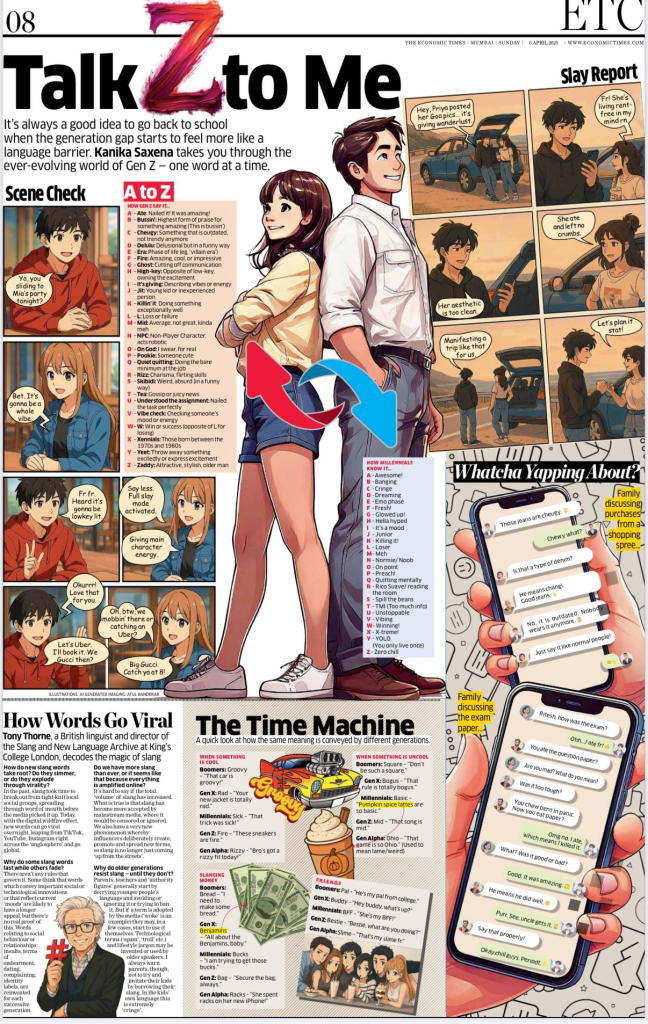
Last week I was interviewed by two young journalists about the pervasive slang generated by Gen Z and Gen Alpha. Interestingly both journalists are operating outside the US/UK matrix from which much of this language variety emanates. Interestingly too, both journalists asked similar questions about the latest linguistic novelties and how we might respond to them. Kanika Saxena‘s piece appeared in the Economic Times of India, and my contribution is here…
1. How do new slang words take root in a generation? Do they slowly build momentum, or does one viral moment suddenly put them everywhere?
In the past it could take some time for slang to escape from the local social group (‘in-group’ or ‘peer group’: a group of friends, a gang, fellow workers, etc.) where it originates into the outside world, then to spread by word of mouth into other parts of society, finally perhaps being picked up by the entertainment or print media. Nowadays this process has been massively speeded up by messaging and the internet, so that a novel term can go viral and reach beyond its original community almost instantaneously. New expressions can spread via social media and platforms like TikTok, Youtube, InstaGram right across the ‘anglosphere’ and go global.
2. Some words stick around for decades, while others vanish overnight. What makes certain slang words stand the test of time?
Linguists have tried to analyse why some terms become briefly fashionable and then disappear while others endure. There don’t seem to be any rules that govern why this happens. Some experts think that words which convey important social or technological innovations or that reflect current ‘moods’ or preoccupations are likely to have a longer appeal, but there’s no real proof of this. It could also be because a word relates to important social behaviour or relationships: insults, terms of endearment, ‘dating’ language, complaining, identity labels, for example, have to be reinvented for each successive generation, then persist until their users mature or grow older.
3. With social media throwing new words at us daily, are we actually creating more slang than before, or does it just feel that way because everything is amplified online?
It’s hard to say if the total ‘volume’ of slang has increased because, in the past at least, it was impossible to quantify it. What is definitely true is that slang has for some time become more accepted by mainstream media whereas it used to be censored or ignored. We also have the very new phenomenon whereby influencers, TikTok stars and content creators are using online resources to consciously, deliberately create, promote and spread new terms, so slang is no longer just coming ‘up from the streets’ (or spread via music, TV and movies) but is a commodity exchanged and pushed to gain prestige or sell oneself.
4. Older generations always seem skeptical of new slang—until, of course, they start using it too. What’s the secret to a word crossing generational lines?
Parents, teachers and ‘authority figures’ generally start by decrying younger people’s language and avoiding or ignoring it or trying to ban it. (This isn’t really justified by the way: slang may be seen as socially marginal but is not technically deficient or defective language and uses the same techniques as poetry or literature) But if a term is adopted by the media (‘woke’ is an example) they may in a few cases start to use it themselves. Technological terms (‘spam’, ‘troll’ etc.) and lifestyle jargon may be invented or used by older speakers. I always warn parents, though, not to try and imitate their kids by borrowing their slang. In the kids’ own language this is extremely ‘cringe’.
My second interview was with Austėja Zokaitė who is based in Lithuania and it appears in the online magazine Bored Panda, an arresting and anarchic daily roundup of the latest viral images, memes and commentary on internet culture. The whole report is here, with my comments interspersed with the succession of visual elements…
Researching and tracking the latest slang can now draw upon statistical analysis of online data.
As 2024 draws to its end and talk among lexicographers, culture journalists and language buffs turns to ‘words of the year’, I’m immensely grateful to Randoh Sallihall of Unscramblerer for providing me with his datasets showing lookups (Google searches) for the most popular recent slang expressions…
Most searched for slang words in United Kingdom:
1. Gaslighting (170 000 searches) – a type of manipulation that makes you doubt your memories and feelings. The person doing it may lie and deny things.
2. Skibidi (125 000 searches) – refers to a viral internet trend featuring surreal, animated videos of singing toilets and dancing heads, popularized on platforms like TikTok for its bizarre humor.
3. Pookie (47 000 searches) – to show endearment and affection. Used for a close friend, partner or family member. A playful way to say someone is special.
4. Hawk tuah (40 000 searches) – imitative of a spitting sound. The catchphrase originates from a viral street interview conducted in June 2024 with Haliey Welch, who stated that her signature move for making a man ‘go crazy’ in bed was to ‘give him that hawk tuah and spit on that thang’.
5. Sigma (37 000 searches) – refers to an independent, self-reliant person who operates outside traditional social hierarchies, often described as a ‘lone wolf.’
6. SMH (31 000 searches) – internet slang for ‘shaking my head’. Used to express disapproval or disappointment.
7. Demure (26 000 searches) – reserved, modest or shy in manner or appearance. The TikTok user Jools Lebron made a series of viral videos using the phrase “very demure”. This trend gave the word a playful slang meaning. She uses it to assess appropriate makeup and fashion choices in various settings.
8. Rizz (25 000 searches) – style, charm or attractiveness. The ability to attract a romantic partner and make others like you.
9. Dei (17 000 searches) – diversity, equity, inclusion. A family friendly way of saying woke.
10. Aura (13 000 searches) – the vibe someone gives off. When used by tweens and teens it is likely a reference to how badass someone is. Aura points make you cooler. So you definitely want to earn more aura points instead of losing them.
We can compare this list with Randoh’s equivalent for the USA, used in the Newsweek article posted previously to which I contributed, and reproduced here with his explanatory comments…
Analysis of Google search data for 2024 reveals the most searched for slang words in America:
1. Demure (260 000 searches) – reserved, modest or shy in manner or appearance. The TikTok user Jools Lebron made a series of viral videos using the phrase “very demure”. This trend gave the word a playful slang meaning. She uses it to assess appropriate makeup and fashion choices in various settings.
2. Sigma (220 000 searches) – refers to an independent, self-reliant person who operates outside traditional social hierarchies, often described as a ‘lone wolf.’
3. Skibidi (205 000 searches) – refers to a viral internet trend featuring surreal, animated videos of singing toilets and dancing heads, popularized on platforms like TikTok for its bizarre humor.
4. Hawk tuah (180 000 searches) – imitative of a spitting sound. The catchphrase originates from a viral street interview conducted in June 2024 with Haliey Welch, who stated that her signature move for making a man ‘go crazy’ in bed was to ‘give him that hawk tuah and spit on that thang’.
5. Sobriquet (105 000 searches) – a nickname or descriptive name given to a person or thing. Borrowed from French sobriquet (nickname).
6. Schmaltz (65 000 searches) – refers to excessive sentimentality or melodrama. Often used for art, movies, music or storytelling if there is too much sappiness.
7. Sen (50 000 searches) – slang for self.
8. Katz (34 000 searches) – a term for anything enjoyable, fun or pleasing. It can also mean ‘yes’.
9. Oeuvre (25 000 searches) – refers to the complete works produced by an artist, writer or composer. A word used by literature professors to express superiority.
10. Preen (20 000 searches) – slang for a child who tries to act like a teenager(wears teen clothes or makeup).
A spokesperson for Unscramblerer.com commented on the findings: “The English language is ever changing. Every year new slang words are created. Many slang words are born through trending topics and viral videos on social media. However only few manage to stick around long enough to be added to the dictionary and remain in daily use. Slang words are a normal and fun evolution of language. We encourage everyone to learn some new words and surprise their children by using them.”
Research was conducted by word-finding experts at Unscramblerer.com.
We analyzed 01.01.2024 -25.10.2024 search data from Google Trends for terms related to slang words.
Methodology: We used Google Trends to discover the top trending slang terms and Ahrefs to find the number of searches. Americas most popular slang terms can be discovered in Google Trends through the keyword ‘meaning’. People will hear or read slang terms and search for the meaning of the term (example ‘demure meaning’). Ahrefs shows many variations of meaning searches like ‘slang’ or ‘trend’ (example ‘demure slang’) and similar keyword combinations (example ‘what does demure mean’). We added up 150 search variations of top slang terms.
A few days after Randoh’s findings were published, I was asked by Robert Milazzo* to take part in the masterclass on new slang and youth language that he convened at Virginia Commonwealth University. The whole lively one-hour event was recorded and can be accessed here…
Robert’s class was particularly illuminating, allowing as it did for contributions from young slang users themselves and from puzzled old-timers too. Bear in mind that the samples handled by data analysts are taken solely from online usage and not from authentic speech. Nearly all the slang used on TikTok, YouTube, Instagram, etc. originates in the USA whereas the slang terms used by British youth in their IRL conversations will differ considerably from their North American counterparts, showing much greater influence from African Caribbean rather than African American sources.
Dictionary makers and journalists are breathlessly – if not desperately – publicising the latest online language – but do they really understand it?
One week on, I spoke to Chloe MacDowell of the UK Guardian newspaper, then to Marni McFall of the US Newsweek magazine on the topic of TikTok language and the online messaging mannerisms of Influencers and GenZ. Chloe was interested in one particular trending TikTok catchphrase, Marni in the whole panoply of 2024’s viral innovations.
Once authentic conversations and personal interactions (previously happening in private spaces or local communities) began to feature on the internet and in messaging and on microblogging platforms, language novelties, slang and faddish usages crossed over from a private realm into the global public domain. The latest slang and new language was visible, audible and immediately available to share. Obscure or exotic terms might quickly catch on and become viral favourites, spreading in some cases across the anglosphere more rapidly than print, broadcast or word-of-mouth transmission had ever been to achieve in the past.
Words and phrases began to function like memes, taking on sometimes a ‘multimodal’ aspect whereby sound and image could reinforce the purely verbal expressions that people chose to exchange and promote. Pre-internet there had always been catchphrases, what linguists call ‘vogue words’, slogans and soundbites, and keywords that somehow seemed to evoke or encapsulate some special aspect of the ‘zeitgeist’. What we have now is a much more knowing, deliberate intention (on the part of trend-setters, influencers, ‘thought-leaders’) to create new language to celebrate new identities and to promote new attitudes and lifestyle innovations to the widest possible audience.
Subcultures like surfers, valley girls, fanboys and girls, hip hop aficionados had always invented striking, expressive language and this is still true, but instead of niche culture we have ‘meganiches’, instead of subcultures we are dealing with globalised communities.
The fashionable language of TikTok and GenZ in particular is part of their wider obsession with vibes, aesthetics and microtrends, many of which arise and are discarded in rapid succession. The prevalent style is exhibitionist, self-promoting, allusive and often ironic, increasingly even absurdist, making it hard for outsiders to grasp the nuances in play. Older commentators and dictionary publishers struggle to keep pace, often misunderstand and record the terms in desperation (in their searches for ‘word of the year’ for example) just as they fall out of use.
The use of this language as an identity marker in an intensely competitive digital ecosystem means that the Gen Alpha cohort now ridicule GenZ usages as being out-of date, while GenZ is still deriding millennials for their old-fashioned ‘cringe’ vocabulary. At the same time would-be influencers practise bragging, ‘manifesting’ and other forms of self-congratulation in a search for clicks and clout.
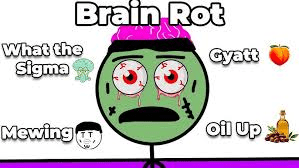
One of the latest features of online wordplay is the elevating of an older concept or cliche into a teasing provocation or pretence at new insights, as we have seen with ‘delulu’, ‘demure’ and ‘mindful’, ‘rizz’ and ‘brat’. The current rash of declarations of ‘being privileged’ – a new version of ‘humblebragging’ or ‘virtue-signalling’ – is another example. In parallel is the ironic celebration of the incoherence or absurdity of much online discourse and of low-quality ‘slop’ by embracing a culture of ‘brainrot’ – nonsense memes such as ‘skibidi’ and vacuous, contagious content.
Most of the innovation in online language and image still emanates from the US and even though a global audience can access it instantly, its tropes (think ‘goblin-mode’ – ‘goblin’ doesn’t have the same associations for Brits) don’t always translate for other speakers of English. In parallel, poses, gestures and looks as well as music-related modes are increasingly generated from non-English cultural zones such as Japan and Korea. It will be interesting to see if other parts of the globe begin to play a part in the evolving online theatre of signs and behaviours, but this doesn’t seem to have happened yet.
On the first of November Collins Dictionaries, ahead of the pack, had already announced their choice of word of the year for 2024, and their candidates illustrated the same, in my opinion mistaken, concentration exclusively on terms from a very narrow range of sources. While postings on social media are performances designed to attract attention, there is an even wider domain in which discourse demands analysis: the crises in the Middle East and Ukraine and the surreal spectacle of the US presidential campaigns, for example, are also highlighting keywords and generating new formulations or reworkings of language – data that mainstream media and lexicographers seem to think unworthy of their attention…
Teen talk continues to baffle older cohorts, but as autumn approaches the vibes shift – and Tiktok identities evolve…
In mid-August I talked to Mary McCarthy about the ever-changing patterns of youth language, and, with her kind permission, Mary’s article for the Irish Independent follows…
No cap, sigma and rizz? You’ll need more than Google Translate for teen talk now
Parents are supposed to be bemused by the slang words their children use, but the new summer vocab in our house has me totally flummoxed. This is particularly so with the younger two lads – eight and 11 – who walk around saying nonsense words like “sigma”, “no cap” “Skibidi Toilet” and “gyat” all the time.
I don’t mind them having in-jokes, and it’s nice to see them falling around laughing – I’ll take that over sullen moods any day. But what are they laughing about?
Are they being kind? I can see the pleasure of getting the giggles over absurd stuff. I used to have this thing with a school friend where we would say repeatedly “The dog is dead” in a Northern Ireland accent – no idea why. But there is so much coming at them now online. How can I know they won’t soak up the wrong messages? The Andrew Tate alpha-male rubbish, for example.
This week I hired my Gen Z 16-year-old to help me decode what his brothers were saying, and he pocketed his €5 before unhelpfully telling me that “it’s just little kids saying random, mental stuff”.
“It’s the internet, it’s TikTok language,” he said. But they don’t have TikTok, I reminded him. YouTube shorts are the same and they have a lot of that, he told me darkly.
So I asked the lads themselves, and they were fairly keen to enlighten me, which was reassuring. “No cap” means no lying, “sigma” just means cool (no Andrew Tate alpha-male link, thank goodness) and rizz is “charisma”.
My 11-year-old elaborated. “So, this would be a chat-up line like, ‘Are you from Tennessee? Because you’re the only ten I see’.” I’m unsure what to say. They refused to explain “gyat”, so I looked it up later.
It mostly seems fine. They’re getting it from pals and YouTube shorts, which I will limit more now. But what I’m most baffled about is the Skibidi Toilet YouTube show, and why they call everything Skibidi for no reason.
The show has amassed over 65 billion views over the last year, and I can’t see any pull factor. It’s about toilets with human heads engaged in a war with people who have CCTV cameras for heads, all set in a dystopian landscape. Apparently, there will be a TV show and a movie. I had a headache watching it after 30 seconds.
Youth slang can spread very quickly these days via online platforms and messaging
It’s everywhere. We were on holiday in Kerry a few weeks ago and had a few hours to kill in Kenmare, so we visited the Kenmare Stone Circle, which was erected some time between 2000 and 500 BC. If you clip a wish at the Hawthorn Fairy Tree, it comes true. That’s according to the man working there, who handed us a piece of paper and a pen.
Being my nosy self, I immediately started reading other people’s wishes, and among the pleas for health, happiness and planning permission there were lots of Skibidi.
“Sigma, sigma on the wall, who is the Skibiest of them all?” one card read.
“Desidere che i cani diventine Skibidy Toilet,” read another, which Google translate told me was “Wish that dogs become Skibidy toilets” in Italian. So it’s not just my children larking around. I’m sure it’s all just a silly phase, perhaps the same as my own “the dog is dead”.
Tony Thorne, director of the Slang and New Language Archive at King’s College London, said young people have always created their own language to keep outsiders like parents and teachers out. It just happens that there’s more around today.
“This language innovation, as linguists call it, used to take place in private spaces and only sometimes spread further – if, for example, the language was used in music or movies or TV comedies,” he said.
“Youth slang can spread very quickly these days via online platforms and messaging and so can become global. Terms often coined in the US rapidly move into the Anglosphere. We see that in the huge network of English speakers who converse excitedly in ‘mid-Atlantic’ accents.”
Thorne recommends the guide to teenage slang on the Gabb.com website. I soon discovered that “gyat” is a way to express admiration, usually for a woman’s backside. So I nipped that one in the bud.
It is a habit for parents and the older generation to laugh at teenagers for speaking in a frivolous way
Once you start researching the origins of these words, it gets interesting. According to a recent Forbes article on how Gen Z language is changing the workplace, to “slay” – which is something my 13-year-old daughter says, as in “You slayed that lasagne, Mammy” – means “high praise” and originated in black and LGBTQ+ communities before gaining popularity on TikTok.
I can’t remember using much slang as a teen, apart from the many violent descriptions we had for being drunk, among them flutered, slaughtered, battered and trollied.
My cousin would visit from Canada, and she loved hearing those terms. Today, though, there’s no difference between what a 15-year-old in Dublin and a 15-year-old in Toronto is exposed to, and they’re the more creative for this. After all, the way we learn to speak is from listening to other people, so we probably don’t really need to worry much about the slang.
Kevin Barry, former professor of English at the University of Galway, said that while adults can see it as foolish, there’s a wisdom to the newly minted words and phrases.
“It is a habit for parents and the older generation to laugh at teenagers for speaking in a frivolous way – to the adults it makes no sense. What they are seeing is the frontier of language change, which is a creative Wild West,” he said.
There’s no point trying to keep up. New slang will be coined as fast as I learn. We can’t police it. The only thing to do is role-model IRL (in real life) what it is to be a nice person. To not shout, to be kind, to make time for the children. To let them know you have high expectations for their behaviour by having high expectations for your own – no cap.
The dominance of memes and viral posts from the USA celebrating a brat summer was challenged in late August by a TikTok injunction to ‘be demure and mindful‘ in all one’s actions and representations. Alternative and mainstream media jumped quickly aboard the accelerating bandwagon – and Ellie Bramley of the Guardian asked me to comment…
‘Demure‘ is a seemingly prim and dated adjective, used recently only by rueful babyboomers and tabloid journalists, for whom it is code for ‘not completely undressed’ when describing female celebrities attending film festivals, tottering along red carpets and catwalks. In drag queen and ‘ballroom LGBT‘ circles, though, it has long featured as a self-mocking keyword when urging the outrageous, usually ironically and teasingly, to behave with modesty and decorum. It is in this spirit that ‘fierce divas’ and other influencers have relaunched the term, along with ‘mindful‘ in its older sense (before the advent of self-seeking ‘mindfulness’) of considerate, respectful and cautious. The Guardian piece is here…
It’s very easy to dismiss GenZ and TikTok fads as shallow, ephemeral provocations, unworthy of the attention of rational adults. Easy, too, to deride aged babyboomers like me who record them and attempt to analyse the thinking behind them. But as Ellie herself remarked, a keyword like ‘demure’, inasfar as it isn’t just an absurdist gesture, can not only signify a genuine shift in self-awareness on the part of a few influential online individuals, but can prompt reflection and even changes in behaviour among a much larger segment of the population.
With that in mind, from Laura Pitcher, here’s Dazed‘s perceptive take on the word of the moment…
During October I relished the chance to talk to the editors of DazedDigital, Serena Smith and Gunseli Yalcinkaya, and they told me about the most recent developments in online and digital communication and the new language varieties trending on social media. I have tried to make sense of a much younger generation’s performances and interactions and the notes I made follow here…
Language and the way we use it is now for the first time truly globalised. This means for example that new accents and intonations and vocal affectations take place across several cultures almost simultaneously. This gives us pronunciation and intonation novelties like Youtuber or Influencer accent, TikTok voice, etc. These are fluid, evolving and can blend more than one traditional source (UK and US linguistic styles and usages for example). The phenomenon is not new – the mid-Atlantic accent dates back many decades and both Valley Girls and users of Multiethnic London English – MLE – have played with new ways of pronouncing, but the platforms and apps of the 2020s – TikTok in particular – highlight these…
Obviously the way we consume and exploit media has changed radically with the internet and mobile technology and determines the kinds of messages we exchange and the words, sounds and visuals we actually use. Short attention-spans mean that messages need to be accelerated, brief and telling: the constraints of apps and platforms make for compressed and dense information packages. At the same time the imperative for innovation (something that has always been part of language evolution, but used to happen very gradually) – novelty, neologisms, new and more liberated attitudes to formality and informality and style in general – is integral to changing fashions, aesthetics, vibes. Even such basics as whether messages have to make sense have been destabilised by Gen Z‘s playful surrealism and absurdism and TikTok’s creative conventions.
One major change is the way that the distinction between written and spoken language has broken down since people began to type conversations and exchange rapid interactions electronically. Also Pre-existing words and expressions are hijacked, reversed, toxified, appropriated and modified as never before. And we all now have the power to do this via electronic media – we don’t need permission to publish and exchange our ideas and indulge our playful, mischievous or creative new usages.
Gunceli asked, There are so many memes joking about how we’ve ‘progressed past the need for language’. Obviously worth taking with a pinch of salt, but do you think there’s any truth to this?
We won’t evolve ‘beyond language’ since language is simply a label for human interaction and communicative practices, but the specifics of that language will continue to adapt and mutate along with our social needs and our technologies. Linguists do talk increasingly in terms of multimodality whereby both online and offline communication involves much more than speech or writing – ‘language’ as we have known it. The buzzword multimodality can refer to how IRL we blend all sorts of semiotics often simultaneously: stance and posture, facial expression, gesture, writing, speaking and using a communication device, but also refers to how online and app messages employ abbreviations, acronyms, audio, video, symbols, memes as well as or instead of words (…soon probably touch and smell as well!)
The NPC streamers phenomenon highlighted by Dazed is another example of what I described as GenZ and TikTokers’ minimalist, surrealist or absurdist treatment of language. NPC stands for ‘non-playable character(s)’, the digital background entities with a limited repertoire of utterances and repetitive actions encountered in video games, and the streaming is an online activity, primarily on the TikTok platform, whereby creators imitate these characters by livestreaming themselves, and viewers reward them with in-app gifts for doing it.
The new primacy of image (and audio) over simply text and conversation has resulted in a human imitation of cartoon sounds and seemingly meaningless bits of language that only followers and enthusiasts will recognise and be positively triggered by. Playing with identities by way of words, slogans, soundbites and catchphrases is as much influenced by the poses of cosplayers or Furries and the behaviour of video-gamers as it is by ‘traditional’ ways of using verbal and visual language.
How do you think the mainstreaming of emerging tech like AI is changing the way we communicate verbally with one another?
Algorithms being used for automated reasoning and the generating of persuasive messaging or content are already operating at sophisticated levels, but the linguistic aspect is just as much prey to error and detectable failures as, for example, deepfake images and impersonations of artistic productions. If we are digitally literate and managing to keep up, we can often see through the deception, and this is probably reassuring. AI has some interesting potential: for example, to allow us to communicate with people whose language we don’t share. But I think the limitations of AI(-its difficulties in interpreting or reproducing human nuance, implication, indirectness, etc) will lead to – is already leading to – new forms of incoherence and misunderstanding. I suspect we will soon be able to recognise a particular ‘AI style’ so that artificially generated messages can be recognised as such in some cases – at least I hope so! Translators and teachers are already grappling with potential of AI to assist, supplement or replace their work – and its limitations in doing so. More alarmingly AI is already inventing and using languages that we humans can’t understand: https://www.fastcompany.com/90132632/ai-is-inventing-its-own-perfect-languages-should-we-let-it
Gunceli’s fascinating review of all these themes and more is here…
Serena Smith spoke to me about the latest version of familect, the intimate, informal, often comical language invented in private domestic spaces, about which I’ve written before on this site. Her excellent account of TikTok’s #MarriageLanguage is here…
“Postmodernity is modernity without the hopes and dreams which made modernity bearable. it is a hydra-headed, decentred condition in which we get dragged along from pillow [sic] to post across a succession of reflected surfaces, drawn by the call of the wild signifier.” – Dick Hebdige, Hiding in the Light, 1988
Among the toxic terms listed in the glossary of weaponised words, elsewhere on this site*, is a term that has seemed contentious and which has been imperfectly understood since its first appearance in the late Sixties. I included the same word – Postmodernism – in my 1993 book Fads, Fashions and Cults, provocatively subtitled ‘The definitive guide to post(modern) culture.’ When my book, which was aimed at a popular, not a scholarly readership, was launched in Slovenia and featured on national television the Slovene philosopher and critical theorist Mladen Dolar dismissed it as atheoretical and trivial, two other resonant terms which I was not sure whether to resent or to celebrate at the time. An extract from the offending title follows…
Elsewhere on this site I have tried to follow the trajectory of woke**, another, rather different toxic buzzword now favoured by the same side, the opponents of BLM, eco-activism, ‘leftist’ attitudes, in the so-called culture wars that rage on despite the pandemic. In a perceptive review in the New Statesman this week William Davies sets out postmodernism’s trajectory, its recent reimaginings and reiterations by very different interest groups. His article, with his kind permission, is here…
To end with for now, another extract from my antique 1993 guide. I am still pondering the present and possible future of the second p-word, along with other characterisations of our era such as late-modern, techno-modern, post-industrial, post-capitalist and the tension between the post-individual and hyperindividualism, also thinking about the way in which critical positions which were significant for me – Situationism and McLuhanism, for instance – are today ignored or forgotten, and how more recent terms that I think encode important insights – third places, heteroglossia, superdiversity – remain marginal and under-examined. I will try to unpack these musings on these pages very soon…
“Post-Modernism, which deals with the past like one huge antique supermarket, looks very relevant indeed. Pastiche and parody is just an uncomfortable transition to a time when period references will be used without any self-consciousness.” – Peter York, StyleWars, 1980
At the very end of September this year came another example of a UK school seeking to police its students’ language and to ban the use of slang and colloquialisms. I have been writing about youth slang since 1990 (there are numerous articles on this site, accessible by entering slang, youth or MLE in the search box) and about such interventions for more than a decade: this time I spoke to the Guardian‘s Social Affairs Correspondent Rob Booth and his article is here…*
September 2021 also saw the fruition, or culmination (portentous words) of a long-term project of mine dealing with the same topic: the rich, creative, controversial use of highly informal language by younger speakers. I have collected the multicultural slang, traded among younger people and used especially in urban centres across the UK. I have listed authentic examples of this language variety gathered from conversations, messaging, fieldwork interviews and donations and stored these in the Archive of Slang and New Language which I have curated at King’s College London.
Looking for a way to make this data available to the widest possible readership – whether students, teachers, researchers, fellow lexicographers or simply individuals fascinated by language change and novelty – I decided against traditional publishing in hardcopy in favour of putting the material online and so was gratified when, a year ago, the University of Aston’s Institute for Forensic Linguistics agreed to host an extract from the Archive, an up-to-date Glossary of UK Youth Slang, in its Forensic Linguistics Databank. This lexicon, very modest in its format but unique in the UK and I think in the wider Anglosphere, has just been made accessible. I hope it will be helpful for interested parties and I urge anyone consulting it to comment, criticise and, above all, send me additions for inclusion in future versions (rights to the content are restricted, so please don’t circulate it or republish it without full acknowledgement). I am constantly updating and expanding this and other datasets of nonstandard and socially significant language as well as teaching and broadcasting about them.
I am very grateful indeed to all the collaborators, colleagues, students, parents, youth workers and many others who have helped me to record and analyse this exciting, inventive, sophisticated and technically innovative language – and to celebrate it rather than decry and stigmatise it in doing so.
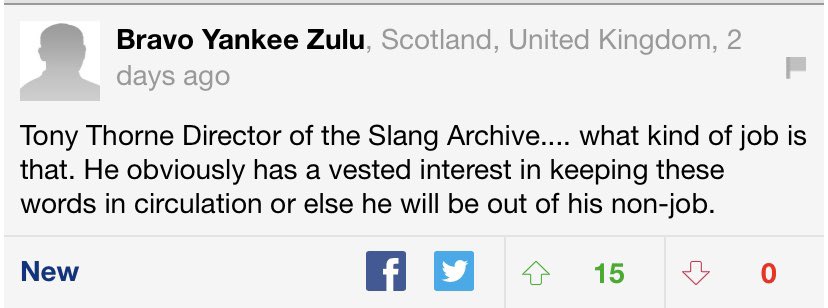
* Rob Booth’s Guardian article was rewritten very slightly and republished by the Daily Telegraph and the Daily Mail. I think the last word on my contribution to the subject, and indeed my career, should go to the anonymous poster of a comment following the Mail‘s piece…
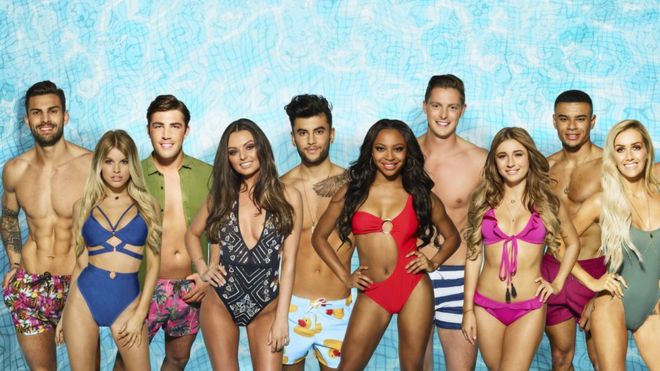
Many TV shows have promoted and propagated catchphrases and slang: ‘Luvly jubbly’ from Only Fools and Horses, ‘Cowabunga’ from the Teenage Mutant Ninja Turtles, for example, but probably the first reality TV series to lodge words and phrases in the British consciousness was T.O.W.I.E – ‘The Only Way is Essex‘ – source of ‘wel jel’, ‘reem’ and more. Love Island, now in its second series, also features a similar demographic – young adult, not necessarily highly educated, extrovert, fit (in both senses) and narcissistic.
As a linguist studying slang, I’m used to having to listen to and interact with criminals, social deviants and other ‘unsavoury’ characters, but one of the most painful experiences of all for me is the obligation to watch reality television. This is not mere linguistic snobbery – though that is certainly a factor – but, if I am honest, because I would never even in my youth have been selected to take part in these beauty contests cum dating games on account of my physical shortcomings. Nevertheless, I have been dutifully tuning in to Love Island recently and trying to come to terms with examples of what linguists call a ‘restricted code’, that is a limited vocabulary and limited grammatical repertoire of made up of simple structures and colloquialisms. This can reflect the limitations of speakers’ communication skills and literacy-levels, but does of course result from the very restricted environment in which participants are placed and the simple, repetitive actions and interactions they have to perform.
You might say, uncharitably perhaps, that the contestants on Love Island are also infantilised by being coerced into playing out simple and repetitive relationship games for the benefit of a voyeuristic audience. The words and phrases which result, and even the intonation and tone of voice that emerges is a weird mix in which the young ‘stars’ alternate attempts at complex formulations when describing psychological pressures with frivolous slang when flirting or teasing, all delivered in the rushed and breathless accents of toddlers.
Psychologists talk about the act of ‘mirroring’ whereby people imitate subconsciously the speech, gestures, mannerisms of others, either to ‘honour ‘ them (if they are seen as high-status or admirable) or to show solidarity and empathy. There is a neuron in the brain that triggers this mimicry in sharing emotion, reinforcing relationships and bonding. Mirroring is contagious like yawning and, again, inside a closed and comparatively claustrophobic environment, its effects are intensified.
The slang used on Love Island may be part of what linguists call a ‘stigmatised’ variety of language – i.e comprising linguistic features that are disapproved of and usually considered substandard in normal society, but slang is at the same time what linguists call a ‘prestige variety’ within the in-groups or subcultures where it originates and where it is exchanged, in other words it confers status on the user and excludes the outsiders who aren’t cool enough to understand it and deploy it convincingly. So for the island community slang helps to reinforce identity and for their fans provides an opportunity to identify with them and emulate them.
The Radio Times has supplied a helpful glossary of the words and phrases in question:
Despite all my misgivings I agreed to speak to journalist Ralph Blackburn about the programme. Ralph had been intrigued by the way the contestants increasingly adopted one another’s language mannerisms just as their vocabularies seemed to reduce as the series progressed. His article appeared today in the Daily Mail:
In the summer of 2021 Dr Hannah Charnock decoded the language of sex employed in the programme (still popular, but condemned by some as a sleaze-fest) for TheConversation:
…And at the end of July the tenth series of the show finished, prompting a cultural retrospective from Lauren Cochrane for the Observer, to which I contributed:
I first encountered codeswitching when as a very young boy I watched the movies of Satyajit Ray, the Indian auteur whose dialogues featured Indian families interspersing their conversations in Bengali with words and phrases in English. In those days the technical term for this, the concept too, was rarely if ever treated by linguists, let alone understood by the wider, overwhelmingly monoglot UK and US publics.
Codeswitching, which is actually commonly practised, usually in less formal settings, in many different societies and multilingual communities, did subsequently become the object of enquiry by language experts, and theories were generated to account for the phenomenon and to analyse its various manifestations (you can find a summary of these on Wikipedia).
More recently in the United States a particular manifestation, that of African American citizens moderating their language to cope with different speech environments, has helped ‘codeswitching’ to begin the crossover from technical terminology into everyday conversation. More recently still, in the last two weeks, the word has featured in a political and cultural cause celebre…
‘She didn’t grow up in the Bronx. She moved out when she was 5. Saying she grew up around the language is misleading; it’s the very reason why it was so cringe-inducing to hear her say it. There was no flava, no swag, no essence. She didn’t pull it off.’
‘From Westchester and Boston U who has never before been seen on any video (and she got lots of those!) speaking in this weird, constrained accent that was a person’s idea of what they should sound like. Leftists don’t get a pass on their racism.’
‘It’s “cultural appropriation.” It satisfies EVERY SINGLE definitional predicate thereof: She is not Black, not poor, and left the Bronx at age 5. She was pandering for political purposes. Not a debatable point.’
The accusations relate to American political Wunderkind and bugbear of the Right, Latina Representative Alexandria Ocasio-Cortez, who was accused of pandering to a new constituency and assuming a fake identity in a speech to a predominantly black audience – accusations she rushed to refute, telling her critics to ‘step off’ – African American vernacular for ‘get lost’:
Some members of the US public did voice their support
‘I think it’s just that most Republican house/Senate members have never talked to anyone except rich white men so they never have to switch’
‘Switching’ or ‘shifting’ is related to what linguists call ‘accommodation’ – altering your speech to match or to empathise with your interlocutors*. It can be simply intended to make communication faster, clearer, or it may be adopted consciously or unconsciously to establish a bond or to affirm solidarity. I certainly find myself doing it – but maybe I’m not typical as I’m a linguist. I do it and have heard it done not only with BAME interlocutors but when more neutral British accents are brought closer to those of Scousers, Geordies, Scots and, still in English, with Jamaicans, Americans and Australians. I think for obvious reasons we are more likely to engage the ’empathy’ mechanism when the conversation is in a more heightened, charged, socially sensitive setting – this of course would apply if we are more conscious of diversity, identity, inequity issues. I also have to talk a lot with younger people who are speaking street slang and MLE in their natural environment and when I do my intonation certainly shifts and I use more informal vocabulary and even slang – I modify the style of my speech in order to accommodate. They probably upscale their style for me too.
Whatever the reason for style-shifting I would say that it should generally be considered a positive rather than negative habit. In the stratified class-conscious British context it would only be questionable if it was condescending, as with a posh person adopting a ‘working class’ accent when talking to tradespeople – which I have to admit I do all the time and which Sunday Times columnist India Knight expounded on back in 2001 (thanks to Stewart McNicol for the reference):
Style-shifting is a positive part of being multilingual or rather ‘heteroglossic‘ – the philosopher and literary theorist Bakhtin’s term for being able to speak in multiple voices for creative effect and in recognition of multiple contexts. The problem is that most monolingual Brits and Americans can’t do it and don’t do it. Of course the adoption of other voices can be overdone or done inappropriately. Some people have accused style-shifters of ‘appropriation’ but it depends on the speaker’s intention. If it’s to claim the other’s identity to exploit it – Australian rapper Iggy Azalea stood accused of faking a ‘blaccent’ last year – it’s bad. If it’s in order to form a bond it can be laudable. The TV comedy Phone Shop brilliantly satirised white men speaking multiethnic street slang, as did Sasha Baron Cohen’s character Ali G more than a decade earlier. DJ and hiphop enthusiast Tim Westwood has been getting away with it for years.
Following the latest brouhaha I talked to London journalist and specialist in BAME-related issues Faima Bakar about code-switching and her report for Metro is here:
In search of a personal take on the issues dealt with here, I spoke to a young academic researching at my own institution. Farhaz Janmohamed told me…
‘I do find the idea of code-switching fascinating… I’ve been doing it all my life. From pronouncing English words with an Indian twang when conversing with my grandparents, to incorporating slang terms when messaging one of my primary school classmates who is currently in jail for gang crime. I’d imagine my most natural speaking style is that which I use when talking to my immediate family, with whom I’ve grown up and am most comfortable. And of course the style of language I would use in a job interview or an email to my lecturers at King’s College London might not be my most natural. It’s certainly interesting to consider motivations for code-switching.
If your natural style of speaking brings you privilege, why would you need to change it, and what does it suggest when you do? Perhaps in my case, my motivation for code-switching could either be to make myself more understandable, e.g. when adjusting my accent and grading my language when speaking to elders in my extended family, or to enhance my image – my ‘face’ – in the case of speaking to somebody who was involved in gang culture. I suppose it can be gratifying to appear trendy in how you speak – in my experience, the coolest kids in school used the latest slang, often acquired from peers or artists in UK rap and street culture. As language itself in that genre of music is regarded as much more essential than in others where there is much more emphasis on melody or vocal ability, there is probably a greater need for rappers to impress listeners with creative lexis in their lyrics.’
On a much lighter note, and lest we forget, Henry Hitchings reminds me to reference former England managers Steve McClaren‘s spectacular act of linguistic accommodation back in 2008…
In August 2020 The BBC released this podcast with personal accounts of codeswitching in the workplace, and the role of MLE…
*After this post and John McWhorter’s article appeared there were useful conversations on Twitter about which technical terms in linguistics most accurately described what AOC had been doing. US based sociolinguist Kelly E Wright commented, ‘I would consider what AOC is doing as style shifting, in a Sociolinguistic sense. To me, code-switching is intrasentential.’ She added, ‘From my theoretical background, I would characterize accommodation as happening on fine grained, lower levels. Slight vowel fronting or raising. Point being, not at the level of metacognitive awareness…We notice a recognizable, and also “foreign” (to us or to the speaker in our percept) speech pattern. That means there is much more than textbook accommodation going on.’ I noted that I had favoured ‘styleshifting’ in my commentaries but that ‘codeswitching’ had now become part of the ‘public conversation’/’sociocultural narrative’ and that ‘accommodation’, whether conscious or not, might be an appropriate term in cases of class-influenced accent moderation in a UK setting.
Three years later, in a UK work environment where accent discrimination is rife, the notion of codeswitching has expanded further, as DrSalina Cuddy writes in The Conversation…














 tony thorne