(NOT) Girls’ Talk


Gal-dem, also galsdem or gyalsdem, refers in London’s multiethnic street-talk to a group of females (mansdem is the male counterpart). It’s also the name of a magazine for women of colour. I talked to Faima Bakar about the street attitudes that mean that girls are criticised for using slang and profanity while boys use them with impunity. The topic relates both to MLE, the mixed urban dialect favoured by many young people, and Banter, a hot issue again in 2016. Both of these are treated elsewhere on this site, but here’s Faima’s article on boys and slang


http://www.gal-dem.com/girls-talk-street-tell-my-man-shut-up/


Multiethnic London English – a Handbook

mle-final-book_tony_s

…and ICYMI, here’s the MLE glossary again:

mle-terms_tony-1

               *But please don’t try to monetise it. It is Chris Nott’s copyrighted work.

The Game of the Name – and How Brands Have Played It

More thoughts about the perils, pitfalls and potentials involved in choosing brand and product names, prompted by the news that Corrections Corporation of America, which runs more than 70 prisons and houses 70,000 inmates around the country, is rebranding as CoreCivic. Mentioned in the  following radio programme from long ago are the Škoda company name, from which the initial Czech ‘sh’ sound has subsequently been dropped for UK ads, and their daring product name Superb which has subsequently  been validated by the car’s success.

The radio discussion took place before the days of podcasts, so this, courtesy of the naming agency Igor, is a transcript.

www.igorinternational.com/press/bbc-naming-a-product-business.php

Citroen Cactus – a thorny question of naming?

This week has seen (rather belated) bemusement online at the car manufacturer Citroen naming one flagship model the Cactus*. They say the word alludes to its low consumption and ‘sober’ image and the rows of ‘airbumps’ on its sides, but for Australians cactus is slang for ‘broken (down)’.

Image result for citroen cactus raison de nom

I mentioned Citroen’s – and arch-rivals Peugeot’s – puzzling naming tactics in an article back in 2002:

BABY YOU CAN DRIVE MY… MAZDA BONGO FRIENDEE

Car names and linguistic confusion

Tony Thorne

Others checked out last month’s Geneva motor show for the cutting-edge automotive technology, but not me. I’m a car buff of a different sort; a connoisseur of exotic model names. The star of this year’s show was the new luxury model from Renault. They are aiming this radical monospace at the so-called e-segment, the executive saloon class which in their words is ‘a world governed by codes which are emblematic of established social norms and of conformism’ …h-m-m.
The name of this code-breaker? The ‘Vel Satis’. H-m-m-m-m…I still haven’t figured out how to pronounce rival Citroen’s Xsara or Xantia – or what they mean. Is Vel Satis another example of Gallic perversity?

When you talk to auto-marketers about product names they alternate between the arrogant we-know-exactly-what-we’re doing and the coy we’re-not-going-to-tell-you-how-we-chose-it. I’m convinced nevertheless that the psychological effect of foreign-sounding words can make or break a product in a particular market. Lancia’s ‘Dedra’ may sound beautiful to Italians but to anglo-saxons it suggests that something has died. The VW Bora has never taken off in the UK, where some ignorant punters also said that the excellent Sharan conjured up an Essex girl in white stilettos. As for the tiny Renault Twingo, it has never even been marketed in English-speaking markets, perhaps because it sounds like a chocolate bar.

Pronunciation problems can’t help. What did foreigners make of Cadillac’s unpronounceable Phaeton or Brougham? Come to that, how did English-speakers cope? Not many people can afford the Lamborghini Murcielago – it means ‘bat’ in Spanish – but if even one potential buyer is put off because he or she can’t say it, that’s more than £100K lost. And I’ve never seen a Lancia Ipsilon Elefantino, but with that name I have my doubts that it’s going to restore the marque’s reputation in the UK

Of course name buffs won’t be satisfied by Geneva, they are looking forward impatiently to October’s Tokyo show. Last year’s was particularly memorable with the unveiling of the Mazda Secret Hydeout, the Suzuki Afternoon Tea, the Mitsubishi Mini Active Urban Sandal, the Suzuki Van Van (which isn’t a van), and who can forget previous landmarks such as the Mitsubishi Mum, the Daihatsu D-Bag, the Toyota Synus.

Japanese manufacturers are reluctant to explain the names, but there are rumours: for instance that when Nissan’s boss asked for the name of a heroic mediaeval knight the Cedric was born. The Colt Starion was said to be a Japanese attempt to pronounce ‘Stallion’, which might also explain this year’s Comprex. And the Toyota Ist (rhymes with ‘list’), could that just possibly be a mis-pronunciation of 1st as in first? No comment.

We can mock but the simple fact is we don’t count. For Japanese and East Asian consumers it’s the shape of the word that pleases, and English sounds cool per se, but the meaning is utterly unimportant. Even when it’s a double meaning: Mitsubishi’s Pajero pronounced in Spanish sounds like the slang for ‘masturbator’, Fiat’s Marea comes out in Spanish as ‘seasickness’. We English speakers can’t be smug: how could we sell the Chevy Nova into Latin America, where no va means ‘won’t go’, or the Pinto, which means ‘small penis’ in Mexico? Or the Rolls Royce Silver Mist in Northern Europe where ‘mist’ translates as ‘crap’.

We’ve come a long way from the innocent early days of models with reassuringly trustworthy names; in the anglophone markets ‘Fidelity’, ‘Safeway’, ‘Utility’ were typical. The fifties and sixties promoted status with the aspirational ‘Ambassador’, or ‘Marquis’, yielding in the seventies to macho-but-naff ‘Marauders’, ‘Valiants’, ‘Cougars’.

It must be significant that today’s successful models mostly have invented ‘international’ names like Mondeo or Premacy, or initials and numbers like XS5 or V70, but some car-makers just don’t learn. Vel Satis? I was stumped; vel is latin for ‘or’ and satis means ‘enough’. Still stumped. A lady from Renault France told me the phrase was a pure invention, ‘it can mean whatever you want it to’, but is intended in French ears to evoke ‘luxury, perfume’, a tantalisingly upmarket je ne sais quoi. I’m worried that the average UK driver will think ‘well-satisfied’, more the aftermath of a good dinner than a mysterious perfume, but one Irish auto-journalist claims the roomy car is aimed at ‘lardy executives’ anyway.

We’ll have to wait for a few more months to see if Renault’s challenge pays off. In the meantime, I’m hoping that Tokyo can come up with something to top the Mitsubishi Lettuce.

 © Copyright Tony Thorne 2002

Versions of this article previously appeared in the Guardian and British Airways’ Business Life magazine

 * Here’s Nancy Friedman‘s blog on the Cactus story…

http://nancyfriedman.typepad.com/away_with_words/2016/10/new-name-beat-citron-cactus.html

And in 2024 an update from the Economist

https://www.economist.com/business/2024/05/16/how-not-to-name-a-new-car

In 2025 Jake Rossen covered the topic for Mental Floss

https://www.mentalfloss.com/how-cars-get-their-names

Multiethnic London English – a Glossary

“The post-racial, non-rhotic, inner city,

Th-fronting, cross cultural,

dipthong shifting, multi-ethnic,

L-vocalisation, K-backing fusion of language”

As a linguist and lexicographer who once worked as a designer, I have long nursed the idea that an iconic reference work, especially one which celebrates and explores creative, exotic and subversive forms of language, could – should – also function as a work of art.

In 2013 I had the privilege of helping Chris Nott in the preparation of his graduation project at the Royal College of Art. Chris designed a glossary of, and a guide to MLEMultiethnic London English – that functions as document and documentation as well as being a unique art object.

Chris, now working as a design specialist in the studios of Brody Associates, has given permission for this artefact to be shared for the first time. It consists of a glossary and a separate guidebook (which highlights the words from the glossary too)

Please do consult it, dip into it, read it from virtual cover to virtual cover, or, better still, print it on to high-quality paper and savour its tactility. Place it on a lectern under a strong light. Use it to teach your students, to inform your friends.*

The contents of this reference work, which includes contributions from other lexicographers and linguists, are still topical, relevant, revelatory three years on. The visual elements and format remain unique.

The samples of language and the commentaries presented in the book move our thinking beyond ‘slang’, beyond older notions of race and class, to consider the post-ethnic realities of a UK subject to what theorists now call Superdiversity, in which, especially but not only for younger speakers, complex questions of identity are bound up intimately with language, style and symbolism.

For me what is also essential in treating slang, dialect or jargon is to go out into the streets, the clubs, school playgrounds and workplaces and record the actual words of their users, words which might never otherwise appear in popular or academic publications.

MLE, Multiethnic London English, now sometimes referred to as Urban British English or Interethnic Vernacular was the designation given to a developing social dialect, featuring a slang vocabulary and new patterns of pronunciation and accent, that came to notice at the end of the 1990s and has since influenced the speech of younger speakers in particular beyond London itself.

Here is Chris Nott’s work. First the Glossary

mle-terms_tony-1

In a few days Chris’s 300-page Guidebook to MLE will be made available too


*But please don’t try to monetise it. It is Chris Nott’s copyrighted work.

WACKAGING

WACKAGING


‘Wacky’ packaging or wackaging, a trend I wrote about in 2014, is back in the news this week as one of its first practitioners, Richard Read, co-founder of Innocent, reminisces in a Guardian article*

Image result for wackaging

Chiming with marketing’s turn towards storytelling and narrative, and the ‘brands are people’ mantra, packaging has gone wacky. Cutesy phrases (‘hello, my name is Caramel Brownie’) first appeared on the back of smoothie bottles more than a decade ago, now a whole range of supposedly chummy, cheeky products are talking back to the customer (‘please pop me in the fridge’). When the producer – ‘our lovely little company’ – tells you its life story on the label, it can seem intimate and fun, but eventually the faux-familiarity and baby-talk grates. The trend has spread to services, too: banks and utilities have gone chatty, and have you noticed that when your browser asks you if you want to translate a text, one option is ‘nope’. Mail error messages have switched to matey (the jargon term is hypercasual) comments such as ‘I’ve given up. Sorry it didn’t work out.’ Some commentators see this as part of a wider phenomenon: the infantilisation of popular culture and media and the pandering by brands to a toddler sensibility detectable in consumers of all ages. Wackaging will probably survive a backlash or two, but hopefully only when targeted at real infants, not kidults and adultescents. Alarmingly though, food manufacturers are experimenting with products and displays that really do engage the buyer in conversation, either via their mobile phones or with the aid of in-store devices. They say the move is targeted at the visually impaired and elderly, but the appearance of audio-empowered sausages and buttonholing robo-strangers lurking in the aisles can’t be far behind.

Vice UK editor Rebecca Nicholson put a collection of examples of the wackaging trend on Tumblr in 2011:

http://wackaging.tumblr.com/

*The Guardian article referenced above is here:

https://www.theguardian.com/books/2016/oct/23/richard-reed-interview-if-i-could-tell-you-just-one-thing-richard-branson-heston-jo-malone


Send buzzwords, jargon and new and exotic usages to tony.thorne@kcl.ac.uk


THE DICTIONARY, BY DESIGN

In recent posts I  have been looking at novel ways of mixing words and images and at the exploitation of nonstandard language varieties – slang and jargon in particular – for marketing, advertising and publicity. The format of the dictionary entry itself, the very familiar sequence of headword, part of speech and definition, lends itself to imitation in the same causes, as discussed here by naming expert Nancy Friedman:

http://nancyfriedman.typepad.com/away_with_words/2016/10/you-could-look-it-up.html

After studying Nancy’s article (included here with her kind permission) I tried in vain to find counterexamples: mainstream ads that had succeeded in using the reference-book template in original and striking ways. I did recall, though, some microexamples from closer at hand, the work of the design team at King’s College London with whom I’ve collaborated. These focused on colloquial language such as cliche, slang and catchphrase, presented in the visual style of thesaurus or academic document, playing with the expectations of a local target audience of students.

In 1998 slang, ancient and modern, and the thesaurus were evoked in an advertisment for student accommodation which proved popular with its intended readership:

KCL My digs 1998.JPG

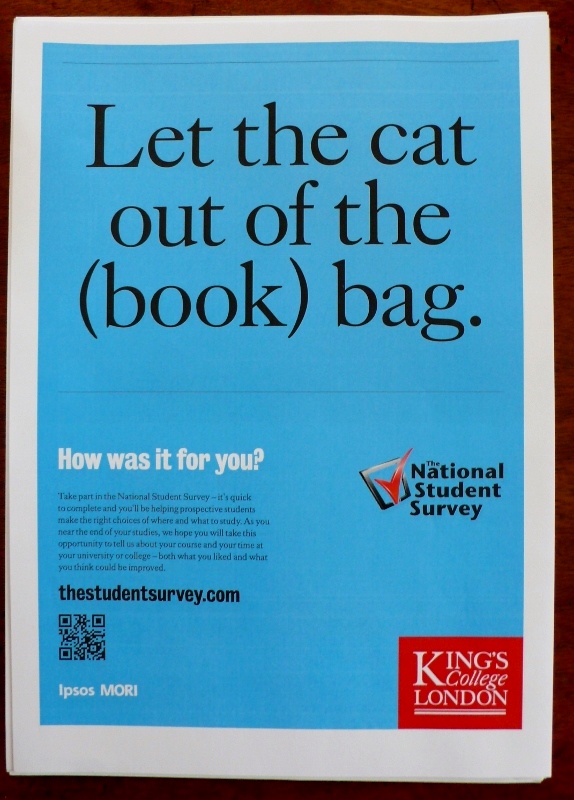
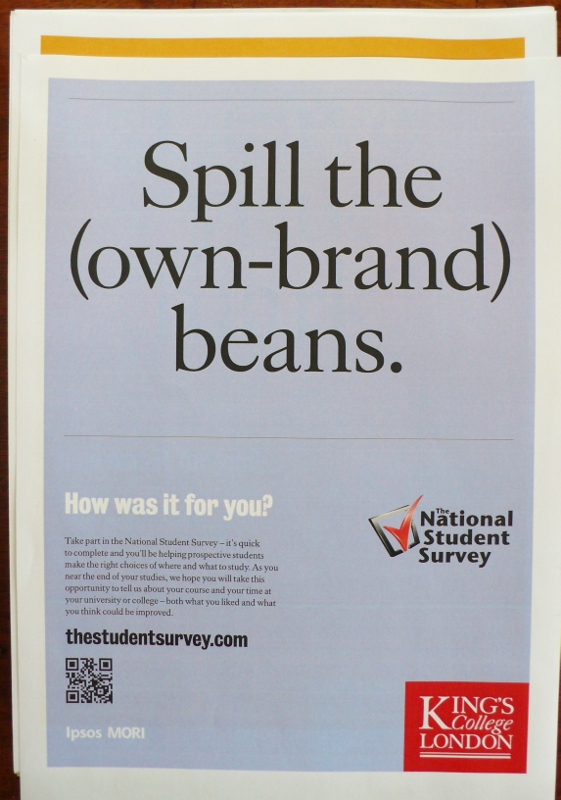
Just recently an appeal for students to take part in a national survey combined a checklist or questionnaire format with plays-on-words, (over)familiar expressions and the sort of throwaway responses that students might employ:

P1090546 (574x800) (574x800).jpg

P1090550.JPG

P1090547 (651x800).jpg

P1090548 (561x800).jpg

P1090549.JPG

A little closer in spirit to Nancy’s examples, but more successful I think because target and context-specific is the mug designed for alumni of King’s College which plays on the Latin word itself, its correlates in English and, in dictionary style, its etymology.

Image result for KCL alumni mug


In my next post I hope to present for the first time a unique slang glossary and guide, created by a design specialist, which is at the same time a book to treasure, a rich source of information and a memorable art object.

A LOAD OF JARGON – 2


blex_outofthebox


“We are all guilty of using redundant and superfluous language throughout our working day, phrases such as blue sky thinking, target audience or thought shower are just a few examples of this strange terminology that has become commonplace.” – It’s Nice That

*

Just as brands, service-providers and media agencies have begun to appropriate slang and jargon for their own purposes, so designers and artists are starting to explore and exploit the potential of colourful nonstandard language with creative juxtapositions and novel interactions.

*

At iconic  The Conran Shop in London It’s Nice That media publication and design partnership Isabel+Helen have collaborated on an exhibition, running through September and October 2016,  which both celebrates and mocks the buzzwords circulating in creative industries. The static and kinetic works on show combine image, text and typography to re-present familiar phrases in a new context, while visitors have the chance to explore further via interactive games and print workshops.

*

A Load of Jargon takes in both well-established and more recent expressions. For instance, the creators lampoon the phrase thinking cap by creating a pile of baseball hats emblazoned with those selfsame words. Next steps, another common business cliche, is a treadmill-like set of stairs, implying the infinite cycle of the phrase. Not all the pieces are purely literal, though: going viral, for example, is a series of yellow ping pong balls in front of a red background, inviting multiple interpretations from spectators.

*

To my jaded ears some of the terms being mocked – going viral itself is one – seem thoroughly useful and no more offensive than the The Conran Group describing itself as a  lifestyle retailer, but that’s not the point here. Surveys have shown again and again that real people (as opposed to linguists specialising in slang) are upset by such language, and other buzzwords from the installation, notably thought shower (which the BBC famously imposed in place of brainstorm in order not to upset epileptics) are prime examples.

Theconranshop_isabelandhelen_itsnicethat_aloadofjargon_00_list

The installations play on the paradox whereby we can be simultaneously amused and irritated by language while we share the nagging suspicion that the sometimes laughable buzz-terms we are seeing and hearing actually signal something important: not just a way of encoding new ideas, new technologies and new ways of working (the project describes itself as a an immersive experience), but also a specialist vocabulary which team-builders and team-members use for bonding and forging identities. We bridle at the use of jargon when it’s novel and unfamiliar and again when it has become overfamiliar, but dare I suggest we try instead to expand our lexical repertoire, appreciate the sociosemantic resonances of these neologisms and get with the programme?

Writing about The Conran Shop exhibits Naresh Ramchandani of Pentagram takes a harsher view…

http://www.itsnicethat.com/features/linguisitc-cocaine-a-load-of-jargon-naresh-ramchandani-041016

With thanks to Manda Wilks and the rest of the It’s Nice That Team

Image result for conran shop

…and to The Conran Shop

Hierarchy Misalignment Syndrome

Hire Older Workers – 5 Key Benefits for Your Business | VANTAGE Aging

HMS, meaning a glaring mismatch in terms of status, is the latest mock-malady to afflict the business world. It was recently highlighted by, among others, PR and communication specialists Shine.com. It describes the awful sensation experienced when you sit down for an important face-to-face with a client or partner and find that your contact is an intern and/or someone 20 years younger than you. As Shine puts it, “It tends to mean that their organisation is taking neither you nor the project seriously – or, even more annoying, that your opposite number is a child prodigy.”

As a babyboomer I’m resigned to seniority or generational mismatches by now, though I try and check attendee status in advance of meetings. In wider contexts — company mergers, for instance — seniority integration is a priority for HR specialists. This coinage has been inspired, I suspect, not just by analogy with PMS (aka PMT) but by two genuine technical expressions: ‘hierarchy malalignment’ when mapping across databases, and ‘miserable malalignment syndrome’ — a painful result of sports injury.