THE LANGUAGE OF YOUTH – 2

Anyone wanting to learn more, or to teach about slang and youth language might be interested in the following. I’ll update this material soon, to include reference to the concepts of enregisterment and stylisation, and will also put an updated bibliography on these pages shortly…

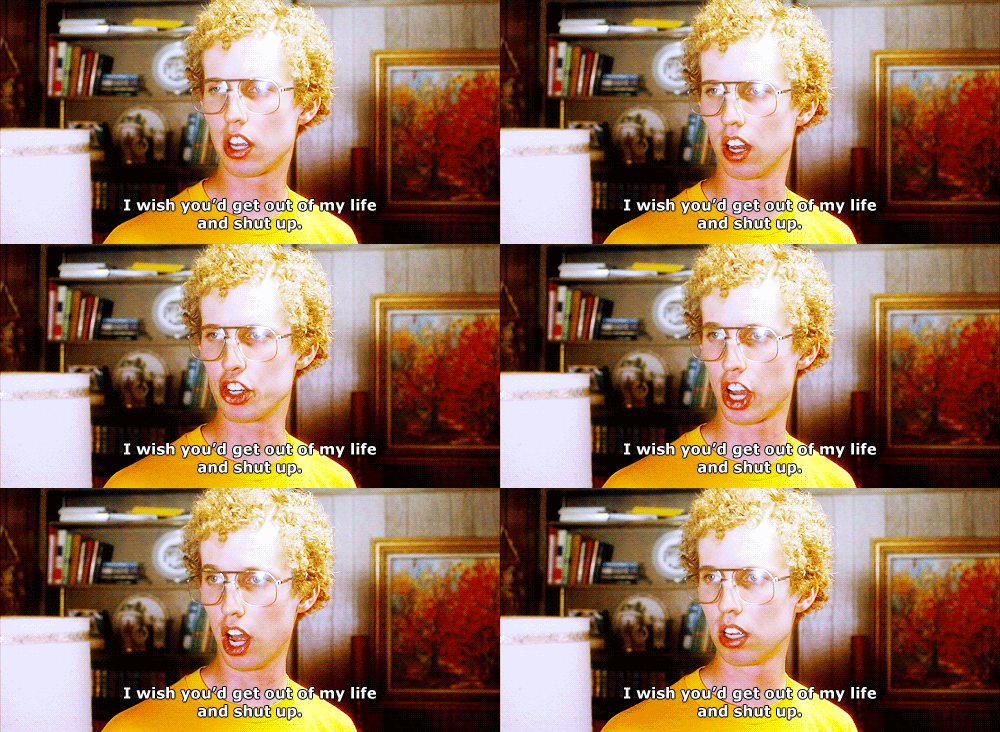
napoleon-dynamite-gif

YOUTH CULTURE AND ITS LEXICON


Tony Thorne


Sub-varieties of language developed by young people may be celebrated (by the media) or stigmatised (by educators and prescriptivists). This extract looks at the forms, functions and social implications of so-called youth slang(s).


SLANG AND YOUTH

While slang was formerly associated with the underworld, and later the armed forces and institutions such as universities or the English public schools, teenagers and young adults are currently thought to be the most prolific linguistic innovators and users of slang in English.

In the USA Teresa Labov (1982), Eckert (1989) and Eble (1996) have studied the use of slang by street gangs, high-school and college students respectively, describing its role in defining member categories in the microsocial order and in ethnic demarcations, and its centrality in dynamic social interactions. Younger slang users are evidently aware of and interested in their own linguistic practices as evidenced by Urban Dictionary, a collaborative user-generated online compilation of over a million items (Damaso and Cotter 2007).

The features ascribed by Halliday in 1978 to anti-languages apply to modern slangs. These are lexical innovation – producing neologisms or reworkings to fill lexical gaps in the language; relexicalisation, or finding novel terms to replace existing ones, and overlexicalisation or hypersynonymy, the coining of a large number of terms for the same or similar concept. Examples are the many nicknames for their weapons of choice used by criminal gangs and the multiple synonyms –‘carnaged’, wazzed’, ‘hamstered’, trolleyed’, etc. – for ‘intoxicated by drink or drugs’ traded by adolescents and young adults.

Slang can be approached by focusing firstly on its social or sociolinguistic functions, then on its lexico-semantic features, that is the ways in which it manipulates language in terms of structure and meaning.


FUNCTIONS

There is a consensus as to the principal functions of slang in socialising processes and social interactions. The ability to understand and deploy slang is an important symbolic element in the construction and negotiation of individual and group identities, enabling bonding, affiliation and expressions of solidarity and engagement. It performs the important function for an in-group of providing a criterion for inclusion of members and exclusion of outsiders. It is at the same time a means (primarily but not only for younger speakers) of signalling ‘coolness’ and indulging in playfulness. The slang vocabulary may be part of a self-referential system of signs, a semiotic repertoire of self-presentation or stylization which can also include dress and accessorizing, body-decoration, gesture, physical stance, etc. It therefore functions not only as a lexicon or linguistic resource but on an ideological level of affect, belief, etc.


FORMS

From a lexico–semantic perspective slang is of interest in the way it both imaginatively invents and reworks according to the semantic possibilities of a language, and forms expressions according to its morphological potential. Slang employs the standard processes of word-formation in English, among the most common being compounding (‘pie-hole’ for mouth), blending, (‘chill (out)’ and ‘relax’ become ‘chillax’); affixation (‘über-nerd’ which is also a rare instance of borrowing, combining with an earlier slang term), change of part of speech or functional shift (‘weirding’, behaving erratically); clipping (‘za’ for pizza, ‘bab’ for kebab), abbreviation and acronymy (‘FOFFOF’ for ‘fair of figure, foul of face’). For further examples see Sornig (1981) and Eble (1996). Slang makes use of more unusual devices such as re-spelling (‘phat’ for fat in the sense of excellent); punning (‘babia majora’ for an attractive female, ‘married alive’ meaning trapped in a relationship), the insertion of a word or element between syllables or tmesis, sometimes called infixing, as in ‘fanfreakingtastic! It employs phonology-based manipulations such as rhyme and reduplication (‘drink-link’, a cash dispenser), and assonance or onomatopoeia (‘clumping’, attacking with fists or feet).

Arbitrary coinages –completely unprecedented inventions – are extremely rare and difficult to substantiate: even the most unusual- looking expressions are usually derived from some linguistic precedent: ‘bazeracked’ and ‘bosfotick’, UK student synonyms for drunk or exhausted, for instance, employ phonosemy or sound symbolism and imitate other multisyllabics denoting destroyed, damaged or confounded. Some words of unknown origin become popular –‘gak’ for cocaine is one such; others like ‘mahoodally’, a term used by some London students to mean ugly, remain in limited circulation.

Slang makes extensive use of metaphorical manipulation, playing on and with meaning and associations in the mind. Sornig (1981) lists the processes involved, drawing examples from German and other languages. Eble (1996) uses US campus slang to show how a range of rhetorical figures is mobilised in the same way as in poetry or literature. These include metaphor (‘beast’ can denote an aggressive law enforcer, male seducer or unattractive female); metonymy (‘anorak’, later ‘cagoule’, the supposedly typical garment standing for the earnest, unfashionable wearer), synecdoche (‘wheels’ for a car); fanciful comparison (‘as dumb as a box of hair’, i.e very stupid); amelioration and pejoration whereby words acquire a more positive (‘chronic’ now denotes wonderful) or negative (neutral ‘random’ comes to mean bad) sense, generalisation and specialisation in which terms extend or narrow down their meanings so that ‘dude’ denotes merely a person while ‘the man’ refers to an agent of oppression; indirect reference whereby ‘her indoors’ denotes one’s wife and ‘the chilled article’ a cold beer. Peculiar to slang is ironic reversal whereby ‘wicked’, ‘sick’ and ‘brutal’ become terms of approbation.


ASSUMPTIONS ABOUT SLANG

That slang is in any way inherently deficient cannot be demonstrated according to linguistic principles. Slang usage is not necessarily ‘impoverished’, though in many in-groups a small number of items may dominate (quasi-kinship terms, greetings and farewells, terms of approbation, insults, chants) and be repeated constantly. Halliday and others have used the term pathological (more often applied to impaired language or speakers) when referring to unorthodox varieties; Sornig calls slang a ‘substandard’ language, and Andersson and Trudgill perpetuate a questionable if common hierarchical discrimination in observing that slang is ‘language use below the level of neutral language usage’ (italics mine). Many linguists are nowadays wary of hierarchies of language or of generalising based on the notions of ‘standard’ or ‘nonstandard’ varieties, and sociolinguists are finding the negotiating of roles, relationships, status and power through language, at least by young speakers, to be far more subtle and fluid than previously suggested.

Slang users may be virtuosos of style-switching and crossing (mixing different ethnic varieties), and may be acutely aware of appropriacy – fitting style to context, or may simply use the occasional expression to liven up conversation (many young people of course use little or no slang and Bucholtz (1999) has shown how deliberate avoidance of ‘cool’ slang can itself be an act of identity). They may also question mainly middle-aged researchers’ theorising of their behaviour in terms of prestige, power and class, when these are not necessarily realistic constructs for them, and prefer to invoke notions of a shared, dynamic alternative culture with a special claim to ‘authenticity’.

Transience is often thought to be a defining characteristic of slang, and there is a rapid replacement rate in certain semantic fields and functional categories, but complete obsolescence generally takes a minimum of several years and some terms remain in the language, still in highly informal usage, for many years (‘punk’, which was used in the 17th century and which now means to dupe or humiliate, is one such), or are recycled, as in the case of the 1960s and 70s terms of approbation, ‘fab’ and ‘wicked’. Some cryptic slangs, such as those of drug-users, and slang used by those afraid of obsolescence – the fashion and music industries for example – have a very high turnover of vogue terms, but others – those of taxi-drivers and street-market traders for instance – may retain some core elements for a long time. In secondary or generalised slang, too, terms may persist, ‘shrink’ meaning a psychiatrist and ‘dosh’, for money being examples.


CONCLUSION

In a multilingual setting, such as a metropolitan secondary school, where standard forms are not the norm and many different first languages are represented, a shifting variegated slang may be the most convenient, accessible (and indeed, locally prestigious) shared style of discourse. Slang is an important component of what linguists such as Cheshire and Kerswill (2004) have identified as an emerging social dialect based on ‘youth’, known as Multicultural London English or ‘multiethnic youth vernacular’. There are suggestions that this variety may impact significantly upon the mainstream. In future what might be viewed as part of a developmental phase in socialisation may have to be reconsidered: the abandoning of the language of adolescence that accompanies full entry into the adult social order may no longer take place to the same extent. Slang’s users are no longer confined to subordinate cultures and, in that it is not nowadays excluded from general conversation or media discourse, slang, at least secondary slang, is no longer a stigmatised variety, yet as part of its function it must retain or at least mimic ‘outsider’ status.


***


  • extracted from K. Malmkjaer, ed. Routledge Linguistics Encyclopedia 3, (2010), London: Routledge


FAMILY LANGUAGE

“STOP PLOITERING AND GRAB THE MELLY!”

I’ve long been interested by the inventive, jokey, sometimes ludicrous expressions that arise within the family and only very occasionally emerge into the speech of the wider community. This variety is sometimes known as family slang or familect, otherwise, by the English Project at Winchester University, as kitchen-table lingo.

The following article gives some examples of these lighthearted, eccentric expressions…

http://www.dailymail.co.uk/news/article-2571693/Fancy-blish-Its-new-slang-nice-cuppa-New-list-gibberish-words-used-families-country-published.html

PR specialist Hamish Thompson has been working on his own glossary of family language and was kind enough to send me his introduction, acknowledgements and a selection of entries:

‘Most families have an invented vocabulary – the words that grow out of mishearing, misspelling, kids’ early attempts at talking or things that you might have seen that have become folkloric.

One of my kids coined the term ‘argubating’, which means arguing a point in a self-indulgent, unproductive way.  We also have ‘wookthack’, which for complicated reasons means ‘a rucksack from Derbyshire’.

And then there’s ‘scrapey’, which is a disappointing texture, named for the moment that my daughter, aged about 5, jumped the fence at the Postman Pat Village at Longleat to touch Mrs Goggins’ hair.

I asked people on Facebook last week whether they had any words that were part of their family vocabulary and I got some lovely responses.

I like the idea of a new dictionary, which I’m going to call ‘Famguage’ (thanks Alex Johnson).  I heard my son talking to his girlfriend about some of our words the other day. Clanguage is something that you’re eventually introduced to when you really enter a family.

I’d love to hear yours and add them to this list.  Tweet me at @HamishMThompson or email me at hthompson@houstonpr.co.uk and I’ll add them here.  Acknowledgements below.’

‪Alligator – a moving staircase.

‪Angipodes – crawly insect

‪Apogetic – opposite of energetic

‪Argubating – self indulgent row

‪Bantry – basement pantry

‪Bisgusting – poor personal habits

‪Bishee bishee Barnarbee – ladybird

Bleenger – someone who keeps losing something

‪Bonger – TV remote control)

‪Boop and bamwhiches – nutritious lunch

Cake Out – a stake out with bought cakes

‪Calm chowder – popular meal for kids in New England

‪Cat-flap – have a big panic or over fussy reaction to something

‪Chish and fips – Fish and Chips

Cluckston – generic term for chicken, hen, rooster, cockrell etc. “It’s some kind of cluckston.” See also, crucially, ‘Quackston’

‪Complify – opposite of simplify

‪Daddy’s soda – beer

‪Dinger- TV remote control

‪Embuggery – embroidery

‪Fi (pronounced like hi) plural of foxes

‪Forgettabox. Floatycoat. Windy man (fart)

‪Goggy for the favorite blankets the boys used when they were little.

‪Graunch – the scraping of furniture on a wooden floor when moving it improperly.

Gruncle and Graunt – great uncle and aunt

‪Gruntled – happy

Hairochopter – helicopter

‪Hangry – annoyed because of lack of food.

‪’Have you forgotten how to English?’

Iforloafer – falling over

In a little minute – buying a bit more time before bed

‪Industriocity – busy / va va voom “hoy lad, it’s time you showed a bit of industriocity”

‪Marshmellons – soft sweet

‪Merangutans – Meringues

‪Miseratating – so constantly miserable you are irritating

Nicknames – Lewie, Boogle, Doodie, Moomin

Nommelin – omelette

‪Nonk – milk

‪On the roof – imminent danger

Ploitering about – piddling about and loitering

‪Pokey pola – Coca-cola

Quackston – a duck (see also ‘cluckston’)

Scrapey – unpleasant texture (after jumping the fence at the Longleat Postman Pat Village to touch Mrs Goggins’ hair)

‪Sidey the table – sit around the table for dinner

Sluggerbaths – kids that dawdle in the bath until the water gets cold

‪Smaggy – horrible

Spudy – a spare bedroom that doubles as a study

‪Stinging lentils – weeds to be avoided

‪Swimpamool – the place you go for a swim in the summer

Tahairnairhair – proximity of a friend called Tahir

‪The Feli – two Felixes – my son and his best friend

‪The Ho Ho Hos – the seven dwarves

‪Till donk – the thing supermarkets use to separate your shopping from another customer on the conveyor at the register.

Tootles – toilets

Tryer trick – trousers falling down to a point that makes walking difficult

‪Veggybubbles – veg

Voulez-vous –  vol au vent.

Wice – wood lice

‪Wish dosher – a machine for cleaning crockery

Wookthack – rucksack from Derbyshire

“Yes then!” – exclamation when receiving good news or when a cunning plan is formed

‪Yippers – indoor footwear

With thanks (so far) to: Kellie Evans, Nicola Texeira, Tamzin Benjamin, Shaun Andrews, David Johnson, Clare Corbet, Vanessa Potts, Michael Cullen, Nick Higham, Michael Moran, Rene Wright, Lynne Clark, Cam Ross, Steve Dring, Alex Johnson, Dawn Murray, Chris Winstanley, Helen Hobbs, Jean Harbilas, Tracey Holmes-Reynolds, Elizabeth Varley, Jenny Hodge, Caroline Lavelle, Andy Ravenscroft, Vivien Patterson, Sharon Rasker, Leroy Bingham, Alex Thomson, Donal McCabe, Duncan Wisbey, Gina Jones, Jim Boulden, Joanna Oliver, Peppi Wilson, Mark Webb, Susanna Voyle, MoiOfRa, Jane Symons, Tyler Massie, Rebecca McKie, Dr Decadence Marple.

More from 2013 in the Guardian…

https://www.theguardian.com/media/mind-your-language/2013/jul/19/mind-your-language-family-slang

…and January 2018, an excellent article that includes personal reflections by Caroline Baum also in the Guardian newspaper…

https://www.theguardian.com/lifeandstyle/2018/jan/03/shnibble-gunzle-dolltalk-share-your-familys-invented-words

In August 2020 the BBC appealed for examples of family-only expressions. They received a good response on Twitter…

@BBCRadio4
Is there a word, or phrase, that only you or your family use?

Bruce Hiscock
@BruceHiscock

Replying to

‘Boys names’ – whenever one of us can’t be bothered to answer. Our youngest son c 4 and a half on returning from his first day at school was asked whether he had a nice day. He said ‘yes’ . Did you make some friends ‘yes’ . What are their names? Answer ‘boys names’!

Sarah Hagger-Holt
@SarahHaggerHolt

Replying to

Coolth (opposite of warmth)

Lord Tim Moon of Glencoe
@TimMoonMusic

Replying to

More betterer.

Sue Goldman
@SueGoldman1

Replying to

Cowlets = calves
Alastair Schwarz
@riot_salad

Replying to

‘bangers’ – not fit for purpose

Reynold Forman, M.Ed.
@ReynoldLeTreaux

Replying to

Dawn squirt, bagel peel
Jackie Smith
@alassmith

Replying to

Eggy-weggy

Kellie Fisher
@Coastineer
Replying to

We used to live in Australia and were fascinated by the way ‘o’ gets added to the end of words. As a result we invented the term ‘umbo’ for umbrella. Even though it’s made up and not Australian at all we still use it!

Alex.Robinson
@_Star_Tron
Replying to

GIF
alan hendrix
@Siralanhe

Replying to

shambolic

boardman
@hawkstonpark

Replying to

Nor
It’s interesting that some of these words are actually in widespread colloquial usage, though those donating them think that they, their family members or friends invented them. Four years on and the topic was attracting renewed interest, from my friend Professor Richard Norquist for one…

THE LANGUAGE OF YOUTH – 1

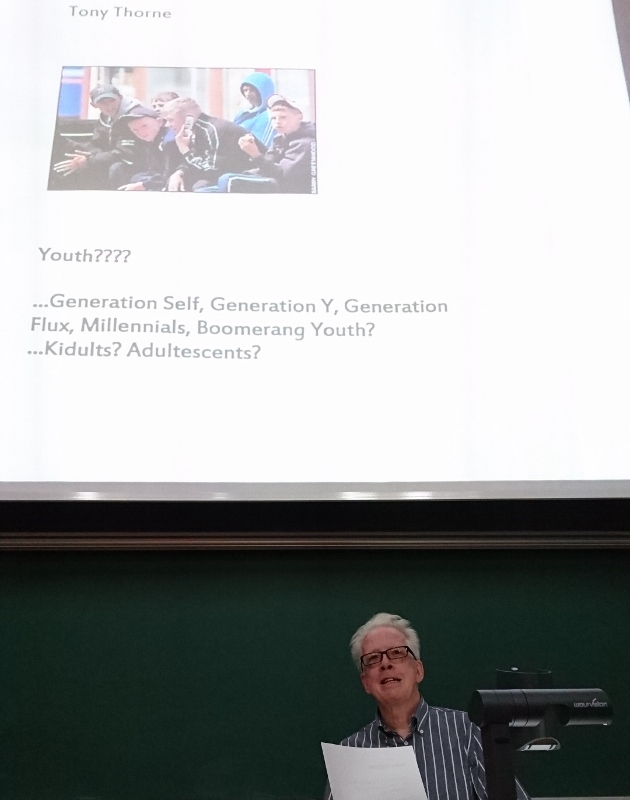
DSC_0100 (630x800)

NOTES ON SLANG AND THE LANGUAGE OF YOUNG PEOPLE


This is a sort of aide-memoire that I use with secondary and undergraduate students and teachers as a starting point in talking about youth language, stating the obvious by way of question-and-answer:

  1. Which recent social and economic developments in British society have affected the attitudes and behaviour of young people?

In the last three decades the UK has seen, according to some commentators, a spectacular breakdown in social cohesion, with high divorce rate/single-parenting/alcohol and drug use/teenage pregnancies/obesity, etc. Especially significant for young people is the absence of authority figures and traditional social constraints. This also contributes to youth crime and gang culture (where the gang may function as a substitute family). Economic turbulence and the peculiarities of the UK property market mean that teenagers may not be able to afford to leave home and may suffer unemployment, but attitudes among teenagers and school-leavers in some cases appear to reflect an indifference to work and lack of aspiration coupled with a sense of entitlement and ‘adult’ desire to consume...

  1. Why do young people invent and use slang?

Slang functions for transgressive in-groups such as street gangs as a secret code which allows them to describe and celebrate their illicit activities and keep them from the attention of authority figures. Young people who may not be transgressing may imitate this ‘deviant’ usage as they see it as glamorous, but in any case slang also serves more innocently as a way for young people to establish a ‘cool’ identity, confirm allegiances within peer-groups and micro-niches and claim ownership of a set of symbols (not only vocabulary but appearance, etc.) that gives them social capital and glamour while they may lack real economic power…

  1. Are text messaging and slang use by young people really affecting their ability to communicate in more formal situations?

‘Experts’ disagree: some government advisors and employers declare and assume that use of unorthodox language is associated with limited vocabulary, lack of communication skills and negative attitudes. Some academic linguists – and this writer – point out that abbreviated codes associated with electronic media are nothing new and that slang usage can be creative rather than destructive. Some research indicates that those who text or use social networking sites actually tend to have improved or possess higher literacy rates. ‘Appropriacy’ – knowing how to fit your style of language to context – may be a problem for some, but many young people are adept at ‘code-switching’ – moving between different language varieties according to who they are communicating with and why. BUT while slang cannot be disapproved of technically – it functions like poetry and literature – we must recognise that for many adults it provokes strong emotional reactions and is associated with serious crime and social breakdown…

  1. What social factors in the UK have contributed to the appearance of a so-called ‘MLE’ (multiethnic London English) or ‘Urban British English’?

Afrocaribbean, and to a lesser extent East and South Asian music and popular culture have high status among youth. In inner city schools across the UK British English is not the mother tongue for many students, while the shared code outside the classroom is for some a multiethnic youth slang rather than local or standard forms of English. Some linguists claim that an emerging generalised dialect spreading from London and developed by young people is displacing previous localised dialects and traditional slang and may impact on mainstream English in the future, possibly in terms of vocabulary, but more probably in terms of accent and intonation. Mixed urban dialects are not only a feature of the UK but have evolved in other European countries where elements of Arabic, Turkish and other ‘minority’ languages have affected colloquial usage and phonology.

CRISIS-TALK

I’m now collecting examples of exotic, disturbing or infuriating post-Brexit language (and welcome contributions from readers, which will be gratefully acknowledged). Back in 2010 I reviewed the new terms generated by the recession that then afflicted us.


THE YEAR IN JARGON


We’re all familiar by now with quantitative easing, and bemused by all those recessionistas practising chiconomics…but the bizwords kept on coming…

Tony Thorne looks back at the terminology born of the downturn/meltdown…


While things were going well it was commonplace to refer complacently to the hidden hand that Adam Smith claimed was quietly regulating the mechanisms of capitalism. Nowadays that concept seems as inappropriate as combining the two words ‘city’ and ‘gent’: the current sense of crisis requires a new set of metaphors and some picturesque contenders are duly emerging. Foremost among them is creative destruction, a phrase first popularised by Austrian economist Joseph Schumpeter in 1942. A much more radical version of the familiar shakeout, this has come to refer to the demolition of monopolies and economic structures by revolutionary innovation – including ‘revolutionary’ financial instruments and their resultant collateral/fallout.

Another term that has come into its own is boiling frog syndrome, apparently coined by one Leopold Stomm (described as a ‘political and economic theorist, amateur naturalist, and sadist’ but possibly fictional). This can be illustrated by the image of ‘frog’ X (insert the name of any major car manufacturer) ‘sitting in shallow water and denying that the temperature is rising’ – right up to the moment when it boils to death.

And what of the victims of economic turmoil, those senior professionals who have been Pluto’d (demoted, like the planet), lateralled (i.e kicked sideways; they are said to be suffering from adjacency), checked out (serving notice) or simply exited (which has replaced all those euphemisms formerly used in HR circles); what of the recently retired who have become the returned – in other words have been forced back into work? One humbling-but-uplifting option may be to take one of the thousands of green-collar jobs that the US and UK governments have promised to create. Successor to the white, blue and pink-collar (the last denoting supposedly ‘feminine’ jobs like beautician –sorry, cosmetologist – care assistant or florist), green-collar describes manual jobs in the ecological economy, usually involving cleaning up pollution or installing energy-saving devices. A quite different sort of comfort might be provided by going on a Ponzi crawl. Highlighted recently by the Madoff débâcle, the latest Ponzi scheme (named after an early 20th-century pyramid scamster of Italian origin) is a serial bar crawl in which the last to join has to treat all his/her fellow drinkers – and gets exactly nothing in return.

In trying to keep track of this year’s blizzard of buzzwords I’ve been helped out by readers of my previous offerings. From the US Nick Harrison writes to signal a new usage: the noun shutter has suddenly become a verb, signifying both closing down and boarding up, as in ‘Madam K’s is soon to shutter’, or ‘Granco has shuttered its operations’. He spotted four examples within four days from the Seattle Times, ‘…sole remaining daily paper in this town since the 150 year-old Post Intelligencer itself shuttered a month or so ago.’ Another novel Americanism yet to cross the oceans is shovel-ready, referring to a major project that is all set to go but awaiting public funding which may not now materialize.

In times of turmoil an upsurge in acronyms and abbreviations is only to be expected, and examples noted by correspondents include GFC (the Australian government’s own shorthand for global financial crisis) and CC which can stand for credit-crunch or current climate. Irish informant Ros Waverley has picked up on the fact that R.I.F, the euphemistic reduction in force(s) (aka downsizing) from a year or so ago, has first become an acronym pronounced ‘riff’, and more recently a verb, as in ‘we’re riffing’/’we’ve been riffed.’

Several readers were amused when Lord Mandelson testily insisted that his £2.5bn rescue package for the UK car industry was not a bailout (Merriam-Webster’s word of the year for 2008), but a greening initiative. Others were tickled by the portentous language governments have come up with to boost their anti-recessionary credentials: a little too late perhaps Australia has embraced countercyclicality, which simply means anticipating periodic economic downturns, while Britain has been promoting flexibilism; adapting your working practices to cope with unexpected crises.

I can’t help chuckling cynically at the latest catchphrases circulating among the cheerfully desperate – or desperately cheerful – flat is the new up is one such, while I heard someone the other day assert in all seriousness that we’ve got to take the HAV (high-altitude view) and look beyond the beyond. Thankfully professional trendspotters also remain resolutely upbeat, promoting something they call innovation jubilation, celebrating nimbleness (marketing’s successor to agility) and announcing the imminent appearance of the unlikely Generation G (for generous).


PERCEPTIONS OF THE YOUNG

Image result for annoying young people


                                                  How are British Youth described? 


Over the last few years I have been collecting articles in the UK press (from tabloids, broadsheets and online sources) which seek to characterise young people. The following, in no particular order, except perhaps for the sake of ironic contrast, are the salient characteristics which emerge from an informal analysis of these articles’ claims:


  • Narcissistic with an unfounded sense of entitlement
  • Experiencing unprecedented levels of anxiety and depression
  • Identifying with celebrity culture
  • Prone to ‘drug abuse, alcohol-fuelled pregnancy or law-breaking,’
  • Clean-living, ambitious and competitive
  • ‘…growing up without boundaries, thinking they can do as they please… No adult will intervene to stop them.’ (David Cameron in 2009: the discourse of ‘broken Britain’)
  • More socially liberal and accepting than previous generations on issues such as gay marriage and euthanasia
  • More politically right-wing than parents or grandparents at the same age
  • Digitally literate and globally empowered
  • Suffering from literacy problems and economic disempowerment
  • Speaking a different language


UrBEn-ID is an ethnographic linguistic research project being carried out at Manchester Metropolitan University, funded by The Leverhulme Trust. UrBEn stands for Urban British English, reflecting the project’s aim to investigate ways in which young people in an urban environment use language in the construction, negotiation and performance of their identities.

Some of their recent findings can be accessed here:


http://www.urben-id.org/attitudes-survey/


Three years on, and those labels; Babyboomer, Generation X, Millennial and Gen Z are still contentious, still contested. This from Marketing Week in April 2019:

Are terms like ‘millennial’ actually useful?


BANTER

TOP BANTZ

Tony Thorne

B2

Banter noun good natured raillery, badinage, chaffing, teasing repartee, clever chit-chat, laddish drollery, facetious, ironic verbal to-and-fro

 verb to converse teasingly, chaff, rib

A national sport? An elaborate private joke between likeminded people? A healthy bonding, a celebration of mateyness?

Banter matters, not least because of its links with bullying, sporting slurs, even rape. In more subtle ways it keys into topical issues like diversity, gender relations and class. Its subversive humour is central to our national identity. A proper investigation is overdue.

For someone like me who suffers long enforced absences in humourless territories overseas, it’s an important pleasure to keep in touch with our own vibrant national conversation, online via Twitter, MumsNet, Popbitch, etc. then to return in person and join in for real. But what a conversation. The soundtrack to modern Britain is made up of non-stop punning, teasing, riffing on catchphrases and clichés, knowing references to pop-culture tropes, gossip and ribaldry and sustained abuse of the privileged and pretentious.

Coming back to the UK, I’m always struck by the native wit immediately on offer from strangers, whether shop assistants, taxi drivers, football fans or simply anonymous citizens waiting in a checkout queue. Banter is absolutely central to an English sense of self and others. For us it’s a default setting. Only the English among all the peoples of the planet are required to be funny, about everything, all the time. It reflects both the worst – the strident endless chippiness – and the best – our cheerful fellow-feeling – of us as a people. In fact I think that where it was once the upside of the reserve and insularity that used to afflict us as a nation, those things no longer apply, leaving only a free-for-all by a newly empowered, insolent and fantastically talkative public.

cluedont @cluedont

I remember the first time I heard a man use the word ‘bantz’ as an abbreviation for ‘banter’, and he’s got the scars to prove it.


We should look more closely at the fascinating history of banter, consider its components: wit, facetiousness, irony, wordplay, sarcasm, looking at examples and analysing its uses:  bonding, bullying, self-defence – and seduction. Examining both sides of this double-edged weapon, we have to consider both the cruelty (when black teenager Stephen Lawrence’s killers were questioned by reporter Martin Bashir about their racist video rant they replied ‘Harmless banter, Martin. Harmless banter’) and the poignancy associated with the practice (ex-players invariably cite it as what they most miss when they retire from sport; hard-pressed police officers I interviewed said that they measured a station by whether the team there ‘had good banter’).

Twitflup ‏@Twitflup 

“Whenever I see my husband naked he reminds me of a beautifully coloured bird”

“Peacock?”

“Well it’s more like a baby carrot to be honest”

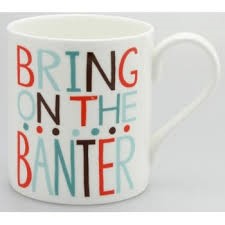
The fun started in earnest, or, another view has it, the rot began to set in, when in October 2007 UKTV relaunched its UKTV G2 channel under the name of Dave. ‘Everyone knows a bloke called Dave’ the press release quipped. The channel’s slogan was, and is, ‘The Home of Witty Banter.’ It was thus that a national pastime which hitherto had gone unnoticed, or had been taken for granted, was highlighted, commercialised and sold back to its legions of fans. By 2012 the b-word was all over t-shirts, posters, mugs and websites, namechecked in radio and TV broadcasts and arraigned over and over again by right-thinking (or sanctimonious) journalists in the ‘quality’ press.

David Stokes ‏@scottywrotem 

Hate it when I’m ironing and people say “can you do my shirt” & “iron these trousers” and “you’re going to have to leave sir, this is Ikea”.

Mutating from a mildly amusing tic into a divisive social issue, where did banter come from, and where is it going? It has come to be our defining characteristic, beloved of the football dressing room and Sky Sports, student bedsittees and Twitter devotees, loathed by Guardianistas, feminists and right-thinking metrosexuals…debated by the chattering classes, but practised – unusually – by all the classes, and, despite what some claim, all the genders, too.

Banter is a catch-all word for idiocy that warns the rest of us that Here Be Lads. Banter is Soccer AM. It is Andy Gray. It is middle-aged men on Top Gear pretending that they are edgy outsiders by mocking society’s weakest, then going home to Chipping Norton where they live two doors down from the Prime Minister. It is an English stag do in Dublin or Amsterdam with matching T-shirts

– Lizzy Porter, Daily Telegraph

Banter is arguably part of a very ancient tradition that takes in ‘flyting’, the ritual exchange of insults practised by Norse and Scottish poets in the fifth century. The word itself, though, is not so very old and its origins are unusually obscure. When bantering appeared, first as verb then as noun, in the street slang of the late seventeenth century it referred to exchanges that were more aggressive and vicious than the mild, playful and friendly exchange of teasing remarks, often preceded in descriptions by ‘harmless’, ‘good-natured’ or ‘witty’, that it had become by the twentieth century. It first meant to trick or bamboozle somebody, to hold them up to ridicule and to give them a ‘roasting’, in a term of the day we still possess. The first recorded instance of the verb is in Madam Fickle, an otherwise unremarkable play of 1676 by Thomas D’Urfey, in which Zechiel cries to his brother: ‘Banter him, banter him, Toby. ’Tis a conceited old Scarab, and will yield us excellent sport — go play upon him a little — exercise thy Wit.’ A letter of 1723 equated banter with ‘Billingsgate’, the foul and vituperative language used by the porters at the London fish market of that name. Banter became notorious because of a spirited attack on it by Jonathan Swift in a famous article he wrote for The Tatler in 1710. In it he attacked what he called ‘the continual corruption of our English tongue’:

‘The third refinement observable in the letter I send you, consists in the choice of certain words invented by some pretty fellows; such as banter, bamboozle, country put, and kidney, as it is there applied; some of which are now struggling for the vogue, and others are in possession of it. I have done my utmost for some years past to stop the progress of mob and banter, but have been plainly borne down by numbers, and betrayed by those who promised to assist me.’

In the same year he referred to the term in his Apology to The Tale of a Tub writing that ‘This polite word of theirs was first borrowed from the bullies in White-Friars, then fell among the footmen, and at last retired to the pedants; by whom it is applied as properly to the productions of wit, as if I should apply it to Sir Isaac Newton’s mathematics.’ Linguists have failed to identify the ultimate origin of the word, but I think it’s very probably from rural dialect, in which ‘banty’ can still mean small, aggressive and irritating.

In the nineteenth and twentieth centuries banter most usually denoted fairly gentle ribbing by friends, acquaintances and workmates. Its connotations have subtly changed again more recently, moving closer perhaps to its original edgier senses, but with added nuances. My survey of recent references from the US shows that there it is nowadays most often linked to the language of would-be seduction – invariably by hapless males of females – or to sales talk or business slogans. In the UK on the other hand it is most likely to be associated with sports fans (where it may be allied to the tradition of ‘sledging’), students (with their ‘neknomination’ drinking rituals and ‘violation nite’ initiation ceremonies) and of course with a myriad amateur and professional humourists, from the wannabe standups and scriptwriters competing for attention on social media sites to the established big guns firing off salvoes in Mock the Week, QI and the like.

Liza Thompson ‏@LizaJThompson 

Today, in celebration of Kierkegaard’s birthday, I’m slumped in a chair in a state of existential despair #curtainsclosedandeverything

 from Camberwell

B2

Shortly after I published this Ben Jagoda explained the term for an American readership…

“Banter”

Update from June 2017: I talked to Archie Bland about this subject and here is his long read in the Guardian this week…

https://www.theguardian.com/society/2017/jun/30/the-age-of-banter

And now, in May 2019, Billy Bragg comments on the visual banter that got Danny Baker fired by the BBC…


BALKANISATION

A word that is bandied about – recently by Boris Johnson among many others – yet rarely examined closely. I have tried to unravel its connotations in two different contexts, once fairly flippantly, once a little more seriously…

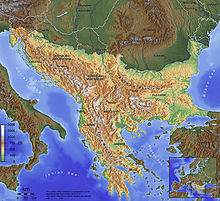
Image result for the balkans

Once used to describe the weakness of tiny, mutually hostile nations with changing borders, this invocation of the troubled Balkan region is now fashionably applied to the banking sector. Balkanisation refers to, in the words of the FT‘s Patrick Jenkins, “the breakdown of cross-border banking as nervous lenders retreat… from the more troubled parts of the Eurozone.”

It is part of the trend towards deglobalisation, financial fragmentation, renationalisation and domestication of debt caused primarily by economic turbulence, prompting banks to introduce more effective safeguards against cyclical changes, aka buffering (another buzzword du jour), but increasingly also due to tighter official regulation. National regulators may now stop banks using deposits in one area to fund debts in another (the ability to shift capital or asset-swap from country to country is known as fungibility), and regulatory intervention can result in the breaking up, or Balkanisation, of the big, diversified financial entities themselves.


Here is a more detailed consideration…(long read) 

Click to access Thorne.pdf


Image result for balkanisation


WEASEL WORDS

A propos of nothing in particular, some thoughts on doubletalk, hypocrisy and evasions…

Image result for weasel

In 1982, during negotiations on a peacekeeping force for the Sinai peninsula, the British Foreign Secretary of the time, patrician Tory smoothie Lord Carrington, was damned by then US Secretary of State Alexander Haig, (using an adjective so rare as to cause some to doubt its existence) as ‘a duplicitous bastard’, and it’s fair to ask whether duplicity, in its various manifestations and like its better-known sibling, hypocrisy, is not a very fundament of the English way of life. Again, it is by our language that ye shall know us and for our language that we are – nowadays – regularly taken to task. For the frequently foulmouthed Haig, this was a mild imprecation; what Carrington had been saying has never been revealed, but ‘the British lied through their teeth’ according to Haig’s aides’. As serious practitioners of the art of insult, the British probably dismissed Haig’s testy comment on Carrington as hardly in the same world class as the invective of Lloyd George, who said that Winston Churchill would ‘make a drum out of the skin of his own mother in order to sound his own praises’; of Haig’s namesake, the World War I Field Marshal, that he ‘was brilliant to the top of his army boots’; or of Lord Derby that he was ‘like a cushion who always bore the impress of the last man who sat on him.’ Devastating ad libs and insults are carefully crafted in Britain; Haig’s was an impulsive throwaway.

One way of characterising language which is self-serving, empty and/or evasive is by damning it as ‘weasel words’. As Plain English Campaign veterans Chrissie Maher and Simon Cutts assert, ‘…in step with managerial thinking, opinion polls and an impossibly demanding media, our political leaders employ this new language of clichés, jargon, platitudes and weasel words to hide or twist the truth.’

Weasel words is an expression that appeared in the USA in the late 19th century, and in print in Stewart Chaplin’s short story Stained Glass Political Platform (published in 1900 in The Century Magazine), deriving not from the furtive sneakiness of Mustela nivalis, but from its habit of sucking out the contents of eggs, hence draining words of their real meaning. Weasel itself comes from an extremely ancient Indo–European word denoting a slimy liquid or poison which may also be the origin of ‘virus’. More recently it has featured in popular metaphor: ‘weaselly’ meaning devious and evasive with overtones of malice, while in the slang of the 1950s a ‘weasel’ could refer to a railway porter’s tip, an amphibious military vehicle or in rhyming slang to one’s coat (from ‘weasel-and–stoat’); weak tea in Yorkshire was ‘weasel-pee’ and wits replaced Shell’s petrol slogan of 1965, ‘Put a Tiger in Your Tank’, with ‘Put a Weasel in Your Diesel.’ Poor Willy Weasel didn’t listen to the advice given by the Tufty the Squirrel and was hit by a car when he tried to buy an ice-cream: as the voiceover (Bernard Cribbins) reminded us, in those poignant road safety cartoons of the 1970s, ‘Now Willy has been hurt. And all because he didn’t ask his mummy to go with him to the ice cream van.’ But what is it that makes it so very clear that Willy Weasel is bad news? You just know that he’s going to come to a nasty end. Is it because he’s a weasel, a by-word for a sneak? Is it because his neck is so long and he doesn’t therefore look quite as cute and human as a squirrel? Is it his stripy jumper with its connotations of criminality? Today in cyberslang weasel can designate both a penis and a home-made hashish pipe.

More pertinently, our then Poet Laureate, Carol Ann Duffy, in 1990 used Weasel Words as the title of a sonnet skewering the political cynicism of the Thatcherite era by parodying parliamentary rhetoric as reported in Hansard:

Let me repeat that we Weasels mean no harm.
You may have read that we are vicious hunters,
but this is absolutely not the case. Pure bias
on the part of your Natural History Book.
(Hear, hear).

We are long, slim-bodied carnivores with exceptionally
short legs and we have never denied this.
Furthermore, anyone here today could put a Weasel
down his trouser-leg and nothing would happen.
(Weasel laughter).

Which is more than can be said for the Ferrets opposite…