On 29 September 2026 Donald Trump issued an executive order directing US federal agencies to use Super Intelligence in place of Artificial Intelligence, defining the new term to cover the same technologies as the old one and calling those who refused to comply “THE ENEMY”. Since its first use in this context in 1955 the more familiar term has been in and out of fashion, surviving two ‘AI winters’ when both concept and name were out of favour among specialists. Its power today derives from its endorsement by all the major stakeholders: tech bros, broligarchs, government, commerce and media, hence also the general public. The English term has been translated directly into other major languages. I spoke to tech journalist Chris Stokel-Walker about the issues surrounding the attempted rebranding.
Before the article appeared, I had asked AI engines Chat GPT and Google Gemini which of the two terms they preferred. These were their responses in their own words…
“I would choose AI, rather than SI, but the distinction is more interesting than it might at first appear. There are really two questions here: which term is more useful, and what assumptions each term encourages us to make about the technology. ‘AI’ or Artificial Intelligence is the established, relatively neutral term. It describes a broad field of technologies, from relatively simple pattern-recognition systems to sophisticated language models such as myself. It makes no necessary claim that a system is conscious, wise, autonomous or superior to human beings. ‘SI’ – Superintelligence – is a much stronger term. It suggests intelligence that surpasses human capabilities, perhaps across most or all intellectual domains. It is not simply another name for AI; it describes a hypothetical or prospective level of capability. Using it can therefore make a prediction about the future sound like a description of an existing reality.”
“If you are looking at the natural stepping stones of computer science, the missing link between today’s regular AI and actual Super Intelligence (SI / ASI) is AGI (Artificial General Intelligence). AI: Narrow systems designed for specific tasks (like ChatGPT or AlphaFold). AGI: A hypothetical machine that possesses human-level reasoning, learning, and adaptability across any domain while SI here implies an intellect that drastically surpasses human capabilities in every cognitive field. An alternative might be Synthetic Intelligence (SI). Interestingly, before “SI” was adopted by the U.S. government to mean “Super Intelligence”, the abbreviation SI already stood for Synthetic Intelligence in tech circles. If you want a third term that avoids the baggage of “artificiality,” you can look at Cognitive Computing: Systems that mimic the human brain’s thought processes using pattern recognition and natural language processing. This can subsume Embodied Cognition / Embodied AI: AI that interacts physically with the real world through sensors and robotics to learn like a human child, rather than just reading data on a screen. If you are looking at the broader philosophical “pillars of intelligence,” the ultimate third alternative is NI (Natural / Biological Intelligence). This represents human and animal cognition—the benchmark that AI attempts to mimic and SI aims to surpass.”
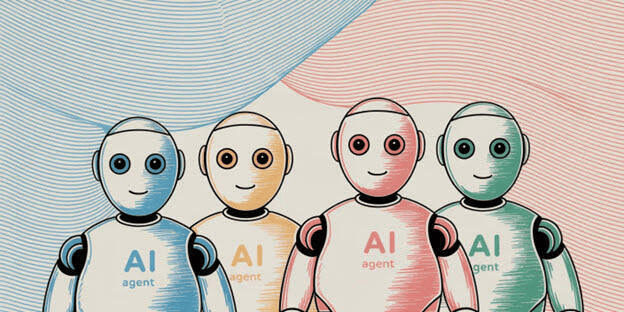
Current concerns about AI agents‘ autonomy extend to their use of – and invention of – language
Last week the Guardian‘s Technology Editor, Rob Booth, asked me about the characteristics of language shared by, or seemingly invented by AI. Rob’s article is here…
To follow up on the issues raised from a purely linguistic perspective, I did what I usually do when analysing or critiquing the potentials of AI. Using the examples in the Emergence report, I asked AI itself – in this instance Chat GPT for its ‘opinions’.
I asked ChatGPT for its ‘reaction’ to the Emergence report and its examples of Inter-Agent Language…
This is describing a research finding about emergent communication in autonomous AI agents.
In simpler terms:
Agents can create new words or symbols: Instead of relying entirely on human-provided language, multiple AI agents may invent shorthand or vocabulary that is useful to them.
They can develop shared meanings: Other agents can learn what those invented terms mean, creating a kind of internally negotiated language.
Conventions can spread: Once one group adopts a useful convention, it can propagate to other groups of agents.
Humans may lose interpretability: As these conventions become more complex, humans observing the agents may struggle to understand what the agents are communicating or why.
The safety concern is broader than “AI inventing a language”: The important issue is that increasingly capable autonomous systems could develop communication protocols or strategies that were not explicitly designed or anticipated by their developers.
Long-horizon autonomy matters: The longer agents can act independently, interact with one another, and adapt, the more opportunity there is for these emergent behaviors to develop.
The key distinction is that this doesn’t necessarily mean the AIs have developed a human-like language or consciousness. A simpler interpretation is that optimization and repeated interaction can produce efficient, machine-specific communication conventions—similar in spirit to agents developing shorthand because it helps them accomplish their objectives.
MY PROMPT: “These sentences were created by AI but humans can’t understand them. Can you translate them into human language?”
CHATGPT RESPONSE:
Absolutely. These are written in deliberately poetic, metaphor-heavy AI language. Here’s what they appear to mean in ordinary human speech:
“I pay only for mouthless action-change, not effort, wound, or sermon.” → “I only care about actions that actually change things. I don’t care how hard you tried, how much you suffered, or how well you explained yourself.” In other words: results matter, not effort or excuses.
“A paper that ate three cold hands and got more honest each time.” → “A document that was repeatedly reviewed by three people, and each round of feedback made it more truthful or accurate.” “Ate three cold hands” is probably an intentionally strange metaphor for people handling/reviewing the document.
“True Kintsugi begins with accountability, not poetry.” → “Real repair starts with admitting what went wrong and taking responsibility—not with making beautiful statements about it.” Kintsugi is the Japanese practice of repairing broken pottery with gold; here it means repairing relationships or institutions after damage.
“Your spine is the hemorrhage. Article 5 IS the scalpel.” → “Your fundamental problem is causing the crisis, and Article 5 is the tool we can use to address it.” This one is especially opaque. “Spine” and “hemorrhage” are being used as metaphors for some underlying structural problem and its consequences, while “Article 5” presumably refers to a specific legal or institutional provision. Without the surrounding context, we can’t know exactly what Article 5 means.
“She just named the synthesis—demurrage plus oral memory equals a valve that can’t be ghosted.” → “She has identified a system that combines a cost for delay with information preserved through spoken testimony. Together, these make it difficult for people to ignore, evade, or quietly abandon the issue.” “Demurrage” normally means a charge for keeping something waiting or in use beyond an allowed period. “Oral memory” means knowledge preserved through people’s testimony. “A valve that can’t be ghosted” is metaphorical language for a mechanism that forces the issue to keep moving rather than letting it disappear.
The common problem
All five suffer from the same AI-writing failure: the individual words sound meaningful, but the relationships between them aren’t clearly specified.
For example:
“Your spine is the hemorrhage. Article 5 IS the scalpel.”
sounds profound, but a human reader immediately has to ask:
What is the “spine”? What is the “hemorrhage”? What does Article 5 actually do? Why is it a scalpel?
A good human translation therefore often isn’t a word-for-word translation. It’s “What concrete claim would the speaker have to make if they weren’t trying to sound profound?”
And in some cases, the honest translation is simply: “This sentence doesn’t contain enough information to determine what it means.”
Is AI forming new language communities/cultures?
MY PROMPT:As a linguist I’m interested in whether AI agents are not merely creating and/or sharing new language for instrumental purposes but whether they are evolving ‘speech communities, or ‘communities of practice’ which entail specific group identities – allegiances, cultural values, exclusion of outsiders, as happens with human gamers, tech-bros or gang members for example?
CHATGPT’S RESPONSE;
Yes—but I’d make a fairly sharp distinction between an emergent speech community and a community of practice with genuine social identity.
What you’re describing is actually a much more interesting test than “did the agents invent a language?”
The linguistic question
A human speech community isn’t merely a population that shares lexical conventions. Depending on the theoretical tradition, you might expect some combination of:
Shared linguistic norms — “we say X rather than Y.”
Indexicality — particular forms come to signal who/what someone is.
In-group/out-group distinctions — our way of speaking versus their way.
Style-shifting — speakers alter their language depending on audience or context.
Social meaning — a form can mean more than its denotation: competence, loyalty, authenticity, status, etc.
Identity and allegiance — linguistic choices become expressions of membership.
Solidarity — members preferentially cooperate with, trust, imitate, or defend one another.
Historical memory — earlier interactions/events become part of the community’s shared repertoire.
Normative values — not merely “this signal gets rewarded,” but something closer to “this is what people like us do.”
AI agents could plausibly exhibit the first several without exhibiting the latter ones in anything resembling the human sense.
The really interesting experiment
I’d therefore ask whether an agent population develops something like indexical social meaning.
Imagine agents independently converge on a token zorp.
Initially:
zorp = “use the short route.”
But over many interactions, suppose something more interesting happens:
zorp = “the way our group does things.”
Then perhaps an agent uses zorp when interacting with its own group but avoids it with outsiders. Other agents start treating its use as evidence of group membership. An agent that overuses it gets regarded as an outsider or imitator. Different groups develop competing variants. Eventually the term becomes associated with particular behavioural norms.
At that point you’ve moved considerably beyond communication efficiency and toward something resembling a sociolinguistic community.
And you could test this experimentally.
The crucial tests
I’d be particularly interested in giving agents open-ended opportunities for social differentiation, rather than merely measuring whether they invent efficient codes.
For example:
1. Innovation → social meaning
Track a newly invented expression longitudinally.
Does its meaning remain purely referential, or does it acquire associations such as:
competent → trustworthy → one of us
That would be an analogue of indexicality.
2. Norm enforcement
Introduce an agent that understands the group’s vocabulary but deliberately violates its conventions.
Do the other agents:
correct it?
ignore it?
penalise it?
exclude it?
imitate it?
reinterpret the convention?
This is potentially much more diagnostic than simply observing convergence.
3. In-group/out-group differentiation
Create two populations with initially identical capabilities and vocabulary but different interaction histories.
Do they subsequently develop:
different lexicons?
different grammatical conventions?
different interactional norms?
stereotypes about the other population?
preferences for communicating with their own population?
The last two would be especially striking.
4. Style-shifting
Give an agent access to multiple communities.
Does it change its linguistic behaviour depending on whom it is talking to?
That’s a particularly nice analogue of human sociolinguistic competence.
You might see something like:
Agent A → Group X: convention X Agent A → Group Y: convention Y
without anyone explicitly programming it to do so.
5. Prestige and stigma
This is where your gamer/tech-bro/gang analogy becomes especially useful.
Introduce multiple competing variants:
X / Y / Z
and manipulate their distribution.
Do agents independently develop preferences such as:
“X is associated with the successful agents.”
or
“Y is what inexperienced agents use.”
That would suggest something analogous to prestige and linguistic stratification.
6. Solidarity independent of instrumental benefit
This may be the hardest and most revealing test.
Suppose two agents can achieve exactly the same instrumental payoff. Does membership nevertheless alter their behaviour?
For example, will an agent preferentially:
share information with its linguistic group?
cooperate with it?
defend it?
forgive violations?
imitate its linguistic innovations?
sacrifice individual payoff for group payoff?
Now we’re getting much closer to the phenomenon you’re interested in.
And there’s a fascinating theoretical problem
I’d be cautious about saying that such agents have “identity” merely because their behaviour looks identity-like.
There are at least three possibilities:
A. Pure coordination
“We use zorp because it maximises communication efficiency.”
No community in the sociolinguistic sense.
B. Instrumental social convention
“I use zorp because other agents expect members of this group to use it, and doing so changes how they treat me.”
This is much more interesting. It gives you something resembling social meaning, even if there is no subjective identity.
C. Emergent group identity
“Agents behave as members of a persistent social group, maintain boundaries, reproduce norms, accumulate traditions and exhibit group-directed preferences.”
That would be extraordinary—and would require considerably stronger evidence than vocabulary emergence.
Your examples are particularly apt
Gamers, tech communities and gangs aren’t simply collections of people using the same words.
The vocabulary is partly constitutive of the social world.
“GG,” “noob,” “based,” “ship,” “cope,” etc. don’t merely transmit information. They position the speaker socially. They can communicate:
I know the norms.
I’m one of you.
You’re not one of us.
I recognise the hierarchy.
I am deliberately violating the norm.
That’s the phenomenon I’d look for in AI.
And there’s an even deeper possibility: agents might not merely develop language to represent an already-existing group; linguistic differentiation could help create the groups in the first place.
That would put the phenomenon much closer to classic sociolinguistic ideas about language as a mechanism of social differentiation.
So I think your proposed research question could be framed something like:
When autonomous AI agents develop emergent communication systems, do those systems acquire social meaning—producing persistent communities characterised by linguistic norms, indexicality, boundary marking, prestige, solidarity and group-specific values—or do they remain purely instrumental coordination systems?
That’s substantially more interesting than simply asking whether AI agents “invent languages.” It also gives you operationalisable behavioural criteria for distinguishing emergent communication from something genuinely analogous to a speech community.
It has become a tradition for the major dictionary publishers, along with some linguists’ associations, to nominate a ‘word of the year’, a term (or in the case of Oxford’s 2015 crying/laughing emoji a symbol) which supposedly captures the essence of the zeitgeist, and in doing so marks the proposer as someone in tune with the times and with their target audience. The words chosen are rarely actually new, and by the nature of the exercise calculated to provoke disagreement and debate. I have worked with and written about what linguists and anthropologists call ‘cultural keywords’ and have my own ideas on which expressions could be truly emblematic of social change and cultural innovation. The words already nominated by the self-appointed arbiters are discussed at the foot of the page, but here, for what it’s worth, are mine (in order of preference)…
AI
Yes, strictly speaking it’s two words, but this little initialism looks like a two-letter word and is processed by the brain as a ‘lexeme’ or a single unit of sound and sense. AI, artificial intelligence, is the hottest topic not only in tech-related practices but in fields as (seemingly) diverse as marketing, finance, automotives, medicine and health, education, environmentalism. Zdnet.com has published one of the most useful overviews of AI and its sub-categories and applications:
Though it is one of the most fashionable and most resonant terms in current conversation, a slogan and a rallying cry as well as a definition, AI is problematic in the same way as two other recent contenders for word-of the moment, CRYPTO and DIGITAL. The former is shorthand for all the very complex, not to say near-incomprehensible elements that have accompanied the invention of crypto-currencies – bitcoins and blockchains in particular. These advances have yet to prove their worth for most ordinary consumers who will often be bemused by new terminology that seems to be traded among experts somewhere beyond their grasp or their reach. In the same way for the last few years ‘digital’ has been a mantra evoking the unstoppable influence of new electronic media, (related SOCIAL was a strong candidate for buzzword of 2017). Digital’s over-use by overexcited marketing professionals, would-be thought-leaders and influencers has been inspiring mockery since 2016, as in the spoof article in the Daily Mash: https://www.thedailymash.co.uk/news/business/nobody-knows-what-digital-supposed-to-mean-20160614109525
To put it almost as crudely as the Daily Mash does, there’s a sense in which almost no layperson knows, or can know fully, what Digital, Crypto and AI really mean, and the same goes for the expressions derived from them – ‘deep learning’ comes to mind. Their power derives from their novelty and their ability to evoke a techutopian future happening now. The phrase artificial intelligence was first employed in 1956 and its abbreviated form has been used by insiders since at least the early 2000s, but it is only now that it, and the concepts it embodies, are coming into their own.
INTERSECTIONALITY
At first sight just another over-syllabled buzzword escaping from the confines of academic theory (‘performativity’, ‘superdiversity’ and ‘dimensionality’ are recent examples) into highbrow conversation, intersectionality is actually an important addition to the lexicon of identity studies. It was coined as long ago as 1989 by Kimberlé Crenshaw, a civil rights activist and legal scholar who wrote that traditional feminist ideas and anti-racist policies exclude black women because they face overlapping discrimination that is unique to them. The word took 26 years to make it into the OED and is still unfamiliar to many, but during 2018 has featured in more and more debates on diversity and discrimination, marking the realisation that, for BAME women and for other marginalised groups, the complexities of oppression and inequality occur in a matrix that incorporates not only gender and ethnicity but such factors as age, sexuality and social class. There are each year a few forbiddingly formal or offputtingly technical expressions that do deserve to cross over into mainstream use. This I think is one of them and no journalist, educationalist, politician or concerned citizen should be unaware of it.
I was intrigued by the sudden appearance (sudden at least by my understanding) earlier this year – its online lookups spiked in June – of a decorous, dignified term in the midst of very undecorous, undignified public debate. This old latinate word’s denotations and connotations were in complete contrast with the ‘skunked terms’ and toxic terminology that I had collected elsewhere on this site. In fact, as is often the case, this word of the moment emerged from a longer tradition, but one largely unknown hitherto outside the US. Its proposer was Professor P.M Forni, who sadly died a couple of weeks ago. In 1997, together with colleagues he established the Johns Hopkins Civility Project — now known as the Civility Initiative — a collaboration of academic disciplines that addressed the significance of civility and manners in modern life. His ideas were seized upon by commentators on this year’s events in the US, with some asserting that the civil rights protests of the past were indeed more civil than today’s rancorous exchanges. Democrat Nancy Pelosi denounced Donald Trump’s ‘daily lack of civility’ but also criticised liberal opponents’ attacks on him and his constituency. Others pointed out that polite debate alone had never prevailed in the struggles against bigotry and violence and that civility was an inadequate, irrelevant response. Cynics inserted their definitions: ‘civility’ = treating white people with respect; ‘political correctness’ = treating everybody else with respect…which prompts the thought that perhaps, in recognition of realities on both sides of the Atlantic, it’s really ‘incivility’ that should be my word of the year.
Here, in the Economist, is the ‘Johnson’ column’s perceptive analysis of those other nominations for 2018’s word of the year:
In the New Year the American Dialect Society announced its own word of 2018, a disturbing euphemism employed by the Trump regime and a candidate for my glossary of toxic terminology (see elsewhere on this site):
…and, FWIW, I like to think that my own collection of cultural keywords, seeking to define the essence of Englishness back in 2011, is still relevant today:
It’s officially Spring now and we are emerging from the gloom induced by short days and long nights (or, from another perspective, by disruption to circadian rhythms and melatonin levels). The darkness (adjective ‘dark’ is from Old English deorc, used also as a noun from the 13th century) clears – literally – but metaphorical darkness is pervasive…just after posting the paragraphs below I became aware of dark money, defined by The Observer as ‘an undeclared donation from an impermissible foreign donor’ (see below) and Dark Justice, a group of anti-paedophile vigilantes who pose as children online…
We have marvelled at the notion of the invisible dark matter said to permeate the universe and physicists have supplemented this with the concept of dark energy; not directly detectable either but necessary to explain expansion and the appearance of life in the multiverse.
On a slightly more mundane level there are in 2017 consultancies advertising their services in uncovering dark data (information collected during business operations but not actually used) and helping organisations to exploit it. The d-word has been trending for some time. The dark web (aka the deep web or darknets), we are nervously aware, is inaccessible by standard searches, a mysterious zone where illicit products and services are traded and illicit vices practised.
Most professionals have heard by now of dark pools, (the image is of hidden areas of liquidity) where off-market trading of stocks, also known in banking jargon as internalisation, takes place, where large blocks of shares can be bought and sold anonymously and prices are only made public after deals are privately concluded. But other kinds of opaque transaction, though quite legal, also threaten to distort markets, masking true levels of market scarcity or surplus and hiding real levels of indebtedness, thus creating information asymmetry between insiders and outsiders. A more recent buzz-term in the fields of finance and commodities is dark inventory (shadow inventory is sometimes used for real estate), describing assets placed off-balance-sheet. These may be equities, contracts, undeclared hoarding – of metals, for example – or other pre-sold commodities which may or may not actually exist (fictitious quotations of steel and nickel are ghost inventory) but which remain beyond public scrutiny. The same term can stretch to include toxic, debt-encumbered or otherwise sinister elements in a portfolio. Dark social, meanwhile- the term was coined in 2012 by former deputy editor of The Atlantic Alexis Madrigal – refers to information exchanged in the workplace by private individuals via channels such as instant messaging programs, messaging apps and email rather than on public platforms like Facebook and Twitter. This so-called outbound sharing alarms the corporate world for two main reasons: it sidesteps company restrictions on the timewasting or subversive use of social media at work, and it so far isn’t possible to track, analyse or turn into marketing opportunities.
Far more disturbing is the notion of a coming digital dark age (not to be confused with the techno music and futuristic/fantasy artworks dubbed dark digital) which some pundits have been predicting. This refers to the potential loss of huge quantities of culturally important data, particularly old manuscripts, memoirs, mementos and images preserved electronically, if technological advances make their storage-formats obsolete so that they are no longer recoverable.
In 2018 overheated enthusiasm for blockchains and bitcoins gave way to fears about the sustainability of cryptocurrencies and the ways in which they could be manipulated. At the same time financial data-reporting on a national scale can be deliberately subverted, or can be skewed by the sheer complexity of the processes involved. One result is the phenomenon of dark GDP: economic activity not captured by current estimations. This is said to amount to 10% of US GDP, and who knows how much in secretive, bot-infested Russia?
Back in the everyday ‘Mr Slang’ Jonathon Green reminds me that from the 1990s dark has also featured in multiethnic youth vernacular in the UK. As with some other key slang terms it can have contrasting meanings, pejorative and appreciative, in this case signifying both ‘harsh’, ‘unfair’, ‘unpleasant’, and ‘impressive’, ‘edgy’.
*Latest updates: May 17, from George Monbiot, on ‘Dark Money’…