The ‘M’ in ‘MLE’ – Youth Slang’s Origins

Much of the vocabulary of MLE, the speech variety known as Multiethnic or Multicultural London English, derives (not always straightforwardly) from Caribbean or Black British usages, or from London’s white ‘working class’, often dubbed ‘Cockney,’ argot. There are, however, a number of slang expressions, used in the school playground and on the street by younger speakers, which come from elsewhere in the UK’s language matrix, even from archaic or foreign sources. Here are some examples…
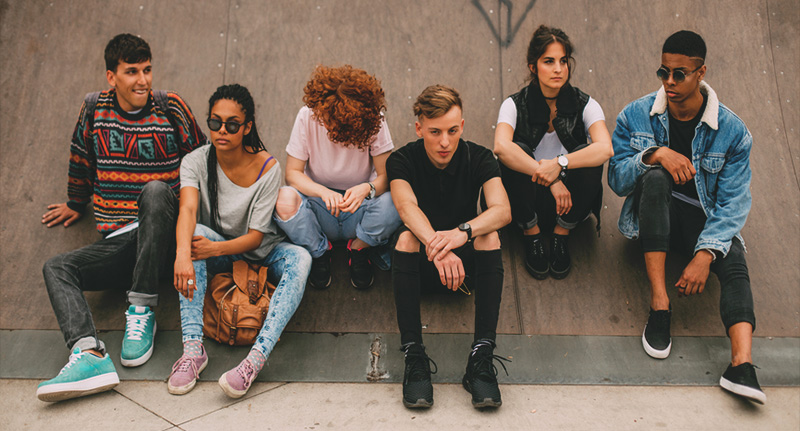
Image result for Multi Ethnic youth

Feen (n)

Means: a male person

Usage: “Who’s the feen over by the gate?”

The proper names for Yoofspeak, so linguists tell us, are MLE (multi-ethnic or multicultural London English) or UBE (urban British English, with ‘vernacular’ sometimes substituted for English), but not all playground language emanates from the larger cities and ethnic or ‘cultural’ doesn’t only mean Afrocarribean or Asian.

One term that’s widely used around the UK is rarely if ever heard in the Smoke, but belongs to a 300 year-old tradition. Feen, also spelled fein, has been borrowed from the slang of Travellers, the argot formerly used by Tinkers and known as Shelta, itself deriving mainly from Irish Gaelic. In Irish feen simply means “man” but in slang it sometimes has the extra senses of “stranger” or “rogue”. Don’t confuse this with the verb “to feen” (sometimes “feem”), a modern import from US street-talk, which is an alteration of ‘fiend’ and means craving for, or obsessing over, as in “I’m feenin’ for some weed” or “he’s feenin’ over that new girl.”

Group Of Young People Laughing Watching A Joke Or A, Stock Photo |  Crushpixel

Hollage (n)

 Means: something hilarious

 Usage: “Have you seen Charlotte’s latest outfit? Très hollage!”

 Posher teens have their own version of yoofspeak, their own mix of would-be street slang, babytalk and invented expressions, typically in the form of girly yells of approval (by both sexes) and squeals of delight (ditto).

When the denizens of the middle-class playground are trading witticisms a favourite trick is to insert touches of French – the odd real word (“quelle disaster”, “beaucoup trouble”) and Franglais pronunciations. “Rummage” (sex), and “bummage” (enthusiasm) have been frenchified, but current favourite is “hollage”, meaning huge amusement or hugely amusing, pronounced to rhyme with English “college” or like French “collage”, or, some young purists insist, as three-syllable “holla-age”.

It looks as if the little sophisticates have adapted “holla”, (the hip-hop version of “holler”, meaning to yell), one of cool Yoof’s iconic expressions from the noughties, and slightly misunderstood it in the process, since it originally described phoning, praising or seducing rather than braying with laughter. In the US the very similar-looking “holla-age” has indeed been used to describe “the appropriate way to acknowledge or compliment a female.”

🤦 Person Facepalming Emoji 😀😂👌❤️😍

Dinlo (n)

Means: an idiot

Usage: “You can tell Callum anything and he’ll believe it, he’s a right dinlo.”

Some linguists are claiming that far from dying out, regional dialects – and that includes local slang terms – are being helped by messaging, chatting and tweeting on social media sites, as well as old-fashioned word of mouth – to spread further across the UK. A probable example of this is yet another term for a complete dope, or dupe, (in practice nearly always male) which originated in Romany (and not in Cantonese as claimed on Urban Dictionary) as dinilo and has long been in use from the New Forest, via Portsmouth’s ‘Pompey – slang’ to East Anglia. Dinlo(w) is the usual form, although “dinler”, “dindler” and “dingle” have also been recorded. Yoof elsewhere have now added these to their already rich lexicon of insults, sometimes abbreviating to “dinny” or just “din”.

Image result for exhausted teens

Trek (v,n)

Means: (to go on) a long and tedious journey

Usage: “Man we been trekkin’ for hours!” “From her endz to ours is a trek.”

Researchers into Yoofspeak will know that in nearly every batch of new expressions offered up as the latest teen lingo, there are one or two which are not really slang at all. This is because most of the younger generation are not familiar with them and don’t realise that they are standard English: also, to be fair, because they sound and look exotic, possibly subversive to the uninitiated. “Trek”, used more or less in its original sense is a popular feature of playground complaints – the moaners probably don’t know much Afrikaans (from which we got the word), and even Star Trek the Prequel is a distant memory. More recently the word, or the variant “treks!” can be an exclamation, declaring that something, not necessarily a journey, is too tiring or boring to bother with or to finish, but one post on Urban Dictionary defines it much more specifically – and perhaps just slightly more positively – as a “4-10-mile” walk undertaken to counteract the effects of drugs or alcohol.

Examples of the same phenomenon are “luka” or “lookah”, used by some London kids to mean money, which seems like Multiethnic dialect but is really the picturesque old phrase ‘filthy lucre’ after a makeover. (Oddly, in the US, the Slavonic boy’s name Luka seems to have been conflated with the colloquial “looker” to denote an attractive male.) “Burly”, which one user explained as a blend of “beautiful” and “gnarly”, expresses admiration for a tough-looking male, and “reek” as in “Ben’s room really reeks” is also considered a really cool novelty. (Incidentally and tangentially, adult informants tell me that for them “reek” mainly registers these days as the name of a character in TV fantasy Game of Thrones, or as a mistyping of ‘wreak.’)

(These terms were first recorded in my Youthspeak column in the TES)

UK YOUTH SLANG NOW

I have a fairly extensive archive of new language, including contemporary slang, from which glossaries, dictionaries and articles are spun off. When I interview young people to ask them about the language they use, to collect examples, or to animate discussions, I use extracts from the archive, but in the form of a simplified glossary. The glossary consists only of terms with their definitions, with all other ‘lexicographical paraphernalia’ – parts of speech, etymologies, regional labels, notes on usage, etc. – removed.  This material is not intended for publication, except by me, (or if commercially in return for payment) but is often used by researchers, authors, teachers and students to stimulate discussion and to help with fieldwork and projects. Here, by way of illustration, is a selection from the letter B


Image result for slang graffiti


B

B – (male) friend

Badmanz – important and/or tough male

Bae – sweetheart, girlfriend or boyfriend

Bag – much, many

Bagga­manz – a lot (of people)

Bag someone out – to criticise, harass

Bait – obvious, intrusive

Ban­gin’ – attractive, exciting

Bangout – failure

Bang-out – successful, skilful

Bants, bantz – banter

Bare – much, many

Bars – (part of) a song

Bashment – party

Basic – unoriginal, conforming to current fashions

Basic B, basic bitch – pretentious but conformist female

Bats – combat trousers

Bay­den – solvent, rich

Beast – excellent, impressive, admirable, cool

Beaut – expression of admiration or approval

Beef – dis­agree­ment, angry altercation

– to aggress

Begfriend – sycophant

Beggin’ – talking nonsense

Beige – boring, tedious

Bell-end, bell – foolish and/or annoying person (usually male)

Ben­nin’ – overcome by laughter.

Bestie – best friend

Betty – girl

BFF – ‘best friend forever’

Big – excellent

Big­gin’ up – com­pli­ment­ing, celebrating

Billies, bills – money, banknotes

Bin off – to throw away, reject, dump (a suitor for instance)

Bitz – area, neighbourhood

Blates – excessive, outrageous

– expression of delight or approval

Blaz­in’ (up) – smoking

Blad – ‘mate’, friend

Bleh – expression of dismissal, disapproval, indifference

Blem – cigarette

Blemboss – someone who smokes to show off

Bless (up) – expression of approval or farewell

Blick – dark

Blonks – big person, usually male

Blud – close friend

Boggin’ – stinking

Bollerz – money

Bonk – to exhaust oneself, tire

Boog – bad, inferior

Booky – suspicious, doubtful, inferior

Boom-ting – party, exciting event

Booty – posterior

– sexy female(s)

Bounce – to depart, flounce off.

Bovvered – unconcerned, indifferent

Boyed – humiliated

Boyment – humiliation

Boyz – money

Braap, blaap – a greeting or expression of approval or agreement.

Brass – bad

Bred­der – someone who copies someone

Bredgie – friend

Bredren, bledren – friends

Breeze – nonsense, rubbish

Brev – male friend, mate

Bro – male friend

Bruck, brok – in bad condition, ugly

Bruv – brother, male friend

Buck – to give

Buff – physically attractive

Bullet – greeting or expression of approval or agreement

Bully van – police vehicle

Bummage – enjoyment

Bump – to trick, defraud, steal from

Bunnin’ – smoking

Bupzin’ – treating or looking after (someone)

–  taking advantage (of someone)

Burned – bested, humiliated

Burner – gun

Buss (out) – to perform (dance moves)

Busted – ugly, unattractive

Bust (off) – to perform (dance moves)

– to recite (lyrics)

But(t) – friend

Butterz – ugly, unattractive


Image result for slang graffiti


I would be very grateful indeed for any additions to my lists. Donations and/or comments will be very welcome and contributors will be acknowledged. If you would like to use the glossary, please contact me. 

LANGUAGE LESSONS FROM THE COOL KIDS

Students and fellow participants at King’s College London’s Language and Popular Culture Laboratory wrote about a joint presentation that Iranian colleague Dr Negar Ardakani and I gave last year. The talk took a first look at comparative data on Persian and English youth slang collected in glossaries and lexicons from the two countries.

The article, shared by kind permission, is here:

https://kinguistics.wordpress.com/2017/01/13/language-lessons-from-the-cool-kids/

Negar and I hope to refine our material and publish a more complete version of our talk in due course. In the meantime, if anyone is interested, we can provide more details in very rough draft form if contacted directly.

(NOT) Girls’ Talk


Gal-dem, also galsdem or gyalsdem, refers in London’s multiethnic street-talk to a group of females (mansdem is the male counterpart). It’s also the name of a magazine for women of colour. I talked to Faima Bakar about the street attitudes that mean that girls are criticised for using slang and profanity while boys use them with impunity. The topic relates both to MLE, the mixed urban dialect favoured by many young people, and Banter, a hot issue again in 2016. Both of these are treated elsewhere on this site, but here’s Faima’s article on boys and slang


http://www.gal-dem.com/girls-talk-street-tell-my-man-shut-up/


Multiethnic London English – a Handbook

mle-final-book_tony_s

…and ICYMI, here’s the MLE glossary again:

mle-terms_tony-1

               *But please don’t try to monetise it. It is Chris Nott’s copyrighted work.

Multiethnic London English – a Glossary

“The post-racial, non-rhotic, inner city,

Th-fronting, cross cultural,

dipthong shifting, multi-ethnic,

L-vocalisation, K-backing fusion of language”

As a linguist and lexicographer who once worked as a designer, I have long nursed the idea that an iconic reference work, especially one which celebrates and explores creative, exotic and subversive forms of language, could – should – also function as a work of art.

In 2013 I had the privilege of helping Chris Nott in the preparation of his graduation project at the Royal College of Art. Chris designed a glossary of, and a guide to MLEMultiethnic London English – that functions as document and documentation as well as being a unique art object.

Chris, now working as a design specialist in the studios of Brody Associates, has given permission for this artefact to be shared for the first time. It consists of a glossary and a separate guidebook (which highlights the words from the glossary too)

Please do consult it, dip into it, read it from virtual cover to virtual cover, or, better still, print it on to high-quality paper and savour its tactility. Place it on a lectern under a strong light. Use it to teach your students, to inform your friends.*

The contents of this reference work, which includes contributions from other lexicographers and linguists, are still topical, relevant, revelatory three years on. The visual elements and format remain unique.

The samples of language and the commentaries presented in the book move our thinking beyond ‘slang’, beyond older notions of race and class, to consider the post-ethnic realities of a UK subject to what theorists now call Superdiversity, in which, especially but not only for younger speakers, complex questions of identity are bound up intimately with language, style and symbolism.

For me what is also essential in treating slang, dialect or jargon is to go out into the streets, the clubs, school playgrounds and workplaces and record the actual words of their users, words which might never otherwise appear in popular or academic publications.

MLE, Multiethnic London English, now sometimes referred to as Urban British English or Interethnic Vernacular was the designation given to a developing social dialect, featuring a slang vocabulary and new patterns of pronunciation and accent, that came to notice at the end of the 1990s and has since influenced the speech of younger speakers in particular beyond London itself.

Here is Chris Nott’s work. First the Glossary

mle-terms_tony-1

In a few days Chris’s 300-page Guidebook to MLE will be made available too


*But please don’t try to monetise it. It is Chris Nott’s copyrighted work.

FESTIVE SLANG

It’s already the Autumn Equinox in the Northern Hemisphere, and memories of this year’s summertime festivals are fast fading…

An Autumn days view

You can nevertheless re-live those hedonistic outdoor excesses by browsing my Festival Dictionary, produced for Lucozade two summers ago and still offering a snapshot of the latest slang, catchphrases, keywords and catcalls to accompany the traffic jams, the endless toilet queues, the muddied tents and the eventual collective euphoria…

The Lucozade Yes Moment Festival Dictionary is free and obtainable here…

https://www.lulu.com/shop/tony-thorne/the-yes-moment-festival-dictionary/ebook/product-21791651.html?q=Yes+moment+dictionary+tony+thorne&page=1&pageSize=4

URBAN LONDON SLANG

By kind permission of Natalie King, here’s her blog post for Oxford University Press on the sort of youth language to be encountered in the streets of London today. I can vouch for the authenticity of all the expressions she mentions, but it’s notable that this account bears out my own investigations: these examples of ‘youth-speak‘ or Multiethnic London English have all been used by teens and younger adults for at least five years, some for more than a decade. Slang is not as ephemeral as many people think…

Urban London slang: an introduction for hipsters

THE LANGUAGE OF YOUTH – 2

Anyone wanting to learn more, or to teach about slang and youth language might be interested in the following. I’ll update this material soon, to include reference to the concepts of enregisterment and stylisation, and will also put an updated bibliography on these pages shortly…

napoleon-dynamite-gif

YOUTH CULTURE AND ITS LEXICON


Tony Thorne


Sub-varieties of language developed by young people may be celebrated (by the media) or stigmatised (by educators and prescriptivists). This extract looks at the forms, functions and social implications of so-called youth slang(s).


SLANG AND YOUTH

While slang was formerly associated with the underworld, and later the armed forces and institutions such as universities or the English public schools, teenagers and young adults are currently thought to be the most prolific linguistic innovators and users of slang in English.

In the USA Teresa Labov (1982), Eckert (1989) and Eble (1996) have studied the use of slang by street gangs, high-school and college students respectively, describing its role in defining member categories in the microsocial order and in ethnic demarcations, and its centrality in dynamic social interactions. Younger slang users are evidently aware of and interested in their own linguistic practices as evidenced by Urban Dictionary, a collaborative user-generated online compilation of over a million items (Damaso and Cotter 2007).

The features ascribed by Halliday in 1978 to anti-languages apply to modern slangs. These are lexical innovation – producing neologisms or reworkings to fill lexical gaps in the language; relexicalisation, or finding novel terms to replace existing ones, and overlexicalisation or hypersynonymy, the coining of a large number of terms for the same or similar concept. Examples are the many nicknames for their weapons of choice used by criminal gangs and the multiple synonyms –‘carnaged’, wazzed’, ‘hamstered’, trolleyed’, etc. – for ‘intoxicated by drink or drugs’ traded by adolescents and young adults.

Slang can be approached by focusing firstly on its social or sociolinguistic functions, then on its lexico-semantic features, that is the ways in which it manipulates language in terms of structure and meaning.


FUNCTIONS

There is a consensus as to the principal functions of slang in socialising processes and social interactions. The ability to understand and deploy slang is an important symbolic element in the construction and negotiation of individual and group identities, enabling bonding, affiliation and expressions of solidarity and engagement. It performs the important function for an in-group of providing a criterion for inclusion of members and exclusion of outsiders. It is at the same time a means (primarily but not only for younger speakers) of signalling ‘coolness’ and indulging in playfulness. The slang vocabulary may be part of a self-referential system of signs, a semiotic repertoire of self-presentation or stylization which can also include dress and accessorizing, body-decoration, gesture, physical stance, etc. It therefore functions not only as a lexicon or linguistic resource but on an ideological level of affect, belief, etc.


FORMS

From a lexico–semantic perspective slang is of interest in the way it both imaginatively invents and reworks according to the semantic possibilities of a language, and forms expressions according to its morphological potential. Slang employs the standard processes of word-formation in English, among the most common being compounding (‘pie-hole’ for mouth), blending, (‘chill (out)’ and ‘relax’ become ‘chillax’); affixation (‘über-nerd’ which is also a rare instance of borrowing, combining with an earlier slang term), change of part of speech or functional shift (‘weirding’, behaving erratically); clipping (‘za’ for pizza, ‘bab’ for kebab), abbreviation and acronymy (‘FOFFOF’ for ‘fair of figure, foul of face’). For further examples see Sornig (1981) and Eble (1996). Slang makes use of more unusual devices such as re-spelling (‘phat’ for fat in the sense of excellent); punning (‘babia majora’ for an attractive female, ‘married alive’ meaning trapped in a relationship), the insertion of a word or element between syllables or tmesis, sometimes called infixing, as in ‘fanfreakingtastic! It employs phonology-based manipulations such as rhyme and reduplication (‘drink-link’, a cash dispenser), and assonance or onomatopoeia (‘clumping’, attacking with fists or feet).

Arbitrary coinages –completely unprecedented inventions – are extremely rare and difficult to substantiate: even the most unusual- looking expressions are usually derived from some linguistic precedent: ‘bazeracked’ and ‘bosfotick’, UK student synonyms for drunk or exhausted, for instance, employ phonosemy or sound symbolism and imitate other multisyllabics denoting destroyed, damaged or confounded. Some words of unknown origin become popular –‘gak’ for cocaine is one such; others like ‘mahoodally’, a term used by some London students to mean ugly, remain in limited circulation.

Slang makes extensive use of metaphorical manipulation, playing on and with meaning and associations in the mind. Sornig (1981) lists the processes involved, drawing examples from German and other languages. Eble (1996) uses US campus slang to show how a range of rhetorical figures is mobilised in the same way as in poetry or literature. These include metaphor (‘beast’ can denote an aggressive law enforcer, male seducer or unattractive female); metonymy (‘anorak’, later ‘cagoule’, the supposedly typical garment standing for the earnest, unfashionable wearer), synecdoche (‘wheels’ for a car); fanciful comparison (‘as dumb as a box of hair’, i.e very stupid); amelioration and pejoration whereby words acquire a more positive (‘chronic’ now denotes wonderful) or negative (neutral ‘random’ comes to mean bad) sense, generalisation and specialisation in which terms extend or narrow down their meanings so that ‘dude’ denotes merely a person while ‘the man’ refers to an agent of oppression; indirect reference whereby ‘her indoors’ denotes one’s wife and ‘the chilled article’ a cold beer. Peculiar to slang is ironic reversal whereby ‘wicked’, ‘sick’ and ‘brutal’ become terms of approbation.


ASSUMPTIONS ABOUT SLANG

That slang is in any way inherently deficient cannot be demonstrated according to linguistic principles. Slang usage is not necessarily ‘impoverished’, though in many in-groups a small number of items may dominate (quasi-kinship terms, greetings and farewells, terms of approbation, insults, chants) and be repeated constantly. Halliday and others have used the term pathological (more often applied to impaired language or speakers) when referring to unorthodox varieties; Sornig calls slang a ‘substandard’ language, and Andersson and Trudgill perpetuate a questionable if common hierarchical discrimination in observing that slang is ‘language use below the level of neutral language usage’ (italics mine). Many linguists are nowadays wary of hierarchies of language or of generalising based on the notions of ‘standard’ or ‘nonstandard’ varieties, and sociolinguists are finding the negotiating of roles, relationships, status and power through language, at least by young speakers, to be far more subtle and fluid than previously suggested.

Slang users may be virtuosos of style-switching and crossing (mixing different ethnic varieties), and may be acutely aware of appropriacy – fitting style to context, or may simply use the occasional expression to liven up conversation (many young people of course use little or no slang and Bucholtz (1999) has shown how deliberate avoidance of ‘cool’ slang can itself be an act of identity). They may also question mainly middle-aged researchers’ theorising of their behaviour in terms of prestige, power and class, when these are not necessarily realistic constructs for them, and prefer to invoke notions of a shared, dynamic alternative culture with a special claim to ‘authenticity’.

Transience is often thought to be a defining characteristic of slang, and there is a rapid replacement rate in certain semantic fields and functional categories, but complete obsolescence generally takes a minimum of several years and some terms remain in the language, still in highly informal usage, for many years (‘punk’, which was used in the 17th century and which now means to dupe or humiliate, is one such), or are recycled, as in the case of the 1960s and 70s terms of approbation, ‘fab’ and ‘wicked’. Some cryptic slangs, such as those of drug-users, and slang used by those afraid of obsolescence – the fashion and music industries for example – have a very high turnover of vogue terms, but others – those of taxi-drivers and street-market traders for instance – may retain some core elements for a long time. In secondary or generalised slang, too, terms may persist, ‘shrink’ meaning a psychiatrist and ‘dosh’, for money being examples.


CONCLUSION

In a multilingual setting, such as a metropolitan secondary school, where standard forms are not the norm and many different first languages are represented, a shifting variegated slang may be the most convenient, accessible (and indeed, locally prestigious) shared style of discourse. Slang is an important component of what linguists such as Cheshire and Kerswill (2004) have identified as an emerging social dialect based on ‘youth’, known as Multicultural London English or ‘multiethnic youth vernacular’. There are suggestions that this variety may impact significantly upon the mainstream. In future what might be viewed as part of a developmental phase in socialisation may have to be reconsidered: the abandoning of the language of adolescence that accompanies full entry into the adult social order may no longer take place to the same extent. Slang’s users are no longer confined to subordinate cultures and, in that it is not nowadays excluded from general conversation or media discourse, slang, at least secondary slang, is no longer a stigmatised variety, yet as part of its function it must retain or at least mimic ‘outsider’ status.


***


  • extracted from K. Malmkjaer, ed. Routledge Linguistics Encyclopedia 3, (2010), London: Routledge