A DRILL DICTIONARY

By their keywords shall thee know them?

Image result for drill music

The latest in a long series of moral panics (the term used by sociologists since the 1970s) exploited by the UK press and now subject of rancorous political debate, the issue of knife-crime and killings by street gangs, mainly in London, is genuinely concerning and is only now receiving the attention and analysis it demands. A side-effect of media interest is that the language used by the gang members and by the music genres that celebrate them is being recorded – haphazardly and not always accurately – for the first time. The musical genre in question is UK Drill, a successor to the ultra-hard-edged Trap Rap (from The Trap, slang nickname for the local area where drugs are dealt) that appeared first in Chicago in the 2000s. Drill (the word can signify shooting but has many other slang senses) has been adopted and adapted by hyperlocal urban communities in the poorer parts of London and, despite their claims, doesn’t just evoke the harsh realities of life on inner-city estates, but often glamorises it and seems to promote an ethos of territoriality, boastful masculinity and murderous retaliatory violence.

Edges Magazine Issue 45 - Is knife ...

So far only very few reporters have managed to penetrate the groups whose members occupy and fiercely defend their microzones, fighting for control, too, of economies based on drug trading. The rappers emerging from the same postcode- or estate-defined enclaves compete and feud electronically, dissing and threatening their rivals in their lyrics – and in a few cases have actually been implicated in killings or woundings on the street.

In May 2018 the Metropolitan Police intensified attempts to ban videos associated with the music genre and the gangs caught up in street violence:

https://www.independent.co.uk/news/uk/crime/drill-music-stabbings-london-youtube-violence-police-knife-crime-gangs-a8373241.html

Since beginning this project I have managed to engage with some members of this subculture and find out more about their values and the way they encode them. In the meantime I have begun to assemble a lexicon of the most significant key terms they use, in a slang which mixes US hiphop argot and Caribbean expressions transposed to or reinvented in London (harking back to the Yardie gang culture of the 1980s). So far just a glossary, my list is far from complete, so please help me add more items if you can, or correct my mistakes. Here is this work in progress as it stands, now updated for July 2020, followed by some relevant links…

125 – scooter

3free (call to free a respected associate or known person)

Active dependable associate

involved in gang activities

Ahk, Akhibrother, friend (from Arabic)

Ammcannabis (abbreviation of Amnesia, a potent strain)

Askaripolice (from Arabic and other African languages)

Back outdraw (a weapon)

Baggedcaught by the police

Baggingstabbing in the lower body

Bally, Balibalaclava

Bandoabandoned property

Bandscoloured elastic bands tying batches of cash

Bangerhit, successful song

Bapthe sound of  a shot or gunfire

 – to fire (a gun)

Barslyrics

Beefdispute, feud

Bellsbullets

Binned shot

Birded off, birded up  –  imprisoned

Bitzone’s neighbourhood

drugs weighing more than 7 grams

Blamshoot

Blowleave, escape

‘take off’, achieve career success

Bluntcannabis ‘spliff’

Bonesdead

Booj, bujheroin

Bookie, bukisuspicious

Bora, borerknife

Botty – firearm

Boxprison

Boxed, boxed in, boxed upimprisoned

Bozzleader

excellent

Breeze offleave town, disappear

Bruck, brukbroken (down), broke

Bruckshotsawn-off shotgun

Buj – obnoxious person

Bunlight up (a cannabis cigarette)

 – shoot, eliminate

Burnergun

Burstshoot

Cabby – cigarette containing cannabis and cocaine or cannabis and crack mix

Cakecrack or cocaine

Callycannabis

Canprison

Car, cahbecause

Catdrug user and/or drug purchaser

CBOcriminal behaviour order

Cheffed (up)stabbed, killed

Chetemachete

Chingknife

to stab

Chingingchilling and hanging out

stabbing

Civilian non-gang-member, non-combatant

Clapattack, shoot

– steal drugs

Codes‘postcode areas’, zones where gangs dominate

Cornammunition

Crashraid, invade

shoot

Crashing cornshooting your gun

Cribhome

Crocannabis

Cunchout-of-town locations where drugs can be sold

Cutterknife

Cuttinleaving, running away

mixing or adulterating illicit drugs

Darg, dargie, dawg – male friend, ‘homie’, male active on the street, gang member

Darkheroin

Dashthrow

run (away)

Dasheenrunning away, fleeing

Diligentadmirable, brave, cool

dependable associate

Ding dongdispute, brawl

also dinger, dinga, dingcheap car

Dippedstabbed

Dipperknife

Donrespected person

Dottie, Dotty, Dotzshotgun

Doughnutidiot

Drawn outinvolved in gang culture, under pressure from street crime

lured, rendered vulnerable

Drenchedstabbed

Drillershooter, gang member

Drillingattacking, aggressing, invading

Dumpyshotgun

Dunkill(ed), punish(ed)

Duppykill, dead

Elizabethmoney

Endzone’s neighbourhood

Factorimportant associate

4-doorsaloon car

Febrezespray a place to remove the smell of cannabis

              – get rid of evidence of illicit activities

Fedspolice

Fielddanger-zone, combat area

Fishinglooking for victims

Flakecocaine

Flashedstopped, pulled over e.g by police

Flickyswitchblade knife

Fooddrugs

Fryshoot (at)

Gassedexcited

g-checkaggressively check someone’s gang credentials

Gemweak person

Get the dropacquire necessary information

Giraffe£1000

Glidedrive into enemy territory

GM(fellow) gang member

Go cunch/countryleave the city to sell drugs in rural/seaside locations

Gotattacked, robbed

Grubbyauthentic, tough (neighbourhood)

Guvprison officer

Gwopmoney

Habsi, hapsiblack person

Hand tingpistol

Hittergunman

HottieSIM card

Iron  – gun

Jakespolice

Jointgun

Jump outundercover police on patrol

emerge from a vehicle

Juicedconfident, energised

bloodstained

Khalablack person

Khalas!  – ‘that’s enough’, stop!

Ketchupblood

Kick down doors, kick in doors, kick doorraid a domestic location

Kwef – violence

Kweff, Queffkill with gun or knife, harm, attack

Kwengcut, stabbed

Lacesammunition

Lackingcaught unawares, without backup

Landingprison, cell

Lanemain street, urban area

Layersprotective clothing

Leggin (it) – escaping, running away

Lenggun

Let ripfire a bullet or discharge a firearm

Lightcocaine, crack

Linea drug-dealing operation or network

Linkcontact, source for drugs

make contact with, meet, collect

Lizziesmoney

           – mobile phones

Loud  – cannabis

Lurkstalk a victim, prowl around

Mmurder

Machinegun

Mac(k)automatic firearm, Mac -9 or Mac-10 small machine gun

Mainsclose companions

streets, urban zone

Mashgun

Maticgun

Matrixedplaced on the London Met police gang database

Mazza, Mazzaleenmadness, crazy situation

Mentsmental, crazy

Millya 9mm pistol

Moistdisgusting, pathetic

cowardly, weak, afraid

Monkey£500

Moplarge gun

Move  – criminal operation, raid or attack

Nankknife, stab

Nap napkidnap

Needcannabis

Niffcocaine

No facemasked, with identity concealed

OJ‘on job’, productive and successful in street activities

Old Billthe police

On paperson parole or probation

On roadoutdoors, active in the streets/neighbourhood(s), eg engaged in selling drugs

On tagfitted with an electronic surveillance device

On voltsintent on or engaged in violence

Ootersshooters

Oppsenemies

Opp-blockenemy territory

OT‘out trapping’, ‘out there’ or ‘out of town’, away on business, dealing in urban or country locations

Oxrazor, blade

Pagan, paigonuntrustworthy person, enemy

Paper, papesmoney, cash

Passadispute, dramatic event

Patchterritory

Patternarrange, sort out, set up

Pattyslow-witted, ‘clueless’ or deluded person

(white) female

Pavestreets

Pay profitable activity, reward

Pebs, pebblespellets or deals of heroin, crack or steroids

Pedmoped

Penprison

Pepperspray with shotgun pellets or bullets, shoot

Plotplan, set up

hang around

conceal

Plug –  a contact for drugs

Plugginghiding drugs in rectum

Poke stab

Poleshotgun, gun

Popopolice

Posted uphanging around, positioned to sell drugs

Preeto check out, assess (a person)

Properexcellent, admirable

Psmoney

Push, pushabicycle

Put in/on a spliff killed

Rack – quantity of money, £1000

Rambolarge knife or machete

Rams, Ramsayknife

Reppromote or publicly declare for (one’s area, gang)

Ride out for (someone)to defend, even if guilty

Riding dirtygoing out armed and/or in possession of drugs

Riseaim (a weapon)

Riz cigarette papers

Roadstreet-smart, active in street culture

Rotty – firearm

Rustyantique or old firearm

Sam, samssamurai sword or large knife

Score kill or injure an enemy

Scoreboard, scorecardlist of enemies killed, injured or defeated

Scramgun

Scrumattractive female, sex

Shankknife

Sh, shh‘don’t mention this’, censored item

Shavedinsulted, humiliated, punished

stabbed

Sheets  – cigarette papers

Shoesguns

Shotbuyer of drugs

Shotting  – dealing drugs

Shoutsgreetings, acclaim

Skate, skeetrun away

Skengknifegun, weapon

Skududurapid gunfire

Slammerprison

Slattcry of affection, respect

Slewruin, defeat

Slidingdriving into enemy territory

Slime  – friend, associate

Smokekill

disappear

conflict, violence, hostility

Snitchinformer

Soak  – stab

Special Kketamine

Spinner, spin-tingrevolver

Spinnerspetite females

Spittingrapping

Splash, splash up, splash downstab

Squirtspray acid (over someone)

Stackslarge quantities of money

Stainrob

 – robbery victim

Stepping on toestrespassing on or attacking enemy territory

Stickgun

Stickydangerous

Stizzygun

Stonesbullets, pellets of crack

Strallygun

Strapgun

Striparea where drugs are traded

Swimmingstabbed

Swingwield (a knife), stab

Swordknife

Tanturn red, stain with blood

Tapped  – tired, off-guard

Tec, tek, tekkyhandgun, Tec-9 semi-automatic pistol

Ten toesrun away, escape, invade, on foot

Throwing up signsmaking gang-related gestures with fingers

Tinggirl

gun

Trapneighbourhood, ‘ghetto’, area where drugs are sold, temporary location for dealing drugs

Trappinghanging out, selling drugs or waiting for buyers to contact

Trey, trepistol

Tum-tumgun

Tweedcannabis

24sall day

Violatingbehaving outrageously

Wapgun

Warheadcigarette containing a drug

Wassstupid person

Westonhandgun

Wetter(s)knife

Wettingstabbing, killing

Whipcar

– break down (a drug) into smaller parts

Wok, wok house – prison

Wooshshoot

Worksybusy, diligent

Yammed  – robbed

Yardhome

Yatgirl

Yaycrack

personal style, skill

Y.I.C‘youngest in charge’, young gang member taking or given responsibility

Yuteyoung person or young people on the street

Zombie zombie knife

Zootcannabis cigarette

I’m keen to add more authentic terms and for my list to be corrected or commented on by those in the know. I’m very grateful indeed to all those who have already contributed, in particular Josh Jolly,  Creative Director for PressPlay Media, Farhaz Janmohamed, George Baker and Nelson Bayomy and to the many students and Drill and Grime aficionados who have donated language.

You can find a dictionary of multi-ethnic London slang and other examples of so called MLE (Multicultural London English) here on my site. I have extensive files of youth language, available to researchers, journalists, etc. on request, and here are some more street slang terms from the UK Rap and Grime milieu, many also used by Drill aficionados:

https://genius.com/15983458

https://pigeonsandplanes.com/in-depth/2013/08/british-rap-slang/draw

And from the mouths of the Drillers themselves:

https://www.youtube.com/watch?v=ZnGZRWUHGh4

The only useful information on alleged links between drill and crime comes from commentators with a street-level perspective:

http://www.gal-dem.com/uk-drill-music-london-gang-violence/

https://pigeonsandplanes.com/in-depth/2018/01/uk-drill-sl-harlem-spartans-67-essay

Belatedly aware that Drill is worthy of attention (‘demonic’ was The Times‘ characterisation), the mainstream press began to investigate:

https://www.independent.co.uk/arts-entertainment/music/features/drill-music-london-stabbings-shootings-rap-67-abra-cadabra-comment-government-a8305516.html

https://www.theguardian.com/music/2018/apr/09/uk-drill-music-london-wave-violent-crime

One successful attempt to get inside the world of the gangs reveals the frustrations and futilities of life in ‘the bits’:

http://www.channel5.com/show/inside-the-gang/

As does this short film:

The lyrics to Ban Drill, essential reading/listening for anyone struggling to untangle the unresolved complexities of the issue are here:

https://beelyrics.net/music/12136-krept-konan/4628167-ban-drill-lyrics.html

And here, from Dazed magazine, is a small selection of some real peoples’ views (they resolutely absolve the music):

http://www.dazeddigital.com/politics/article/39960/1/knife-crime-young-people-east-london?utm_source=newzmate&utm_medium=email&utm_campaign=dazed_daily

In June 2018 this important piece, from youth worker Ciaran Thapar in the New Statesman:

https://www.newstatesman.com/culture/music-theatre/2018/06/treating-drill-rappers-terrorists-colossal-mistake

…And here, also from June 2018, a timely review of all Black UK music genres from Yomi Adegoke:

https://www.theguardian.com/music/2018/jun/01/grime-afro-bashment-drill-how-black-british-music-became-more-fertile-than-ever

View at Medium.com

In October 2018, Channel 4 TV commissioned a music video in which drill music is combined with language used by British politicians:

https://www.channel4.com/news/what-do-drill-musicians-make-of-mps-violent-rhetoric-watch-the-music-video

Here is an update on the subject from the Guardian:

https://www.theguardian.com/commentisfree/2019/feb/06/dont-censor-drill-music-listen-skengdo-am

In July 2019, from the Telegraph;

https://www.telegraph.co.uk/politics/2019/07/11/youtube-will-keep-drill-rap-videos-platform-despite-links-gang/

And in August Irena Barker reported in the Guardian on a scheme using drill with a positive spin:

https://www.theguardian.com/society/2019/aug/21/knife-crime-drill-music-tackle-gang-culture-young-people

More from Ciaran Thapar, also in the Guardian, on rappers OFB:

https://www.theguardian.com/music/2019/sep/06/uk-drill-rappers-ofb-no-one-helps-us-round-here-music-is-the-only-way?CMP=share_btn_tw

In October 2019 the slang words themselves were highlighted in the sentencing of a rapper:

https://www.dailymail.co.uk/news/article-7594837/Drill-rapper-banned-using-drug-related-slang-words-performing.html

In August 2020 Tortoise published a very detailed history of US Drill also by Ciaran Thapar, focusing on its Chicago origins:

https://members.tortoisemedia.com/2020/08/31/200831-drill-long-read/content.html#utm_source=twitter&utm_medium=social&utm_campaign=drill-pain-music

In the same month Vice magazine printed an important review by Kamila Rymajdo of the prosecuting and criminalising of Drill and some of its adherents:

https://www.vice.com/en/article/4ayp5d/drill-lyrics-used-against-young-black-men-court-uk

In January 2021 Elliott Kime wrote in the Economist about UK Grime and Drill music as vehicles for exporting UK street language and slang:

https://www.economist.com/britain/2021/01/30/grime-and-uk-drill-are-exporting-multicultural-london-english?fbclid=IwAR2VaFkDOBEjH7NSypk0P80huvEKBcmtGvbv1zXobfzyHzRvRENcil-lPWE

And more on the cross-influences between UK and US Drill from Kit Mackintosh in August 2021:

‘BAD’ LANGUAGE RE-REVISITED

In the last post we looked at ways in which women use, and are judged for using, so called ‘bad language’ while earlier posts addressed the n-word and the b-word. Swearing, perennially a contentious topic, has been trending on social media, in the press and, to an extent, has featured in academic discussion, in the UK at least, since the beginning of this year. The ESL teachers’ periodical The EL Gazette asked me for a short opinion piece on whether and how the subject could be approached in the classroom.

Here is a very slightly longer version of the article they printed…

DON’T LET YOUR STUDENTS DOWN – TEACH THEM SWEAR-WORDS!?@#$~!?

We have to hope that, although as a nation we are famous for ‘effing and blinding’, ‘bad language’ is not the first kind of language our visiting students encounter. Sooner or later, though, many teachers will decide it’s time to broach the topic, or else their students will demand that they do.

For learners trying to grapple with TV and movie dialogue, song lyrics or real-life or electronic conversations we can begin by helping them decode what used to be called the ‘four-letter words’, the ‘f-word’, the ‘sh-word’, the ‘c-word’. Judging by the language trending on social media and in the UK press we may need to add the ‘tw-word’ too. Nowadays, as surveys have shown, in British English ethnic or gendered slurs – the ‘n-word’, the ‘b-word’ in particular – are just as shocking if not more so, especially for a younger generation much less bothered by old-fashioned sexual or religious oaths.

Teachers will need to negotiate cultural sensitivities very carefully while they explain these terms (and students may lack the surrounding language required to make sense of them; the medical terms for parts of the body or sexual activities for example), then perhaps learners can identify equivalents in their own languages and consider the moral or social assumptions that come with them.

But beware: teaching taboo language at anything but the most basic level demands a lot of teachers. They must understand the linguist’s concept of ‘appropriacy’, the fact that the force of a swearword varies according to who uses it and in what circumstances. Expletives may be used in the heat of the moment to express pain or anger, casually to reinforce friendship or shared interests as well as deliberately to insult and provoke. Teaching them presupposes too an awareness of nuances of meaning – the terms don’t mean exactly the same thing for all ages, genders or nationalities. Finally, you must remind your students that while it’s a good idea to understand swearing it’s almost impossible to swear convincingly in a foreign language, and trying to do that is likely to provoke at best mockery, at worst instant physical retaliation.

                                                                        *  *  *

I hope to follow this, no more really than a squib, with a more detailed consideration of how this tricky subject can be taught – with strategies, examples and ideas for exploitation – and to consider, too, whether what has been called the ‘aesthetic of expletive avoidance’ – deliberately not using rude words – or finding wittier alternatives to those brutal monosyllables may not in fact be more creative, more fulfilling and more productive for students and instructors.

In the meantime, here are links to some relevant recent articles with a bearing on the subject…

https://www.wired.com/story/the-science-of-why-swearing-physically-reduces-pain/


https://debuk.wordpress.com/2018/01/27/call-the-fishwife-thoughts-on-sex-class-and-swearing/


https://www.sciencedirect.com/science/article/pii/S1469029216301352


https://www.economist.com/news/books-and-arts/21735577-new-book-explores-subtle-and-strategic-art-swearing-power-profane-language


…the very latest, from April 2018…

Mind your tongue: teen swearers perceived as less trustworthy and less intelligent


Image result for swearing emoji

Linguist Stan Carey has written on ‘expletive avoidance’ as a literary device and also on how alternatives to expletives may be deployed in popular culture. He has kindly shared those insights, which are reproduced here…

https://stancarey.wordpress.com/2015/01/23/literary-expletive-avoidance/

https://stronglang.wordpress.com/2015/10/04/freak-those-monkey-fightin-melon-farmers/


BADMOUTHING LADIES?!

Cognitive scientist puts profanity in its place | Science News
I talked last week to London journalist Faima Bakar about the varying reactions to ‘bad language’ as manifested by men and women. In her investigations she is still finding that many males routinely chastise females, telling them that swearing is unattractive and inappropriate.

Both genderfluidity and the questioning of gender norms have fundamentally changed perceptions of feminine behaviour and of masculine responses too. At the same time the effects of social media in empowering women and giving them an equal voice have been transformative. But we can see from the messages exchanged on social media that many men have not evolved, cling to macho attitudes whereby  – probably because they feel embattled and insecure – they choose to, or pretend to believe in such dated concepts as ‘ladylike women don’t use bad language.’

Swearing as a male trait is definitely embedded in 20th – century and to some extent 21st -century attitudes and assumptions: According to Jay (2000), individuals having high scores on the trait of masculinity will also swear most frequently, and:

https://books.google.si/books?id=00EsBwAAQBAJ&pg=PA140&lpg=PA140&dq=swearing+masculine+trait&source=bl&ots=PfQoPlse0w&sig=_FVQD7VghjJfaC-IiamKKym6HPg&hl=en&sa=X&ved=0ahUKEwjmuv3NidjYAhVHIewKHTpyAgMQ6AEILTAB#v=onepage&q=swearing%20masculine%20trait&f=false

Studies have shown that more honest and more intelligent people swear more – which may be a justification, if one is needed, for women’s effing and blinding in the 21st century!

http://www.independent.co.uk/life-style/swear-wearing-honesty-lie-more-honest-facebook-psychology-cambride-university-maastricht-hong-kong-a7512601.html

Despite this evidence, perceptions of those who swear call in question the notions of honesty and sincerity – and intelligence.

Mind your tongue: teen swearers perceived as less trustworthy and less intelligent

Swearing is the language of power and indulging in it is part of the public or private exercising, or performing of power and of the celebration of it. Women’s language, as formerly perceived, was the language of powerlessness or reticence:

https://www.academia.edu/2962962/Profanity_and_Gender_a_diachronic_analysis_of_mens_and_womens_use_and_perception_of_swear_words?auto=download

In a patriarchal society men impose taboos, then men claim the power to break those taboos – such as by using profane or offensive language. It’s very interesting to me not just that women are now reclaiming power in society and are swearing but that they are consciously using swearing as a statement of that power. This is evidenced, for example, on Twitter where there are many feisty (I’m aware that the word can be male code for ‘uppity’), witty, outspoken women who boast in their profiles or in their tweets that they are ‘sweary’. These tweeters, who include comedians, actors and writers as well as numerous unknown impresarios of obloquy, tease, mock and criticise offensive or unreconstructed males and use very rude words in doing so.

Here’s Faima’s article, with her own original insights and conclusions, in today’s Metro newspaper:

Do men find women who swear unattractive?

Faima has written on the same subject before, with some contributions by me too. Here is a link to that article, with some additional observations:

https://tonythorneglobal.wordpress.com/2016/12/13/not-girls-talk/

On a personal note, although I’m a linguist and obliged to treat ‘taboo’ language with absolute objectivity, and although I challenge the right of others to invoke moral or social disapproval, I still, hypocritically perhaps, criticise my own partner (who is not a native speaker of English) and my teenage son for being pottymouths, pointing out that delighting indiscriminately in expletives (which they both do) nearly always implies a lack of respect for hearers. Linguists assert that language can’t be viewed in isolation, but depends always on context, on the speaker or writer’s intent and on audience. Judgements can be made but based on what they call ‘appropriacy’ – the suitability of an utterance to its time, place and to those on the receiving end. If foul language is used, it should be indulged in only in the right setting – between friends who willingly join in, as part of a private conversation, a performance, even a Twitter tirade.

An update: ten days after Faima’s article was published Debbie Cameron responded on her blog:

https://debuk.wordpress.com/2018/01/27/call-the-fishwife-thoughts-on-sex-class-and-swearing/

And in March Emma Byrne treated the same subject in Elle magazine:

https://www.elle.com/life-love/a19431418/swearing-double-standard/


Building the Perfect Profanity | Discover Magazine


Most recently, Deborah Cameron revisited and updated the subject in a very informative  post:

https://debuk.wordpress.com/2020/04/03/slanging-match/

The N-word Yet Again

On July 10 Samir Dathi tweeted: ‘Anne Marie Morris suspended for using N-word. Good. But why is someone who called black people ‘picaninnies’ our foreign secretary?’

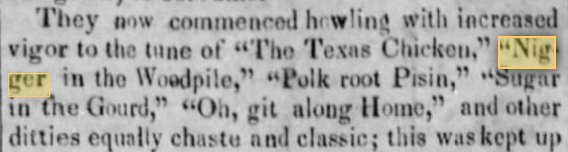
Morris, the Conservative MP for Newton Abbot’s use of the phrase ‘nigger in the woodpile‘ provoked widespread condemnation and resulted in her suspension and an abject public apology, but the UK public and media have a very short memory. It was far from an isolated instance of this crass archaism being invoked by British politicians, as this website records:

https://www.theyworkforyou.com/search/?q=%22in+the+woodpile%22&o=o

The expression originated in the USA (Mr Slang, Jonathon Green has a first citation as the name of a popular song from the 1840s) where it was usually associated with an image of a runaway slave in concealment, but it is in the UK where it has enjoyed a lengthy and unfortunate afterlife.

I can testify that the phrase was used by middle-class speakers in conversation in the UK the 1950s and 1960s. It was possible to use the n-word (not the whole phrase) in Britain up to the end of the 1950s without having a conscious racist intention. The WW2 flying ace Guy Gibson, for instance, named his beloved pet dog ‘Nigger’ and I can remember myself using the word in a public swimming pool in suburban London in about 1959 to point out a black child playing nearby (a rare thing in our lower middle-class neighbourhood). Even then my father rebuked me very sternly, saying ‘we don’t say that and you mustn’t use the word! (‘Black’ was in those days never uttered.)

Yasmeen Serhan reported on the MP’s gaffe for American readers in The Atlantic:

https://www.theatlantic.com/international/archive/2017/07/anne-marie-morris-suspended/533220/

Image result for nigger in woodpile

Attempts were made, by Tory supporters and some linguists, to excuse the MP on the grounds that she is 60 years old and so for her generation the words in question carry little or less force. Professor Geoff Pullum of Edinburgh University was among those who also suggested that when the n-word is in combination with other words as part of a stock phrase, it might not carry the same negative charge (http://languagelog.ldc.upenn.edu/nll/?p=33594). I’m told, for example, that in the parlance of small-boat sailors in the UK the phrase ‘boat-nigger’ is used to denote the most junior member of the crew. Other commentators opined that inadvertent racism is nonetheless racism, but where quibbles about slurs and taboos are concerned, I think the acid test is actually to debate them in real-life environments. I have discussed the n-word and similar controversies with a range of young people and with older members of BAME communities* and they are simply not acceptable. Quite apart from clumsiness and insensitivity on the part of somebody in public life, it’s arguable, too, that Morrison used the expression wrongly: it doesn’t mean an unanticipated or an unappreciated future eventuality, but a hidden snag. The nuances – the semantic components and assumptions embedded in the phrase are interesting and challenging to unpick – the connotations of such usages may also mutate over time. Potential confusions are illustrated by the several interpretations or misunderstandings posted on Urban Dictionary:
On a very personal note, it occurred to me that finding an escaped slave today, perhaps in the woodshed behind a prosperous suburban or rural home, is entirely possible in a Britain where traffickers and slavemasters prey on migrants, refugees and the poor and desperate. Oh and, on the subject of the Foreign Secretary, a satirical Twitter poll resulted in this:
  Whether B[oris] Johnson should also be expelled for calling black people ‘piccaninnies’ with ‘watermelon smiles’: Yes: 95% No: 5%’)
AT, also on Twitter, reminded me of this case, for comparison:
It’s not only in English that such words have conflicted and conflicting resonances. Jonathon Green again: ‘Do you know nègre, which is the equivalent of ‘intern’ or maybe ‘gofer’? Also means a ghost-writer. Still used, I am told, without the slightest hesitation and nary a blush. The usual nègre, if the irony even needs noting, is of course white.’ And here (in French) is someone I know personally causing a furore in 2015:
In August 2017 this – provocatively titled but heartfelt and authentic – opinion piece was published by Steven Dunn:
…then in September this, also a personal take, on, inter alia, Kanye West and Piers Morgan, from Jessica Morgan:
…in October, from University of Calgary linguist Darin Flynn in The Conversation:
…yet more on racial slurs, from Indiana Professor Michael Adams:
 …and Geoffrey Pullum on British English deprecations:
Nearly a year on and the c-word has been trending transatlantically. Here’s Deborah Cameron’s interesting take on reclaiming a slur:
…in August 2018 Bethan Tovey reflected on some recent linguistic debates, including reference once again to the n-word:
…more recently, student journalist Nathan Graber-Lipperman has posted a lengthy reflection on the n-word and its relationship with hip-hop and white youth:
…here, in August 2019, is an assessment by John McWhorter:
And, in March 2020, news that, at least in the USA, one f-word is being reclaimed:
*https://language-and-innovation.com/2016/08/13/the-b-word/

A SINGLE CURRENCY? – the status of English post-Juncker and post-Europe


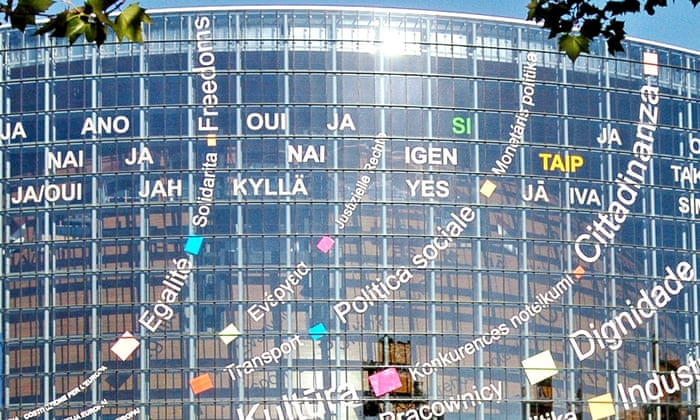
President of the European Commission, Eurocrat par excellence and Brexiteers’ bugbear, Jean-Claude Juncker raised a laugh in Florence a couple of weeks ago with his public provocation, opining that post-Brexit the English language would lose its status as the EU’s de facto lingua franca. IMVHO he’s probably wrong: even in his native Luxembourg (first language Luxembourgish, a Mosel-Franconian dialect of German) one fifth of the population currently claim to use English for everyday communication and three quarters say they speak it fluently.

In the wider EU 46m Germans and 23m French citizens are estimated to have a good command of English, 38% of the remaining nationalities, too. Only 12% over-all claim fluency in French and 11% in German. In Brussels and Strasbourg,  the cities where EU business is primarily carried out, English is, in the Eurocrats’ jargon a relay language, an intermediate code used in meetings, in corridors and in cafes by those for whom it is a second or third language. This is especially the case for those coming from the more recent member states who are generally reluctant to embark on learning French or German when English is already familiar from school, university and from exposure to popular culture.

In fact, the language actually used beyond the formal speeches and official documents is an odd sort of English-based hybrid sometimes known as Euro-speak, laced with ‘continental’ usages (alien to native speaker English but common to other European tongues) whereby terms like subsidiarity, conditionality and conventionality are exchanged and standard English words shift in meaning so that control comes to mean check, assist means attend, execute means carry out, actual replaces current and resume can mean both re-start and sum up. Perhaps in time it is this dialect which will come to dominate in practice while the official languages remain as they are today. Well-meaning attempts to introduce an alternative common language have so far come to nothing. A petition calling for the artificial language Esperanto to be added to the official list has received only 12, 383 signatures to date – in an EU population of around 450m.

In the Guardian this week Tess Reidy has been considering the fate of English post-Brexit and pace Juncker, with the help of experts and some contributions by me. Her article is here…

https://www.theguardian.com/education/2017/may/24/which-language-would-ease-our-way-in-the-post-brexit-world

Last year Mike MacKechnie listed some of the Euro-English terms that puzzled ‘native-speakers’ have to contend with:

10 Funny Euro-English Words We Might Hear More Often If The UK Leaves the EU

The EU is well aware of the peculiarities and idiosyncrasies of its own communication practices, as evidenced by its recognition of the jargon issue…

http://termcoord.eu/2014/06/eurojargon/

Though it took the BBC to decode the global English jargon of the Davos summit:

http://www.bbc.co.uk/news/business-42791874

Here from the European Court of Auditors is a very useful guide to EU misuses of the English language…

https://wordstodeeds.com/2017/06/02/guide-to-misuse-of-english/

Here are some further thoughts from Marko Modiano of Gävle University, published in September 2017…

http://onlinelibrary.wiley.com/doi/10.1111/weng.12264/full


And, in November 2017, a challenging, if possibly slightly tongue-in-cheek suggestion from Italy…

http://www.telegraph.co.uk/news/2017/11/25/eu-should-force-uk-give-us-english-language-brexit-former-italian/

Michael Swan took issue last year with the way the notion of ‘English as a Lingua Franca (ELF)’ is often presented…

http://www.eltresearchbites.com/201802-rethinking-english-as-a-lingua-franca/#comments

Here, should there be any doubt, is the confirmation, from Esther Bond writing in slator,  that English is not about to lose its official status…

https://slator.com/demand-drivers/eu-provides-clarity-on-post-brexit-future-for-english-language/

For any readers who are actively engaging with EU and other terminology (as translators, interpreters or proofreaders for example), here’s a useful list of online resources…

http://albionlanguages.com/best-online-terminology-resources/

And finally, for now, from November 2019, an article by EU translator Hannah Critoph addressing the difference between ‘Eurish’, ‘Globish’ and ‘natural English’…

Click to access Subject-brief-Hannah-Critoph.pdf

(NOT) Girls’ Talk


Gal-dem, also galsdem or gyalsdem, refers in London’s multiethnic street-talk to a group of females (mansdem is the male counterpart). It’s also the name of a magazine for women of colour. I talked to Faima Bakar about the street attitudes that mean that girls are criticised for using slang and profanity while boys use them with impunity. The topic relates both to MLE, the mixed urban dialect favoured by many young people, and Banter, a hot issue again in 2016. Both of these are treated elsewhere on this site, but here’s Faima’s article on boys and slang


http://www.gal-dem.com/girls-talk-street-tell-my-man-shut-up/


Name Analysis and Ethnic Profiling


Image result for profiling


I talked to Zoë Henry of Inc. magazine about reports that profilers in the USA can now pinpoint ethnic identities from individuals’ names. Zoë’s article is here:

http://www.inc.com/zoe-henry/companies-using-software-to-predict-customers-ethnicities.html

I’m sure these experts are scrupulous in not doing anything illegal but I think, in the case of hyperindividualised and hyperlocalised profiling, the subjects (who presumably don’t know they have been identified) will probably feel comfortable about it if their names have been retrieved from lists they have subscribed to, possibly less so if they have been traced from other sources like electoral rolls, phone directories, library memberships.

In marketing there’s the assumption that a member of a group will conform to a stereotype of that group’s consumer behaviour – an assumption that is potentially patronising if not controversial. And when we look in close-up at actual instances, what precisely can we predict about, say, LeKeysha LLoyd Muhammad’s buying patterns and preferences? Especially if they are trans and have an address in rural Idaho?

Ethnic name profiling of course has a potentially bad reputation when used by government or law enforcement or by employers* in covertly vetting prospective hirings. As US human rights lawyer Bill Quigley commented:

‘One of the draconian consequences of 9/11 is racial profiling. Bollywood Muslim actor Shah Rukh Khan became the latest victim of what some call “flying while a Muslim” after he was singled out by US airport authorities allegedly because of his Muslim surname “Khan”. “I was really hassled at the American airport because my name is Khan,” he said. The other recent Indian victim was former president of India. On April 24, 2009 in a clear violation of protocol, Dr. A.P.J. Abdul Kalam, a Muslim, was frisked by the staff of American airliner Continental Airlines.’


*an article on that subject:

Stereotyped ethnic names as a barrier to workplace entry


CRISIS-TALK

I’m now collecting examples of exotic, disturbing or infuriating post-Brexit language (and welcome contributions from readers, which will be gratefully acknowledged). Back in 2010 I reviewed the new terms generated by the recession that then afflicted us.


THE YEAR IN JARGON


We’re all familiar by now with quantitative easing, and bemused by all those recessionistas practising chiconomics…but the bizwords kept on coming…

Tony Thorne looks back at the terminology born of the downturn/meltdown


While things were going well it was commonplace to refer complacently to the hidden hand that Adam Smith claimed was quietly regulating the mechanisms of capitalism. Nowadays that concept seems as inappropriate as combining the two words ‘city’ and ‘gent’: the current sense of crisis requires a new set of metaphors and some picturesque contenders are duly emerging. Foremost among them is creative destruction, a phrase first popularised by Austrian economist Joseph Schumpeter in 1942. A much more radical version of the familiar shakeout, this has come to refer to the demolition of monopolies and economic structures by revolutionary innovation – including ‘revolutionary’ financial instruments and their resultant collateral/fallout.

Another term that has come into its own is boiling frog syndrome, apparently coined by one Leopold Stomm (described as a ‘political and economic theorist, amateur naturalist, and sadist’ but possibly fictional). This can be illustrated by the image of ‘frog’ X (insert the name of any major car manufacturer) ‘sitting in shallow water and denying that the temperature is rising’ – right up to the moment when it boils to death.

And what of the victims of economic turmoil, those senior professionals who have been Pluto’d (demoted, like the planet), lateralled (i.e kicked sideways; they are said to be suffering from adjacency), checked out (serving notice) or simply exited (which has replaced all those euphemisms formerly used in HR circles); what of the recently retired who have become the returned – in other words have been forced back into work? One humbling-but-uplifting option may be to take one of the thousands of green-collar jobs that the US and UK governments have promised to create. Successor to the white, blue and pink-collar (the last denoting supposedly ‘feminine’ jobs like beautician –sorry, cosmetologist – care assistant or florist), green-collar describes manual jobs in the ecological economy, usually involving cleaning up pollution or installing energy-saving devices. A quite different sort of comfort might be provided by going on a Ponzi crawl. Highlighted recently by the Madoff débâcle, the latest Ponzi scheme (named after an early 20th-century pyramid scamster of Italian origin) is a serial bar crawl in which the last to join has to treat all his/her fellow drinkers – and gets exactly nothing in return.

In trying to keep track of this year’s blizzard of buzzwords I’ve been helped out by readers of my previous offerings. From the US Nick Harrison writes to signal a new usage: the noun shutter has suddenly become a verb, signifying both closing down and boarding up, as in ‘Madam K’s is soon to shutter’, or ‘Granco has shuttered its operations’. He spotted four examples within four days from the Seattle Times, ‘…sole remaining daily paper in this town since the 150 year-old Post Intelligencer itself shuttered a month or so ago.’ Another novel Americanism yet to cross the oceans is shovel-ready, referring to a major project that is all set to go but awaiting public funding which may not now materialize.

In times of turmoil an upsurge in acronyms and abbreviations is only to be expected, and examples noted by correspondents include GFC (the Australian government’s own shorthand for global financial crisis) and CC which can stand for credit-crunch or current climate. Irish informant Ros Waverley has picked up on the fact that R.I.F, the euphemistic reduction in force(s) (aka downsizing) from a year or so ago, has first become an acronym pronounced ‘riff’, and more recently a verb, as in ‘we’re riffing’/’we’ve been riffed.’

Several readers were amused when Lord Mandelson testily insisted that his £2.5bn rescue package for the UK car industry was not a bailout (Merriam-Webster’s word of the year for 2008), but a greening initiative. Others were tickled by the portentous language governments have come up with to boost their anti-recessionary credentials: a little too late perhaps Australia has embraced countercyclicality, which simply means anticipating periodic economic downturns, while Britain has been promoting flexibilism; adapting your working practices to cope with unexpected crises.

I can’t help chuckling cynically at the latest catchphrases circulating among the cheerfully desperate – or desperately cheerful – flat is the new up is one such, while I heard someone the other day assert in all seriousness that we’ve got to take the HAV (high-altitude view) and look beyond the beyond. Thankfully professional trendspotters also remain resolutely upbeat, promoting something they call innovation jubilation, celebrating nimbleness (marketing’s successor to agility) and announcing the imminent appearance of the unlikely Generation G (for generous).