
As a collector of slang and commentator on popular culture I had long been fascinated by my predecessor, the 18th century ‘alternative Dr Johnson’, Captain Francis Grose. In searching out the language of the underworld and demi-monde for his own dictionary, the hugely corpulent, hard-drinking Grose abandoned the dusty archives where Johnson (and all his modern successors) toiled, to go down into the gutters, taverns and bawdy-houses of London in a quest for the authentic voices of the users of what he called ‘the vulgar tongue.’
As an ageing babyboomer, would-be flâneur and one-time follower of fashion, (and, like the Captain, dilettante and enthusiast) I was acutely conscious that time was getting short. Morosely celebrating a significant birthday this year I realised with a shock that I had reached the age at which the Captain’s adventures were terminated –by ‘a sudden apopleptic fit’, in mid-carousal, in an inn in Dublin.
I decided five or six years ago it was time to realise my project of a life of Grose, a hommage, a profile, but not in the form of a classic biography. I would follow him into the bars and clubs, the backstreets, precincts and sink estates of 21st-century England, seeking out the low-lifers of today and recording the richly evocative, scabrous and exotic codes in which they communicate. I knew already that there were strange echoes of Grose’s times still present in the secret argot – some of it Elizabethan, some influenced by Romany and Irish – used by prisoners, travellers and gang members in modern times. I knew, too that the multilingual free-for-all of Hogarth’s London has mutated into an even richer mix where Black and Asian cadences combine with native Cockney to produce excitingly novel vocabularies, accents, perhaps even new dialects.
Any treatment of Grose, his work and his world would have to take in the other pioneering slang enthusiasts who together compiled the ‘rogue literature’ of England, from the 16th century wastrel, Harman, through the succession of renegade magistrates, con-men, gamesters and grub-street hacks who followed in the same tradition of chronicling society’s underside and its language.
Though it’s not to be in any sense an autobiography, I would have to put into my book my own memories and experiences; anecdotes gathered during the years in which I tried on a series of identities – gang-member, dandy, provocateur, punk, yuppie, and dabbled in a variety of secret languages – polari, rhyming slang, ‘lifestyle’ and business jargon…
You can find some Grosean fragments that I have gathered here (look under Slang Articles, Francis Grose):
http://www.kcl.ac.uk/study/preparation-courses/tony-thorne/slang-and-new-language.aspx
Sadly the projected biography has yet to come to fruition – other things have intervened and publishers are now, more than then, reluctant to pay for an author’s research-time. I would be happy to see another writer take up the challenge and would be happy to assist them…otherwise I’ll wait on a Lottery win or an eager PhD student.
Back in 2011 the publication of a short Grose glossary prompted a conversation with Roland White of the Sunday Times. This is his article…
Pay attention, all you hopper-arsed hoddy doddys. Gather round, you dandyprats, Jerry Sneaks and jolter heads. Any ale drapers and mutton mongers at the back should sit up straight and stop fiddling with their inexpressibles. And if anybody else wants to know what that was all about, they should adjust their periwigs and read on.
In the age of the internet and instant communication we rather pride ourselves on the witty and imaginative way that we create new words. We speak in a rather smug, knowing way of affluenza and low-hanging fruit. For no useful reason we refer to mobile phones as blab slabs and use them to diss our frenemies among the Twitterati. All in all we consider ourselves at the cutting edge of clever. Yet our slang turns out to be flat and colourless compared with the vigour and invention of the 18th century, when the only technology available was a quill pen and the pox.
The late 1700s was an age of catch farts, flaybottomists, Norfolk dumplings and totty-headed mopseys. How the words just roll off the tongue. Back then it must have been a pleasure to have been insulted. And what now seems a golden age of invective is being celebrated in Lobcocks and Fartleberries, a new book that reprints extracts from a celebrated dictionary of slang first published in 1785.
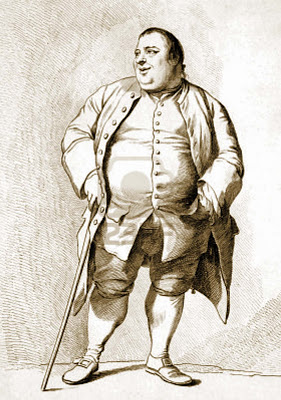
As we know from the drawings of Hogarth and his contemporaries, England was teeming with drunks, rogues, beggars, tricksters and ne’er-do-wells. Life in the darker depths of society was so brutish that the upper crust lived in constant fear of the sort of revolution that would later grip France. Yet there was at least one man who seemed quite at home in this shadowy world: Captain Francis Grose. Born to a Swiss immigrant father, he was a former army officer, a connoisseur of antiques, an occasional caricaturist, a part-time journalist, a friend of the poet Robert Burns and above all something of a character.
Grose not only lived up to his name but also revelled in it. Almost as wide as he was tall, he had a voracious appetite for food and drink and a rollicking personality to match. If anybody now made a film of his life, Grose would almost certainly be played by Brian Blessed (although the actor would have to fatten up considerably for the role). In between eating, drinking and becoming slang’s answer to Dr Johnson, he still found time to produce 10 children, one of whom — also called Francis — became a general and the lieutenant-governor of New South Wales.
“Grose’s most abiding talent was to seek out the roisterers and the ne’er-do-wells, the cardsharps, cutpurses, highwaymen and low-lifers of Hogarthian London and listen to their repartee,” says Tony Thorne, author of the Bloomsbury Dictionary of Contemporary Slang, who is working on a biography of Grose. “In an age when both the nascent middle classes and the aristocracy lived in terror of revolution, it was courageous as well as unprecedented.”
Complete with his own Boswell-style sidekick called Tom Cocking, which itself sounds like 18th-century slang for something saucy, Grose toured the Hogarthian underworld and uncovered a list of about 2,000 words, which he published in his 1785 work A Classical Dictionary of the Vulgar Tongue. Just under 250 of these words can be found in Lobcocks and Fartleberries — from addle-plot, a spoilsport, to zouch, a slovenly fellow (for the complete work you can download an 1811 edition from gutenberg.org).
Historians can tell a lot about an age from its slang. “You can see how important the military side of life was in the 18th century,” says Thorne, consultant at King’s College London. “Soldiering and its associated slang was very prevalent. Also, England was teeming with beggars and tricksters.”
Cant was the secret language of the rogues, beggars and vagabonds who peopled the underworld of early England
Because we are embarrassed to use the conventional words, slang down the ages has always found many ways of describing the sex organs, and the 18th century was no exception. For women, there was the madge, doodle sack, gigg or notch, while men had nutmegs, gingamabobs, plug tails and lobcocks. An apple dumplin shop described an ample cleavage, as did Cupid’s kettle drums. The original meaning of nincompoop, incidentally, was a man who had never set eyes on his wife’s madge or doodle sack.
By contrast, some of the colloquialisms of the time were very learned, using puns and allusions to Latin. Arbor vitae (tree of life) was yet another word for the penis, while an ambassador of Morocco was an elaborate term to describe a shoemaker. They don’t seem all that amusing to the modern eye but they were probably hilarious at the time.
Grose’s dictionary is rich in ways to describe slightly effeminate or silly men. He notes twiddle poop, fribble and — rather marvellously — tony. There were also many words for women who were either not as attractive as they might be or no better than they ought to be: trugs, toad eaters, sosse brangles, queans, hedge whores, gilflurts and laced mutton.
“What is surprising is how they used to laugh and mock, especially at fops and the effete,” says Thorne. “It wasn’t a gay thing and it certainly wasn’t cruel or nasty like some of the unpleasant phrases of the past 40-50 years. It seemed more affectionate. Even if we find certain sexual characteristics funny, we can’t do that any more. Back then it sounded gentle, although it might be the case that those words had a harsher ring to a contemporary audience.”
Many of the words and phrases uncovered by Grose and Cocking are still familiar today. Not just nincompoop, but also beetle-browed, old biddy, whipper-snapper, pettyfogging, thingamabob, a drubbing, hatchet-faced, bamboozle and balderdash — which now means nonsense but then referred to adulterated wine.
Other words and phrases have long fallen into misuse. Which is a pity, because after last week’s revelation that British people are the fattest in Europe, our language is crying out for a phrase such as hopper-arsed, which describes a man with a backside so large it juts out to the rear.
“You just can’t predict what will last,” says Thorne. “I haven’t been able to come up with any definitive characteristic that marks out words which have survived against those that haven’t. A lot of it comes down to human quirkiness and people’s affection for certain sounds and conjured images.
“Terms based on obvious, clear images or metaphors often survive — for example, bracelets for handcuffs. Many terms disappear because the cultural allusions they use, or ways of behaving they describe, simply become obsolete.”
“Babes in the wood” described criminals sitting in the stocks, a punishment that fell from favour in the middle of the 19th century. Be thankful also that we no longer need the term “vice-admiral of the narrow seas”, which described a drinker who urinated under the table into the shoes of his fellow revellers.
Grose’s work caught the public imagination, yet it was not the first dictionary of its kind. Researchers — many of them slightly disreputable — had been collecting such words since the early 1500s, but the first published compilation was A New Dictionary of Terms Ancient and Modern of the Canting Crew, published in 1699 by somebody known only as “BE, Gent”.
This was recently reissued by the publishing arm of the Bodleian Library as The First English Dictionary of Slang 1699. Among the 4,000 entries you will find old friends such as chitchat and eyesore, but also dandyprat (a rather puny man; see also arsworm), fizzle (to break wind in a quiet, half-hearted sort of way) and bundletail (a short, fat woman). Would anybody join me in campaigning to bring back grumbletonians? This describes people who are constantly dissatisfied with life.
“Cant was the secret language of the rogues, beggars and vagabonds who peopled the underworld of early England,” writes John Simpson, chief editor of the Oxford English Dictionary, in the introduction to the Bodleian edition. “The word ‘slang’ itself is not recorded by the OED until 1756. Short lists of canting vocabulary had been available in print since at least the early 16th century, but they had always been tucked away in longer texts. BE was the first person to present the canting tongue in dictionary form.”
Slang is pretty much universal. There are some small tribes that regulate language so strictly that innovation is impossible, but no country is too conservative to use slang, even if — like Japan and Slovenia, where Thorne also operates — it has to borrow it. Japan uses English slang, while Slovenia imports words from Serbia and Germany, which have a wide range of colourful insults and technical terms for sexual activity.
“Everybody uses slang, every sector of society,” says David Crystal, the English language guru (from Sanskrit guruh: weighty). “Doctors have their slang; journalists have their slang; academics have their slang. The chief use of slang is to show you’re one of the gang.”
And being part of a gang means you don’t want other gangs using your vocabulary. “Bling came in a few years ago among Jamaicans and they used it all over the place and that seemed a word they were going to use for ages,” says Crystal. “Then middle-class white people picked it up. As soon as that happened, the Jamaicans stopped using it. That’s the sort of thing that happens. It went out of use just because another group in society started using it.”
According to Crystal, three quarters of new words eventually disappear without trace. The ones that manage to cling on usually fulfil a linguistic need: “They are saying something that people couldn’t say before.” Some words disappear, only to resurface generations later. Dosh, ackers, spondulicks and wonga — all referring to money — were commonly heard in the late 19th and early 20th centuries. They fell from favour, only to be revived by the City workers of the yuppie 1980s.
Where do such words come from? Who first called somebody else a nincompoop? Which man — surely a man — glanced across at a woman and saw nothing but an apple dumplin shop? Who later described a female friend with a love of designer clothing as a “tag hag”?
The great beauty of slang is that nobody seems to know. “One of the things I find romantic is that these are coined by anonymous wits,” says Thorne. “We almost never know who first used these phrases. Quite a lot of people come to me and claim they invented something but it nearly always turns out that they’ve heard it elsewhere and registered it subconsciously. I don’t think I’ve ever found a provable originator of a famous slang phrase. It all happens underground and out of sight.”
At the end of the 19th century, lexicography became the province of the nerd and the geek. The first recorded slang, back in the 15th century, came from closed adult society. It was the language of the armed forces, of travellers and particularly the underworld. Slang usually begins as a secret code and then catches on in wider society. Down the years, wider society has worked its way through hippie slang, Oxbridge slang, public school slang, rhyming slang, hip-hop slang and — more recently — multicultural yoof slang.
Researchers have even identified which areas of life inspire the most phrases. Of these, the top three are: 1 Iconic areas of the group’s culture: drugs, drink and sex. Especially sex.
When Jonathon Green published his Dictionary of Slang in 1998, his publisher boasted it was the only book to feature 1,232 words for sexual intercourse, 997 ways to describe the penis, 856 words for vagina and 797 phrases for masturbation. 2 Terms of approval (wicked, brill, phat). 3 Ways to describe outsiders (nerds, geeks etc).
Thorne is a former hippie-turned-punk who draws on the inspiration of Grose in his work (punk, incidentally, was an 18th-century — or earlier — word meaning rent boy or prostitute). He goes direct to football hooligans, street gangs, students and teenagers to learn the latest words. He used to go clubbing as part of his research but, at the age of 59, now feels that he looks a little conspicuous.
“At the end of the 19th century, lexicography became the province of the nerd and the geek, but until then people were part of that demi-monde,” he says. “I try and emulate them. I have given up clubbing but I still talk to taxi drivers, criminals and gangs of young people. Without being pious, I think it’s important.”
His latest research has uncovered the following words:
From criminals and travellers — soolbick (mobile phone), children (drugs), warbs (the police).
From youth street talk — goon (a group of people), spud or cheez (very good), to wok (have sex), demmick or zep (chav), kidaani (a greeting used by Asian youths).
From students — bungalowed (drunk or exhausted), CBA (can’t be arsed), frape (from Facebook rape — illegal tampering with one’s profile page), neek (a cross between a nerd and a geek), SDW (secret degree working — studying hard while pretending not to).
Goons and frape aren’t a patch on flap dragon or betwattled — the 18th-century version of gobsmacked (thought to be late 19th-century Irish). Could it be that British society has become a little too posh?
As you get older and more comfortable you grow out of slang. “You tend to carry a little core of slang with you beyond the teenage years,” says Thorne, “but as you conform with bourgeois existence the opportunities to use slang diminish.”
And that’s when you discover you’ve turned into a complete and utter twiddle poop.
Lobcocks and Fartleberries: 18th Century Insults to Confound Your Foes, by Francis Grose, is published by Summersdale, £4.99.
The First English Dictionary of Slang 1699, by BE, is published by the Bodleian Library, £12.99.
The Bloomsbury Dictionary of Contemporary Slang, 4th edition, by Tony Thorne, is published by Bloomsbury, £16.99
The monumental Green’s Dictionary of Slang, in three volumes, by Jonathon Green, has , thanks to Jonathon’s generosity now been made available for free online: https://greensdictofslang.com/
Here is the entry for Francis Grose from “The General Biographical Dictionary” by Alexander Chalmers, F.S.A., 1814, Vol 16
GROSE (Francis)
GROSE, Francis, an eminent English antiquary, was the son of Mr. Francis Grose, of Richmond, jeweller, who died in 1769. He was born in 1731, and having a taste for heraldry and antiquities, his father procured him a place in the college of arms, which, however, he resigned in 1763. By his father he was left an independent fortune, which he was not of a disposition to add to or even to preserve. He early entered into the Surrey militia, of which he became adjutant and paymaster; but so much had dissipation taken possession of him, that in a situation which above all others required attention, he was so careless as to have for some time (as he used pleasantly to tell) only two books of accounts, viz. his right and left pockets. In the one he received, and from the other paid; and this too with a want of circumspection which may be readily supposed from such a mode of book-keeping. His losses on this occasion roused his latent talents: with a good classical education he united a fine taste for drawing, which he now began to cultivate; and encouraged by his friends, he undertook the work from which he derived both profit and reputation: his Views of Antiquities in England and Wales, which he first began to publish in numbers in 1773, and finished in 1776. The next year he added two more volumes to his English views, in which he included the islands of Guernsey and Jersey, which were completed in 1787. This work, which was executed with accuracy and elegance, soon became a favourite with the public at large, as well as with professed antiquaries, from the neatness of the embellishments, and the succinct manner in which he conveyed his information, and therefore answered his most sanguine expectations; and, from the time he began it to the end of his life, he continued without intermission to publish various works, generally to th advantage of his literary reputation, and almost always to the benefit of his finances. His wit and good-humour were the abundant source of satisfaction to himself and entertainment to his friends. He visited almost every part of the kingdom, and was a welcome guest wherever he went. In the summer of 1789 he set out on a tour in Scotland; the result of which he began to communicate to the public in 1790, in numbers. Before he had concluded this work, he proceeded to Ireland, intending to furnish that kingdom with views and descriptions of her antiquities, in the same manner he had executed those of Great Britain; but soon after his arrival in Dublin, being at the house of Mr. Hone there, he suddenly was seized at table with an apoplectic fit, on the 6th May 1791, and died immediately. He was interred in Dublin.
“His literary history,” says a friend, “respectable as it is, was exceeded by his good-humour, conviviality, and friendship. Living much abroad, and in the best company at home, he had the easiest habits of adapting himself to all tempers; and, being a man of general knowledge, perpetually drew out some conversation that was either useful to himself, or agreeable to the party. He could observe upon most things with precision and judgement; but his natural tendency was to humour, in which he excelled both by the selection of anecdotes and his manner of telling them: it may be said too, that his figure rather assisted him, which was in fact the very title-page to a joke. He had neither the pride nor malignity of authorship: he felt the independency of his own talents, and was satisfied with them, without degrading others. His friendships were of the same cast; constant and sincere, overlooking some faults, and seeking out greater virtues.”
Grose, to a stranger, says Mr. Noble, might have been supposed not a surname, but one selected as significant of his figure: which was more of the form of Sancho Pança than Falstaff; but he partook of the properties of both. He was as low, squat, and rotund as the former, and not less a sloven; equalled him to in his love of sleep, and nearly so in his proverbs. In his wit he was a Falstaff. He was the butt for other men to shoot at, but it always rebounded with a double force. He could eat with Sancho, and drink with the knight. In simplicity, probity, and a compassionate heart, he was wholly of the Pança breed; his jocularity could have pleased a prince. In the “St. James’s Evening Post,” the following was proposed as an epitaph for him:
“here lies FRANCIS GROSE.
On Thursday, May 21, 1791
Death put an end to his
Views and prospects.”
Mr. Grose married Catherine, daughter of Mr. Jordan, of Canterbury, by whom he had two sons and five daughters;
1. Francis Grose, of Croydon-Crook in Surrey, esq. a colonel in the army, governor in 1790 of new South Wales;
2. Onslow Grose, esq. captain of the pioneer corps on the Madras establishment, who died very lately in India; and four daughters, one of whom married to Anketel Singleton, esq. lieutenant-governor of Landguard-Fort, in Essex.
His works are, 1. “The Antiquities of England and Wales,” 8 vols. 4to and 8vo. 1. “The Antiquities of Scotland,” 2 vols. 4to and 8vo. 3. “The Antiquities of Ireland,“ 2 vols. 4to and 8vo, a posthumous work, edited by Mr. Ledwich, 1794. 4. “A Treatise on ancient Armour and Weapons,“ 1785, 4to. 5. “A Classical Dictionary of the Vulgar Tongue,” 1785, 8vo. 6. “Military Antiquities; being a history of the English Army from the Conquest to the present Time,” 1786, 1788, 2 vols. 4to. 7. “The History of Dover Castle, by the rev. William Darell,” 1786, 4to. 8. “A Provincial Glossary, with a Collection of local Proverbs and popular Superstitions,” 1788, 8vo. 9. “Rules for drawing Caricatures,” 1788, 8vo. 10. “ Supplement to the Treatise on ancient Armour and Weapons,” 1789, 4to. 11. “A guide to the Health, Beauty, Honour, and Riches,” being a collection of humorous advertisements, pointing out the means to obtain those blessings; with a suitable introductory preface, 8vo. 12. “The Olio, a collection of Essays,” jests, small pieces of poetry, all highly characteristic of Mr. Grose, but the collection was not made by him, and we suspect all the contents are not from his pen; 1793, 8vo.[1]
[1] European mag. 1791—Gent. Mag. 1791.




 tony thorne