THE DICTIONARY, BY DESIGN

In recent posts I  have been looking at novel ways of mixing words and images and at the exploitation of nonstandard language varieties – slang and jargon in particular – for marketing, advertising and publicity. The format of the dictionary entry itself, the very familiar sequence of headword, part of speech and definition, lends itself to imitation in the same causes, as discussed here by naming expert Nancy Friedman:

http://nancyfriedman.typepad.com/away_with_words/2016/10/you-could-look-it-up.html

After studying Nancy’s article (included here with her kind permission) I tried in vain to find counterexamples: mainstream ads that had succeeded in using the reference-book template in original and striking ways. I did recall, though, some microexamples from closer at hand, the work of the design team at King’s College London with whom I’ve collaborated. These focused on colloquial language such as cliche, slang and catchphrase, presented in the visual style of thesaurus or academic document, playing with the expectations of a local target audience of students.

In 1998 slang, ancient and modern, and the thesaurus were evoked in an advertisment for student accommodation which proved popular with its intended readership:

KCL My digs 1998.JPG

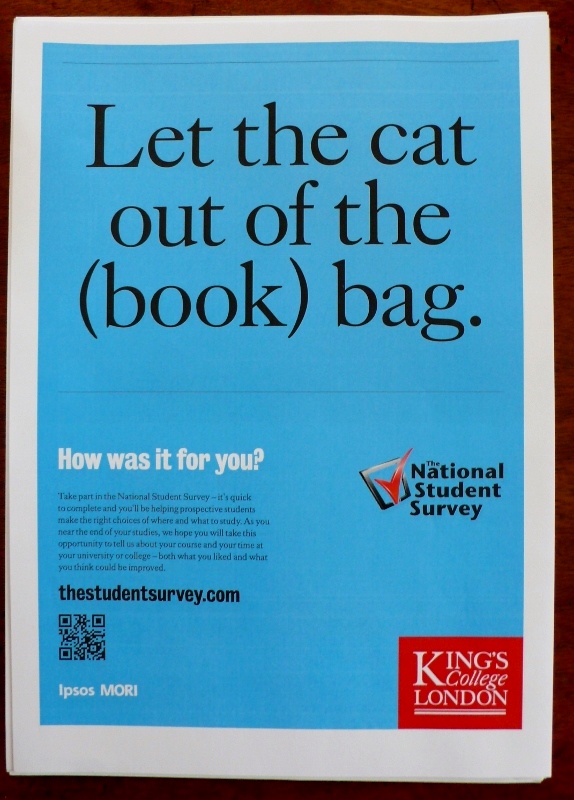
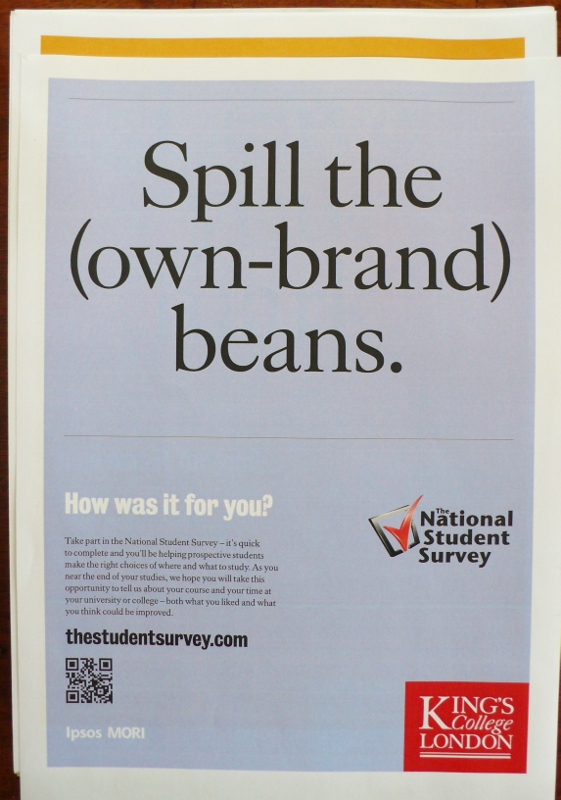
Just recently an appeal for students to take part in a national survey combined a checklist or questionnaire format with plays-on-words, (over)familiar expressions and the sort of throwaway responses that students might employ:

P1090546 (574x800) (574x800).jpg

P1090550.JPG

P1090547 (651x800).jpg

P1090548 (561x800).jpg

P1090549.JPG

A little closer in spirit to Nancy’s examples, but more successful I think because target and context-specific is the mug designed for alumni of King’s College which plays on the Latin word itself, its correlates in English and, in dictionary style, its etymology.

Image result for KCL alumni mug


In my next post I hope to present for the first time a unique slang glossary and guide, created by a design specialist, which is at the same time a book to treasure, a rich source of information and a memorable art object.

A LOAD OF JARGON – 2


blex_outofthebox


“We are all guilty of using redundant and superfluous language throughout our working day, phrases such as blue sky thinking, target audience or thought shower are just a few examples of this strange terminology that has become commonplace.” – It’s Nice That

*

Just as brands, service-providers and media agencies have begun to appropriate slang and jargon for their own purposes, so designers and artists are starting to explore and exploit the potential of colourful nonstandard language with creative juxtapositions and novel interactions.

*

At iconic  The Conran Shop in London It’s Nice That media publication and design partnership Isabel+Helen have collaborated on an exhibition, running through September and October 2016,  which both celebrates and mocks the buzzwords circulating in creative industries. The static and kinetic works on show combine image, text and typography to re-present familiar phrases in a new context, while visitors have the chance to explore further via interactive games and print workshops.

*

A Load of Jargon takes in both well-established and more recent expressions. For instance, the creators lampoon the phrase thinking cap by creating a pile of baseball hats emblazoned with those selfsame words. Next steps, another common business cliche, is a treadmill-like set of stairs, implying the infinite cycle of the phrase. Not all the pieces are purely literal, though: going viral, for example, is a series of yellow ping pong balls in front of a red background, inviting multiple interpretations from spectators.

*

To my jaded ears some of the terms being mocked – going viral itself is one – seem thoroughly useful and no more offensive than the The Conran Group describing itself as a  lifestyle retailer, but that’s not the point here. Surveys have shown again and again that real people (as opposed to linguists specialising in slang) are upset by such language, and other buzzwords from the installation, notably thought shower (which the BBC famously imposed in place of brainstorm in order not to upset epileptics) are prime examples.

Theconranshop_isabelandhelen_itsnicethat_aloadofjargon_00_list

The installations play on the paradox whereby we can be simultaneously amused and irritated by language while we share the nagging suspicion that the sometimes laughable buzz-terms we are seeing and hearing actually signal something important: not just a way of encoding new ideas, new technologies and new ways of working (the project describes itself as a an immersive experience), but also a specialist vocabulary which team-builders and team-members use for bonding and forging identities. We bridle at the use of jargon when it’s novel and unfamiliar and again when it has become overfamiliar, but dare I suggest we try instead to expand our lexical repertoire, appreciate the sociosemantic resonances of these neologisms and get with the programme?

Writing about The Conran Shop exhibits Naresh Ramchandani of Pentagram takes a harsher view…

http://www.itsnicethat.com/features/linguisitc-cocaine-a-load-of-jargon-naresh-ramchandani-041016

With thanks to Manda Wilks and the rest of the It’s Nice That Team

Image result for conran shop

…and to The Conran Shop

A LOAD OF JARGON – 1

Despite my own attempts, sometimes facetiously, often more sincerely, to celebrate the colourful language of the business world, jargon and buzzwords generally receive a very bad press. Of course there are good reasons for this – most profoundly the way the language of ‘marketisation’ has penetrated professional and everyday communication, thereby implicitly reinforcing free-market values,  a tendency which disturbs academic discourse specialists if not the public at large. More superficially, but no less worryingly, the spread of jargon empowers some workers and disempowers others, as well as inflicting its irritating clichés on them.

I’m interested, though, to see how some agencies, brands and providers have raised awareness of jargon – more effectively so far than linguists have managed to do – at the same time exploiting a critique of jargon to market their services.

One recent example comes from telecommunications provider Powownow:

https://www.infographicszone.com/business/what-do-people-think-of-business-jargon

As long ago as 2005 the Irish recruitment agency Irishjobs.ie carried out a survey of officeworkers to discover how they felt about jargon in the workplace. Their findings were that…

  • 50% of respondents regularly hear such phrases as raising the bar, hitting the ground running and singing from the same hymn sheet in their workplace
  • such language is most likely to be used by those in the 30-40 age group. The younger (18-25) and older (50-plus) age groups are the least likely to use this language.
  • 68% find this style of language annoying or very annoying.
  • 68% think that this type of language is primarily used to impress rather than to communicate information.
  • 63% think that business-speak is primarily used to hide a lack of knowledge.
  • 26% think it is used to intimidate.
  • 64% think it is actually detrimental to communication.
  • 41% admit to having used such language to impress someone in the context of work.
  • 77% report having been told to think outside the box at least once by their manager.

In April 2016 the Amba Hotel chain polled 2000 business travellers to determine the most annoying examples of ‘management-speak’. The top ten came out as:

  • Touch base offline: 30% (meaning: let’s meet and talk)
  • Blue sky thinking: 26% (meaning: empty thinking without influence)
  • Punch a puppy*: 25% (meaning: do something detestable but good for the business)
  • Thought shower: 25% (meaning: brainstorm)
  • Thinking outside the box: 24% (meaning: thinking creatively)
  • It’s on my radar: 17% (meaning: I’m considering it)
  • Close of play: 16% (meaning: end of the day)
  • Singing from the same hymn sheet: 15% (meaning: all on the same page)
  • Peel the onion: 13% (meaning: examine the problem)
  • To wash its own face: 9% (meaning: to justify or pay for itself

The hotel brand then offered a top ten of more fashionable and up-to-date buzz-terms:

  1. Bacon wrap: when you take something good and elevate it to excellence by changing it or adding value to it
  2. Buffling: speaking at length and off the point in a business context
  3. Derp: a simple, undefined reply when an ignorant comment or action is made
  4. Dumbwalking: walking slowly, without paying attention to the world around you because you are on a smartphone
  5. Humblebrag: the practice of saying something apparently modest which is really intended to boast – “Just stepped in gum.  Who spits gum on a red carpet”
  6. Nomophobia: fear of being without your mobile phone
  7. Power paunch: a large stomach worn proudly as a badge of status
  8. Qwerty nosedive: falling asleep at the keyboard
  9. Sunlighting: doing a very different job on one day of the working week
  10. Underbrag: a boast which consists of openly admitting to failings to prove you are confident enough not to care what others think of you

I’m still not convinced that we should only condemn the several varieties of language grouped together under the ‘jargon’ umbrella. Elsewhere on this site I’ve posted examples of brands who have celebrated slang in the form of dictionaries, lexicons and glossaries. Next I will be looking at how designers have combined the visual with the linguistic in new and original explorations of nonstandard language.

*Punch a puppy, which I hadn’t come across before, is a version of the phrase shoot the puppy, (the title of my 2006 jargon dictionary) an Americanism meaning ‘dare to do the unthinkable’, inspired by a proposal for a game show (mercifully never commissioned) in which participants would be dared to shoot a dog.

…and here is an article by Dr Erika Darics of Aston University which also pleads for tolerance of nonstandard language in the corporate sphere:

https://theconversation.com/looking-under-the-bonnet-of-annoying-management-speak-61443

…Eight years on and the same hymn from the same hymnsheet in the Mirror:

https://www.mirror.co.uk/news/uk-news/brits-who-dont-understand-corporate-32945411

Hierarchy Misalignment Syndrome

Hire Older Workers – 5 Key Benefits for Your Business | VANTAGE Aging

HMS, meaning a glaring mismatch in terms of status, is the latest mock-malady to afflict the business world. It was recently highlighted by, among others, PR and communication specialists Shine.com. It describes the awful sensation experienced when you sit down for an important face-to-face with a client or partner and find that your contact is an intern and/or someone 20 years younger than you. As Shine puts it, “It tends to mean that their organisation is taking neither you nor the project seriously – or, even more annoying, that your opposite number is a child prodigy.”

As a babyboomer I’m resigned to seniority or generational mismatches by now, though I try and check attendee status in advance of meetings. In wider contexts — company mergers, for instance — seniority integration is a priority for HR specialists. This coinage has been inspired, I suspect, not just by analogy with PMS (aka PMT) but by two genuine technical expressions: ‘hierarchy malalignment’ when mapping across databases, and ‘miserable malalignment syndrome’ — a painful result of sports injury.

THE RETURN OF THE COUNTESS – 2

File:Condesa Elizabeth Bathory, Carmilla.jpg - Wikimedia CommonsImage result for mediaeval hungary map

Interest in Countess Elisabeth Bathory (the 16th century ‘Countess Dracula’, ‘the Blood Countess’) hasn’t waned  (see previous post). VICE Australia editor, photographer and film-maker Julian Morgans returned from an expedition to her castle in Slovakia and we talked about this enduring icon…

http://www.vice.com/en_au/read/inside-the-ruined-castle-of-medieval-serial-killer-elizabeth-bathory

Five years – and several foreign-language podcasts and broadcasts later – I was interviewed in August 2021 by the US-based comedy broadcaster Rebecca Delgado Smith for The Alarmist Podcast. Rebecca had already hosted a lively discussion of the Countess’s crimes…

I was then interviewed in the role of the expert witness, providing corroboration or correction…

FESTIVE SLANG

It’s already the Autumn Equinox in the Northern Hemisphere, and memories of this year’s summertime festivals are fast fading…

An Autumn days view

You can nevertheless re-live those hedonistic outdoor excesses by browsing my Festival Dictionary, produced for Lucozade two summers ago and still offering a snapshot of the latest slang, catchphrases, keywords and catcalls to accompany the traffic jams, the endless toilet queues, the muddied tents and the eventual collective euphoria…

The Lucozade Yes Moment Festival Dictionary is free and obtainable here…

https://www.lulu.com/shop/tony-thorne/the-yes-moment-festival-dictionary/ebook/product-21791651.html?q=Yes+moment+dictionary+tony+thorne&page=1&pageSize=4

TALKING LIKE A PIRATE

Today, September 19, is, in the calendar of spoof and parody, International Talk Like A Pirate Day, so here is a first note on pirate language…more to follow…

PIRATE TALES AND PIRATE TALK

Meet the real pirates of the Caribbean—and the Carolinas

The pirate is one of the most enduring icons of folklore and popular culture across the English-speaking world and beyond. Nowadays a ‘piratical’ boss may strike fear into the hearts of his workers and ‘pirated’ goods have to be avoided, but everything else about these intrepid marauders is tinged with romance. The word itself is from Latin pirata, derived from Greek peiran, to attack: the associated ‘buccaneering’ and ‘swashbuckling’ are terms of admiration, evoking a devilishly determined rogue who is villain and hero at the same time. It was England’s first Queen Elizabeth who launched the privateers, as they became known, on their way when she licensed 16th-century explorers like Francis Drake, Walter Raleigh and John Hawkins to take foreign ships and plunder the treasure houses of the Americas. But the pirates’ golden age came later, in the 17th and 18th centuries, when they operated freely in their hundreds across the seven seas, even establishing their own pirate state on the islands of Hispaniola and Tortuga in the Caribbean. The real lives of Blackbeard, Calico Jack, Irishwoman Ann Bonny and the rest were first recorded – and considerably embellished – in Captain Charles Johnson’s A General History of the Robberies and Murders of the most notorious Pyrates, published in 1724.

While pirates made their mark on history and on fiction, for hundreds of years the sea and its sailors were a very real presence for ordinary Britons, whose family members, whether fishermen, naval mariners  – or perhaps smugglers or slavers – struggled to make their fortunes at sea, risking their lives and enduring months or years away. The language of the sea penetrated the language used at home, to such an extent that we have forgotten the nautical origins of many of our everyday expressions…

All at sea

A shot across the bows

Batten down the hatches

Clear the decks

Dead in the water

Flagship

Fly the flag/show your true colours/nail your colours to the mast/with flying colours

Give someone a wide berth

Hit the deck

Loose cannon

On an even keel

Plain sailing

Safe haven

Sail close to the wind

Show someone the ropes

Take on board

The coast is clear

Weather the storm

URBAN LONDON SLANG

By kind permission of Natalie King, here’s her blog post for Oxford University Press on the sort of youth language to be encountered in the streets of London today. I can vouch for the authenticity of all the expressions she mentions, but it’s notable that this account bears out my own investigations: these examples of ‘youth-speak‘ or Multiethnic London English have all been used by teens and younger adults for at least five years, some for more than a decade. Slang is not as ephemeral as many people think…

Urban London slang: an introduction for hipsters

THE RETURN OF THE COUNTESS


The face of a woman who killed more than 100 young girls.


A fascination with language can lead to writing about language itself of course, but can also prompt excursions into subjects, themes and real places that are all but inaccessible for Anglophone monoglots. In 1997 I wrote Countess Dracula, the life of the 17th century Hungarian Countess Elisabeth Bathory. The evidence in this sensational and controversial story of serial murder, such as it is, exists only in Hungarian, Latin, Slovak and German. The verdicts arrived at at the time are still being questioned centuries later and the whole affair is periodically revived in novels, film, opera and in rival biographies and press articles. I plan to revisit the haunts of the Countess in Austria, Slovakia and Hungary soon, to search for the new information that I am sure awaits discovery there. In the meantime, here is an article from 2008 marking one such celebration of her infamy…

http://www.telegraph.co.uk/culture/film/3555482/Countess-Elizabeth-Bathory-icon-of-evil.html