PATTERNS AND VISIONS – THE WORKS OF LOUIS WAIN

In January and February 2016 Bethlem Museum of the Mind is staging an exhibition devoted to the art of Louis Wain, once a patient at the Bethlem Royal Hospital, formerly the notorious  ‘Bedlam’ asylum in Southeast London where in earlier times the public came to gaze at inmates. Wain is categorised as a visionary or outsider artist, like other self-taught creators who work outside the mainstream and share characteristics such as reclusiveness, mental impairment or extreme eccentricity. He is among the best known practitioners of outsider art,  also known as Art Brut, because his sequences of images seemed to many to track the progressive psychological or psychic disintegration that accompanies a ‘descent’ into mental illness.

Here is my profile of Wain, followed by details of the exhibition.


THE PERFECT CAT AND ITS CREATOR

 By Tony Thorne

Image result for henry Boxer gallery louis wain

‘The solitary one more real persian cat is the one that is now going to be the one that is the real living animal left alone until the call is given to it at night time this evening … This can be done by giving the call directly the light is seen after the first sleep is over… It is the perfect cat made the more perfect by the willingness given to it.’

 This bizarre text, scribbled on the obverse of a cat portrait, is the work of someone who was once one of England’s most renowned illustrators. Born in London in1860, the artist and visionary Louis Wain travelled a path from obscurity to fame, and back again into seclusion and silence, before his death in 1939 in Napsbury Hospital in Hertfordshire. He was born with a slightly deformed mouth and was kept apart from other children until the age of ten. Even after that the dreamy, distracted boy rarely attended school, preferring to wander around museums and the London dockyards, inhabiting his own private world. He found his vocation at the West London Institute of Art where he studied and for a while taught, before turning to freelance illustration to make his living, beginning with accomplished, naturalistic drawings of birds, dogs, rabbits and fish. When his new wife Emily lay dying of cancer in their home, Louis sat at her bedside and drew her faithful companion, their cat, Peter, and it was these drawings that first caught the public imagination. From 1890 Wain’s cat caricatures, reproduced in magazines like the Illustrated London News and Punch, became a bestselling part of the Edwardian fashion for sentimental pictures of animals, especially dressed as humans and playing human roles, and the artist became a household name.

An early painting, also from 1890, of a group of cats watching a beetle crossing a tablecloth, is both a tour de force of oil technique and, in the intensity of the cats’ quizzical expressions, a faint precursor of future strangeness, (or is this just because we see it with hindsight, knowing what was to become of the artist?)

Image result for henry Boxer gallery louis wain

Louis himself was considered a charming, shy eccentric with an odd, indirect conversational style: he liked particularly to talk of cats’ unusual links with electricity, their sensitivity and intelligence, he tried to interest breeders in developing a spotted variety of cat. He not only depicted cats again and again, acting out fairy-tales, posing in oriental vignettes, impersonating Edwardian gentlemen, in sketches, paintings and book illustrations, on postcards and on keepsakes, to the delight of his new audience, but became a public figure, a champion and patron of the cat as a cherished pet with a life of its own (a late Victorian and Edwardian novelty; previously they had been kept, by men at least, mainly to control vermin). In the decade before World War I Wain was producing up to 600 cat pictures every year; his Louis Wain Annual appeared in 1901, was published every year until 1914, then occasionally up to 1923. ‘English cats that do not look like Louis Wain cats are ashamed of themselves’, pronounced the writer H.G Wells.

Image result for henry Boxer gallery louis wain

In 1907 Wain’s fame took him to the USA, but, never able to manage money and hopeless at negotiating adequate fees, he returned to London penniless. Not long after this came the first signs of a profound psychic change, and a gradual transformation of the artist’s vision which can be tracked through his later, unpublished works. It is this latter phase of Wain’s working life that has fascinated scholars and members of the medical community. The cats, still playing ball, picnicking, performing on musical instruments, frolicking in gardens, appear more frenzied or ecstatic, their fur electrified, the colours heightened, even livid. Later the titles and printing instructions pencilled on the back of his pictures sometimes mutate into rambling mystical texts, creeping over the page and onto the illustrations themselves.

Wain had spent most of his widowhood living with his five sisters, the youngest of whom, Marie became convinced that she was suffering from leprosy, was witnessing murders, and was certified insane in 1900. Tellingly, in the same year, thirteen years after his wife’s tragic death, Wain recollected that he, she and Peter the cat had formed points on an electric circuit, Emily and the cat acting as batteries. He later imagined that visits to the cinema were robbing his sisters of the electricity which animated them. After Caroline, his eldest sister, died in 1917 Louis’ behaviour became more and more erratic, finally violent. In 1924 he was formally diagnosed as suffering from dementia and placed in a pauper’s ward in Springfield asylum, where the diagnosis was revised to one of schizophrenia. The patient said that he had been ‘bothered by spirits night and day for six years.’ It seemed as if his public had forgotten him, but one year later he was discovered and a campaign by celebrities, including aristocrats, the most eminent authors (Galsworthy and Wells among them) and the prime minister himself, raised thousands of pounds for his care and resulted in him being moved to more pleasant surroundings. While he was incarcerated in the Bethlem Hospital in South London (heir to the infamous Bedlam), Wain made a black-and-white sketch of the hospital exterior, the wards in the background, a solitary cat in the foreground. He presented the drawing as a gift to a visiting clergyman, ‘the cat’, he declared, ‘is me.’

Image result for henry Boxer gallery louis wain

From the early 1920s some abstract tapestry-like patterns had started to appear in Wain’s work, first perhaps recalling the oriental textiles in which his father traded and his mother’s religious embroideries, but becoming more and more spiked and vivid until they begin to invade the foreground, merging with and finally in some cases overwhelming the central images. Possibly better known today than any of the early, conventional works or the jaunty, lovable caricatures is a sequence of five cat portraits, preserved in the Guttman-Maclay archive at the Bethlem museum, that seem to illustrate in the most dramatic way the gradual disintegration of a human personality, a realistic cat morphing into a frenzied apparition before fragmenting into a kaleidoscope of jagged, electrified particles. These images have been reproduced in textbooks and generally taken as visual evidence of mental breakdown, but the truth may be a little more complicated. It’s doubtful that these undated works were completed in the order they are shown and some have tried to claim that they come from very different periods of Wain’s career, (although the staff who nursed him confirmed that they all appeared in the 1930s).

From a conventional viewpoint, Wain may indeed seem a textbook case of schizophrenia, (more recent speculations have included toxoplasmosis and Asperger’s Syndrome) but looked at with a more open mind, his journey can be appreciated in a different way. The gentle, baffled, unworldly outsider comes to identify with the cat for its extreme delicacy and its instinctive, mysterious empathy…and the faint static experienced when stroking its fur becomes an obsession with electrical currents. The distinction between the cat, the self and their surroundings begins to blur. One less orthodox take on so-called schizophrenia is that it is an extreme case of sensitivity and empathy in which the individual personality dissolves, moves beyond our banal human concerns and eventually becomes one with its environment, with all of creation.

Image result for henry Boxer gallery louis wain

During the last period of his life Louis Wain also produced a series of mysterious psychedelic landscapes, part imaginary, partly referencing indirectly real places that he may have known or seen. These scenes usually contain no cats, some depict birds or deer among streams, waterfalls, blossoms and bright coloured leaves, several no living thing at all. In one such work, ‘Ethereal City’, a lone human figure, a tiny man in suit and hat, wheels a trolley through the foreground. Behind him stretch steep hills and deep valleys, more Tibetan than English, with white castellated buildings and walls winding into the distance. Others feature different styles of architecture; mock-Tudor baronial or oriental cupolas. (Wain’s signature on these paintings, incidentally, is clear and firm, identical to those on the early, celebrated productions.)

The late landscapes seem to show a serene, though magically, surreally luminous, world into which the artist himself was disappearing. His visitors in his last years described a peaceful old gentleman, sweeping up leaves or meditating in a deckchair, his agitation and aggression long subsided: still physically inhabiting his quiet institutional home, he perhaps had entered another even more tranquil, idyllic place. As he himself once wrote: ‘I am the origin of nothing I came to the world to try to be the whole of creation I was told the world went round I was told the world went to sleep I awoke to the truth. I was nothing…’

Image result for henry Boxer gallery louis wain

In recent years new generations have rediscovered Wain’s cats – his first posthumous exhibition was in 1972 – and he is once again a celebrated, bestselling artist. Now, though, our appreciation of him must be more complex, taking in the fantastical, unsettling, transcendent hinterland of the cat and its creator along with the charm and enchantment of the wide-eyed, cavorting felines.

Copyright Tony Thorne 2017


Here are details of the current exhibition of Wain’s works, with an excellent review and biography and links to related sites of interest:

https://outsideinpallant.wordpress.com/2017/01/16/the-art-of-louis-wain/


SHARP NUMBERS AND STATUS SPHERES


I’m interested in the extent to which the trendy jargon of business and lifestyle really is transient, as it’s often presumed to be. Many of the buzzwords which I discovered and tried to analyse back in the noughties decade are no longer current. Some of them never managed to escape the rarefied circles in which they were invented and briefly exchanged. Others, however, still resonate  – and still, remarkably, are seen as innovative and novel. Here are two examples of what I mean: can you decide in which years the following words were written?


Image result for presenting numbers interesting way

SHARP NUMBERS

I’m almost certainly in the top category – a so-called high skeptic – on Obermiller and Spangenburg’s grading of consumers’ resistance to advertising claims. I’m endlessly irritated for instance at prices that end in 95p or 99p rather than go the whole hog. This tactic is crude and familiar, but other forms of number manipulation and the quasi-technical terms describing them increasingly crop up in commercial conversation.

Theorists of customer behaviour and information load describe my bugbear as the (positive) nine-ending effect, closely related to the (negative) left digit effect – if increasing the price causes the leftmost digit to change, the sale may well be lost. In analysing consumer inference and the processing of brand information the experts cite a numerical superiority effect. This simply means that claims expressed in numbers (‘78.6% effective’) appear to be objective  – based on empirical data – while claims expressed in words (‘finished to the highest technical standards’) tend to be judged as subjective. The same distinction operates between round figures or round numbers, often suspected of being approximations or guesstimates, and sharp numbers, assumed to demonstrate verifiability. This quirk of human psychology the experts describe as precision heuristics. Round numbers incidentally don’t always have to end in zero: given our system based on tens, fives are also salient (i.e more memorable and processed more readily).

Mathematician Stanislas Dehaene highlighted these and other psychological features of number-perception a decade ago, (and Proctor and Gamble’s claim that their Ivory soap was ‘99 and 44/100 per cent pure’ is a century old), but only recently have they begun to cross over into public awareness. The housing market in particular has woken up to a related phenomenon, that buyers have an innate tendency to treat sharp numbers as lower than round ones. They may for example unconsciously perceive £725,000 as higher than £725,647. Sharp numbers play a key role, too, in the pique technique, also known as mindful persuasion, whereby a request is made in an unusual way to pique the subject’s interest, usually illustrated by the simple example of a beggar asking for 97p instead of a pound. Such requests have been shown to have a potential 60% success-rate as opposed to 10% for round figures.

In US financial journalism, by the way, the phrase sharp numbers has another, predictable, sense: it means the numbers that hurt.


Image result for spheres

STATUS SPHERES

According to research by Standard Life Bank two out of three Brits in their 30s and 40s are now suffering from status anxiety about their homes, prompting TV consumer psychologist Benjamin Fry to attempt a more detailed diagnosis. They are apparently experiencing improvenza, which sounds like another affliction, but is touted not as the disease but the potential cure, involving as it does reconfiguring the work-life balance and, as often as not, renovating rather than moving. The notion of status anxiety as a defining modern malaise has been around for some time, but was popularised by UK philosopher Alain de Botton in his 2004 book of the same name. US trendspotter Faith Popcorn has since argued that it is moral status anxiety which increasingly defines our attitudes. She and others have been predicting the end of conspicuous consumption, to be replaced by conspicuous austerity (slogan: ‘less is the new more’), thrifting (opting for low-cost, low-profile living) or conscientious consumption, whereby our individual standing is defined by how far we manage to combine spending and leisure pursuits with self-improvement and charitable works.

Amsterdam-based Trendwatching.com, who also single out status as the key driver of new consumer behaviours, this year upped the stakes by coining the expression status despair to describe the awful realisation, for example, that a fellow oligarch has a more sumptuously fitted-out private jet than you. Journalists have identified other manifestations of this new angst, ranging from yacht-envy to bag-envy. The latter, according to media strategist Tracy Hofman, can be countered by what she calls status flair, ‘the thrill that resonates when you realise that the quilted Chanel handbag you acquired in 1990 is now back in fashion!’

Trendwatching claim that, in an experience economy, hierarchies based purely on spending power are outdated, supplanted by so-called status-spheres; different areas of activity such as ‘participation’, ‘giving’, ‘experiencing’ from which individuals derive self-validation and peer-recognition. In the same way those physical status symbols – visible, tangible purchases for display – are giving way to status stories, told not by manufacturers but by consumers bragging to other consumers, presumably by word-of-mouth and by way of blogging and viralling, about their personalised adventure holidays, their web-presence, not-for-profit investments, eco-credentials, etc.


Nativity – piety and puns

Nativity Scene, Faras Cathedral - World ...

Christmas Eve in the Anglosphere is a curious concatenation of Christian iconography, pagan indulgence and excess (including in some cases the illicit practices described in my last post) and quaint folk custom. The tradition of the excruciating pun, still to be found inside the Christmas cracker, but now a staple, too, of waggish posts on social media, puts language centre-stage. A quite different shared language is the repertoire of terms used to tell the Christmas story itself: ancient, resonant words originating in the gospels and coming down to us by way of re-translation and reinterpretation, but so familiar as to pass unexamined.

This year I took a look at both varieties of Christmas language in this article for The Conversation

https://theconversation.com/uncovering-the-language-of-the-first-christmas-70686

Barneblad: Christmas crackers! - The Norwegian AmericanImage result for stone manger wall

…and more on those awful cracker jokes here:

https://theconversation.com/the-victorians-gave-us-the-christmas-cracker-but-are-also-to-blame-for-the-terrible-jokes-inside-70745?utm_source=Twitter&utm_medium=Social&utm_campaign=Echobox#link_time=1482486752

Nine years later the BBC joins the pre-Christmas conversation:

https://www.bbc.com/news/articles/c741jg9k2dgo

…and here are thoughts from a believer on the name(s) of Jesus:

The Name of Jesus

A WHITE CHRISTMAS?

GAK – A CASE IN POINT


One of the showbiz gossip-sheet Popbitch’s favourite words of the last decade, the online crowd-sourced Urban Dictionary’s earliest citations of it are from 2003, defining it in one instance as cocaine, in another as amphetamine or methamphetamine. The short sharp single-syllable in question is gak.

It interests me because it seems to be without precedent, ‘of uncertain etymology’ as the dictionary compilers have it. The same word is, in their jargon, ‘polysemous’, and can mean quite different things: paraphernalia, ‘stuff’ used on-set in the jargon of movie crews; something nauseating, or an exclamation of disgust in high-school slang, and semen or ejaculation in the argot of pornographers and sexploitation professionals. Like gank it can also mean to steal, rob or plagiarise in the US street argot and cyberslang of the noughties.

From comments supplied by those ‘donating’ the word to Urban Dictionary or other online lexicons the drug it most often denotes seems to vary according to region: methamphetamine in Nevada, cocaine only in London (just this week replaced by Antwerp as Europe’s number one consumer according to analysis of the water) and marihuana in Sydney, Australia. On an online forum in 2002 a UK-based contributor asserts that ‘gak is cocaine’, noting the trending expression gak attack to describe sniffing the drug from a partner’s naked body or blowing it up their nose.

When I first encountered the word I guessed that it had something to do with the involuntary constriction of the throat that the sound of it replicates, a connection which would fit with more than one of its referents, but I had no evidence to support this. Green’s Dictionary of Slang has a citation from 1997 with the spelling gack, and hazards that it may derive from a British dialect word for chatter, which I think is doubtful. In my own 2014 Bloomsbury Dictionary of Contemporary Slang I glossed it then as ‘probably the most widespread nickname for the drug in use from the mid-noughties’, though it now has rivals in chang, ching and chop, opining that it ‘may be an imitation of a gagging reflex or sudden swallowing and/or snorting as a dramatic reaction to ingestion.’

The word highlights an interesting challenge that the lexicographer, of slang in particular, has to grapple with; the fact that in the communities where such terms are coined and traded there are no real authorities. There are anonymous individuals fluent in the colourful nonstandard vocabulary, ‘expert users’ in linguistic jargon, but these are not ‘language experts’ who can compare and contrast and draw on knowledge of earlier examples. Even when the real-world informants that fieldworkers rely on offer up a convincing etymology, as they often do, accompanied by plausible anecdotal supporting evidence of who said it first, in which locations the expression is widely used, etc. these confident assertions are as likely as not to be mistaken, if not invented for the occasion. The dates attached to reports of slang may not mean much either: most slang originates in speech and slang usages can be exchanged for years in an underground milieu before they come to the notice of commentators. Dictionary citations nearly always record only the first printed examples.

Consumers of illicit drugs inevitably coin their own nicknames for the substances they ‘abuse’. They aren’t going to use the ‘official’ technical names for the chemical compounds in question (unless reworked as in Ket, K or Special K for Ketamine) and ownership of an exotic and mysterious alternative marks out the user (of the words and the drug) as an insider, a member of an exclusive, transgressive community. When a drug is a crucial part of a shared sense of identity its users will come up with more than one name for it, eventually developing a whole range of colourful references, a phenomenon known as ‘hypersynonymy’ (drinkers, university students for example, also do this, using scores of more interesting ways of saying ‘drunk’). Whether they see themselves as glamorous or fun-loving or abject and pitiful, cocaine enthusiasts can in the midst of euphoria display a hint of levity, as my own favourite terms beak and bugle (both older British slang synonyms for nose) and, evoking the singleminded satisfying of animal appetite, nosebag, testify.


    Image result for nosebag

In June 2019 Tory leadership contender Michael Gove admitted to having used cocaine, prompting facetious and irreverent comments on social media, many of which referred to the drug by the slang designations mentioned above, as well as flake, sparkle, blow and yayo. Perhaps the most memorable remark came from MonkeyDog on Twitter: ‘I’m more surprised when people haven’t tried cocaine. I mean how have you avoided it? Even popping to the pub there’s more beak than at an owl sanctuary.’

This helpful 2016 guide to drug nicknames from VICE magazine includes our key word, and provides comments on users and usage:

http://www.vice.com/en_uk/read/what-your-choice-of-drugs-slang-says-about-you?utm_source=vicetwitteruk

…and Gak’s popularity is highlighted in this Londoner’s blog from 2013:

https://confessionsofashallowman.wordpress.com/2013/04/03/coke-city-how-gak-is-taking-over-east-london/

High society magazine Tatler investigated fashionable drug use and its terminology in 2013:

http://www.tatler.com/news/articles/june-2013/the-drugs-report-part-one

http://www.tatler.com/news/articles/june-2013/the-drugs-report-part-two

…and UK drug advisory agency FRANK published this A- Z of drug slang:

http://www.talktofrank.com/drugs-a-z


(NOT) Girls’ Talk


Gal-dem, also galsdem or gyalsdem, refers in London’s multiethnic street-talk to a group of females (mansdem is the male counterpart). It’s also the name of a magazine for women of colour. I talked to Faima Bakar about the street attitudes that mean that girls are criticised for using slang and profanity while boys use them with impunity. The topic relates both to MLE, the mixed urban dialect favoured by many young people, and Banter, a hot issue again in 2016. Both of these are treated elsewhere on this site, but here’s Faima’s article on boys and slang


http://www.gal-dem.com/girls-talk-street-tell-my-man-shut-up/


Madame Tussaud

‘THOSE DISTINGUISHED CHARACTERS’

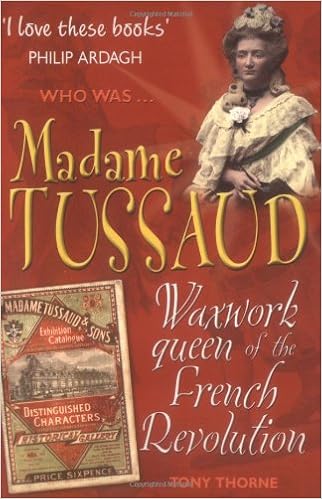
Some years ago I wrote a short life of the waxworker par excellence, Madame Marie Tussaud, for children. Mme Tussaud lived through, and profited from, the French Revolution, having previously, she claimed, served members of the French Royal Family at Versailles. She became a leading promoter of spectacle and entertainment in the French capital, then emigrated to London where she established her famous wax museum. As well as being a successful female entrepreneur, a businesswoman before such a concept really existed, Tussaud was a pioneer of what we might call in modern parlance the ‘commodification of celebrity’.

Now, at long last, this complex and elusive character – or characters, given her capacity for embellishment and reinvention – has been celebrated, and some at least of the complexities and contradictions in her story unravelled, in a full-length documentary treatment by French director Nina Barbier.

The TV film, in French, is here:

http://www.arte.tv/guide/fr/064268-000-A/l-etonnante-histoire-de-mme-tussaud-et-de-ses-theatres-de-cire

CAPTAIN GROSE’S VERY VULGAR TONGUE


As a collector of slang and commentator on popular culture I had long been fascinated by my predecessor, the 18th century ‘alternative Dr Johnson’, Captain Francis Grose. In searching out the language of the underworld and demi-monde for his own dictionary, the hugely corpulent, hard-drinking Grose abandoned the dusty archives where Johnson (and all his modern successors) toiled, to go down into the gutters, taverns and bawdy-houses of London in a quest for the authentic voices of the users of what he called ‘the vulgar tongue.’

As an ageing babyboomer, would-be flâneur and one-time follower of fashion, (and, like the Captain, dilettante and enthusiast) I was acutely conscious that time was getting short. Morosely celebrating a significant birthday this year I realised with a shock that I had reached the age at which the Captain’s adventures were terminated –by ‘a sudden apopleptic fit’, in mid-carousal, in an inn in Dublin.

I decided five or six years ago it was time to realise my project of a life of Grose, a hommage, a profile, but not in the form of a classic biography. I would follow him into the bars and clubs, the backstreets, precincts and sink estates of 21st-century England, seeking out the low-lifers of today and recording the richly evocative, scabrous and exotic codes in which they communicate. I knew already that there were strange echoes of Grose’s times still present in the secret argot – some of it Elizabethan, some influenced by Romany and Irish – used by prisoners, travellers and gang members in modern times. I knew, too that the multilingual free-for-all of Hogarth’s London has mutated into an even richer mix where Black and Asian cadences combine with native Cockney to produce excitingly novel vocabularies, accents, perhaps even new dialects.

Any treatment of Grose, his work and his world would have to take in the other pioneering slang enthusiasts who together compiled the ‘rogue literature’ of England, from the 16th century wastrel, Harman, through the succession of renegade magistrates, con-men, gamesters and grub-street hacks who followed in the same tradition of chronicling society’s underside and its language.

Though it’s not to be in any sense an autobiography, I would have to put into my book my own memories and experiences; anecdotes gathered during the years in which I tried on a series of identities – gang-member, dandy, provocateur, punk, yuppie, and dabbled in a variety of secret languages – polari, rhyming slang, ‘lifestyle’ and business jargon…

You can find some Grosean fragments that I have gathered here (look under Slang Articles, Francis Grose):

http://www.kcl.ac.uk/study/preparation-courses/tony-thorne/slang-and-new-language.aspx

Sadly the projected biography has yet to come to fruition – other things have intervened and publishers are now, more than then, reluctant to pay for an author’s research-time. I would be happy to see another writer take up the challenge and would be happy to assist them…otherwise I’ll wait on a Lottery win or an eager PhD student.

Back in 2011 the publication of a short Grose glossary prompted a conversation with Roland White of the Sunday Times. This is his article…
Pay attention, all you hopper-arsed hoddy doddys. Gather round, you dandyprats, Jerry Sneaks and jolter heads. Any ale drapers and mutton mongers at the back should sit up straight and stop fiddling with their inexpressibles. And if anybody else wants to know what that was all about, they should adjust their periwigs and read on.
In the age of the internet and instant communication we rather pride ourselves on the witty and imaginative way that we create new words. We speak in a rather smug, knowing way of affluenza and low-hanging fruit. For no useful reason we refer to mobile phones as blab slabs and use them to diss our frenemies among the Twitterati. All in all we consider ourselves at the cutting edge of clever. Yet our slang turns out to be flat and colourless compared with the vigour and invention of the 18th century, when the only technology available was a quill pen and the pox.
The late 1700s was an age of catch farts, flaybottomists, Norfolk dumplings and totty-headed mopseys. How the words just roll off the tongue. Back then it must have been a pleasure to have been insulted. And what now seems a golden age of invective is being celebrated in Lobcocks and Fartleberries, a new book that reprints extracts from a celebrated dictionary of slang first published in 1785.
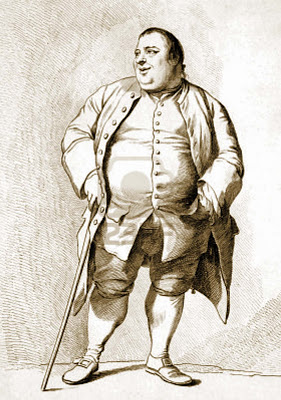
As we know from the drawings of Hogarth and his contemporaries, England was teeming with drunks, rogues, beggars, tricksters and ne’er-do-wells. Life in the darker depths of society was so brutish that the upper crust lived in constant fear of the sort of revolution that would later grip France. Yet there was at least one man who seemed quite at home in this shadowy world: Captain Francis Grose. Born to a Swiss immigrant father, he was a former army officer, a connoisseur of antiques, an occasional caricaturist, a part-time journalist, a friend of the poet Robert Burns and above all something of a character.
Grose not only lived up to his name but also revelled in it. Almost as wide as he was tall, he had a voracious appetite for food and drink and a rollicking personality to match. If anybody now made a film of his life, Grose would almost certainly be played by Brian Blessed (although the actor would have to fatten up considerably for the role). In between eating, drinking and becoming slang’s answer to Dr Johnson, he still found time to produce 10 children, one of whom — also called Francis — became a general and the lieutenant-governor of New South Wales.
“Grose’s most abiding talent was to seek out the roisterers and the ne’er-do-wells, the cardsharps, cutpurses, highwaymen and low-lifers of Hogarthian London and listen to their repartee,” says Tony Thorne, author of the Bloomsbury Dictionary of Contemporary Slang, who is working on a biography of Grose. “In an age when both the nascent middle classes and the aristocracy lived in terror of revolution, it was courageous as well as unprecedented.”
Complete with his own Boswell-style sidekick called Tom Cocking, which itself sounds like 18th-century slang for something saucy, Grose toured the Hogarthian underworld and uncovered a list of about 2,000 words, which he published in his 1785 work A Classical Dictionary of the Vulgar Tongue. Just under 250 of these words can be found in Lobcocks and Fartleberries — from addle-plot, a spoilsport, to zouch, a slovenly fellow (for the complete work you can download an 1811 edition from gutenberg.org).
Historians can tell a lot about an age from its slang. “You can see how important the military side of life was in the 18th century,” says Thorne, consultant at King’s College London. “Soldiering and its associated slang was very prevalent. Also, England was teeming with beggars and tricksters.”
Cant was the secret language of the rogues, beggars and vagabonds who peopled the underworld of early England
Because we are embarrassed to use the conventional words, slang down the ages has always found many ways of describing the sex organs, and the 18th century was no exception. For women, there was the madge, doodle sack, gigg or notch, while men had nutmegs, gingamabobs, plug tails and lobcocks. An apple dumplin shop described an ample cleavage, as did Cupid’s kettle drums. The original meaning of nincompoop, incidentally, was a man who had never set eyes on his wife’s madge or doodle sack.
By contrast, some of the colloquialisms of the time were very learned, using puns and allusions to Latin. Arbor vitae (tree of life) was yet another word for the penis, while an ambassador of Morocco was an elaborate term to describe a shoemaker. They don’t seem all that amusing to the modern eye but they were probably hilarious at the time.
Grose’s dictionary is rich in ways to describe slightly effeminate or silly men. He notes twiddle poop, fribble and — rather marvellously — tony. There were also many words for women who were either not as attractive as they might be or no better than they ought to be: trugs, toad eaters, sosse brangles, queans, hedge whores, gilflurts and laced mutton.
“What is surprising is how they used to laugh and mock, especially at fops and the effete,” says Thorne. “It wasn’t a gay thing and it certainly wasn’t cruel or nasty like some of the unpleasant phrases of the past 40-50 years. It seemed more affectionate. Even if we find certain sexual characteristics funny, we can’t do that any more. Back then it sounded gentle, although it might be the case that those words had a harsher ring to a contemporary audience.”
Many of the words and phrases uncovered by Grose and Cocking are still familiar today. Not just nincompoop, but also beetle-browed, old biddy, whipper-snapper, pettyfogging, thingamabob, a drubbing, hatchet-faced, bamboozle and balderdash — which now means nonsense but then referred to adulterated wine.
Other words and phrases have long fallen into misuse. Which is a pity, because after last week’s revelation that British people are the fattest in Europe, our language is crying out for a phrase such as hopper-arsed, which describes a man with a backside so large it juts out to the rear.
“You just can’t predict what will last,” says Thorne. “I haven’t been able to come up with any definitive characteristic that marks out words which have survived against those that haven’t. A lot of it comes down to human quirkiness and people’s affection for certain sounds and conjured images.
“Terms based on obvious, clear images or metaphors often survive — for example, bracelets for handcuffs. Many terms disappear because the cultural allusions they use, or ways of behaving they describe, simply become obsolete.”
“Babes in the wood” described criminals sitting in the stocks, a punishment that fell from favour in the middle of the 19th century. Be thankful also that we no longer need the term “vice-admiral of the narrow seas”, which described a drinker who urinated under the table into the shoes of his fellow revellers.
Grose’s work caught the public imagination, yet it was not the first dictionary of its kind. Researchers — many of them slightly disreputable — had been collecting such words since the early 1500s, but the first published compilation was A New Dictionary of Terms Ancient and Modern of the Canting Crew, published in 1699 by somebody known only as “BE, Gent”.
This was recently reissued by the publishing arm of the Bodleian Library as The First English Dictionary of Slang 1699. Among the 4,000 entries you will find old friends such as chitchat and eyesore, but also dandyprat (a rather puny man; see also arsworm), fizzle (to break wind in a quiet, half-hearted sort of way) and bundletail (a short, fat woman). Would anybody join me in campaigning to bring back grumbletonians? This describes people who are constantly dissatisfied with life.
“Cant was the secret language of the rogues, beggars and vagabonds who peopled the underworld of early England,” writes John Simpson, chief editor of the Oxford English Dictionary, in the introduction to the Bodleian edition. “The word ‘slang’ itself is not recorded by the OED until 1756. Short lists of canting vocabulary had been available in print since at least the early 16th century, but they had always been tucked away in longer texts. BE was the first person to present the canting tongue in dictionary form.”
Slang is pretty much universal. There are some small tribes that regulate language so strictly that innovation is impossible, but no country is too conservative to use slang, even if — like Japan and Slovenia, where Thorne also operates — it has to borrow it. Japan uses English slang, while Slovenia imports words from Serbia and Germany, which have a wide range of colourful insults and technical terms for sexual activity.
“Everybody uses slang, every sector of society,” says David Crystal, the English language guru (from Sanskrit guruh: weighty). “Doctors have their slang; journalists have their slang; academics have their slang. The chief use of slang is to show you’re one of the gang.”
And being part of a gang means you don’t want other gangs using your vocabulary. “Bling came in a few years ago among Jamaicans and they used it all over the place and that seemed a word they were going to use for ages,” says Crystal. “Then middle-class white people picked it up. As soon as that happened, the Jamaicans stopped using it. That’s the sort of thing that happens. It went out of use just because another group in society started using it.”
According to Crystal, three quarters of new words eventually disappear without trace. The ones that manage to cling on usually fulfil a linguistic need: “They are saying something that people couldn’t say before.” Some words disappear, only to resurface generations later. Dosh, ackers, spondulicks and wonga — all referring to money — were commonly heard in the late 19th and early 20th centuries. They fell from favour, only to be revived by the City workers of the yuppie 1980s.
Where do such words come from? Who first called somebody else a nincompoop? Which man — surely a man — glanced across at a woman and saw nothing but an apple dumplin shop? Who later described a female friend with a love of designer clothing as a “tag hag”?
The great beauty of slang is that nobody seems to know. “One of the things I find romantic is that these are coined by anonymous wits,” says Thorne. “We almost never know who first used these phrases. Quite a lot of people come to me and claim they invented something but it nearly always turns out that they’ve heard it elsewhere and registered it subconsciously. I don’t think I’ve ever found a provable originator of a famous slang phrase. It all happens underground and out of sight.”
At the end of the 19th century, lexicography became the province of the nerd and the geek. The first recorded slang, back in the 15th century, came from closed adult society. It was the language of the armed forces, of travellers and particularly the underworld. Slang usually begins as a secret code and then catches on in wider society. Down the years, wider society has worked its way through hippie slang, Oxbridge slang, public school slang, rhyming slang, hip-hop slang and — more recently — multicultural yoof slang.
Researchers have even identified which areas of life inspire the most phrases. Of these, the top three are: 1 Iconic areas of the group’s culture: drugs, drink and sex. Especially sex.
When Jonathon Green published his Dictionary of Slang in 1998, his publisher boasted it was the only book to feature 1,232 words for sexual intercourse, 997 ways to describe the penis, 856 words for vagina and 797 phrases for masturbation. 2 Terms of approval (wicked, brill, phat). 3 Ways to describe outsiders (nerds, geeks etc).
Thorne is a former hippie-turned-punk who draws on the inspiration of Grose in his work (punk, incidentally, was an 18th-century — or earlier — word meaning rent boy or prostitute). He goes direct to football hooligans, street gangs, students and teenagers to learn the latest words. He used to go clubbing as part of his research but, at the age of 59, now feels that he looks a little conspicuous.
“At the end of the 19th century, lexicography became the province of the nerd and the geek, but until then people were part of that demi-monde,” he says. “I try and emulate them. I have given up clubbing but I still talk to taxi drivers, criminals and gangs of young people. Without being pious, I think it’s important.”
His latest research has uncovered the following words:
From criminals and travellers — soolbick (mobile phone), children (drugs), warbs (the police).
From youth street talk — goon (a group of people), spud or cheez (very good), to wok (have sex), demmick or zep (chav), kidaani (a greeting used by Asian youths).
From students — bungalowed (drunk or exhausted), CBA (can’t be arsed), frape (from Facebook rape — illegal tampering with one’s profile page), neek (a cross between a nerd and a geek), SDW (secret degree working — studying hard while pretending not to).
Goons and frape aren’t a patch on flap dragon or betwattled — the 18th-century version of gobsmacked (thought to be late 19th-century Irish). Could it be that British society has become a little too posh?
As you get older and more comfortable you grow out of slang. “You tend to carry a little core of slang with you beyond the teenage years,” says Thorne, “but as you conform with bourgeois existence the opportunities to use slang diminish.”
And that’s when you discover you’ve turned into a complete and utter twiddle poop.
Lobcocks and Fartleberries: 18th Century Insults to Confound Your Foes, by Francis Grose, is published by Summersdale, £4.99.

The First English Dictionary of Slang 1699, by BE, is published by the Bodleian Library, £12.99.

The Bloomsbury Dictionary of Contemporary Slang, 4th edition, by Tony Thorne, is published by Bloomsbury,  £16.99

The monumental Green’s Dictionary of Slang, in three volumes, by Jonathon Green, has , thanks to Jonathon’s generosity now been made available for free online: https://greensdictofslang.com/
Here is the entry for Francis Grose from “The General Biographical Dictionary” by Alexander Chalmers, F.S.A., 1814, Vol 16

GROSE (Francis)

GROSE, Francis, an eminent English antiquary, was the son of Mr. Francis Grose, of Richmond, jeweller, who died in 1769. He was born in 1731, and having a taste for heraldry and antiquities, his father procured him a place in the college of arms, which, however, he resigned in 1763. By his father he was left an independent fortune, which he was not of a disposition to add to or even to preserve. He early entered into the Surrey militia, of which he became adjutant and paymaster; but so much had dissipation taken possession of him, that in a situation which above all others required attention, he was so careless as to have for some time (as he used pleasantly to tell) only two books of accounts, viz. his right and left pockets. In the one he received, and from the other paid; and this too with a want of circumspection which may be readily supposed from such a mode of book-keeping. His losses on this occasion roused his latent talents: with a good classical education he united a fine taste for drawing, which he now began to cultivate; and encouraged by his friends, he undertook the work from which he derived both profit and reputation: his Views of Antiquities in England and Wales, which he first began to publish in numbers in 1773, and finished in 1776. The next year he added two more volumes to his English views, in which he included the islands of Guernsey and Jersey, which were completed in 1787. This work, which was executed with accuracy and elegance, soon became a favourite with the public at large, as well as with professed antiquaries, from the neatness of the embellishments, and the succinct manner in which he conveyed his information, and therefore answered his most sanguine expectations; and, from the time he began it to the end of his life, he continued without intermission to publish various works, generally to th advantage of his literary reputation, and almost always to the benefit of his finances. His wit and good-humour were the abundant source of satisfaction to himself and entertainment to his friends. He visited almost every part of the kingdom, and was a welcome guest wherever he went. In the summer of 1789 he set out on a tour in Scotland; the result of which he began to communicate to the public in 1790, in numbers. Before he had concluded this work, he proceeded to Ireland, intending to furnish that kingdom with views and descriptions of her antiquities, in the same manner he had executed those of Great Britain; but soon after his arrival in Dublin, being at the house of Mr. Hone there, he suddenly was seized at table with an apoplectic fit, on the 6th May 1791, and died immediately. He was interred in Dublin.

“His literary history,” says a friend, “respectable as it is, was exceeded by his good-humour, conviviality, and friendship. Living much abroad, and in the best company at home, he had the easiest habits of adapting himself to all tempers; and, being a man of general knowledge, perpetually drew out some conversation that was either useful to himself, or agreeable to the party. He could observe upon most things with precision and judgement; but his natural tendency was to humour, in which he excelled both by the selection of anecdotes and his manner of telling them: it may be said too, that his figure rather assisted him, which was in fact the very title-page to a joke. He had neither the pride nor malignity of authorship: he felt the independency of his own talents, and was satisfied with them, without degrading others. His friendships were of the same cast; constant and sincere, overlooking some faults, and seeking out greater virtues.”

Grose, to a stranger, says Mr. Noble, might have been supposed not a surname, but one selected as significant of his figure: which was more of the form of Sancho Pança than Falstaff; but he partook of the properties of both. He was as low, squat, and rotund as the former, and not less a sloven; equalled him to in his love of sleep, and nearly so in his proverbs. In his wit he was a Falstaff. He was the butt for other men to shoot at, but it always rebounded with a double force. He could eat with Sancho, and drink with the knight. In simplicity, probity, and a compassionate heart, he was wholly of the Pança breed; his jocularity could have pleased a prince. In the “St. James’s Evening Post,” the following was proposed as an epitaph for him:

“here lies FRANCIS GROSE.
On Thursday, May 21, 1791
Death put an end to his
Views and prospects.”

Mr. Grose married Catherine, daughter of Mr. Jordan, of Canterbury, by whom he had two sons and five daughters;
1. Francis Grose, of Croydon-Crook in Surrey, esq. a colonel in the army, governor in 1790 of new South Wales;
2. Onslow Grose, esq. captain of the pioneer corps on the Madras establishment, who died very lately in India; and four daughters, one of whom married to Anketel Singleton, esq. lieutenant-governor of Landguard-Fort, in Essex.

His works are, 1. “The Antiquities of England and Wales,” 8 vols. 4to and 8vo. 1. “The Antiquities of Scotland,” 2 vols. 4to and 8vo. 3. “The Antiquities of Ireland,“ 2 vols. 4to and 8vo, a posthumous work, edited by Mr. Ledwich, 1794. 4. “A Treatise on ancient Armour and Weapons,“ 1785, 4to. 5. “A Classical Dictionary of the Vulgar Tongue,” 1785, 8vo. 6. “Military Antiquities; being a history of the English Army from the Conquest to the present Time,” 1786, 1788, 2 vols. 4to. 7. “The History of Dover Castle, by the rev. William Darell,” 1786, 4to. 8. “A Provincial Glossary, with a Collection of local Proverbs and popular Superstitions,” 1788, 8vo. 9. “Rules for drawing Caricatures,” 1788, 8vo. 10. “ Supplement to the Treatise on ancient Armour and Weapons,” 1789, 4to. 11. “A guide to the Health, Beauty, Honour, and Riches,” being a collection of humorous advertisements, pointing out the means to obtain those blessings; with a suitable introductory preface, 8vo. 12. “The Olio, a collection of Essays,” jests, small pieces of poetry, all highly characteristic of Mr. Grose, but the collection was not made by him, and we suspect all the contents are not from his pen; 1793, 8vo.[1]

[1] European mag. 1791—Gent. Mag. 1791.

Multiethnic London English – a Handbook

mle-final-book_tony_s

…and ICYMI, here’s the MLE glossary again:

mle-terms_tony-1

               *But please don’t try to monetise it. It is Chris Nott’s copyrighted work.

The Game of the Name – and How Brands Have Played It

More thoughts about the perils, pitfalls and potentials involved in choosing brand and product names, prompted by the news that Corrections Corporation of America, which runs more than 70 prisons and houses 70,000 inmates around the country, is rebranding as CoreCivic. Mentioned in the  following radio programme from long ago are the Škoda company name, from which the initial Czech ‘sh’ sound has subsequently been dropped for UK ads, and their daring product name Superb which has subsequently  been validated by the car’s success.

The radio discussion took place before the days of podcasts, so this, courtesy of the naming agency Igor, is a transcript.

www.igorinternational.com/press/bbc-naming-a-product-business.php

Citroen Cactus – a thorny question of naming?

This week has seen (rather belated) bemusement online at the car manufacturer Citroen naming one flagship model the Cactus*. They say the word alludes to its low consumption and ‘sober’ image and the rows of ‘airbumps’ on its sides, but for Australians cactus is slang for ‘broken (down)’.

Image result for citroen cactus raison de nom

I mentioned Citroen’s – and arch-rivals Peugeot’s – puzzling naming tactics in an article back in 2002:

BABY YOU CAN DRIVE MY… MAZDA BONGO FRIENDEE

Car names and linguistic confusion

Tony Thorne

Others checked out last month’s Geneva motor show for the cutting-edge automotive technology, but not me. I’m a car buff of a different sort; a connoisseur of exotic model names. The star of this year’s show was the new luxury model from Renault. They are aiming this radical monospace at the so-called e-segment, the executive saloon class which in their words is ‘a world governed by codes which are emblematic of established social norms and of conformism’ …h-m-m.
The name of this code-breaker? The ‘Vel Satis’. H-m-m-m-m…I still haven’t figured out how to pronounce rival Citroen’s Xsara or Xantia – or what they mean. Is Vel Satis another example of Gallic perversity?

When you talk to auto-marketers about product names they alternate between the arrogant we-know-exactly-what-we’re doing and the coy we’re-not-going-to-tell-you-how-we-chose-it. I’m convinced nevertheless that the psychological effect of foreign-sounding words can make or break a product in a particular market. Lancia’s ‘Dedra’ may sound beautiful to Italians but to anglo-saxons it suggests that something has died. The VW Bora has never taken off in the UK, where some ignorant punters also said that the excellent Sharan conjured up an Essex girl in white stilettos. As for the tiny Renault Twingo, it has never even been marketed in English-speaking markets, perhaps because it sounds like a chocolate bar.

Pronunciation problems can’t help. What did foreigners make of Cadillac’s unpronounceable Phaeton or Brougham? Come to that, how did English-speakers cope? Not many people can afford the Lamborghini Murcielago – it means ‘bat’ in Spanish – but if even one potential buyer is put off because he or she can’t say it, that’s more than £100K lost. And I’ve never seen a Lancia Ipsilon Elefantino, but with that name I have my doubts that it’s going to restore the marque’s reputation in the UK

Of course name buffs won’t be satisfied by Geneva, they are looking forward impatiently to October’s Tokyo show. Last year’s was particularly memorable with the unveiling of the Mazda Secret Hydeout, the Suzuki Afternoon Tea, the Mitsubishi Mini Active Urban Sandal, the Suzuki Van Van (which isn’t a van), and who can forget previous landmarks such as the Mitsubishi Mum, the Daihatsu D-Bag, the Toyota Synus.

Japanese manufacturers are reluctant to explain the names, but there are rumours: for instance that when Nissan’s boss asked for the name of a heroic mediaeval knight the Cedric was born. The Colt Starion was said to be a Japanese attempt to pronounce ‘Stallion’, which might also explain this year’s Comprex. And the Toyota Ist (rhymes with ‘list’), could that just possibly be a mis-pronunciation of 1st as in first? No comment.

We can mock but the simple fact is we don’t count. For Japanese and East Asian consumers it’s the shape of the word that pleases, and English sounds cool per se, but the meaning is utterly unimportant. Even when it’s a double meaning: Mitsubishi’s Pajero pronounced in Spanish sounds like the slang for ‘masturbator’, Fiat’s Marea comes out in Spanish as ‘seasickness’. We English speakers can’t be smug: how could we sell the Chevy Nova into Latin America, where no va means ‘won’t go’, or the Pinto, which means ‘small penis’ in Mexico? Or the Rolls Royce Silver Mist in Northern Europe where ‘mist’ translates as ‘crap’.

We’ve come a long way from the innocent early days of models with reassuringly trustworthy names; in the anglophone markets ‘Fidelity’, ‘Safeway’, ‘Utility’ were typical. The fifties and sixties promoted status with the aspirational ‘Ambassador’, or ‘Marquis’, yielding in the seventies to macho-but-naff ‘Marauders’, ‘Valiants’, ‘Cougars’.

It must be significant that today’s successful models mostly have invented ‘international’ names like Mondeo or Premacy, or initials and numbers like XS5 or V70, but some car-makers just don’t learn. Vel Satis? I was stumped; vel is latin for ‘or’ and satis means ‘enough’. Still stumped. A lady from Renault France told me the phrase was a pure invention, ‘it can mean whatever you want it to’, but is intended in French ears to evoke ‘luxury, perfume’, a tantalisingly upmarket je ne sais quoi. I’m worried that the average UK driver will think ‘well-satisfied’, more the aftermath of a good dinner than a mysterious perfume, but one Irish auto-journalist claims the roomy car is aimed at ‘lardy executives’ anyway.

We’ll have to wait for a few more months to see if Renault’s challenge pays off. In the meantime, I’m hoping that Tokyo can come up with something to top the Mitsubishi Lettuce.

 © Copyright Tony Thorne 2002

Versions of this article previously appeared in the Guardian and British Airways’ Business Life magazine

 * Here’s Nancy Friedman‘s blog on the Cactus story…

http://nancyfriedman.typepad.com/away_with_words/2016/10/new-name-beat-citron-cactus.html

And in 2024 an update from the Economist

https://www.economist.com/business/2024/05/16/how-not-to-name-a-new-car

In 2025 Jake Rossen covered the topic for Mental Floss

https://www.mentalfloss.com/how-cars-get-their-names