BAKING-OFF – A PREMONITION?

I wrote this back in 2009 in an attempt to explain a novel term that was puzzling British professionals at the time. Little did I know…

BAKE-OFF

US cook-speak baffles Brits

 Reader N. S. (he prefers anonymity) was irritated by a message announcing an upcoming ‘spam-filter bake-off’. ‘I’m pretty sure I know what it means, but I wish they’d write in English, not American. What exactly does it mean, and where did it spring from?’

Sometimes an obscure slang term, the property of a tiny clique, a microniche or microscene, is first adopted by other groups of specialists for their jargon, then crosses over and becomes a respectable technical term – burn, meaning record onto CD or DVD is an example of this, and mashup, denoting a feature edited together from samples, is moving in the same direction. If it fills a crucial gap in the mainstream language such a word might eventually become part of everyday speech – blog is one such. Occasionally, though, this process is stymied by cultural difficulties along the way, as seems to be the case with bake-off where Brits are concerned.

In techno-jargon a bake-off is more properly described as a real-time interoperability testing event and refers to live testing of the functioning and/or compatibility of similar technical products or systems. This may involve, in engineering-speak, threat modelling, identifying and handling edge cases – problems that occur only at extreme operating parameters – and popping the hood (ie revealing the inner workings) of black-box products.

In the USA it can also mean competitive bidding by securities traders for investment banking business, while in media jargon: a script bakeoff takes place when a number of rival writers compete to rewrite part of a flawed movie or TV programme (often contributing ideas for free in the process).

Bake-off is actually a trade-mark whose owners, US food giant General Mills’ Pillsbury subsidiary sent ‘cease and desist’ notices to Columbia University and several software developers in 2001, forbidding them from using the term on their websites. Since 1949 Pillsbury have sponsored a nationwide recipe competition under the title Bake-off, but Columbia riposted that the term had already been in use as engineering jargon for twenty years.

The fact is that baking off just doesn’t feature in the UK’s cooking culture, such as it is, and so the expression continues to sound alien. Baked-off as adjective is slightly different. It’s used in automotive production and furniture design to mean finished off, inspired by the various heat processes used to laminate or seal.

(This first appeared in British AirwaysBusiness Life Magazine)

BIZWORDS AND BUZZWORDS – 2

Back in the 70s and 80s ‘Val-speak’ or ‘Valley-speak’ used to refer to the modish slang of the well-to-do girls living in and around the San Fernando Valley in Southern California. Now it is more likely to denote the jargon circulating in Northern California’s Silicon Valley and beyond, the language of startups, digital entrepreneurism and tech innovation.  This language has now, characteristically, itself been commodified, packaged and sold by some of its users (see below). In the UK I have also been tracking the new language of technology, digital marketing and finance, and the terms thrown up by so-called hipster culture. Here are three examples…


FLAT WHITE


We all know that the finance sector is a major driver of UK growth, especially and disproportionally in London, but there’s another sector currently outperforming it, a sector that as yet doesn’t even have a name. Douglas McWilliams of the Centre for Economics and Business Research reported in 2016 that ‘the firms that are driving growth are all those businesses that you can’t easily describe…a mixture of IT, culture and marketing – you can’t define them by any Standard Industrial Code.’ The catchiest catch-all term for this phenomenon is the Flat White Economy, so called because the bicycle-riding hipsters supposed to be coordinating it favour Flat Whites, a coffee style imported from Australia, over Lattes or Cappuccinos. This motley collection of creatives, digital marketers and start-up entrepreneurs, many centred on East London’s Silicon Roundabout hub (based on Old Street and Shoreditch, the third-largest technology startup cluster in the world after San Francisco and New York City) is not uncontroversial, with some commentators doubting its capacity for longer-term growth, others seeing it as part of an overheated, overrated London-centric bubble.


ULTRA-URBAN

Image result for new urban plans


The hipsters who have been steadily colonising our inner cities over the last decade haven’t actually given us much new language: too precious for street slang, too cool for corporate jargon, they tend merely to over-use existing terms like ‘craft’, ‘artisan’, ‘vintage’ and ‘pop-up’. Two recent exceptions, however, are the expressions UltraUrban (as it is often spelled) and Epicentral. Both are being used literally to denote central areas (ultra-urban is a technical term from planning and waste–management) like London’s Silicon Roundabout,  Berlin’s Kreuzburg or Budapest’s VII District, but also as adjectives with approving overtones of edginess (if that’s not a contradiction), authenticity and cultural dominance, applied to clothing, galleries, avant-garde music, etc. Should you, however, be allergic to ultra-urban first movers and all they represent, the Yelp website has used word maps to identify hipster hot zones to avoid in a range of cities across the US, Canada and Europe. In related news the Office for National Statistics (ONS) announced in 2017 that non-dairy milk such as soya, rice and oat milk now features on the list it uses to track prices. The list is used to calculate CPIH, the headline measure of inflation. Gin also returns to the product basket after a 13-year absence following a rise in consumption and a growth in the number of ‘artisan’ gin producers. The ONS also said that their list will now include bicycle helmets.


LASTING SPACES

 Image result for green urban zones


The dynamic – and often precarious and ephemeral – nature of the latest retail operations has been symbolised by the term pop-up. Temporary outlets spring up in unexpected places and disappear, while the urban landscape is potentially blighted by the high-speed turnover of small traders and obsolescent businesses. Now, however, the first signs of an opposing trend have yielded a very different expression. Lasting spaces may refer to newly established green zones, to boutiques, markets and drop-in welfare centres intended to stay put and reinforce permanent communities, also to novel interpretations of living accommodation such as container homes. The notion of lasting spaces forms part of what has been dubbed the local love or love local phenomenon, taking hold in the US, Australia and the UK. As well as simply showcasing local produce and promoting local enterprises, trendspotters see this as an important innovation in consumerism allied to the SoLoMo (‘social-local-mobile’) movement bringing together smartphones, social media and hyperlocal commerce.


Promoters and marketers of Silicon-valley language can be found at:

 http://www.siliconvalleyspeak.com/

And here is one of the very few articles to highlight the language of innovation from a UK perspective:

http://www.bbc.com/capital/story/20170313-the-secret-language-you-speak-without-realising-it?ocid=twcptl

BIZWORDS AND BUZZWORDS

For more than twenty years I wrote the Bizwords column for British Airways’ Business Life magazine. The series, which  highlighted examples of the most topical, colourful or outrageous jargon circulating in the corporate world, has just ended, but in its memory here are some of the last items published…

REPLICABILITY

What had once been a technical term – for the successful reduplication of test results – or a neutral definition – the ability to recreate a product, service or environment – threatened to become a dirty word in 2016. Replicability came to symbolise second – or perhaps third – thoughts by many progressives concerning the hipster design aesthetic and its global spread. Retro logos, distressed decors, artisan micro-brands and wired-up, gentrified workplaces, copied and imitated across markets and cultures have resulted in what columnist Kyle Chayka dubbed ‘AirSpace’, a faux-authentic, frictionless zone through which an affluent mobile elite can travel (checking for local recommendations from apps like Fourspace or Yelp, then Instagramming their discoveries to friends) without ever really leaving home territory. The replicated style, which, though much-mocked since its inception, once defined a desire for difference and originality, has morphed into a new all-enveloping mainstream.


 LEAD-MAGNET

Creative Lead Magnet and Funnel PowerPoint - SlideModel


Digital Marketing is a non-stop – and seemingly unstoppable – generator of new terminology, so agencies must help novices to keep up by posting glossaries of the latest buzzwords. Turning prospects into leads into actual customers involves, in the jargon, directing traffic to your landing page (ideally frictionless) or welcome gate which is likely to feature a lead-magnet, aka opt-in bribe, a benefit such as a free consultation, free trial, discount offer, or a content-upgrade like a toolkit or guide to induce the visitor to give you their contact details. That is a conversion, the start of a relationship with the site visitor who should then go on to register with you, follow you on social media and/or purchase something. (Measure success by your conversion rate, failure by your bounce-rate). The series of steps you use to draw in the customer, from ads via webpages through interactions all the way to payment is known as the funnel.

W.E.I.R.D

Image result for rich western students

If a colleague tells you that your target demographic is WEIRD, will you know how to react? The letters of the acronym stand for ‘western, educated, industrialised, rich, democratic’ and are used to point up a crucial flaw in the studies of human behaviour underpinning much global marketing. The problem is that the samples on which assumptions are based are not representative: ‘Westerners’ are thought to make up around 96% of respondents in psychological studies, US citizens at least 68%. W.E.I.R.D subjects tend to be outliers, exceptions, in terms of many traits such as visual and spatial perception, notions of fairness, cooperation – even in how to design and respond to survey questionnaires. Differences between so-called traditional or collectivist societies and the individualist west are well-known, but even within a modern multiculture like the US, UK or Australia ‘human’ responses vary according to ethnicities, microcultures and niches. Still searching for universals, analysts now have to grapple with the much more complex reality evoked by their latest buzzword: superdiversity.

CLIMATARIAN

A raft of novel foodie expressions reflects the huge impact of the gastronomy economy (not to be confused with economy gastronomy which is one such term meaning luxury cooking on a budget). The progressive connoisseur and the green militant have recently come together in the form of the climatarian, an activist consumer who combats climate change by favouring poultry, pork and sustainable fish instead of CO2 culprits beef, lamb or venison, insists on unfrozen produce from sources close at hand to counter refrigeration and transport emissions and uses 100% of every meal by processing skin, bones, vegetable offcuts, etc. In his lexicon entitled ‘Eatymology’ US author Josh Friedland has collected more examples of the new food-speak, including carrot mob, a so-called reverse boycott whereby crowds of enthusiasts descend on an outlet in order to celebrate its healthy credentials, and – less healthily perhaps – gastrosexual, an individual who uses cooking prowess in order to seduce. In a similar vein militant locavores (promoters of local produce) if male are now known as brocavores, while food porn is flagged by the hashtag #foodspo.


I’m always collecting jargon, buzzwords and new and exotic usages like these. Please contact me to donate examples (and you will be credited in upcoming articles and publications!)

HOLACRACY

I wrote about this new notion which claims to combine the agile organisation with a peer-to-peer workplace for British Airways Business Life in 2014, but judging from a recent Quartz article  (the link follows below), the concept continues to be influential – and controversial…


Image result for holacracy

Taking its name from the Greek holon, meaning an autonomous unit, the very latest thing in organisational theory promotes a new and radical flattening of the pyramid. Embracing holacracy, as online shoe retailer Zappos has done, means moving from a traditional hierarchy to distributed leadership whereby managers and job titles are replaced by work teams (known as circles) who choose their own tasks. According to its often messianic proponents the system involves ‘thinking beyond shareholders and stakeholders’, ‘dispensing with parental heroic leaders’ and ‘baking empowerment into the core of the organization by ‘detecting dissonance and processing tensions’. There are a very few successful firms – the Gore company of Gore-Tex fame is one – who have been virtually managerless for decades, but critics of the holacracy movement claim that it only works for outliers – quirky SMEs, local or family companies on the margins – and can’t provide the sophisticated governance and discipline required in larger and more complex corporations.


Zappos is struggling with Holacracy because humans aren’t designed to operate like software

LANGUAGE LESSONS FROM THE COOL KIDS

Students and fellow participants at King’s College London’s Language and Popular Culture Laboratory wrote about a joint presentation that Iranian colleague Dr Negar Ardakani and I gave last year. The talk took a first look at comparative data on Persian and English youth slang collected in glossaries and lexicons from the two countries.

The article, shared by kind permission, is here:

https://kinguistics.wordpress.com/2017/01/13/language-lessons-from-the-cool-kids/

Negar and I hope to refine our material and publish a more complete version of our talk in due course. In the meantime, if anyone is interested, we can provide more details in very rough draft form if contacted directly.

NOT PRIVACY

Publicy


Image result for internet privacy


The opposite of privacy. A neologism which has been promoted by social media guru Stowe Boyd as a counter to ‘privacy’ in its more controversial online contexts. He claims it will be the defining concept of the next decade. In his words, ‘rather than concealing things, and limiting access to those explicitly invited, tools based on publicy default to things being open and with open access.’ In looking at how providers and users choose to regulate digital content and steer social interactions, Wired magazine has preferred the term sociality, (originating in the jargon of sociology and biology to describe the degree to which animals are prepared to socialise) to designate the possible new default settings for social networking sites. Some claim that behind the simply technical aspects of changing setting-priorities lies a quite new response to digitality (the condition of existing in a digitalised world), a philosophy which, while not totally discounting privacy, transcends outmoded traditions of secrecy and anonymity. Others have observed pointedly that in an era of the free no-one makes money by creating private communities.


TONY THORNE

Send your buzzwords, jargon and new and exotic usages to tony.thorne@kcl.ac.uk

MOMENT MARKETING ….and COMPARISONING

Two more recent buzzwords, to reignite the debate that I delight in: are these ludicrous and redundant formulations, designed to bamboozle and bemuse, or are they valid – even laudable – examples of creative lexical innovation? 


MOMENT MARKETING

 Inspired by the 34 minutes in 2013 during which Oreo cookies seized on a power cut at the Super Bowl to tweet ‘…you can still dunk in the dark’, moment marketing, also known as adaptive or reactive marketing, is advertising’s current obsession. The concept stretches from running digital campaigns off the back of real-world events (Paddy Power and Mini cars capitalising on the horse meat scandal, Warburtons bakery on a royal birth) to personalising customer relationships by tracking what consumers are doing at particular times of day – accessing different media, planning journeys or caring for kids for instance – and recording significant dates in their lives. Brands can emphasise authenticity and spontaneity by reacting speedily to trending topics – not just sports but showbiz, politics, weather – cutting to a minimum the time it takes to get from ideation to posting. In the jargon this is described as moving from real-time marketing to right-time marketing, linking offline to online to exploit hype-cycles and micro-moments.

The notion’s topicality is captured in TVTY agency’s new year message for 2017…

“As we have seen in 2016, careful moment planning – the process of deciding which moments matter most to a target audience – can lead to exciting results…we’ve seen the Germans and Italians win gold at the Olympics, the FMCG sector scored big at the Euros and there was a huge surge in ad-jacking during the Super Bowl. But 2017 is set to be even bigger and marketers need to ensure moment planning is a top priority…we have highlighted the events that will capture the attention of millions of consumers across the globe in our new tent pole event calendar.”


COMPARISON

‘Before making buying decisions millennials prefer to comparison on digital media’ is an example of ‘nerbing’, the converting of nouns into verbs (conference, signature and caveat are other recent examples), which business jargon delights in. In the same way hero has morphed from familiar noun to trendy verb in the last couple of years, as in ‘we will hero the women who align with our brand values’. Verbs may also become nouns, witness the ask, the build and the recover, while some jargoneers have turned solve into a noun and made solution a verb. Incentive was transformed first into incentivise and later abbreviated to incent. Another twist is to create new plurals, for example ‘practitioners will share practical learnings and advice on how brands can scale their operations across geographies.’ Egregious errors or desperate attempts at novelty depending on your take, these innovations may sometimes signal a subtle shift in meaning, so that comparison as verb refers not to comparing in general but specifically to online sites.

More on ‘nerbing’ from an early piece in Buzz Feed:

https://www.buzzfeed.com/jwherrman/the-verb?utm_term=.spvE8aXO8d#.cdEQYNK7YA


TONY THORNE


Send buzzwords, jargon and new and exotic usages to tony.thorne@kcl.ac.uk

PATTERNS AND VISIONS – THE WORKS OF LOUIS WAIN

In January and February 2016 Bethlem Museum of the Mind is staging an exhibition devoted to the art of Louis Wain, once a patient at the Bethlem Royal Hospital, formerly the notorious  ‘Bedlam’ asylum in Southeast London where in earlier times the public came to gaze at inmates. Wain is categorised as a visionary or outsider artist, like other self-taught creators who work outside the mainstream and share characteristics such as reclusiveness, mental impairment or extreme eccentricity. He is among the best known practitioners of outsider art,  also known as Art Brut, because his sequences of images seemed to many to track the progressive psychological or psychic disintegration that accompanies a ‘descent’ into mental illness.

Here is my profile of Wain, followed by details of the exhibition.


THE PERFECT CAT AND ITS CREATOR

 By Tony Thorne
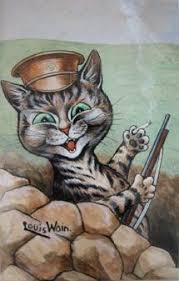
Image result for henry Boxer gallery louis wain

‘The solitary one more real persian cat is the one that is now going to be the one that is the real living animal left alone until the call is given to it at night time this evening … This can be done by giving the call directly the light is seen after the first sleep is over… It is the perfect cat made the more perfect by the willingness given to it.’

 This bizarre text, scribbled on the obverse of a cat portrait, is the work of someone who was once one of England’s most renowned illustrators. Born in London in1860, the artist and visionary Louis Wain travelled a path from obscurity to fame, and back again into seclusion and silence, before his death in 1939 in Napsbury Hospital in Hertfordshire. He was born with a slightly deformed mouth and was kept apart from other children until the age of ten. Even after that the dreamy, distracted boy rarely attended school, preferring to wander around museums and the London dockyards, inhabiting his own private world. He found his vocation at the West London Institute of Art where he studied and for a while taught, before turning to freelance illustration to make his living, beginning with accomplished, naturalistic drawings of birds, dogs, rabbits and fish. When his new wife Emily lay dying of cancer in their home, Louis sat at her bedside and drew her faithful companion, their cat, Peter, and it was these drawings that first caught the public imagination. From 1890 Wain’s cat caricatures, reproduced in magazines like the Illustrated London News and Punch, became a bestselling part of the Edwardian fashion for sentimental pictures of animals, especially dressed as humans and playing human roles, and the artist became a household name.

An early painting, also from 1890, of a group of cats watching a beetle crossing a tablecloth, is both a tour de force of oil technique and, in the intensity of the cats’ quizzical expressions, a faint precursor of future strangeness, (or is this just because we see it with hindsight, knowing what was to become of the artist?)

Image result for henry Boxer gallery louis wain

Louis himself was considered a charming, shy eccentric with an odd, indirect conversational style: he liked particularly to talk of cats’ unusual links with electricity, their sensitivity and intelligence, he tried to interest breeders in developing a spotted variety of cat. He not only depicted cats again and again, acting out fairy-tales, posing in oriental vignettes, impersonating Edwardian gentlemen, in sketches, paintings and book illustrations, on postcards and on keepsakes, to the delight of his new audience, but became a public figure, a champion and patron of the cat as a cherished pet with a life of its own (a late Victorian and Edwardian novelty; previously they had been kept, by men at least, mainly to control vermin). In the decade before World War I Wain was producing up to 600 cat pictures every year; his Louis Wain Annual appeared in 1901, was published every year until 1914, then occasionally up to 1923. ‘English cats that do not look like Louis Wain cats are ashamed of themselves’, pronounced the writer H.G Wells.
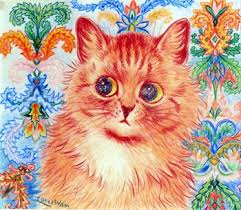
Image result for henry Boxer gallery louis wain

In 1907 Wain’s fame took him to the USA, but, never able to manage money and hopeless at negotiating adequate fees, he returned to London penniless. Not long after this came the first signs of a profound psychic change, and a gradual transformation of the artist’s vision which can be tracked through his later, unpublished works. It is this latter phase of Wain’s working life that has fascinated scholars and members of the medical community. The cats, still playing ball, picnicking, performing on musical instruments, frolicking in gardens, appear more frenzied or ecstatic, their fur electrified, the colours heightened, even livid. Later the titles and printing instructions pencilled on the back of his pictures sometimes mutate into rambling mystical texts, creeping over the page and onto the illustrations themselves.

Wain had spent most of his widowhood living with his five sisters, the youngest of whom, Marie became convinced that she was suffering from leprosy, was witnessing murders, and was certified insane in 1900. Tellingly, in the same year, thirteen years after his wife’s tragic death, Wain recollected that he, she and Peter the cat had formed points on an electric circuit, Emily and the cat acting as batteries. He later imagined that visits to the cinema were robbing his sisters of the electricity which animated them. After Caroline, his eldest sister, died in 1917 Louis’ behaviour became more and more erratic, finally violent. In 1924 he was formally diagnosed as suffering from dementia and placed in a pauper’s ward in Springfield asylum, where the diagnosis was revised to one of schizophrenia. The patient said that he had been ‘bothered by spirits night and day for six years.’ It seemed as if his public had forgotten him, but one year later he was discovered and a campaign by celebrities, including aristocrats, the most eminent authors (Galsworthy and Wells among them) and the prime minister himself, raised thousands of pounds for his care and resulted in him being moved to more pleasant surroundings. While he was incarcerated in the Bethlem Hospital in South London (heir to the infamous Bedlam), Wain made a black-and-white sketch of the hospital exterior, the wards in the background, a solitary cat in the foreground. He presented the drawing as a gift to a visiting clergyman, ‘the cat’, he declared, ‘is me.’
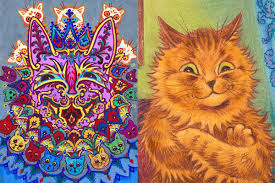
Image result for henry Boxer gallery louis wain

From the early 1920s some abstract tapestry-like patterns had started to appear in Wain’s work, first perhaps recalling the oriental textiles in which his father traded and his mother’s religious embroideries, but becoming more and more spiked and vivid until they begin to invade the foreground, merging with and finally in some cases overwhelming the central images. Possibly better known today than any of the early, conventional works or the jaunty, lovable caricatures is a sequence of five cat portraits, preserved in the Guttman-Maclay archive at the Bethlem museum, that seem to illustrate in the most dramatic way the gradual disintegration of a human personality, a realistic cat morphing into a frenzied apparition before fragmenting into a kaleidoscope of jagged, electrified particles. These images have been reproduced in textbooks and generally taken as visual evidence of mental breakdown, but the truth may be a little more complicated. It’s doubtful that these undated works were completed in the order they are shown and some have tried to claim that they come from very different periods of Wain’s career, (although the staff who nursed him confirmed that they all appeared in the 1930s).

From a conventional viewpoint, Wain may indeed seem a textbook case of schizophrenia, (more recent speculations have included toxoplasmosis and Asperger’s Syndrome) but looked at with a more open mind, his journey can be appreciated in a different way. The gentle, baffled, unworldly outsider comes to identify with the cat for its extreme delicacy and its instinctive, mysterious empathy…and the faint static experienced when stroking its fur becomes an obsession with electrical currents. The distinction between the cat, the self and their surroundings begins to blur. One less orthodox take on so-called schizophrenia is that it is an extreme case of sensitivity and empathy in which the individual personality dissolves, moves beyond our banal human concerns and eventually becomes one with its environment, with all of creation.
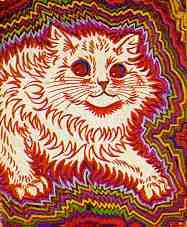
Image result for henry Boxer gallery louis wain

During the last period of his life Louis Wain also produced a series of mysterious psychedelic landscapes, part imaginary, partly referencing indirectly real places that he may have known or seen. These scenes usually contain no cats, some depict birds or deer among streams, waterfalls, blossoms and bright coloured leaves, several no living thing at all. In one such work, ‘Ethereal City’, a lone human figure, a tiny man in suit and hat, wheels a trolley through the foreground. Behind him stretch steep hills and deep valleys, more Tibetan than English, with white castellated buildings and walls winding into the distance. Others feature different styles of architecture; mock-Tudor baronial or oriental cupolas. (Wain’s signature on these paintings, incidentally, is clear and firm, identical to those on the early, celebrated productions.)

The late landscapes seem to show a serene, though magically, surreally luminous, world into which the artist himself was disappearing. His visitors in his last years described a peaceful old gentleman, sweeping up leaves or meditating in a deckchair, his agitation and aggression long subsided: still physically inhabiting his quiet institutional home, he perhaps had entered another even more tranquil, idyllic place. As he himself once wrote: ‘I am the origin of nothing I came to the world to try to be the whole of creation I was told the world went round I was told the world went to sleep I awoke to the truth. I was nothing…’
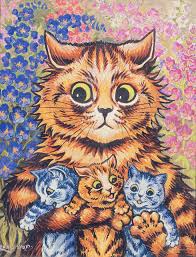
Image result for henry Boxer gallery louis wain

In recent years new generations have rediscovered Wain’s cats – his first posthumous exhibition was in 1972 – and he is once again a celebrated, bestselling artist. Now, though, our appreciation of him must be more complex, taking in the fantastical, unsettling, transcendent hinterland of the cat and its creator along with the charm and enchantment of the wide-eyed, cavorting felines.

Copyright Tony Thorne 2017


Here are details of the current exhibition of Wain’s works, with an excellent review and biography and links to related sites of interest:

https://outsideinpallant.wordpress.com/2017/01/16/the-art-of-louis-wain/


SHARP NUMBERS AND STATUS SPHERES


I’m interested in the extent to which the trendy jargon of business and lifestyle really is transient, as it’s often presumed to be. Many of the buzzwords which I discovered and tried to analyse back in the noughties decade are no longer current. Some of them never managed to escape the rarefied circles in which they were invented and briefly exchanged. Others, however, still resonate  – and still, remarkably, are seen as innovative and novel. Here are two examples of what I mean: can you decide in which years the following words were written?


Image result for presenting numbers interesting way

SHARP NUMBERS

I’m almost certainly in the top category – a so-called high skeptic – on Obermiller and Spangenburg’s grading of consumers’ resistance to advertising claims. I’m endlessly irritated for instance at prices that end in 95p or 99p rather than go the whole hog. This tactic is crude and familiar, but other forms of number manipulation and the quasi-technical terms describing them increasingly crop up in commercial conversation.

Theorists of customer behaviour and information load describe my bugbear as the (positive) nine-ending effect, closely related to the (negative) left digit effect – if increasing the price causes the leftmost digit to change, the sale may well be lost. In analysing consumer inference and the processing of brand information the experts cite a numerical superiority effect. This simply means that claims expressed in numbers (‘78.6% effective’) appear to be objective  – based on empirical data – while claims expressed in words (‘finished to the highest technical standards’) tend to be judged as subjective. The same distinction operates between round figures or round numbers, often suspected of being approximations or guesstimates, and sharp numbers, assumed to demonstrate verifiability. This quirk of human psychology the experts describe as precision heuristics. Round numbers incidentally don’t always have to end in zero: given our system based on tens, fives are also salient (i.e more memorable and processed more readily).

Mathematician Stanislas Dehaene highlighted these and other psychological features of number-perception a decade ago, (and Proctor and Gamble’s claim that their Ivory soap was ‘99 and 44/100 per cent pure’ is a century old), but only recently have they begun to cross over into public awareness. The housing market in particular has woken up to a related phenomenon, that buyers have an innate tendency to treat sharp numbers as lower than round ones. They may for example unconsciously perceive £725,000 as higher than £725,647. Sharp numbers play a key role, too, in the pique technique, also known as mindful persuasion, whereby a request is made in an unusual way to pique the subject’s interest, usually illustrated by the simple example of a beggar asking for 97p instead of a pound. Such requests have been shown to have a potential 60% success-rate as opposed to 10% for round figures.

In US financial journalism, by the way, the phrase sharp numbers has another, predictable, sense: it means the numbers that hurt.


Image result for spheres

STATUS SPHERES

According to research by Standard Life Bank two out of three Brits in their 30s and 40s are now suffering from status anxiety about their homes, prompting TV consumer psychologist Benjamin Fry to attempt a more detailed diagnosis. They are apparently experiencing improvenza, which sounds like another affliction, but is touted not as the disease but the potential cure, involving as it does reconfiguring the work-life balance and, as often as not, renovating rather than moving. The notion of status anxiety as a defining modern malaise has been around for some time, but was popularised by UK philosopher Alain de Botton in his 2004 book of the same name. US trendspotter Faith Popcorn has since argued that it is moral status anxiety which increasingly defines our attitudes. She and others have been predicting the end of conspicuous consumption, to be replaced by conspicuous austerity (slogan: ‘less is the new more’), thrifting (opting for low-cost, low-profile living) or conscientious consumption, whereby our individual standing is defined by how far we manage to combine spending and leisure pursuits with self-improvement and charitable works.

Amsterdam-based Trendwatching.com, who also single out status as the key driver of new consumer behaviours, this year upped the stakes by coining the expression status despair to describe the awful realisation, for example, that a fellow oligarch has a more sumptuously fitted-out private jet than you. Journalists have identified other manifestations of this new angst, ranging from yacht-envy to bag-envy. The latter, according to media strategist Tracy Hofman, can be countered by what she calls status flair, ‘the thrill that resonates when you realise that the quilted Chanel handbag you acquired in 1990 is now back in fashion!’

Trendwatching claim that, in an experience economy, hierarchies based purely on spending power are outdated, supplanted by so-called status-spheres; different areas of activity such as ‘participation’, ‘giving’, ‘experiencing’ from which individuals derive self-validation and peer-recognition. In the same way those physical status symbols – visible, tangible purchases for display – are giving way to status stories, told not by manufacturers but by consumers bragging to other consumers, presumably by word-of-mouth and by way of blogging and viralling, about their personalised adventure holidays, their web-presence, not-for-profit investments, eco-credentials, etc.


Nativity – piety and puns

Nativity Scene, Faras Cathedral - World ...

Christmas Eve in the Anglosphere is a curious concatenation of Christian iconography, pagan indulgence and excess (including in some cases the illicit practices described in my last post) and quaint folk custom. The tradition of the excruciating pun, still to be found inside the Christmas cracker, but now a staple, too, of waggish posts on social media, puts language centre-stage. A quite different shared language is the repertoire of terms used to tell the Christmas story itself: ancient, resonant words originating in the gospels and coming down to us by way of re-translation and reinterpretation, but so familiar as to pass unexamined.

This year I took a look at both varieties of Christmas language in this article for The Conversation

https://theconversation.com/uncovering-the-language-of-the-first-christmas-70686

Barneblad: Christmas crackers! - The Norwegian AmericanImage result for stone manger wall

…and more on those awful cracker jokes here:

https://theconversation.com/the-victorians-gave-us-the-christmas-cracker-but-are-also-to-blame-for-the-terrible-jokes-inside-70745?utm_source=Twitter&utm_medium=Social&utm_campaign=Echobox#link_time=1482486752

Nine years later the BBC joins the pre-Christmas conversation:

https://www.bbc.com/news/articles/c741jg9k2dgo

…and here are thoughts from a believer on the name(s) of Jesus:

http://www.patheos.com/blogs/geneveith/2016/12/the-name-of-jesus-3/