The N-word Yet Again

On July 10 Samir Dathi tweeted: ‘Anne Marie Morris suspended for using N-word. Good. But why is someone who called black people ‘picaninnies’ our foreign secretary?’

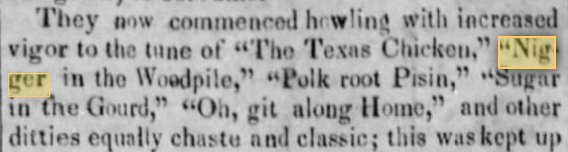
Morris, the Conservative MP for Newton Abbot’s use of the phrase ‘nigger in the woodpile‘ provoked widespread condemnation and resulted in her suspension and an abject public apology, but the UK public and media have a very short memory. It was far from an isolated instance of this crass archaism being invoked by British politicians, as this website records:

https://www.theyworkforyou.com/search/?q=%22in+the+woodpile%22&o=o

The expression originated in the USA (Mr Slang, Jonathon Green has a first citation as the name of a popular song from the 1840s) where it was usually associated with an image of a runaway slave in concealment, but it is in the UK where it has enjoyed a lengthy and unfortunate afterlife.

I can testify that the phrase was used by middle-class speakers in conversation in the UK the 1950s and 1960s. It was possible to use the n-word (not the whole phrase) in Britain up to the end of the 1950s without having a conscious racist intention. The WW2 flying ace Guy Gibson, for instance, named his beloved pet dog ‘Nigger’ and I can remember myself using the word in a public swimming pool in suburban London in about 1959 to point out a black child playing nearby (a rare thing in our lower middle-class neighbourhood). Even then my father rebuked me very sternly, saying ‘we don’t say that and you mustn’t use the word! (‘Black’ was in those days never uttered.)

Yasmeen Serhan reported on the MP’s gaffe for American readers in The Atlantic:

https://www.theatlantic.com/international/archive/2017/07/anne-marie-morris-suspended/533220/

Image result for nigger in woodpile

Attempts were made, by Tory supporters and some linguists, to excuse the MP on the grounds that she is 60 years old and so for her generation the words in question carry little or less force. Professor Geoff Pullum of Edinburgh University was among those who also suggested that when the n-word is in combination with other words as part of a stock phrase, it might not carry the same negative charge (http://languagelog.ldc.upenn.edu/nll/?p=33594). I’m told, for example, that in the parlance of small-boat sailors in the UK the phrase ‘boat-nigger’ is used to denote the most junior member of the crew. Other commentators opined that inadvertent racism is nonetheless racism, but where quibbles about slurs and taboos are concerned, I think the acid test is actually to debate them in real-life environments. I have discussed the n-word and similar controversies with a range of young people and with older members of BAME communities* and they are simply not acceptable. Quite apart from clumsiness and insensitivity on the part of somebody in public life, it’s arguable, too, that Morrison used the expression wrongly: it doesn’t mean an unanticipated or an unappreciated future eventuality, but a hidden snag. The nuances – the semantic components and assumptions embedded in the phrase are interesting and challenging to unpick – the connotations of such usages may also mutate over time. Potential confusions are illustrated by the several interpretations or misunderstandings posted on Urban Dictionary:
On a very personal note, it occurred to me that finding an escaped slave today, perhaps in the woodshed behind a prosperous suburban or rural home, is entirely possible in a Britain where traffickers and slavemasters prey on migrants, refugees and the poor and desperate. Oh and, on the subject of the Foreign Secretary, a satirical Twitter poll resulted in this:
  Whether B[oris] Johnson should also be expelled for calling black people ‘piccaninnies’ with ‘watermelon smiles’: Yes: 95% No: 5%’)
AT, also on Twitter, reminded me of this case, for comparison:
It’s not only in English that such words have conflicted and conflicting resonances. Jonathon Green again: ‘Do you know nègre, which is the equivalent of ‘intern’ or maybe ‘gofer’? Also means a ghost-writer. Still used, I am told, without the slightest hesitation and nary a blush. The usual nègre, if the irony even needs noting, is of course white.’ And here (in French) is someone I know personally causing a furore in 2015:
In August 2017 this – provocatively titled but heartfelt and authentic – opinion piece was published by Steven Dunn:
…then in September this, also a personal take, on, inter alia, Kanye West and Piers Morgan, from Jessica Morgan:
…in October, from University of Calgary linguist Darin Flynn in The Conversation:
…yet more on racial slurs, from Indiana Professor Michael Adams:
 …and Geoffrey Pullum on British English deprecations:
Nearly a year on and the c-word has been trending transatlantically. Here’s Deborah Cameron’s interesting take on reclaiming a slur:
…in August 2018 Bethan Tovey reflected on some recent linguistic debates, including reference once again to the n-word:
…more recently, student journalist Nathan Graber-Lipperman has posted a lengthy reflection on the n-word and its relationship with hip-hop and white youth:
…here, in August 2019, is an assessment by John McWhorter:
And, in March 2020, news that, at least in the USA, one f-word is being reclaimed:
*https://language-and-innovation.com/2016/08/13/the-b-word/

SOUNDS, SENSITIVITIES – and CELLAR DOORS

Another extract from a work in progress, or, if that project comes to nothing, a fragment from a series of jottings (see elsewhere on this blog for others): either way, I keep returning to my fascination with the symbolic, psychological, psychic effects of  the sounds of words…
Image result for sweet talk

The traditional view of words and names is that, apart from those words that directly imitate natural noises, there is only an arbitrary link between sound and meaning. But a few psychologists and neuroscientists have claimed to find evidence that phonemes (the human speech sounds that constitute words) have an inherent, non-arbitrary emotional quality*. Their data suggests that the effect on feelings of certain phoneme combinations (nonsense examples they worked with included bupaba, which was received positively and dugada which was negatively perceived) depends on a specific acoustic feature which can be measured, namely, the dynamic shifts within the phonemes’ frequency.

At Laurentian University in Canada researchers examined the links between proper names and hearer’s emotions: The ten most popular boys’ and girls’ names for most years of the 20th century were studied in terms of the emotional associations of their sounds and their pronounceability. A set of historical and socioeconomic variables, namely, war, depression, the advent of the birth control pill, inflation, and year seemed to correspond with the scores that members of the public gave for name length, emotionality, and pronounceability.

At a more human level UK national treasure Stephen Fry tells us his favourite word is ‘moist’. He’s being arch and gently provocative as usual, but says that he just likes the sound of it. I have said that I find the sound of the word ‘mellifluous’ pleasant, but friends have told me they hear in it prissiness and fussiness. My own fondness for ‘buoyancy’, too has been a cause of bemusement for some.

Whether we are talking about ‘pure’ sounds that imitate the noises of nature like ‘plop’,  ‘buzz’ and ‘hum’ or the clusters of phonemes that form single words, or the longer more varied sequences of conversational noise, these acoustic disturbances are not just conveyors of information but can act as triggers provoking an emotional response in the hearer. How they do this depends on the associations they have for us and these may be intensely personal, may be social and cultural and may in many cases depend entirely on which language we are hearing and thinking in.

Hearing the slang word ‘chillax’ for the first time (it has now become fairly well-known, even embarrassingly part of the linguistic repertoire of a former PM) would probably have a different effect on a teenager, who might have recognised the blending of ‘chill out’ and ‘relax’ from a grandparent more likely to hear ‘chilly’ and ‘axe.’

The fact that our reaction to the sound of words is culturally conditioned and not simply ‘natural’ can be proved by asking people to listen to and comment on words that they aren’t familiar with; invented words or terms from an unknown language. The words sranje, mierda, hovno and mist don’t seem to upset English speakers who are exposed to them for the first time. They are all synonyms of English sh**t in not too distant languages: Slovene, Spanish, Czech and Danish respectively. An old friend from France used to complain that her word for dog, chien, sounded nothing like any of the animals of that species, whereas the English word, she thought, suited exactly.

When we move from words to longer examples of intonation, rhythm and pitch, it can be a mixture of supposed familiarity – we recognise the same sounds from a different context such as baby-talk or comic exaggeration – and unfamiliarity – we don’t know what it means –that leads us to find the sound of the Dutch language funny for example.

Where other accents – the regional British variants among them – are concerned, studies have found that people react positively or negatively first according to how closely the accent resembles their own and secondly to its associations, usually which prominent figures (typically actors, newsreaders, footballers) employ it and in which contexts it has been encountered (so a Northern Irish accent, once evoking the language of the Troubles is now, like the Scottish Connery lilt, linked to actors who charm and don’t threaten.)

Asked in 2008 to nominate his favourite word, then mayoral candidate and Tory MP Boris Johnson selected ‘carminative’, teasing both in its obscurity and in that the word formed from these four sonorous syllables denotes a cure for flatulence. Three quite different, and differently resonant, syllables were chosen by French artist Loris Gréaud as the title of his solo exhibition at London’s ICA, part of a large-scale experimental multi-media project dealing in the interplay between rumour and fact, in hidden meanings and in transitions and interruptions. It’s no coincidence that the London installation and the project itself go by the name of CELLAR DOOR. The coming together – not for the first time – of these two unremarkable English words is part of a curious sequence of borrowings and allusions, a sort of underground tradition or urban legend that Gréaud is just the latest to tap into.

It was J R R Tolkien in 1955 who first suggested that ‘cellar door’ was one of the most beautiful, if not the most affecting combination of sounds in the English language. He described the phrase on two occasions as being intrinsically inspiring, and since then a series of writers have used Tolkien’s cue to fabricate a quite spurious history of references to cellar door, according to which an American opinion poll, the author H.L.Mencken and various Chinese and Japanese visitors have all, apparently independently, pronounced it the most beautiful sound in English. The cult movie Donnie Darko popularised the idea for a pop culture audience, asserting that of all the endless combination of words in all of history, this was the most beautiful. The film script attributed the claim to ‘a famous linguist’, but the director Richard Kelly in subsequent interviews namechecked, quite wrongly, Edgar Allan Poe.

We can’t be sure of the personal and cultural associations, conscious or unconscious, that led Tolkien to favour this particular collection of phonemes, apart from ‘the door of the cellar’ there are no sound-alikes in English other than, and of course this might be significant, celadon, a colour which is apparently a sort of pale willowy green (and is named, curiously, after the shepherd hero of a 17th century French romance) and celandine, the French-sounding name of two different species of flower. It seems to be a prerequisite that cellar door is pronounced in a donnish British RP accent rather than in a provincial burr or North American twang; although for me, and perhaps for Tolkien, too, a Welsh lilt might help reinforce its quasi-mythic pretensions.

Celador isn’t Welsh but is a real word in Spanish: pronounced with initial ‘th’ in Castilian Spanish, with ‘ts’ in the Americas historically it means ‘guardian of the bedchamber’, nowadays more prosaically it denotes a hospital orderly, a classroom supervisor or sometimes a prison guard. Spanish and Latin American friends tell me that for them the sound of the word is as humdrum as its modern meaning: it has no special resonance for them.

Although one explanation of the origins of language, known as the bow-wow theory, holds that all words started out as imitations of sounds found in nature, it’s clear that by now, apart from the obviously onomatopoeic like splash and plash and smash, sound and sense have become quite disconnected. The word voted the most beautiful in a British Council survey in 2004 was ‘mother’, for most of us redolent of tenderness, but downbeat and abrupt in terms of its component sounds. Conversely and perversely James Joyce had earlier proposed ‘cuspidor’, a nice noise, but a nasty receptacle.

The notion, though, that the sounds of a word might evoke certain feelings in the hearer, quite independently of its literal meaning, is a commonsense one, and linguists know the phenomenon variously as phonaesthetics, psychoacoustics or sound symbolism. But these emotional or aesthetic effects are not consistent and vary quite unpredictably across cultures and even among speakers who share a common language. ‘Mist’ which seems pleasant on the ear, means ‘crap’ in other Northern European languages. Stephen Fry may like the word ‘moist’, but it ranks high in lists of people’s unfavourites (‘phlegm’ and ‘panties’ even higher) and a teenager told me the other day that it’s now the most horribly offensive thing you can say in London street slang.

Playing of course on its literal sense, but helped by its new status as a linguistic talisman ‘cellar door’ has been used as the name of a host of wine merchants, wine bars and wine magazines and of a slasher movie, too.  A café in Guernsey, a London cabaret venue, a Jazz band, an Indie band, a metal band, a literary magazine have all adopted the title: spelled as in Spanish it’s the name of a well-known TV production company: a novel printing typeface, Kellermeister, turns out to be inspired by it, and dozens of Internet blogs contrive to work the phrase in somewhere in their mashups.

Why is it that there seems to be this need for a mantra, a magic set of sounds that can be constantly reinvoked? Is it those phonemes: that front vowel, sibilant and lateral, along with the allusion to something always hidden just beyond our field of vision that combine to give cellar door its unique charm? Whatever lies behind it (pun intended), and however impressive Gréaud’s work actually is, I’m afraid that I’m quite immune to the two words in question: for me ‘seller’ only evokes the housing crisis at the time of writing, and door rhymes with ‘sore’, and ‘poor’ – and most tellingly of all – with ‘bore’.


* I have not yet had time to digest this very interesting paper from July 2017, but here is the link…

https://peerj.com/articles/3466/


Image result for listening

A term whose time has come?

I wrote about the intriguing notion of the Anglosphere in 2006. In a pre-election, perhaps pre-Brexit phase in the UK’s collective experience, the term surfaces again as the title of a British Academy conference.

Here are my jottings from eleven years ago…

ANGLOSPHERE

When writing about language, there’s a word I constantly invoke – it’s a useful shorthand version of the cumbersome “areas where English is the dominant language”. But this expression (apparently first used in writing by science-fiction writer Neal Stephenson in 1995) may turn out to be the defining term of the 21st century’s global order. The word is Anglosphere, denoting not just a group of English-speaking nations, but a sphere – or set of interconnected spheres – of influence (Sinosphere and Hispanosphere have been employed subsequently and similarly).

According to US businessman and technologist James C Bennett, it “implies far more than merely the sum of all persons who employ English as a first or second language. To be part of the Anglosphere requires adherence to the fundamental customs and values that form the core of English-speaking cultures.”

Primary among these are individualism, openness and the honouring of contracts. Just doing business in English doesn’t qualify you. You have to have internalised the hidden system of behaviours and assumptions that Anglos implicitly embrace, thereby gaining membership in what Bennett calls a network civilisation or network commonwealth. Other fashionable buzzwords associated with the phenomenon are collectivity, commonality and commensurability.

At the rarefied level of international politics, Anglosphere can mean a geopolitical conversation for insiders only. In terms of innovation in technology, law and commerce, it encourages pathfinder cultures to cooperate seamlessly. To some anti-globalisers and multiculturalists this smacks of ethnocentrism, cultural imperialism and linguicism (language-based racism), or at the very least a shared superiority complex on the part of largely rightwing commentators. Part of the potency of the idea is certainly that it offers Brits, and Canadians, Australians and New Zealanders, too, the prospect of world domination, alongside the US, and despite the looming presence of China and India. Others protest that this is all simply stating the obvious – that English speakers communicate easily with one another. But perhaps they are missing the essential point: the real potential of the Anglosphere lies not just in instantaneous information-sharing but in the millions of informal, often unnoticed relationships and collaborations that amount to a much more unified power-bloc than any artificially created entity – the EU springs to mind.


And here are details of the conference in question…

http://www.britac.ac.uk/events/anglosphere-and-its-others-english-speaking-peoples-changing-world-order


A SINGLE CURRENCY? – the status of English post-Juncker and post-Europe


President of the European Commission, Eurocrat par excellence and Brexiteers’ bugbear, Jean-Claude Juncker raised a laugh in Florence a couple of weeks ago with his public provocation, opining that post-Brexit the English language would lose its status as the EU’s de facto lingua franca. IMVHO he’s probably wrong: even in his native Luxembourg (first language Luxembourgish, a Mosel-Franconian dialect of German) one fifth of the population currently claim to use English for everyday communication and three quarters say they speak it fluently.

In the wider EU 46m Germans and 23m French citizens are estimated to have a good command of English, 38% of the remaining nationalities, too. Only 12% over-all claim fluency in French and 11% in German. In Brussels and Strasbourg,  the cities where EU business is primarily carried out, English is, in the Eurocrats’ jargon a relay language, an intermediate code used in meetings, in corridors and in cafes by those for whom it is a second or third language. This is especially the case for those coming from the more recent member states who are generally reluctant to embark on learning French or German when English is already familiar from school, university and from exposure to popular culture.

In fact, the language actually used beyond the formal speeches and official documents is an odd sort of English-based hybrid sometimes known as Euro-speak, laced with ‘continental’ usages (alien to native speaker English but common to other European tongues) whereby terms like subsidiarity, conditionality and conventionality are exchanged and standard English words shift in meaning so that control comes to mean check, assist means attend, execute means carry out, actual replaces current and resume can mean both re-start and sum up. Perhaps in time it is this dialect which will come to dominate in practice while the official languages remain as they are today. Well-meaning attempts to introduce an alternative common language have so far come to nothing. A petition calling for the artificial language Esperanto to be added to the official list has received only 12, 383 signatures to date – in an EU population of around 450m.

In the Guardian this week Tess Reidy has been considering the fate of English post-Brexit and pace Juncker, with the help of experts and some contributions by me. Her article is here…

https://www.theguardian.com/education/2017/may/24/which-language-would-ease-our-way-in-the-post-brexit-world

Last year Mike MacKechnie listed some of the Euro-English terms that puzzled ‘native-speakers’ have to contend with:

10 Funny Euro-English Words We Might Hear More Often If The UK Leaves the EU

The EU is well aware of the peculiarities and idiosyncrasies of its own communication practices, as evidenced by its recognition of the jargon issue…

http://termcoord.eu/2014/06/eurojargon/

Though it took the BBC to decode the global English jargon of the Davos summit:

http://www.bbc.co.uk/news/business-42791874

Here from the European Court of Auditors is a very useful guide to EU misuses of the English language…

https://wordstodeeds.com/2017/06/02/guide-to-misuse-of-english/

Here are some further thoughts from Marko Modiano of Gävle University, published in September 2017…

http://onlinelibrary.wiley.com/doi/10.1111/weng.12264/full


And, in November 2017, a challenging, if possibly slightly tongue-in-cheek suggestion from Italy…

http://www.telegraph.co.uk/news/2017/11/25/eu-should-force-uk-give-us-english-language-brexit-former-italian/

Michael Swan took issue last year with the way the notion of ‘English as a Lingua Franca (ELF)’ is often presented…

http://www.eltresearchbites.com/201802-rethinking-english-as-a-lingua-franca/#comments

Here, should there be any doubt, is the confirmation, from Esther Bond writing in slator,  that English is not about to lose its official status…

https://slator.com/demand-drivers/eu-provides-clarity-on-post-brexit-future-for-english-language/

For any readers who are actively engaging with EU and other terminology (as translators, interpreters or proofreaders for example), here’s a useful list of online resources…

http://albionlanguages.com/best-online-terminology-resources/

And finally, for now, from November 2019, an article by EU translator Hannah Critoph addressing the difference between ‘Eurish’, ‘Globish’ and ‘natural English’…

Click to access Subject-brief-Hannah-Critoph.pdf

UK YOUTH SLANG NOW

I have a fairly extensive archive of new language, including contemporary slang, from which glossaries, dictionaries and articles are spun off. When I interview young people to ask them about the language they use, to collect examples, or to animate discussions, I use extracts from the archive, but in the form of a simplified glossary. The glossary consists only of terms with their definitions, with all other ‘lexicographical paraphernalia’ – parts of speech, etymologies, regional labels, notes on usage, etc. – removed.  This material is not intended for publication, except by me, (or if commercially in return for payment) but is often used by researchers, authors, teachers and students to stimulate discussion and to help with fieldwork and projects. Here, by way of illustration, is a selection from the letter B


Image result for slang graffiti


B

B – (male) friend

Badmanz – important and/or tough male

Bae – sweetheart, girlfriend or boyfriend

Bag – much, many

Bagga­manz – a lot (of people)

Bag someone out – to criticise, harass

Bait – obvious, intrusive

Ban­gin’ – attractive, exciting

Bangout – failure

Bang-out – successful, skilful

Bants, bantz – banter

Bare – much, many

Bars – (part of) a song

Bashment – party

Basic – unoriginal, conforming to current fashions

Basic B, basic bitch – pretentious but conformist female

Bats – combat trousers

Bay­den – solvent, rich

Beast – excellent, impressive, admirable, cool

Beaut – expression of admiration or approval

Beef – dis­agree­ment, angry altercation

– to aggress

Begfriend – sycophant

Beggin’ – talking nonsense

Beige – boring, tedious

Bell-end, bell – foolish and/or annoying person (usually male)

Ben­nin’ – overcome by laughter.

Bestie – best friend

Betty – girl

BFF – ‘best friend forever’

Big – excellent

Big­gin’ up – com­pli­ment­ing, celebrating

Billies, bills – money, banknotes

Bin off – to throw away, reject, dump (a suitor for instance)

Bitz – area, neighbourhood

Blates – excessive, outrageous

– expression of delight or approval

Blaz­in’ (up) – smoking

Blad – ‘mate’, friend

Bleh – expression of dismissal, disapproval, indifference

Blem – cigarette

Blemboss – someone who smokes to show off

Bless (up) – expression of approval or farewell

Blick – dark

Blonks – big person, usually male

Blud – close friend

Boggin’ – stinking

Bollerz – money

Bonk – to exhaust oneself, tire

Boog – bad, inferior

Booky – suspicious, doubtful, inferior

Boom-ting – party, exciting event

Booty – posterior

– sexy female(s)

Bounce – to depart, flounce off.

Bovvered – unconcerned, indifferent

Boyed – humiliated

Boyment – humiliation

Boyz – money

Braap, blaap – a greeting or expression of approval or agreement.

Brass – bad

Bred­der – someone who copies someone

Bredgie – friend

Bredren, bledren – friends

Breeze – nonsense, rubbish

Brev – male friend, mate

Bro – male friend

Bruck, brok – in bad condition, ugly

Bruv – brother, male friend

Buck – to give

Buff – physically attractive

Bullet – greeting or expression of approval or agreement

Bully van – police vehicle

Bummage – enjoyment

Bump – to trick, defraud, steal from

Bunnin’ – smoking

Bupzin’ – treating or looking after (someone)

–  taking advantage (of someone)

Burned – bested, humiliated

Burner – gun

Buss (out) – to perform (dance moves)

Busted – ugly, unattractive

Bust (off) – to perform (dance moves)

– to recite (lyrics)

But(t) – friend

Butterz – ugly, unattractive


Image result for slang graffiti


I would be very grateful indeed for any additions to my lists. Donations and/or comments will be very welcome and contributors will be acknowledged. If you would like to use the glossary, please contact me. 

IT’S GETTING DARKER

It’s officially Spring now and we are emerging from the gloom induced by short days and long nights (or, from another perspective, by disruption to circadian rhythms and melatonin levels). The darkness (adjective ‘dark’ is from Old English deorc, used also as a noun from the 13th century) clears – literally – but metaphorical darkness is pervasive…just  after posting the paragraphs below I became aware of dark money, defined by The Observer as ‘an undeclared donation from an impermissible foreign donor’ (see below) and Dark Justice, a group of anti-paedophile vigilantes who pose as children online…

 BBA-OpenMind-dark-data-ahmed-banafa

We have marvelled at the notion of the invisible dark matter said to permeate the universe and physicists have supplemented this with the concept of dark energy; not directly detectable either but necessary to explain expansion and the appearance of life in the multiverse.

On a slightly more mundane level there are in 2017 consultancies advertising their services in uncovering dark data (information collected during business operations but not actually used) and helping organisations to exploit it. The d-word has been trending for some time. The dark web (aka the deep web or darknets), we are nervously aware, is inaccessible by standard searches, a mysterious zone where illicit products and services are traded and illicit vices practised.

Most professionals have heard by now of dark pools, (the image is of hidden areas of liquidity) where off-market trading of stocks, also known in banking jargon as internalisation, takes place, where large blocks of shares can be bought and sold anonymously and prices are only made public after deals are privately concluded. But other kinds of opaque transaction, though quite legal, also threaten to distort markets, masking true levels of market scarcity or surplus and hiding real levels of indebtedness, thus creating information asymmetry between insiders and outsiders. A more recent buzz-term in the fields of finance and commodities is dark inventory (shadow inventory is sometimes used for real estate), describing assets placed off-balance-sheet. These may be equities, contracts, undeclared hoarding – of metals, for example – or other pre-sold commodities which may or may not actually exist (fictitious quotations of steel and nickel are ghost inventory) but which remain beyond public scrutiny. The same term can stretch to include toxic, debt-encumbered or otherwise sinister elements in a portfolio. Dark social, meanwhile- the term was coined in 2012 by former deputy editor of The Atlantic Alexis Madrigal – refers to information exchanged in the workplace by private individuals via channels such as instant messaging programs, messaging apps and email rather than on public platforms like Facebook and Twitter. This so-called outbound sharing alarms the corporate world for two main reasons: it sidesteps company restrictions on the timewasting or subversive use of social media at work, and it so far isn’t possible to track, analyse or turn into marketing opportunities.

Far more disturbing is the notion of a coming digital dark age (not to be confused with the techno music and futuristic/fantasy artworks dubbed dark digital) which some pundits have been predicting. This refers to the potential loss of huge quantities of culturally important data, particularly old manuscripts, memoirs, mementos and images preserved electronically, if technological advances make their storage-formats obsolete so that they are no longer recoverable.

In 2018 overheated enthusiasm for blockchains and bitcoins gave way to fears about the sustainability of cryptocurrencies and the ways in which they could be manipulated. At the same time financial data-reporting on a national scale can be deliberately subverted, or can be skewed by the sheer complexity of the processes involved. One result is the phenomenon of dark GDP: economic activity not captured by current estimations. This is said to amount to 10% of US GDP, and who knows how much in secretive, bot-infested Russia?

Back in the everyday ‘Mr Slang’ Jonathon Green reminds me that from the 1990s dark has also featured in multiethnic youth vernacular in the UK. As with some other key slang terms it can have contrasting meanings, pejorative and appreciative, in this case signifying both ‘harsh’, ‘unfair’, ‘unpleasant’, and ‘impressive’, ‘edgy’.


*Latest updates: May 17, from George Monbiot, on ‘Dark Money’

https://www.theguardian.com/commentisfree/2017/may/17/dark-money-democracy-billionaires-funding

…and from The Conversation on August 24, ‘Dark DNA’

https://theconversation.com/introducing-dark-dna-the-phenomenon-that-could-change-how-we-think-about-evolution-82867?utm_term=Autofeed&utm_campaign=Echobox&utm_medium=Social&utm_source=Twitter#link_time=1503571067

…and as the skies darken at the outset of Autumn, here’s The Conversation again, this time on ‘Dark Tourism’ 

https://theconversation.com/dark-tourism-can-be-voyeuristic-and-exploitative-or-if-handled-correctly-do-a-world-of-good-81504


BIZWORDS AND BUZZWORDS

For more than twenty years I wrote the Bizwords column for British Airways’ Business Life magazine. The series, which  highlighted examples of the most topical, colourful or outrageous jargon circulating in the corporate world, has just ended, but in its memory here are some of the last items published…

REPLICABILITY

What had once been a technical term – for the successful reduplication of test results – or a neutral definition – the ability to recreate a product, service or environment – threatened to become a dirty word in 2016. Replicability came to symbolise second – or perhaps third – thoughts by many progressives concerning the hipster design aesthetic and its global spread. Retro logos, distressed decors, artisan micro-brands and wired-up, gentrified workplaces, copied and imitated across markets and cultures have resulted in what columnist Kyle Chayka dubbed ‘AirSpace’, a faux-authentic, frictionless zone through which an affluent mobile elite can travel (checking for local recommendations from apps like Fourspace or Yelp, then Instagramming their discoveries to friends) without ever really leaving home territory. The replicated style, which, though much-mocked since its inception, once defined a desire for difference and originality, has morphed into a new all-enveloping mainstream.


 LEAD-MAGNET

Creative Lead Magnet and Funnel PowerPoint - SlideModel


Digital Marketing is a non-stop – and seemingly unstoppable – generator of new terminology, so agencies must help novices to keep up by posting glossaries of the latest buzzwords. Turning prospects into leads into actual customers involves, in the jargon, directing traffic to your landing page (ideally frictionless) or welcome gate which is likely to feature a lead-magnet, aka opt-in bribe, a benefit such as a free consultation, free trial, discount offer, or a content-upgrade like a toolkit or guide to induce the visitor to give you their contact details. That is a conversion, the start of a relationship with the site visitor who should then go on to register with you, follow you on social media and/or purchase something. (Measure success by your conversion rate, failure by your bounce-rate). The series of steps you use to draw in the customer, from ads via webpages through interactions all the way to payment is known as the funnel.

W.E.I.R.D

Image result for rich western students

If a colleague tells you that your target demographic is WEIRD, will you know how to react? The letters of the acronym stand for ‘western, educated, industrialised, rich, democratic’ and are used to point up a crucial flaw in the studies of human behaviour underpinning much global marketing. The problem is that the samples on which assumptions are based are not representative: ‘Westerners’ are thought to make up around 96% of respondents in psychological studies, US citizens at least 68%. W.E.I.R.D subjects tend to be outliers, exceptions, in terms of many traits such as visual and spatial perception, notions of fairness, cooperation – even in how to design and respond to survey questionnaires. Differences between so-called traditional or collectivist societies and the individualist west are well-known, but even within a modern multiculture like the US, UK or Australia ‘human’ responses vary according to ethnicities, microcultures and niches. Still searching for universals, analysts now have to grapple with the much more complex reality evoked by their latest buzzword: superdiversity.

CLIMATARIAN

A raft of novel foodie expressions reflects the huge impact of the gastronomy economy (not to be confused with economy gastronomy which is one such term meaning luxury cooking on a budget). The progressive connoisseur and the green militant have recently come together in the form of the climatarian, an activist consumer who combats climate change by favouring poultry, pork and sustainable fish instead of CO2 culprits beef, lamb or venison, insists on unfrozen produce from sources close at hand to counter refrigeration and transport emissions and uses 100% of every meal by processing skin, bones, vegetable offcuts, etc. In his lexicon entitled ‘Eatymology’ US author Josh Friedland has collected more examples of the new food-speak, including carrot mob, a so-called reverse boycott whereby crowds of enthusiasts descend on an outlet in order to celebrate its healthy credentials, and – less healthily perhaps – gastrosexual, an individual who uses cooking prowess in order to seduce. In a similar vein militant locavores (promoters of local produce) if male are now known as brocavores, while food porn is flagged by the hashtag #foodspo.


I’m always collecting jargon, buzzwords and new and exotic usages like these. Please contact me to donate examples (and you will be credited in upcoming articles and publications!)

MOMENT MARKETING ….and COMPARISONING

Two more recent buzzwords, to reignite the debate that I delight in: are these ludicrous and redundant formulations, designed to bamboozle and bemuse, or are they valid – even laudable – examples of creative lexical innovation? 


MOMENT MARKETING

 Inspired by the 34 minutes in 2013 during which Oreo cookies seized on a power cut at the Super Bowl to tweet ‘…you can still dunk in the dark’, moment marketing, also known as adaptive or reactive marketing, is advertising’s current obsession. The concept stretches from running digital campaigns off the back of real-world events (Paddy Power and Mini cars capitalising on the horse meat scandal, Warburtons bakery on a royal birth) to personalising customer relationships by tracking what consumers are doing at particular times of day – accessing different media, planning journeys or caring for kids for instance – and recording significant dates in their lives. Brands can emphasise authenticity and spontaneity by reacting speedily to trending topics – not just sports but showbiz, politics, weather – cutting to a minimum the time it takes to get from ideation to posting. In the jargon this is described as moving from real-time marketing to right-time marketing, linking offline to online to exploit hype-cycles and micro-moments.

The notion’s topicality is captured in TVTY agency’s new year message for 2017…

“As we have seen in 2016, careful moment planning – the process of deciding which moments matter most to a target audience – can lead to exciting results…we’ve seen the Germans and Italians win gold at the Olympics, the FMCG sector scored big at the Euros and there was a huge surge in ad-jacking during the Super Bowl. But 2017 is set to be even bigger and marketers need to ensure moment planning is a top priority…we have highlighted the events that will capture the attention of millions of consumers across the globe in our new tent pole event calendar.”


COMPARISON

‘Before making buying decisions millennials prefer to comparison on digital media’ is an example of ‘nerbing’, the converting of nouns into verbs (conference, signature and caveat are other recent examples), which business jargon delights in. In the same way hero has morphed from familiar noun to trendy verb in the last couple of years, as in ‘we will hero the women who align with our brand values’. Verbs may also become nouns, witness the ask, the build and the recover, while some jargoneers have turned solve into a noun and made solution a verb. Incentive was transformed first into incentivise and later abbreviated to incent. Another twist is to create new plurals, for example ‘practitioners will share practical learnings and advice on how brands can scale their operations across geographies.’ Egregious errors or desperate attempts at novelty depending on your take, these innovations may sometimes signal a subtle shift in meaning, so that comparison as verb refers not to comparing in general but specifically to online sites.

More on ‘nerbing’ from an early piece in Buzz Feed:

https://www.buzzfeed.com/jwherrman/the-verb?utm_term=.spvE8aXO8d#.cdEQYNK7YA


TONY THORNE


Send buzzwords, jargon and new and exotic usages to tony.thorne@kcl.ac.uk

SHARP NUMBERS AND STATUS SPHERES


I’m interested in the extent to which the trendy jargon of business and lifestyle really is transient, as it’s often presumed to be. Many of the buzzwords which I discovered and tried to analyse back in the noughties decade are no longer current. Some of them never managed to escape the rarefied circles in which they were invented and briefly exchanged. Others, however, still resonate  – and still, remarkably, are seen as innovative and novel. Here are two examples of what I mean: can you decide in which years the following words were written?


Image result for presenting numbers interesting way

SHARP NUMBERS

I’m almost certainly in the top category – a so-called high skeptic – on Obermiller and Spangenburg’s grading of consumers’ resistance to advertising claims. I’m endlessly irritated for instance at prices that end in 95p or 99p rather than go the whole hog. This tactic is crude and familiar, but other forms of number manipulation and the quasi-technical terms describing them increasingly crop up in commercial conversation.

Theorists of customer behaviour and information load describe my bugbear as the (positive) nine-ending effect, closely related to the (negative) left digit effect – if increasing the price causes the leftmost digit to change, the sale may well be lost. In analysing consumer inference and the processing of brand information the experts cite a numerical superiority effect. This simply means that claims expressed in numbers (‘78.6% effective’) appear to be objective  – based on empirical data – while claims expressed in words (‘finished to the highest technical standards’) tend to be judged as subjective. The same distinction operates between round figures or round numbers, often suspected of being approximations or guesstimates, and sharp numbers, assumed to demonstrate verifiability. This quirk of human psychology the experts describe as precision heuristics. Round numbers incidentally don’t always have to end in zero: given our system based on tens, fives are also salient (i.e more memorable and processed more readily).

Mathematician Stanislas Dehaene highlighted these and other psychological features of number-perception a decade ago, (and Proctor and Gamble’s claim that their Ivory soap was ‘99 and 44/100 per cent pure’ is a century old), but only recently have they begun to cross over into public awareness. The housing market in particular has woken up to a related phenomenon, that buyers have an innate tendency to treat sharp numbers as lower than round ones. They may for example unconsciously perceive £725,000 as higher than £725,647. Sharp numbers play a key role, too, in the pique technique, also known as mindful persuasion, whereby a request is made in an unusual way to pique the subject’s interest, usually illustrated by the simple example of a beggar asking for 97p instead of a pound. Such requests have been shown to have a potential 60% success-rate as opposed to 10% for round figures.

In US financial journalism, by the way, the phrase sharp numbers has another, predictable, sense: it means the numbers that hurt.


Image result for spheres

STATUS SPHERES

According to research by Standard Life Bank two out of three Brits in their 30s and 40s are now suffering from status anxiety about their homes, prompting TV consumer psychologist Benjamin Fry to attempt a more detailed diagnosis. They are apparently experiencing improvenza, which sounds like another affliction, but is touted not as the disease but the potential cure, involving as it does reconfiguring the work-life balance and, as often as not, renovating rather than moving. The notion of status anxiety as a defining modern malaise has been around for some time, but was popularised by UK philosopher Alain de Botton in his 2004 book of the same name. US trendspotter Faith Popcorn has since argued that it is moral status anxiety which increasingly defines our attitudes. She and others have been predicting the end of conspicuous consumption, to be replaced by conspicuous austerity (slogan: ‘less is the new more’), thrifting (opting for low-cost, low-profile living) or conscientious consumption, whereby our individual standing is defined by how far we manage to combine spending and leisure pursuits with self-improvement and charitable works.

Amsterdam-based Trendwatching.com, who also single out status as the key driver of new consumer behaviours, this year upped the stakes by coining the expression status despair to describe the awful realisation, for example, that a fellow oligarch has a more sumptuously fitted-out private jet than you. Journalists have identified other manifestations of this new angst, ranging from yacht-envy to bag-envy. The latter, according to media strategist Tracy Hofman, can be countered by what she calls status flair, ‘the thrill that resonates when you realise that the quilted Chanel handbag you acquired in 1990 is now back in fashion!’

Trendwatching claim that, in an experience economy, hierarchies based purely on spending power are outdated, supplanted by so-called status-spheres; different areas of activity such as ‘participation’, ‘giving’, ‘experiencing’ from which individuals derive self-validation and peer-recognition. In the same way those physical status symbols – visible, tangible purchases for display – are giving way to status stories, told not by manufacturers but by consumers bragging to other consumers, presumably by word-of-mouth and by way of blogging and viralling, about their personalised adventure holidays, their web-presence, not-for-profit investments, eco-credentials, etc.


Nativity – piety and puns

Nativity Scene, Faras Cathedral - World ...

Christmas Eve in the Anglosphere is a curious concatenation of Christian iconography, pagan indulgence and excess (including in some cases the illicit practices described in my last post) and quaint folk custom. The tradition of the excruciating pun, still to be found inside the Christmas cracker, but now a staple, too, of waggish posts on social media, puts language centre-stage. A quite different shared language is the repertoire of terms used to tell the Christmas story itself: ancient, resonant words originating in the gospels and coming down to us by way of re-translation and reinterpretation, but so familiar as to pass unexamined.

This year I took a look at both varieties of Christmas language in this article for The Conversation

https://theconversation.com/uncovering-the-language-of-the-first-christmas-70686

Barneblad: Christmas crackers! - The Norwegian AmericanImage result for stone manger wall

…and more on those awful cracker jokes here:

https://theconversation.com/the-victorians-gave-us-the-christmas-cracker-but-are-also-to-blame-for-the-terrible-jokes-inside-70745?utm_source=Twitter&utm_medium=Social&utm_campaign=Echobox#link_time=1482486752

Nine years later the BBC joins the pre-Christmas conversation:

https://www.bbc.com/news/articles/c741jg9k2dgo

…and here are thoughts from a believer on the name(s) of Jesus:

http://www.patheos.com/blogs/geneveith/2016/12/the-name-of-jesus-3/